Showing posts with label WATER. Show all posts

12 January 2023 - SHAKI WATERFALL & HYDRO - ARMENIA


SHAKI WATERFALL
 & HYDRO 
- ARMENIA -

G'day folks,

After visiting hours, this picturesque waterfall is essentially turned "off" to be used for hydroelectric power. 

Shaki Waterfall is a beautiful spot, where cascades of water plunge 60 feet down over solidified basalt lava flows. The waterfall was enjoyed much like any other natural attraction until the 1990s, when someone built a small hydroelectric generator nearby and began diverting most of the water from upstream to generate electricity.


When visitors would come to witness the falls, they were disappointed to see the diminished flow as the picturesque falls were essentially turned “off.” And so a compromise was reached: For a fee, visitors could have all the water sent to the waterfall and enjoy the full effect once more. This agreement lasted for several years, but many folks were not happy to have to pay to see their old waterfall.

In 2017, the Armenian government decided that at least during tourist season, the waterfall should flow uninterrupted and free of charge for much of the day. They set regular opening hours, and now anyone can enjoy the full splendor of the falls—as long as you get there at the right time.


30 December 2022 - IRRIGATION CHANELS BUILT INTO MOUNTAINS


 IRRIGATION CHANELS

 BUILT INTO MOUNTAINS


G'day folks,

Medieval irrigation channels built into the sides of mountains provided Valais with water for hundreds of years.  

Some of the best places to hike in the state of Valais in Switzerland are ancient pathways that once used to bring water down from mountain streams to farms in the valleys and meadows below.


The creation of these channels, known as bisses, goes back at least as far as the 14th century, though some believe those medieval routes were built where Roman channels had previously been. In the aftermath of the Black Death in the mid-1300s, with a significantly reduced population across Europe, the grain fields in Valais were repurposed to grow hay to raise cattle for the rising demand of beef across the border in Italy.


Owners of the fields and pastures pooled their resources to build bisses for irrigation, which was more necessary than it had been for growing grain. A lot of resources were needed, since many of the bisses were built into the sides of mountains and cliffs, which made digging them particularly dangerous hundreds of years ago. They tended to be between 5 and 10 kilometers, though a few stretched more than 20 kilometers.

Over time, they came to be used by vineyards and orchards in the area as well. Those more wealthy landowners, who controlled the water supply, arranged for systems allowing the use of the water by the smaller farmers. The smaller farmers and their families, in turn, helped maintain the bisses, cleaning and repairing them every spring. Canal guards, who lived in cabins along the channels, kept regular watch over the flow of water, making sure it was not interrupted.

For the most part, the bisses that remain have become scenic tourist attractions and inspired hiking trails, though some are still in use. Some of the trails run alongside the bisses, but others are the bisses themselves, repaired and reinforced. Le Musée des Bisses offers a convenient itinerary of some of the most spectacular bisse-adjacent trails, the bisse of Sion, the bisse ‘Ayent, and the Bitailla, in addition to exhibits on the history of the Valais bisses.

12 December 2022 - ANCIENT WATER CHANNELS ON MOUNTAINS in SWITZERLAND


ANCIENT WATER CHANNELS 

ON 

MOUNTAINS in SWITZERLAND 


G'day folks,

Medieval irrigation channels built into the sides of mountains provided Valais with water for hundreds of years.  

Some of the best places to hike in the state of Valais in Switzerland are ancient pathways that once used to bring water down from mountain streams to farms in the valleys and meadows below.

The creation of these channels, known as bisses, goes back at least as far as the 14th century, though some believe those medieval routes were built where Roman channels had previously been. In the aftermath of the Black Death in the mid-1300s, with a significantly reduced population across Europe, the grain fields in Valais were repurposed to grow hay to raise cattle for the rising demand of beef across the border in Italy.


Owners of the fields and pastures pooled their resources to build bisses for irrigation, which was more necessary than it had been for growing grain. A lot of resources were needed, since many of the bisses were built into the sides of mountains and cliffs, which made digging them particularly dangerous hundreds of years ago. They tended to be between 5 and 10 kilometers, though a few stretched more than 20 kilometers.


Over time, they came to be used by vineyards and orchards in the area as well. Those more wealthy landowners, who controlled the water supply, arranged for systems allowing the use of the water by the smaller farmers. The smaller farmers and their families, in turn, helped maintain the bisses, cleaning and repairing them every spring. Canal guards, who lived in cabins along the channels, kept regular watch over the flow of water, making sure it was not interrupted.

For the most part, the bisses that remain have become scenic tourist attractions and inspired hiking trails, though some are still in use. Some of the trails run alongside the bisses, but others are the bisses themselves, repaired and reinforced. Le Musée des Bisses offers a convenient itinerary of some of the most spectacular bisse-adjacent trails, the bisse of Sion, the bisse ‘Ayent, and the Bitailla, in addition to exhibits on the history of the Valais bisses.

The address and coordinates above are for the museum, which provides a good launching point for many hikes through the bisses.

22 October 2022 - HADRIAN'S RESERVOIR - ATHENS, GREECE


HADRIAN'S RESERVOIR

 - ATHENS, GREECE -


G'day folks,

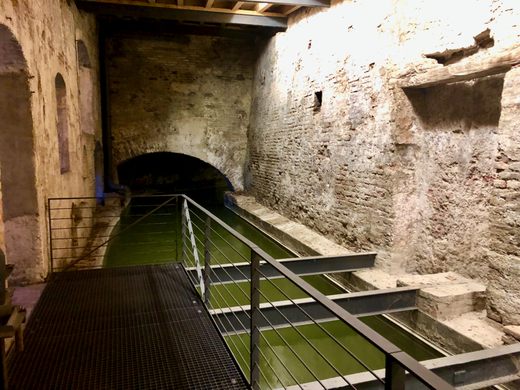
 This ancient hydrological marvel is now the base of a modern outdoor cinema. 

One of Roman Athensmost amazing engineering feats now lies below a modern outdoor movie theater. Fans of the silver screen can gather beneath the night air to watch their favorite films, all while perched atop a nearly 2,000-year-old reservoir.


Due to Athens’ growing water needs in the second century CE, Emperor Hadrian ordered a project to increase the city’s water supply. Construction thus started in 125 for an aqueduct that began at Mount Parnitha and stretched more than 12 miles to the base of Mount Lycabettus, where a reservoir was built.

The aqueduct consisted primarily of an underground channel constructed manually through solid rock. When completed in 140 CE, it was Athens’ largest infrastructure project to date.

Hadrian’s Reservoir sits at the western base of Mt. Lycabettus. Pipes originating there provided enough water to cover the needs of the area’s residents for over 1,000 years. The structure had a propylon (destroyed in the late 18th-century) with four Ionic columns and an architrave with a dedication to Hadrian and his successor Antoninus Pius, during whose reign the work was completed.

The reservoir was abandoned during the Ottoman Empire’s occupation, causing most residents to become reliant on wells. Restoration of the aqueduct began in 1847, though it ceased to be a main source of water after the construction of the Marathon Dam in 1929. 

Today, it no longer supplies drinking water. Some water from the reservoir still makes it to the end, though it empties right into the sewer. Currently, only parts of the steps and two column bases remain at the site. A portion of the architrave also still exists, though it currently sits in the National Gardens.


24 October 2022 - THE STUNNING CRESTA AQUEDUCT - CALIFORNIA


THE STUNNING 

CRESTA AQUEDUCT

 - CALIFORNIA -


G'day folks,

Welcome to a picturesque example of brute-force engineering conquering nature. 

At first glance, this structure appears to be an enigma. It’s a bridge between two granite monoliths, an above-ground tunnel, and an aqueduct carrying water over a creek. This structure is actually part of an elaborate water system.

The Feather River Canyon is a scenic wonder. Sheer granite slabs rise hundreds of feet above the water. Almost equally impressive are the measures engineers have taken to conquer this rugged terrain.


Constructed in 1949, the Cresta Power Dam diverts water through a 21,000-foot-long tunnel bored through solid rock. At 12 feet in diameter, this tube delivers water to the Cresta Powerhouse four miles downstream. The elevation drop of 290 feet allows this system to generate 70 megawatts of electricity.

The Cresta Aqueduct allows water to pass over the gap created by Grizzly Creek, and it is the only portion of the Cresta tunnel system visible.

Pacific Gas and Electric (P.G.&E.) operates several similar dam and powerhouse projects along the Feather River. Collectively they are known as the “Stairway of Power,” as they are able to reuse the same water, over and over, to generate electricity as it flows down the canyon.


13 October 2022 - EDSTONE AQUEDUCT - ENGLAND


EDSTONE AQUEDUCT 

- ENGLAND -


G'day folks,

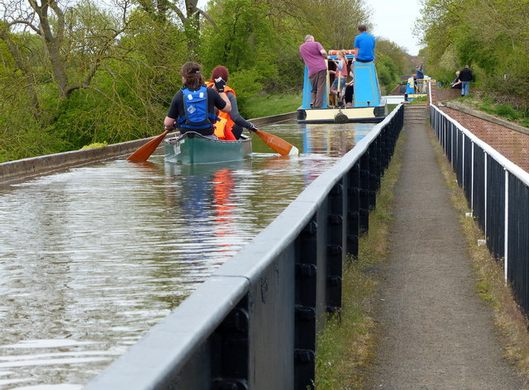
The longest canal aqueduct in England was built without a plan to get water past the moving boats. 

Built in 1816 to carry the Stratford-upon-Avon Canal, the Edstone Aqueduct is the longest canal aqueduct in England (although there are longer ones in both Scotland and Wales and a number of higher ones too). It is 475 feet long and 33 feet high at its highest point. The engineer was William Whitmore.

It crosses a minor road, a stream, a live railway line (formerly the Birmingham, North Warwickshire and Stratford Railway) and a disused railway line (the former Alcester railway later taken into the Great Western Railway). Both railways lines post date the aqueduct by many years and took advantage of the existing structure.


The canal is carried in iron troughs supported on  brick pillars. The troughs were constructed by bolting together 14-foot by five-foot flanged cast iron plates. It is possible to walk across the aqueduct on the towpath which has parapet alongside it (and is at the level of the base of the trough) but if on a boat there is no parapet on the canal side and the water comes very close to the top of the trough. The trough is too narrow to allow boats to pass without building up a bow wave in front and for horse drawn boats this created a distinct barrier to the passage across the viaduct. Later cast iron viaduct designs benefited from the experience of this example.

There are two more similar, but shorter, iron trough type aqueducts on this four-mile stretch of the canal. The Great Western Railway owned the aqueduct for a time and they fitted a pipe to the trough to allow water to be withdrawn to fill up steam locomotives below.

25 August 2022 - AQUEDUCT AT THE RED GATE - GERMANY


AQUEDUCT AT 

THE RED GATE 

- GERMANY  -


G'day folks,

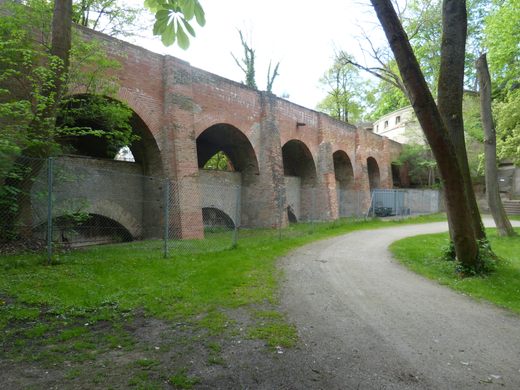
What appears to be an ordinary bridge is actually a rare aqueduct.  

This ancient bridge towards the old town region of Augsburg dates back to the 18th-century. Taking a descent into the moat allows visitors to view the massive aqueduct that once supplied the city with drinking water and power to move waterwheels. 

This aqueduct is one of the more unique found in the city because the water transportation system is divided into two, designed to lead two channels into one aqueduct into the city. It was constructed this way so that one channel, fed by the nearby river Lech, could power waterwheels and could be used to dispose of waste. The other channel, fed by springs in the forest, provided drinking water as it was completely separated from the other channels.


The aqueduct was originally comprised of wood but was replaced with the structure seen today around 1777 by Johann Christian Singer. The aqueduct also included a water tower that pumped water into the city’s public wells and private households with perfect pressure. 

Today, the water in the canals is no longer used for drinking, and the two streams now flow together before reaching the aqueduct. 

In 2019, the city’s water system was declared a World Heritage Site. It considers 22 different objects like water barriers, hydroelectric plants, in total 77 kilometers of canals and also the world’s first artificial canoe trail where competitions of the Olympic Games in 1972 took place.


30 June 2022 - TUNNEL NUMBER 3 - MANHATTAN, NEW YORK


TUNNEL NUMBER 3

 - MANHATTAN, NEW YORK -


G'day folks,

Deep under Manhattan is the largest construction project in city history. So far, the project has taken the lives of 23 workers, or "a man a mile." 

The state of New York began digging this tunnel in 1970 to provide water to the city from its upstate source.

When completed, the tunnel will be over 60 miles long, snaking across the city from Yonkers across Central Park, the East River and Roosevelt Island and ending up in Astoria, Queens. 


The construction project costed over $6 billion and was not finished until 2020. The costs for the ambitious project have already been high with 23 workers losing their lives to the tunnel, averaging about one life each mile.


22 June 2022 - ANCIENT AQUEDUCT IN ITALY


ANCIENT AQUEDUCT

 IN ITALY 


G'day folks,

For centuries this cliffside aqueduct was believed to be of Roman origin, but it actually dates to the medieval era. 

Far in the northwest corner of Italy, in the town of Antey-Saint-André, an ancient, little-known aqueduct hugs the hillside. Dating back to the ninth century, the medieval aqueduct, known as Ru Du Pan Perdu, was originally built as an irrigation canal. The structure would collect water falling from mountainside streams and funnel it to the agricultural land below. The name Ru Du Pan Perdu literally means “channels of lost bread” and indicates that the laborers who built the aqueduct were likely never paid for their work and therefore did not complete the project.


The site became a popular spot on the European “Grand Tour.” From the 17th to the mid-19th centuries, European wealthy young people would embark on these Grand Tours across Europe and the Middle East, often spending months or even years away. One such tourist, Edward Whymper, who climbed the Matterhorn in 1865, wrote about seeing the aqueduct in his diary: “One sees from the path, at several places on the right bank of the valley, groups of arches which have been built high against the faces of the cliffs.”

At the time, almost everyone thought these impressive arches were Roman, not medieval. Guide books of the era repeated the falsehood. But Whymper correctly guessed the aqueduct was a later construction. He wrote, “the work has not the usual Roman solidity. The arches have always seemed to me to be the remains of an unfinished work.”

Today, the aqueduct is visited far less frequently than in the 19th-century. But for those willing to make the trek, the structure also offers stunning views of the surrounding Alps.


26 May 2022 - STUNNING TINAGO FALLS, PHILIPPINES


STUNNING 

TINAGO FALLS

- PHILIPPINES -


G'day folks,

Hidden deep within a Filipino jungle is an incredible waterfall that plunges into a dazzling blue-green pool. 

Away from the more than 300,000 inhabitants of nearby Iligan City, Tinago Falls provides a serene getaway deep within the jungles of Mindanao. Tucked within a forest-fringed ravine, this mighty waterfall’s name fittingly means “one that is hidden.”

Approximately 240 feet high, its colossal rock structures are dotted by thick masses of trees and natural foliage. Despite this towering scene, what lies at the bottom of the falls leaves visitors in even greater awe. 

Tinago’s basin features a stunning blue-green pool of water. The colorful sheen of the water is more than enough to inspire legends of supernatural guardians that protect this aquamarine refuge.


In spite of its mystic undertones, Tinago has been developed by locals to carry adventurers toward the falls. By way of a small ferry ride on one of two makeshift bamboo rafts, you can experience one of the area’s main attractions: when directly underneath the plunging falls, you can feel the therapeutic beating of the water on your skin. 

More than a hundred feet deep, the basin is not only a site for those who want a peaceful sanctuary, but also those who crave adventure. Thrill-seekers and adrenaline junkies are often found climbing and jumping off of the high rock walls surrounding the basin. 

Clancy's comment: Yet, another reason to visit this magnificent part of the world. 

I'm ...