Showing posts with label ITALY. Show all posts

19 March 2023 - ONE OF THE WORST DAM FAILURES - ITALY


ONE OF THE WORST 

DAM FAILURES 

- ITALY -


G'day folks,

The sinister ruins of one of the worst dam failures of the 20th century lie in this astonishing alpine setting. 

In a growing modern nation craving for energy, as Italy was at the beginning of the 20th century, hydroelectric power was a synonym of progress, representing a victory of humankind over nature. Yet in the mountains of Bergamo province in Lombardy, that attempted feat would take a tragic turn. 


Construction of a hydroelectric dam to exploit the river Gleno in the the Valle di Scalve (Scalve valley) began in 1916, but the project was immediately cursed by poor materials and poor workmanship. On top of that, due to funding problems, the plan changed from the original idea of a gravity dam to a multiple-arch dam while the work was still in progress, resulting in a mixed-type dam.


Just after its completion, heavy rains filled the reservoir, and several leaks caused concern among the inhabitants of the valley below.

Sure enough on December 1, 1923, at 7:15 in the morning, the tragedy happened. The central section collapsed, causing a mass of 4.5 million cubic meters of water to pour into the villages in the Scalve valley. The official death toll counted 356 lives lost as a result of the flood, as well as massive damage to roads, bridges and buildings.

What remains of the dam is a 160-foot-high concrete barrage with a huge, chilling laceration in its central section. The sinister ruins are a stark and surreal contrast with the stunning alpine surroundings. 

4 December 2022 - MYSTERIOUS STONE ALTARS FOUND IN ITALY


MYSTERIOUS STONE 

ALTARS FOUND IN ITALY


G'day folks,

Ancient, mysterious stone altars are hidden among wild woods in central Italy. 

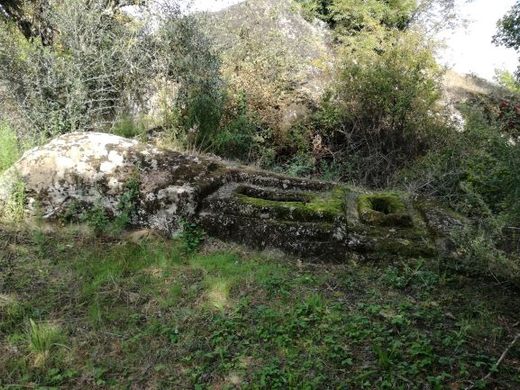
In the foothills of the Cimini Mountains, near the village of Bomarzo—renowned for its 16th century Renaissance garden—there is a wild woodland known as the Selva di Malano (Malano forest). The gentle sloping landscape, where wild oak forests mingle with hazelnut orchards, suddenly gives way to deep canyons and ravines, and ancient stone altars are hidden among the trees.


It was most likely the Etruscans who carved the massive volcanic rocks that were cast here from volcanic eruptions and fashioned them into these mysterious altars. A few structures stand out: the two stones known as Sasso del Predicatore (Preacher’s Stones) and the even more mysterious cubic altar, a perfectly shaped cube which defies any logical explanation.

The two stones are very similar in shape, consisting of a staircase carved in the rock leading to an upper level where the altars would have been located. Additionally, the cubic altar even preserves a cross-shaped inscription which might indicate cardinal points. According to several scholars, the altars might have been used by the Etruscans for religious rites (such as the observation of birds) and astronomical observations.


Other minor altars were turned into tombs by Roman freedmen (the inscriptions are sometime visible), such as the so-called Coelius tomb where the inscription reads: “D. Coelius D. L. Alexander / Quintia P. L. Hilara,” or “Decimus Coelius Alexander, freedman of Decimus and Quintia Hilaria freedwoman of Publius.” On the top of the tomb, two burial recesses were carved to preserve the ashes of the two individuals. Several Roman tombs have also been reported around the area, with carvings and Latin inscriptions, but their location is often difficult to pinpoint due to the absence of trails and signs.

One especially interesting monument has, unfortunately, become inaccessible in recent years since it is now on private, fenced property. However, it can be spotted emerging from the hazelnut trees: the ruins of San Nicolao, a medieval Benedictine monastery built over three Roman tombs. The ruins consist of a Romanesque church, a coenobium, and a fortified building built directly on top of a massive block of stone. The three tombs are located at the base of the stone and are beautifully decorated with architectural details.

2 October 2022 - THE MOVING ISLAND - ITALY


THE MOVING ISLAND 

- ITALY -


G'day folks,

This serene, turquoise lake in an extraordinary nature reserve showcases a rare natural phenomenon. 

Posta Fibreno is a karstic lake in the foothills of Italy’s Lazio region, and though it may seem more like an engrossed river, it is a small, serene lake home to a very unusual natural phenomenon known since Roman times. Described by Pliny the Elder in his 1st-century Naturalis Historia, the lake is the setting for the subtle dances and movements of a natural floating island.


The island, known as La Rota for its round shape, was formed over the years by free-floating rhizomes, peat, and roots. At about 13 feet thick and 130 feet wide, the mass is not rooted to the ground below the water, and thus the wind and currents cause it to move freely around the surface of the lake. Small trees and shrubs cover the land, and when a breeze blows or the volume of the water released by the underwater springs varies, the island appears to be somehow floating around on its own. This is a phenomenon so rare that Posta Fibreno is one of the only places on Earth to see it occur.

Geological anomaly aside, Lake Posta Fibreno’s mild temperature and extraordinarily clear waters have made it a paradise for divers, kayakers, wildlife lovers, and birdwatchers. The landscape is a nature reserve that protects a local endemic species of fish, the Fibreno trout. The lake has no tributaries and it is fed by karstic springs, whose constant flow are responsible for the turquoise water’s remarkable transparent hue. The fishermen on Posta Fibreno still use a traditional boat known locally as a “nĂ ue,” and these may be spotted when walking along the nature reserve’s boardwalks. 


29 September 2022 - ANCIENT ROMAN RUINS FOUND BENEATH LIBRARY - ITALY


ANCIENT ROMAN RUINS 

FOUND BENEATH LIBRARY

 - ITALY -


G'day folks,

The remains of an ancient Roman city are hidden underneath Bologna's beautiful public library. 

When the Romans designed the city of Bologna in the 2nd and 3rd century BC, they really built it to last. And last it did: Excavation of the historic center of Bologna in the 1990s uncovered the two main streets built during the Roman Empire, still intact beneath the gorgeous Salaborsa Library in the city’s most popular piazza.


The Salaborsa Library (Biblioteca Salaborsa) is a modern space housed within a beautiful historic building, sitting on top of an extraordinary piece of history. You can see the underground ruins from the main room in the library, through the clear glass panes in the floor. It’s worth getting a closer look though, so head downstairs to the small museum to further explore this hidden remnant of antiquity.


Before you enter the archaeological area, there is a timeline of the history of Bologna, at the end of which is a door. Through the door, you are transported back in time, surrounded by ancient building foundations, a well, and even an ancient sewage system. A kind Italian guide may even be available to point out the different layers of history, which are clearly visible in the remarkably preserved structures. The deepest, oldest levels of the ruins may date back even earlier than the founding of Bologna, suggesting a settlement already existed here before the Romans.

22 September 2022 - THE MAGNIFICENT ROCCA SFORZESCA - ITALY


THE MAGNIFICENT 

ROCCA SFORZESCA 

- ITALY -


G'day folks,

This castle was once the home of one of the most powerful women of the Renaissance.  

Rocca Sforzesca is a stunning example of the evolution of castles and fortifications between the Middle Ages and the Renaissance. Its origins date back to 1261 when a 10 tower structure was built on the remains of a pre-existing tower from the 11th-century. At the end of the 15th-century, the rectangular towers proved to be completely unsuitable for countering firearms, such as cannons. Between 1472 and 1484 the towers were changed into thicker circular structures and renovated by the Sforza family, along with the rest of the castle. 

One of the ancient rectangular towers is still recognizable, incorporated with the south-east tower while the central one, il Mastio, was maintained.


At the end of the 15th-century Caterina Sforza, one of the most important female figures of the Renaissance, also known as Lady of Imola and Forli, lived in the castle. She was an example of Machiavellian resoluteness. NiccolĂ² Machiavelli, the famous diplomat and writer wrote that in 1488 she came under attack and her enemies threatened to kill her sons. To avoid this fate, she climbed to the top of the castle, raised her dress, and shouted, “Kill them if you will, I have the means to make many more!”

Between 1499 and 1500 Cesare Borgia, Duke of Valentine and the illegitimate son of Pope Alessandro VI, attacked the region and conquered Rocca Sforzesca. He later captured Sforza in the castle of Forli’, as she put up a final stand with weapons in hand. Many legends and tales have arisen over the centuries about Sforza.

It was said that Sforza, named by many “Tygre” the Tiger of Imola and Forli’, used to throw her enemies into the well of Rocca Sforzesca, which was reinforced with sharp blades. Another story claimed that she built the castle with the help of the devil. Local residents say that her ghost appears to visitors who get too close to her treasure hidden in the castle’s dungeon.

Perhaps the most popular legend states that during a full moon, it’s possible to see her standing on the wall of Rocca, waiting for the arrival of the Borgia army. She was also an expert in alchemy and wrote the book, Liber de experimentiis Catherinae Sfortiae.


13 September 2022 - MAJESTIC CASTLE of ROCCASCALENGNA - ITALY


MAJESTIC CASTLE 

of

 ROCCASCALENGNA

 - ITALY -


G'day folks,

This precariously perched fortress was once ruled by a crow-worshipping baron. 

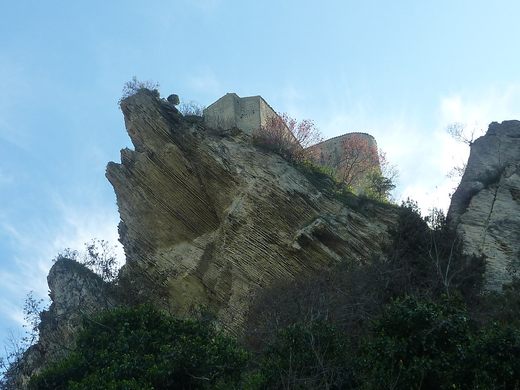
Roccascalegna is a small village in the Majella region of Abruzzo in central Italy. The village, thought to be founded by the Lombards around 600, sits at the foot of the impossibly-built Castle of Roccascalegna.

This extraordinary fortress is perched on the edge of a massive basalt cliff, and was likely built to guard the Secco Valley below. The rocky outcrop looks out over lush meadows and olive orchards, but the idyllic setting has a rough past. In the centuries since it was first built, the valley has seen several invasions and pirate incursions from the Adriatic coast.


Starting in the 15th century, the fortress was rebuilt and enlarged, but over time its fortunes changed. Around 1700 the castle was largely abandoned, and years of neglect, weather, and looting led it to a state of disrepair. In 1985, the town of Roccascalegna took ownership of the structure and began restoration works that took more than 10 years to complete.

The castle’s most famous legend is that of the Corvo de Corvis, or the Crow Baron, who, in the 17th century, introduced the right of jus primae noctis, which held that all newlywed brides of his fiefdom were obligated to lie with him on their wedding night. Stories say the baron was stabbed to death, either by one of the brides or her husband in disguise, and upon dying he left a bloody mark on the walls which could never again be washed away. Some claim that the mark is still visible within the castle, as is the restless spirit of the Baron.

Nowadays, visitors can visit the keep, the inner courtyard, the prison, the chapel, and the castle walls, which provide an exceptional view on the landscape below, which includes Majella National Park. As of 2018, you can also rent the castle as an event venue for €100 (about $110).


16 September 2022 - ANCIENT LOMBARD TOWER - CATINO, ITALY


ANCIENT LOMBARD TOWER

 - CATINO, ITALY -


G'day folks,

This seventh-century fortification marked the western border of the Lombard duchy of Spoleto.  

On the foothills of the Sabine mountains, overlooking the countryside that stretches all the way to Rome, a solitary tower stands guard above the hamlet of Catino, which is part of the town of Poggio Catino.

Poggio Catino is named after the enormous karstic sinkhole that hides beneath the hamlet and has helped make the site a formidable fortress. In the early Middle Ages, the area marked the border between the Roman/Byzantine territory of Rome and the Lombard duchy of Spoleto, and one of the main thoroughfares through the mountains.


The ruins of the fortress, which is mentioned in the work of the town’s most famous citizen, Gregorio da Catino, in his Regestum Farfense, are perched on an outcrop above the hamlet and surround a central keep, with an enormous pentagonal tower (108 feet tall) and that seems unassailable. It’s also survived earthquakes of the past few centuries.

That may not have been by accident. To make the tower lighter and more resilient, the Lombard lords had the upper section built of spongolite, a stone made from fossilized sponges, which could be extracted nearby.


4 September 2022 - ENORMOUS SINKHOLE IN ITALY


ENORMOUS

 SINKHOLE

 IN ITALY 


G'day folks,

This enormous sinkhole hides a secret world created from divine wrath.  

The mountains and forests surrounding the medieval village of Roccantica are wild and lush. They also hide several beautiful sights, such as hermitages and waterfalls but above all, the enormous and unusual sinkhole locally known as “U’revotano.”

This enormous abyss is a common geological phenomenon in Central Italy, also known as doline, in which karstic processes of erosion cause the collapse of a limestone roof over an underground cavern. This natural occurrence has inspired a local legend in which a village is known as Revotano.


According to local tradition, the village was inhabited by blasphemous residents and was swallowed up by divine wrath. As the story goes, the young wife of a local inhabitant who had gone to the stream to wash her laundry with her son suddenly heard a voice. The voice warned that divine punishment was going to befall her village. A great earthquake shook the land and the voice-guided them to safety. Revotano was swallowed into the sinkhole

The abyss is 820 feet (250-meters) wide and 426 feet (130 meters) deep. There are a few viewpoints that provide an understanding of the enormity of the sinkhole. A slippery, unmarked trail leads (with the help of a few ropes) to the bottom of the sinkhole where a fragile world of moss-carpeted trees and boulders resides.

The air is colder and more humid at the bottom of the sinkhole, allowing the moss and ferns to grow lush and in vivid hues. As this is a very fragile and unusual example of nature, take special care not to damage the vegetation when visiting.