Showing posts with label GREECE. Show all posts

28 October 2022 - KALAVRYTA SACRIFICE MEMORIAL - GREECE


KALAVRYTA 

SACRIFICE MEMORIAL 

- GREECE -


G'day folks,

Here is a solemn reminder of the infamous World War II war crime that massacred almost all the men in a small Greek town. 

In October 1943, Greek People’s Liberation Army guerrillas captured 77 German soldiers on a patrol mission, following an ambush in the mountains outside Kalavryta, southern Greece. After negotiations for a prisoner exchange failed, the captives were executed in a local ravine, with only two making a lucky escape undetected. 

In response, commanding General Karl Von Le Suire ordered Unternehmen Kalavryta, a guerrilla cleanup operation that  included terrible reprisals aimed at the local civilian population. Troops from the 117th Jaeger Division, a unit with previous counter insurgency experience in what was then occupied Yugoslavia, converged to the town of Kalavryta from all directions, burning and looting 50 villages along the way and executing 143 male civilians.



Upon reaching Kalavryta on December 13, 1943, the soldiers began setting the town ablaze. They then gathered the town’s entire population at the schoolyard and separated them in two groups. All able men age 13 and upward were led to a hill outside the town, while women, the elderly, and small children were locked inside the schoolhouse. 

At noon, the schoolhouse was set on fire with over 200 people inside, while at the hill, the soldiers began executing the 461 men by machine gun fire. The action was coordinated by flares, so the men would die in full view of the burning town, and within earshot of the screaming women, children, and elders, now surrounded by flames. While the execution was taking place on the hill, the panicked, choking prisoners managed to smash through the school’s doors and escape in a frantic stampede, while others threw their children outside the windows of the burning building to save them. 


Only 13 men survived the execution, injured or hiding under the bodies of the dead, while soldiers roamed the hill, delivering the coup-de-grace. After the soldiers’ departure, the escaped women, children, and elderly reached the blood-soaked hillside, where they discovered the grim fate of their male relations. Without any tools or farm animals left in their looted households, they began dragging the bodies to the cemetery nearby or digging shallow graves with their hands. 

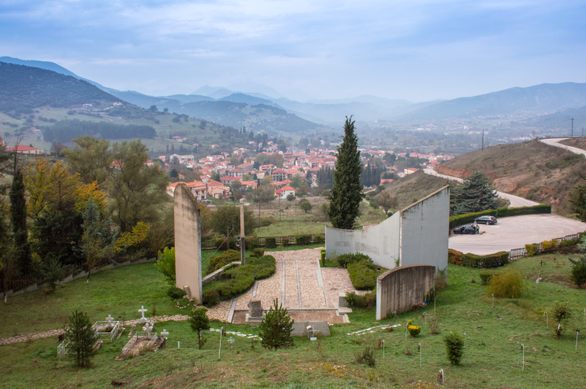
Today, a solemn memorial complex stands on the hill where the execution took place. It includes a large cross, ossuary, the harrowing sculpture of a lamenting woman of Kalavryta, as well as some on-the-spot graves that remained on site since that day. The Kalavryta schoolhouse has been converted to a museum displaying everyday and personal items that survived the town’s destruction, as well as photos and eyewitness accounts that testify to the atrocious conduct of the 117th Jaeger Division.   

30 October 2022 - GESTAPO INTERROGATION MEMORIAL - ATHENS, GREECE


GESTAPO INTERROGATION

 MEMORIAL

 - ATHENS, GREECE -


G'day folks,

This is the site where hundreds of Greeks were tortured by the Nazi secret police, but is now a cosmetics store. 

When the German army invaded and occupied Athens in April 1941, it began enacting laws to control the local population. Many Greeks resisted these laws, and the Greek Resistance Movement was soon organized, known as one of the fiercest resistance groups in World War II Europe. When the resistance began having an impact on the occupation, the Germans sought retribution.


The Nazi occupation force included the ruthless Gestapo, which requisitioned a building at 6 Merlin Street in central Athens to act as its headquarters. The site served as the primary interrogation center of the secret police, outfitted with torture chambers and prison cells. Those suspected of being members of the resistance, or committing individual acts of defiance, were brought to this hellish place.

Hundreds of individuals who passed through the doors of the building were either tortured to death or sent to the nearby concentration camp of Chaidari. The Nazis left many of the bodies hanging from trees for days, guarded by local collaborators, to send the message that acts of defiance would be dealt with swiftly and without mercy.

When the Germans withdrew from the city in October 1944, the building returned to civilian use. In the 1980s, it was converted to a shopping center, and the site of the former Gestapo building now houses a beauty retail chain; the area where the torture chambers were is now full of cosmetic displays.


This eerie place now tells the story of a dark chapter in human history that should not be forgotten. Outside the building is a memorial to those that were detained, tortured, or killed at 6 Merlin. The memorial includes a carving of a bound prisoner, one of the original torture chamber doors, and several plaques. One of the plaques reads, “Free people were led through this door.”

22 October 2022 - HADRIAN'S RESERVOIR - ATHENS, GREECE


HADRIAN'S RESERVOIR

 - ATHENS, GREECE -


G'day folks,

 This ancient hydrological marvel is now the base of a modern outdoor cinema. 

One of Roman Athensmost amazing engineering feats now lies below a modern outdoor movie theater. Fans of the silver screen can gather beneath the night air to watch their favorite films, all while perched atop a nearly 2,000-year-old reservoir.


Due to Athens’ growing water needs in the second century CE, Emperor Hadrian ordered a project to increase the city’s water supply. Construction thus started in 125 for an aqueduct that began at Mount Parnitha and stretched more than 12 miles to the base of Mount Lycabettus, where a reservoir was built.

The aqueduct consisted primarily of an underground channel constructed manually through solid rock. When completed in 140 CE, it was Athens’ largest infrastructure project to date.

Hadrian’s Reservoir sits at the western base of Mt. Lycabettus. Pipes originating there provided enough water to cover the needs of the area’s residents for over 1,000 years. The structure had a propylon (destroyed in the late 18th-century) with four Ionic columns and an architrave with a dedication to Hadrian and his successor Antoninus Pius, during whose reign the work was completed.

The reservoir was abandoned during the Ottoman Empire’s occupation, causing most residents to become reliant on wells. Restoration of the aqueduct began in 1847, though it ceased to be a main source of water after the construction of the Marathon Dam in 1929. 

Today, it no longer supplies drinking water. Some water from the reservoir still makes it to the end, though it empties right into the sewer. Currently, only parts of the steps and two column bases remain at the site. A portion of the architrave also still exists, though it currently sits in the National Gardens.


20 October 2022 - LYCABETTUS FUNICULAR RAILWAY - ATHENS, GREECE


LYCABETTUS 

FUNICULAR RAILWAY

 - ATHENS, GREECE -


G'day folks,

This railway carts travelers to central Athens's highest peak, which offers stunning vistas of the city. 

Running from the lower terminus in Kolonaki to the upper terminus atop Mount Lycabettus, the Lycabettus Funicular takes passengers on a 680-foot underground journey up to the highest peak in central Athens.

Mount Lycabettus sits 908 feet above sea level. In 1960, construction began on a funicular railway that would take visitors to the top of the mountain. After much digging and hauling, the Lycabettus Funicular was inaugurated on April 18, 1965.


The funicular ran uninterrupted for 38 years until 2002, when the carriages were replaced and the mechanical and electrical systems were renovated. Now, each car has a capacity of 34 people and the funicular transports an average of 300,000 riders annually.

Atop the mountain is a panoramic view of all of Athens. On the higher peak is the 19th-century Chapel of Saint George, a tiny Cycladic-style chapel that was first used by a Monk in 1834 and sits on the grounds of an ancient temple dedicated to the God Zeus as well as a café and restaurant. On the lower peak sits a 4,000-seat Amphitheater.


24 June 2022 - QUIRKY BOOKSTORE IN GREECE


QUIRKY BOOKSTORE 

IN GREECE


G'day folks,

Atlantis Books is a quirky bookstore hidden beneath a sea of whitewashed Greek villas. 

A mecca for bookworms is buried beneath the waves of whitewashed buildings flowing toward the Aegean Sea. Virtually invisible unless deliberately sought it out, Atlantis Books is a tiny bookstore packed with some of the greatest literary works by authors such as Leo Tolstoy and Samuel Beckett.

Opened in 2004 by a group of young and adventurous college students, the shop offers a plethora of books from international authors translated into English. A small set of stairs framed by vines funnels visitors past a vibrant mural and into the bookstore.


The store is a winding maze of books, all sorted by genre. You’ll find anything from literary classics to intriguing newer titles. Splashed along white walls are quotes and colorful illustrations that swirl around the entire bookstore. There’s also a timeline of the bookstore’s creation running along one wall.

Chairs and tables are tucked into the nooks and crannies of the area, inviting readers to sit down and get lost within the pages of a book. Don’t be surprised if you spot a cat or two snoozing among the stacks. Above ground, the bookstore boasts a patio offering a stunning view of the sparkling sea.


2 November 2021 - LOST CITY DISCOVERED UNDERWATER 1,500 YEARS LATER


LOST CITY DISCOVERED 

UNDERWATER 1,500 

YEARS LATER


G'day folks,

Great discoveries are still being made around the world. 

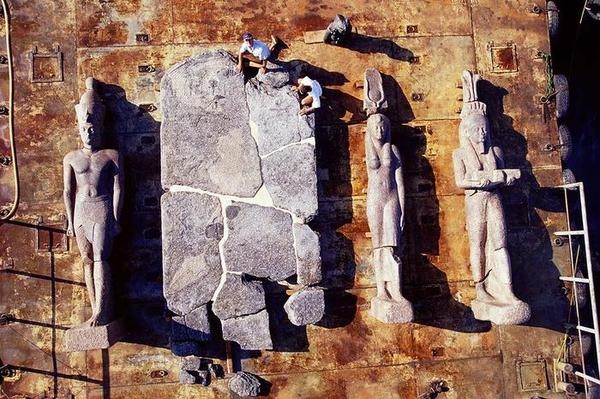
Heracleion, a very prosperous and a known city had been engulfed underwater 1500 years ago. This grand city had also been mentioned by the Greek writer Herodotus, the 5th-century BC historian. He had told a wonderful tale of Helen of Troy, the most beautiful woman in the world, who had launched a thousand ships, travelled to Heracleion, then a port of ‘great wealth’, with her glamorous Trojan lover, Paris.


Clancy's comment: Stunning!

I'm ...


30 May 2021 - THE TEMPLE of APOLLO


THE TEMPLE of APOLLO


G'day folks,

The Temple of Apollo is located at Delphi, the center of the Ancient Greek world, and was built on the location of two earlier temples. 
 
The temple was first built around the 7th century BC by the two iconic architects Trophonios and Agamedes and was rebuilt after a fire in the 6th century BC. The temple was of the Doric order and had 6 columns at the front, and 15 columns at the flanks. 
 

In 373 BC, the Temple of Apollo was destroyed by an earthquake and was rebuilt for the third time in 330 BC. Even after so many centuries, the foundations of the iconic temple still survive today along with several Doric columns that are made of porous stone and limestone. Not much is known about the temple’s interior arrangement. However, ancient writers have mentioned that the walls of the temple were inscribed with the aphorisms of the seven sages.


Clancy's comment: I've been to many of these temples in Europe. When visiting these sites, I tried to imagine what it was like back in the day when they were active.  

I'm ...


25 May 2021 - TEMPLE OF APOLLO, GREECE


TEMPLE OF APOLLO, GREECE


G'day folks,

The Temple of Apollo is located at Delphi, the center of the Ancient Greek world, and was built on the location of two earlier temples. 
 
The temple was first built around the 7th century BC by the two iconic architects Trophonios and Agamedes and was rebuilt after a fire in the 6th century BC. The temple was of the Doric order and had 6 columns at the front, and 15 columns at the flanks. In 373 BC, the Temple of Apollo was destroyed by an earthquake and was rebuilt for the third time in 330 BC. Even after so many centuries, the foundations of the iconic temple still survive today along with several Doric columns that are made of porous stone and limestone. 
 

Not much is known about the temple’s interior arrangement. However, ancient writers have mentioned that the walls of the temple were inscribed with the aphorisms of the seven sages.
 
 
Clancy's comment: I can only imagine what it looked like when it was built.

I'm ...


8 December 2018 - BOURTZI - HOME OF EXECUTIONERS IN GREECE


BOURTZI 

- HOME OF EXECUTIONERS IN GREECE -

G'day folks,

This 15th-century island fortress later served as home to the executioners no one wanted to live near. 

 An executioner’s life is not an easy one. The men who spent their days carrying out the death sentences of the criminals incarcerated in the Greek prison of Palamidi in the latter half of the 19th century lived alone on an island, because most people did not want to live near them.


The imposing island fort of Bourtzi off the coast of Nafplio was home to executioners for several decades, after it stopped serving a military purpose. Bourtzi, meaning tower in Turkish, was built by the Venetians, invaded by the Turks, and is now a part of Greece. 

When the Venetians, in the 15th century, discovered the strategic importance of the small island, situated right near the Nafplio port, they built a fortress in the shape of an imperfect hexagon to match the shape of the narrow landmass. The stairs were made movable in the 3-storey tower structure, and cannons and flamethrowers were positioned such that they could be unleashed at short notice. 


 A major threat at the time came from the pirates wandering the nearby seas. But the fort eventually fell, in 1715, into the hands of the Ottoman Turks, who went on to strengthen the fortification even further. They also dropped hundreds of large stones in the surrounding waters, to ensure that no big ships could reach the island. 


During the time of the Greek Revolution, between 1821 and 1832, it was won back by the Greeks, who used it to shelter their leaders from the chaos that was taking over the rest of the land. When the strife subsided, Bourtzi was no longer required as a defensive fortress, and the executioners were housed there for the second half of the century. 


If the people in the 19th century had qualms about living near these men, 20th-century tourists had no such misgivings about staying in the very spaces previously occupied by them. The fortress was converted into a hotel in the 1930s, functioning all the way till the 1970s. 

 After serving in all these different roles, it now sits empty aside from visits by curious tourists wanting to see the vacant castle and its great views of the city, and the music festival occasionally held there. 


Clancy's comment: Looks like a fascinating place. Make a great writer's retreat.
I'm ....