Showing posts with label EUROPE. Show all posts

24 November 2022 - ANCIENT LIMESTONE MINE BENEATH DENMARK


ANCIENT LIMESTONE 

MINE BENEATH DENMARK


G'day folks,

Nearly 40 miles and 1,000 years of limestone mines exist under Denmark. 

If the walls of Mønsted Kalkgruber could talk, they could say a lot about the thousands of people who have come through the mines over the centuries, but probably even more about the thousands of bats that currently live there.

The caves are very, very old. When Denmark was becoming an increasingly Christian nation around the 11th century, limestone mining was a profitable industry because the stone was used in cathedrals. From this time up until the 19th century, the miners used practically the same technique of assembly line-style limestone ferrying. Machinery was introduced in the mid-1800s, individual mines merged together, and the tunnels were mined more extensively. Limestone remained profitable until the mid 20th century. The mines closed in 1953.

The caves changed hands many times in the years following the quarry’s closing. At one point they were the property of Anker Buch, a concert violinist who staged performances in the acoustically accommodating caves, a practice which continues even now. In addition to cultural events in the caves, a museum dedicated to showcasing Denmark’s oldest industry also operates within the mines. 


Sixty kilometers (about 37 miles) of underground paths comprise the caves of Mønsted Kalkgruber, though only two kilometers of that are electrically lit. The tunnels vary wildly in size: Some are cathedral height, some are low enough that an adult can’t walk through upright. These tunnels open up into various cave “rooms,” some of which contain entire underground lakes. Visitors to the Mønsted Kalkgruber museum can wander through the caves on their own or take a train ride tour throughout. 

The train rides are only available between May and August, however, out of respect to the caves’ inhabitants: some 18,000 bats. In spring and summer the bats fly all over Jutland, eating insects to their hearts’ content. In the fall and winter months the bats retreat to the caves, when they need quiet for hibernation (hence no trains). During the beginning of the cold season, they tuck themselves into crevices in the caves, out of view from the museum visitors. In the latter half of the season though, the bats emerge from hibernation to test the climate. They fly about and hang from the ceilings as they wait for spring. The Mønsted Kalkgruber museum is intent on preserving the bat population, so much so that they feature a bat counter, noting each bat’s entry and exit from the caves.

7 November 2022 - THE CHAPEL OAK - FRANCE


THE CHAPEL OAK

 - FRANCE -


G'day folks,

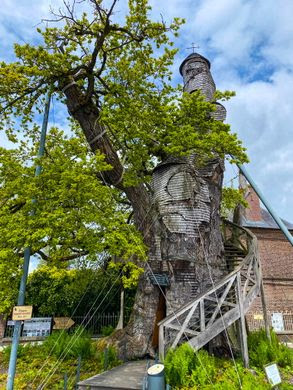
Two small chapels are housed inside this ancient tree. 

Like something out of a fairy tale (or Keebler elves commercial) this ancient oak tree’s hollowed out trunk is is home to two small chapels, reached by a spiral staircase surrounding the trunk. This, the oldest known tree in France, has lived through Louis XIV, the French Revolution, Napoleon, Sarkozy, and amazingly, is still standing.

Located in the small French farming village of Allouville-Bellefosse, France, according to local lore, the tree has grown in pace with the development of the French country itself. Said to have begun growing 1000 years ago (which would make it one of the oldest trees in the world) during the reign of Charlemagne, and in 1035, William the Conqueror is supposed to have knelt at its base. While scientists say the tree is only around 800 years old – too young to have been around in the age of Charlemagne – it is nonetheless, by far, the oldest known tree in France.


In the 1600s, disaster struck. The then middle aged (roughly 470-year-old) oak tree, was struck by lightning, burning right through its center and hollowing out the trunk. However, not only did the tree survive this fate, but the newly hollowed tree came to the attention of the local Abbot Du Détroit and father Du Cerceau. Deciding they wanted to build a different kind of sanctuary they began building a shrine to the Virgin Mary directly into the hollow of the tree. Later another small chapel and a stair case climbing the outside of the tree was added.

Things almost took a very bad turn for the tree during the French revolution. A crowd inspired by the revolution came to burn the tree as it was a symbol of the old way and the abhorred church. A quick thinking local quickly renamed the oak the “temple of reason” sparing it a fiery fate.

Today the common oak is showing signs of age and stress. Now held up by poles, part of the 33-foot trunk has died and the majority of the tree has been covered over with wooden shingles where the bark has fallen away. Although Chene Chappelle’s host tree has begun to wane, its congregation still gathers twice a year for Mass and the tree is still the destination of annual pilgrimage on August 15, the Feast of the Assumption of the Virgin.

9 November 2022 - LARGEST UNDERGROUND LAKE IN EUROPE


LARGEST UNDERGROUND

 LAKE IN EUROPE


G'day folks,

Welcome to the largest underground lake in Europe. 

In the middle of the Valais valley, just below some beautiful vineyards, lies the inconspicuous entrance to one of Europe’s most impressive underground sites: Lac Souterrain de Saint-Léonard. It is the largest subterranean lake in Europe, with a length of 300 meters and a width of 20 meters.


After entering and descending the 50 steps you find yourself on a jetty, with waters of the continent’s largest natural underground lake stretches out in front of you. Its total area is approximately 6,000 square meters, and the water stays at an average temperature of 11 degrees Celsius (52 degrees Fahrenheit). The water is so very still that every drop hitting the surface can be heard distinctly in the cave.


The underground lake is located in a bed of Triassic gypsum. It formed over millions of years as the rock was slowly dissolved by groundwater. On the guided boat tour bats or the settled trout can be observed, and so can the bare gypsum, slate, and marble walls touching the edge of the water.

3 November 2022 - AMAZING PREDJAMA CASTLE - SLOVENIA


AMAZING 

PREDJAMA CASTLE 

- SLOVENIA -


G'day folks,

This castle has a secret tunnel which withstood a siege until its owner was killed by the Holy Roman Empire, whilst sitting on the toilet. 

Built directly into a rocky cliff face, Predjama Castle, or Predjamski grad in Slovenian, was considered virtually impenetrable when it was constructed in the 13th century. However, a few centuries later the structure’s fortifications were put to the test when a robber baron started a war with the Habsburgs and was forced to hole up in the castle for over a year.


According to legend, Erazem Lueger and his family had taken over the Gothic Predjama castle in the late 15th century. Acquiring land and power, Erazem had become a well-known robber baron in the region. However, he quickly grew too big for his britches, murdering the kinsman of Frederick III, the Holy Roman Emperor. With the strength of all of his forces, Frederick came after Lueger, and forced him into hiding in his castle.

Despite the Emperor’s superior forces, the rebellious Lueger had both brains and a secret tunnel between the castle and the nearby Postojna Cave. For an entire year and one day, Lueger snuck out of the castle and replenished food and drink through the tunnel from a nearby town. Finally, after surviving for so many days, one of his servants sold him out.

Waiting for Lueger to use the outhouse on a high floor of the outside face of the castle, the servant raised a flag and one single shot from a cannon blasted the baron off the toilet.


The castle has been completely reconstructed many times over the years. With a Renaissance-style remaining, the Gothic facade and the legend of Erazem Lueger are often forgotten. However, the Postojna Cave is still in use, allowing visitors to relive the siege and covert activities of a knight who crossed the wrong royal family of Europe. Another peculiar fact is that the cave under the Castle is the home to a colony of bats.

8 November 2022 - SECRET PASSAGES IN FRENCH MONASTERY


SECRET PASSAGES 

IN FRENCH MONASTERY


G'day folks,

This is an ancient monastery, containing a locked room and secret passages, involving a mysterious book heist. 

“I’m afraid my burning passion overrode my conscience. It may appear selfish, but I felt the books had been abandoned. They were covered with dust and pigeon droppings and I felt no one consulted them any more. There was also the thrill of adventure — I was very scared of being found out.”

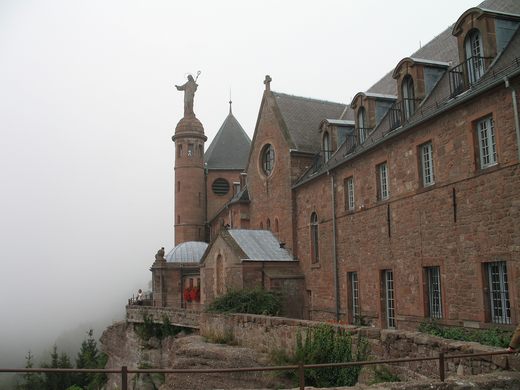
In 2003, Stanislas Gosse admitted to the theft of over 1,000 ancient and rare books from a locked private library in a monastery perched 2,500 feet up in the Vosges mountains in France. In order to accomplish this feat, he climbed exterior walls and hidden stairways into a long-forgotten medieval passageway with secret access behind library cupboards. He then sneaked into the library, chose his victims, and left through the same route. He was not a professional thief out for money — all the books were found safely in his tiny apartment. He was a local teacher who stumbled across a map to the secret passages in the city archives and couldn’t resist the thrill.


The picturesque and remote Mont Sainte-Odile is encircled by 10 kilometer walls, the ruins of fortifications called Mur Païen. The monastery/convent dates to the 7th century AD, and is dedicated to St. Odile of Alsace, who was born blind, but miraculously gained her eyesight after angelic intervention. The buildings have been destroyed and rebuilt many times, most recently in the 1600s, and again in 1853. None of the monks nor staff at the building were aware of the existence of secret passages until the books started disappearing.


The theft of the books had not gone unnoticed, but since the room was firmly locked and off limits to the public, for two years the means and method remained a mystery. It was only after the exterior windows were blocked, and locks replaced, that police determined that there must be another entrance to the room. Finally the secret was discovered when a section of bookcase swung back to reveal the secret space. Rope ladders led up to the roof and then out into other rooms more commonly open to the public. It is thought that the secret passages may have originally been built to allow senior members of the monastery to listen in on monk’s conversations inside what was then the common room.

After setting up hidden cameras to catch him in the act, police arrested Gosse, still carrying climbing rope and three suitcases full of books. He received a fine, a suspended prison sentence, and was assigned community service — helping catalog the books in the library at Sainte-Odile.

30 October 2022 - GESTAPO INTERROGATION MEMORIAL - ATHENS, GREECE


GESTAPO INTERROGATION

 MEMORIAL

 - ATHENS, GREECE -


G'day folks,

This is the site where hundreds of Greeks were tortured by the Nazi secret police, but is now a cosmetics store. 

When the German army invaded and occupied Athens in April 1941, it began enacting laws to control the local population. Many Greeks resisted these laws, and the Greek Resistance Movement was soon organized, known as one of the fiercest resistance groups in World War II Europe. When the resistance began having an impact on the occupation, the Germans sought retribution.


The Nazi occupation force included the ruthless Gestapo, which requisitioned a building at 6 Merlin Street in central Athens to act as its headquarters. The site served as the primary interrogation center of the secret police, outfitted with torture chambers and prison cells. Those suspected of being members of the resistance, or committing individual acts of defiance, were brought to this hellish place.

Hundreds of individuals who passed through the doors of the building were either tortured to death or sent to the nearby concentration camp of Chaidari. The Nazis left many of the bodies hanging from trees for days, guarded by local collaborators, to send the message that acts of defiance would be dealt with swiftly and without mercy.

When the Germans withdrew from the city in October 1944, the building returned to civilian use. In the 1980s, it was converted to a shopping center, and the site of the former Gestapo building now houses a beauty retail chain; the area where the torture chambers were is now full of cosmetic displays.


This eerie place now tells the story of a dark chapter in human history that should not be forgotten. Outside the building is a memorial to those that were detained, tortured, or killed at 6 Merlin. The memorial includes a carving of a bound prisoner, one of the original torture chamber doors, and several plaques. One of the plaques reads, “Free people were led through this door.”

22 October 2022 - HADRIAN'S RESERVOIR - ATHENS, GREECE


HADRIAN'S RESERVOIR

 - ATHENS, GREECE -


G'day folks,

 This ancient hydrological marvel is now the base of a modern outdoor cinema. 

One of Roman Athens’ most amazing engineering feats now lies below a modern outdoor movie theater. Fans of the silver screen can gather beneath the night air to watch their favorite films, all while perched atop a nearly 2,000-year-old reservoir.


Due to Athens’ growing water needs in the second century CE, Emperor Hadrian ordered a project to increase the city’s water supply. Construction thus started in 125 for an aqueduct that began at Mount Parnitha and stretched more than 12 miles to the base of Mount Lycabettus, where a reservoir was built.

The aqueduct consisted primarily of an underground channel constructed manually through solid rock. When completed in 140 CE, it was Athens’ largest infrastructure project to date.

Hadrian’s Reservoir sits at the western base of Mt. Lycabettus. Pipes originating there provided enough water to cover the needs of the area’s residents for over 1,000 years. The structure had a propylon (destroyed in the late 18th-century) with four Ionic columns and an architrave with a dedication to Hadrian and his successor Antoninus Pius, during whose reign the work was completed.

The reservoir was abandoned during the Ottoman Empire’s occupation, causing most residents to become reliant on wells. Restoration of the aqueduct began in 1847, though it ceased to be a main source of water after the construction of the Marathon Dam in 1929. 

Today, it no longer supplies drinking water. Some water from the reservoir still makes it to the end, though it empties right into the sewer. Currently, only parts of the steps and two column bases remain at the site. A portion of the architrave also still exists, though it currently sits in the National Gardens.


30 September 2022 - CHISINAU JEWISH CEMETERY


CHISINAU JEWISH

 CEMETERY


G'day folks,

There is a mouldering Jewish cemetery hidden away in the capital of Moldova. 

In the outskirts of Moldova’s capital Chisinau, is a massive Jewish cemetery that lies in ruins.

A little known fact, even for Moldovans living in Chisinau, is that a large Jewish cemetery can be found in the city. In the end of the 19th century there was a large Jewish community of about in Chisinau, accounting for nearly half of the Jewish population of Bessarabia. It was one of the most vibrant Jewish communities in the region. But that would all change. Tensions grew in the city and led to a small pogrom in 1903 that resulted in the tragic deaths of over 40 Jewish citizens.


The 1930s marked the peak of Jewish life in Moldova. They had been granted citizenship in 1918 when Romania took control over Bessarabia and there were numerous Jewish schools and hospitals in the city. Unfortunately after 1941, around 147,000 Jewish Moldovans were deported to concentration camps, with a staggering 90,000 perishing. 

By the end of the 19th century there were around 25,000 graves at the cemetery but it all fell into despair after WWII, with many of the structures being destroyed by bombing. Today much of it is covered by thick vegetation and a number of the graves don’t seem to have been visited for decades.


24 September 2022 - THE WINE CELLARS OF CRICOVA


THE WINE CELLARS 

OF CRICOVA


G'day folks,

Seventy-five miles of limestone caves host more than a million bottles of wine beneath a sleepy Moldovan town. 

Cricova takes the notion of a “wine city” to another level, in more ways than one. About 260 feet below this little-known Moldovan town, over 75 miles of limestone caves are home to about 1.3 million bottles of wine.

The fertile region surrounding the town of Cricova had no problem becoming a major source of wine for the USSR by the mid-1900s. They did have a problem storing all of it, however.

Conveniently, the excavation of vast amounts of limestone to build the nearby capital of Chişinău left a sprawling underground network of cool, dry caves, ideal for aging and storing wine. As more limestone was mined to build the city, more space was created underground to host an imperial collection of bottled wine. After Milestii Mici, another underground Moldovan winery, Cricova is the second-largest wine cellar on the planet.


Today, the above-ground winery is a jack of all trades, producing more than 150 styles, including basics such as muscat, pinot noir, cabernet, and sauvignon blanc, but also unique local varieties such as rkaţiteli and aligote. The “streets” and “avenues” that make up the underground booze-storage metropolis are named for the wines they store, helping tour guides navigate visitors through the network by mini-train. The winery is most famous for producing a sparkling variety known as kodrinskoie, utilizing methods made famous by French monk Dom Pierre Pérignon. According to Balkan Insight, a team of five women rotates as many as 35,000 bottles of the sparkling vino 45 degrees in wooden slots to encourage the movement of sediments.


Though an over-the-top underground oddity, the site was made a visiting point for all official delegations to the USSR and, even after its collapse, still holds the collections of various political heavyweights. Angela Merkel, John Kerry, Joe Biden, and Petro Poroshenko all visited and were gifted private collection spaces. Vladimir Putin has an impressive assortment of wines here, and, according to Forbes, a gold-plated mini-car to take him through the tunnels. While no politician, the first man in space, Yuri Gagarin, is rumored to have gotten lost in the caves for hours (guides like to joke that it was easier for him to get into space than out of the wine cellar). 

Perhaps most shockingly, the wine collection of Hermann Göring, one of Hitler’s henchmen, rests here, as well. After the Red Guard took Berlin, his collection of more than 2,000 bottles from regions occupied by Germany during World War II were brought here to continue aging. 

After each tour, visitors can sample an array of wines in one of the facility’s five extravagant tasting rooms, including “The Sea Bottom,” a nautical-themed room; the “Presidential Hall,” meant to host official delegates; and the unambiguous “Fireplace Room.”

Feel free to purchase as much wine from the store as you’d like. Cricova’s not running out any time soon.