Showing posts with label INDIA. Show all posts

2 June 2022 - ORIGINS OF THE TAJ MAHAL


ORIGINS OF 

THE TAJ MAHAL


G'day folks,

Mumtaz Mahal, the beloved wife of an emperor died in 1631, leaving her husband consumed with grief. So much so that he spent 22 years constructing an incredible monument on her burial ground – the magnificent Taj Mahal.

He was Shah Jahan who entered the world in 1592 at Lahore, then capital city of the Mughal Empire, as Prince Shihab-ud-din Muhammad Khurram.

He was the son of Jehangir, the fourth Mughal emperor of India and the grandson of Akbar the Great. The name Khurram, meaning "joyful", was given to the prince by Akbar.

He became an impressive military leader but also a renowned architect. Among the many titles that he received is one that seems today to be most appropriate: "The Builder of the Marvels”.

Shah Jahan’s life would change forever in 1607 when he was just fourteen years old. The annual Meena Bazaar was being held in the imperial city of Agra when the ladies of the palace, including Mughal princesses, would hold a mock market place and set up stalls to sell goods.

The Mughal princes and other royalty and noblemen would indulge in playful banter with the stallholders and perhaps buy a few articles.

According to legend, 14-year-old Shah Jahan was wandering through the bazaar when he spotted a girl selling silk and glass beads. It was love at first sight and the prince immediately went to his father and declared that he wanted to marry the girl.

She was Arjumand Banu Begum, a 15-year-old Muslim Persian princess. The couple began an intense relationship and were married five years later – the date chosen by court astrologers.

Shah Jahan’s father died in 1628 and the son then became Emperor. Immediately, the new ruler bestowed upon his wife the title of Mumtaz Mahal, roughly meaning the “Jewel of the Palace”.

Although Shah Jahan had other wives, his relationship with them, according to the official court chronicler Qazwini, "had nothing more than the status of marriage. The intimacy, deep affection, attention and favour which His Majesty had for the Cradle of Excellence (Mumtaz) exceeded by a thousand times what he felt for any other".

She was indeed his inseparable companion and even went with him on military campaigns.

Tragically, in 1631, complications set in while Mumtaz Mahal was giving birth to their 14th child, and she died. She was 38 years old.

Shah Jahan was so consumed with grief that he ordered the court into mourning for two years. Then he began the task of erecting the world's most beautiful monument in memory of his beloved.


Construction of the Taj Mahal over Mumtaz Mahal’s burial site at Agra took 22 years using the labour of about 20,000 men and cost Shah Jahan most of his royal treasury. The bill was estimated at the time to be about 32 million rupees, which today would be around 70 billion rupees (about U.S. $916 million).

Different types of marble were used and brought to the site from various regions and countries including Rajasthan, Punjab, China, Tibet, Afghanistan, Sri Lanka, and Arabia. More than 1,000 elephants were procured for the marble’s transportation.

As many as 28 varieties of semi-precious and precious stones were used to adorn the Taj with exquisite inlay work. And the colour of the monument appears to change at different times of the day.

Now a Unesco World Heritage site, the Taj Mahal counts among the Seven Wonders of the World, attracting up to four million visitors a year. English poet Edwin Arnold described it as "not a piece of architecture, as other buildings are, but the proud passion of an emperor's love wrought in living stones.”

When Shah Jahan died in 1666, aged 74, his body was placed in a tomb next to that of Mumtaz Mahal inside the monument. Apart from the Taj Mahal, other noble structures associated with his name include the Red Fort of Delhi, Jama Masjid of Delhi, Section of Agra Fort, the Wazir Khan Mosque and the Moti Masjid in Lahore, Pakistan.

* The Taj Mahal hit international headlines in 1992 when it was visited by Diana, Princess of Wales. She and her husband, Prince Charles, were on an official tour of India and it was expected that the royal couple would visit the beautiful monument together. But amid rumours swirling about the state of their marriage, Diana turned up alone. Charles was said to be “at a business meeting”.

With 30 to 40 photographers gathered, Diana sat on a bench (now known as Lady Di’s Chair) while her picture was taken in front of the Taj Mahal. The irony was lost on no-one as the image of a princess, alone at a glorious monument to love, was flashed around the world.

Later that year Diana and Charles officially separated.

Clancy's comment: A famous monument for a famous princess.

I'm ...


7 December 2021 - INDIA'S MULTI-COLOURED SQUIRRELS


INDIA'S MULTI-COLOURED

 SQUIRRELS


G'day folks,

These particularly resplendent rodents are the state animal of Maharashtra. 

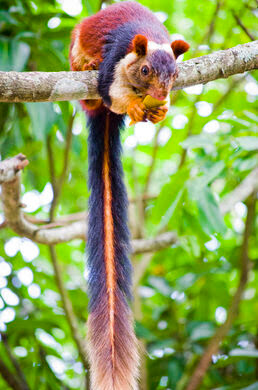
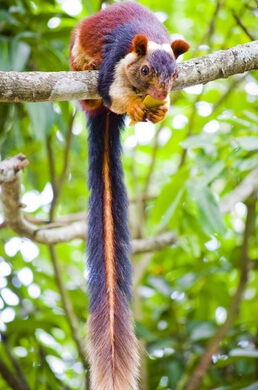
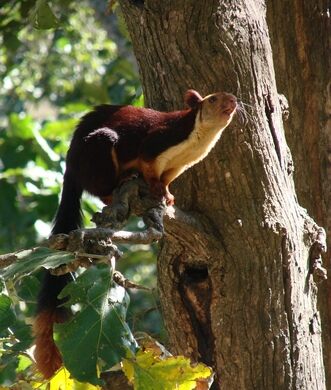
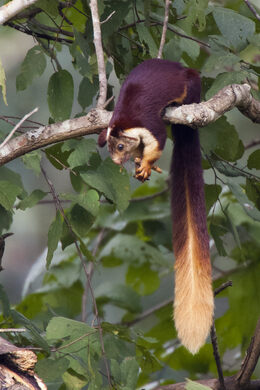
If you’re passing below a thick tree canopy in peninsular India and happen to hear a scurrying above you, be sure to look up. You might catch a glimpse of a striking squirrel whose fur appears to have been hand-painted with splashes of brown, orange, maroon, and black.

Meet the Malabar giant squirrel, which boasts an all-natural technicolor coat. Also known as shekru, these bright, bushy beauties, which are endemic to India, stretch as much as three feet long—much longer than the eastern gray squirrel and other svelter counterparts. 

The patchwork fur may help the squirrels hide up in the sun-speckled canopy, which would be an advantage, because they spend most of their lives up there, scampering among the branches and nibbling on flowers, bark, seeds, insects, and bird eggs. Their feathery, charcoal-colored tails help them balance while they teeter on narrow branches or hang straight down to feast. High above the forest floor, they’re out of many predators’ reach—but if they are startled, though (say, by one of their winged predators, like the crested serpent eagle), they plop down flush against the branches, as though trying to melt into them.

The cute critter is the state animal of Maharashtra—and if you’re setting out to spot some, your best bet will be in that region’s Bhimashankar Wildlife Sanctuary, tucked among the green, rolling Western Ghats mountain range.

The site is also home to one of India’s 12 jyortirlingas, or shrines, dedicated to the god Shiva. Devotees often flock to the temple during monsoon season—an especially wild time to trek through hills tangled with dense, fog-cloaked forests, and dip a toe into the pools at the base of waterfalls. 


 The sanctuary was established in the 1980s and has seen the squirrel population grow since. The animals have popped up on endangered species lists, but a census of the furry residents found that their numbers climbed by eight percent in the sanctuary between 2015 and 2016. Researchers surveyed squirrel nests in the nearby mango, coconut palm, and jamun trees and estimated that there were 2,145 individuals bedding down in the branches there. Each squirrel may build as many as eight nests; in 2017, the sanctuary’s census counts more than 22,000 of them. 


 As an extra boost to the animal’s numbers in the wild, the Rajiv Gandhi Zoological Park and Research Centre launched a breeding effort in July 2018. Soon, there may be more of these colorful creatures than ever. 

Clancy's comment: These are one of my favourite animals, but they are very hard to photograph.

I'm ...


22 August 2021 - BABY ELEPHANT SAVED BY TRAIN PASSENGERS IN INDIA


BABY ELEPHANT SAVED BY

 TRAIN PASSENGERS IN INDIA


G'day folks,

When you aren’t typically surrounded by wild animals, you don’t think too much about the hazards they probably encounter every day. This can include predators looking for their next meal, humans looking to cash in on their valuable body parts, but what about road hazards? 

 That’s exactly what happened in this story. This cute little elephant was walking with his herd when he slipped and fell into an embankment under a railroad track in Assam, India. Thankfully, the train came to a halt and dozens of passengers leaped out to help pull him to safety.


The little elephant had been trying to keep up with its herd when it slipped on the crumbling rail track.

 Thankfully dozens of passengers stopped to lend a hand as he became submerged in mud. He continued to sink, but they were determined to help.

 The animal appeared scared at the predicament it faced but, but fortunately the situation was happily resolved. The baby elephant was able to be rescued and reunited with its herd.


Clancy's comment: A happy end to this story.

I'm ...


28 July 2021 - CHIKILIDAE - NEW AMPHIBIAN DISCOVERED IN INDIA


CHIKILIDAE - NEW AMPHIBIAN 

DISCOVERED IN INDIA


G'day folks,

An entirely new family of limbless amphibians was discovered in northeastern India in 2012. 
 
Part of the caecilian order of amphibians, these creatures look more like earthworms than frogs or toads because of the inexistence of limbs in their bodies. These amphibians, christened Chikilidae, build underground nests and can grow to be more than a meter (3.2 foot) in length. 
 

DNA analysis of the specimens found that their closest relatives are the Herpelidae in Africa, from which they deflected about 140 million years ago. The discovery of the Chikilidae is a great step in understanding amphibian evolution.

 
Clancy's comment: Another survivor.

I'm ...


26 December 2020 - THE STUNNING AJANTA CAVES IN INDIA


THE STUNNING AJANTA

 CAVES IN INDIA


G'day folks,

According to archaeologists, construction of the Ajanta caves in Maharashtra, India, began about 2,200 years ago. 


Over hundreds of years of work and more than 30 monuments were laboriously cut into the rock face of the mountains. According to speculation, the use of the caves stopped around 1000 AD for unknown reasons, letting a thick jungle canopy grow around them, hiding them away for many generations.

No human eye saw the caves again until centuries later, in 1819 when an Englishman by the name of John Smith was hunting a tiger and he discovered a hidden doorway to one of the temples. We know this because he unfortunately left his name on the wall of the temple - and a date, which can still be seen today.


But although that first English discoverer did not go immediately public with his discovery, the existence of the caves became known, and soon after Indian and European tourists started pouring into the ancient site - after much digging and cleaning that is (the caves were home to many species of animals for centuries).


Experts have dated the caves from the second century BC - 200 years before the birth of Christ. Their function seems to be ritualistic, used as prayer halls. Much use of Roman design is evident in the columns and arches of the caves. The hard rock face of the caves was apparently chiseled with rough tools and even bare hands.


Almost every surface but the floor is covered in paintings - literally. They have lost much of their former glory, of course, but efforts are being made to restore them. Poems are also painted on the walls - 547 of them - which tell stories of Buddha's previous lives.


Clancy's comment: Looking at the type of rock, this would have been a massive project.

I'm ...