Showing posts with label BLOGGER. Show all posts

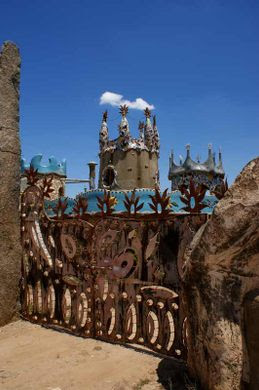
22 February 2023 - SPANISH ARTIST BUILDS CASTLE


 SPANISH ARTIST 

BUILDS CASTLE


G'day folks,

 People spend their whole lives looking for whatever it is that makes a perfect home. For some, it’s as simple as a walk-in closet or space in the yard for an herb garden that looks just so. For others, nothing can compare to grandiose dreams of a seaside villa or a mountain chalet. Not so for Francisco Gonzalez Grajera.

Francisco Gonzalez Grajera was an artist and he did not want a normal home.


So Francisco set about building something special, with his bare hands, that would satisfy his creativity both while he lived there and while he built it. Before long, he had created a startlingly unique estate – one that fits right in with the whimsical outsider art sculpture house of Peter Buchs, or Ed Leedskalnin’s coral castle.

Clad in elaborate mosaics built in the trencadis style of broken tiles, the house of Francisco Gonzalez is a sprawling castle-shaped villa, flanked with towering ramparts and spires made to look like the points of a massive royal crown. Tourists now drop by the Gonzalez home, still a private residence, just to see the odd house the locals always talk about.

If you were to speak to Francisco himself, he would tell you there’s nothing odd about this place. To Francisco, it’s just home.


10 February 2023 - THE MAGNIFICENT IRON HOLE


THE MAGNIFICENT 

IRON HOLE


G'day folks,

At the centre of an island in the middle of the Indian Ocean is a deep chasm ringed by tall waterfalls. 

RĂ©union is an island in the Indian Ocean, sandwiched between Madagascar and Mauritius, a thousand miles from the east coast of Africa. Despite its remote location, as a “department” of France it’s actually part of the Eurozone, and with nearly a million inhabitants and some of the lushest and most magical landscapes in the world, the volcanic outpost has a robust tourist industry.


Tourism in the area centers around the coastal regions of RĂ©union, but at the island’s center is one of its most extraordinary sites, a canyon that reaches nearly a quarter mile (300 meters) into the Earth, ringed by a chorus of six tall waterfalls. Trou de Fer (the “Iron Hole”) is a collapsed crater of an ancient volcano, fed by bubbling rivers and streams, but dangerous to descend.

So rugged is the terrain at Trou de Fer, and so rain-soaked most of the year, the deep chasm wasn’t fully explored until 1989. Not that climbers hadn’t tried to reach its depths—they just never made it back out. Today it is a relatively easy hike to get there, just a couple of miles of well-groomed trails with a viewing platform at the end. From the high vantage point, you can see the surrounding mountains, tropical forests, and all the waterfalls that make their way to the bottom. 

4 February 2023 - THE RESULTS OF FEUDING BROTHERS - LEBANON


THE RESULTS OF 
FEUDING BROTHERS
 - LEBANON -

G'day folks,

Beirut's thinnest building was the result of feuding brothers. 

A sliver-thin house in Beirut, built in 1954, is the ultimate display of how deep sibling annoyance can go. Known as The Grudge, or Al Ba’sa in Arabic, the house is just a bit over 13 feet at its widest point, and just around 2 feet at its narrowest.

At a side view, the “house” built of brotherly spite looks more like a wall than a place to live. But despite its narrow dimensions, Al Ba’sa is habitable, and is the skinniest building in the city. 

As the story goes, two brothers inherited land from their father. They couldn’t decide how to split the land between them, a dispute complicated further by the fact that one part of the property had been cut over the years by various municipal infrastructure projects, leaving a portion of the land a small and sort of odd shape. 


One brother decided to take that small, oddly shaped bit of land and build on it, constructing a building that fit the confines of the land with the added bonus of blocking his brother’s ocean view. Not only would his brother not be able to enjoy his spectacular sea view, but because he was now facing what was essentially a wall his property values would sink, too. The perfect plan.

Over the years, there have been some tenants in the house that sibling rivalry built. Each floor of the structure contains two apartments. For years, one was in use as a brothel, while the others served as refuge for a family fleeing the war.

Today the house stands as a reminder of a long-ago feud, and it probably will for a very long time; current city zoning laws state that the plot of land the house sits on is too small to build on. If The Grudge comes down, nothing else can be put in its place, making the land more profitable with the house than without it. As architect Sandra Rishani pointed out in her essay on the house, Al Ba’sa “continues to exist grudgingly and also defiantly in one of Beirut’s most prime locations, only time will tell what will become of it.”


5 February 2023 - WORLD'S TALLEST SOLAR TOWER - ISRAEL


WORLD'S TALLEST 

SOLAR TOWER 

- ISRAEL -


G'day folks,

Deep in the Negev Desert, the world's tallest solar tower looks like it's straight out of a science fiction comic. 

Thanks to drip irrigation, the roads to Be’er Sheva in Israel are fringed with fields that were once barren. A simple system of water-carrying pipes have transformed the Negev Desert into productive agricultural land. But a newer addition just south of Be’er Sheva, transforms the desert into something more akin to a science fiction movie.


The first sign of something unusual ahead appears just after you leave the city limits. If you look carefully, you’ll notice a pale orange flame floating just above the horizon. As you get closer, a tall dark tower appears, its pinnacle glowing as bright as the sun. Light radiates towards the ground, seeming like sunbeams. This is the Ashalim Power Station.

Opened in September 2019, Ashalim is the tallest solar power station in the world, standing 260 meters (853 feet) tall. Ashalim Power Station uses an array of 56,000 solar panels known as heliostats arranged around the tower to reflect sunlight onto the pinnacle. The heliostats are computer-controlled and follow the sun as it moves from east to west through the day.

From the barren hilltops surrounding the station, the tower and the heliostats look like a scene from a futuristic story. The system produces enough clean energy to power 120,000 homes, about five percent of all homes in Israel. And development at the power station is still ongoing. While electricity production has already started, further plans will allow Ashalim Power Station to combine solar thermal energy, photovoltaic energy, and natural gas.

13 January 2023 - MAYMAND - ANCIENT CAVE VILLAGE - IRAN


MAYMAND

 - ANCIENT CAVE VILLAGE -

- IRAN -


G'day folks,

This 12,000 year old Iranian cave village has been continuously inhabited for over 3,000 years. 

From an American point of view, where very few settlements have been around for more than a few hundred years, its hard to fathom just how long a village like Maymand in Iran (which is thought to have been established around 12,000 years ago) has been around. But the still inhabited cave dwellings help.


The staggering age of the settlement at Maymand was determined by fragments of stone etchings that established the existence of human settlers. However the defining characteristic of the village, namely its 300+ in-ground cave homes are not nearly so old, only dating back 3-4,000 years. It is thought that the cave dwellings began as religious sites, but slowly evolved into permanent houses as settlers stayed on the spot longer and longer. As the locals tell it, their ancestors carved out the simple cave homes using a type of hard, sharpened stone that can be found in the area as opposed to traditional tools. The single room dwellings are stacked atop one another four and five tall sometimes, yet each of the barren caves has room for its own stove area. 


Miraculously for such an ancient and stark settlement, the array of caves that make up the village are still inhabited today. Some of the homes are thought to have been continually inhabited since their creation thousands of years earlier. The population as of 2006 numbered 673, but tends to fluctuate with the seasons. The caves may have a sort of barren beauty, but they are not exactly luxury accommodations. 

Iran is a country rich in history, and the village of Maymand is one of the oldest places there, as well as one of the most beautiful.

2 January 2023 - THE SAD TALE of CHATEAU LAURIER - OTTAWA


THE SAD TALE 

of 

CHATEAU LAURIER 

- OTTAWA -


G'day folks,

The mastermind behind this palatial hotel perished on the Titanic weeks before its grand opening. 

With its elegant turrets and enormous size, this riverside hotel looks like it could double as some sort of fairytale castle perched atop a European hillside. The nearby canal even makes it seem as though a moat surrounds part of what could easily be mistaken as a stoic fortress.

The architectural beauty isn’t a palace at all, though it has had a few brushes with royalty. Many famous figures, prime ministers, and royalty from around the world have stayed within this 429-room hotel.


Its insides reveal early 20th-century hand-moulded plaster decorations, original Tiffany stained-glass windows, and walls made with the finest Indiana limestone. When it first opened in 1912, a private room cost a whopping $2 per night.

Yet despite the hotel’s grandeur, its story is tinged with sadness. The palatial ChĂ¢teau Laurier was commissioned by Charles Melville Hays, American millionaire, philanthropist, and president of the (now long-bankrupt) Grand Trunk Railway System. But unfortunately for Hays, he died before he could see the hotel’s grand opening.


Hays, anxious to return from London to Ottawa for the ChĂ¢teau’s big opening, booked a ticket on the famously ill-fated RMS Titanic. Strangely, he reportedly prophesied an “appalling disaster” on the very night the ship collided with the iceberg and met its demise. Hays sadly perished when the ship sank.

Notably, the ChĂ¢teau has a second connection to the Titanic. Hays commissioned French sculptor, Paul ChevrĂ©, to create a bust of prime minister Sir Wilfrid Laurier for the hotel’s official opening. The bust, still located in the hotel foyer today, was transported aboard another ship, La Bretagne. ChevrĂ© and Hays boarded the Titanic, but unlike Hays, ChevrĂ© survived the sinking.

17 January 2023 - PHNOM PENH MEMORIAL STUPA - CAMBODIA


PHNOM PENH 

MEMORIAL STUPA  

- CAMBODIA - 


G'day folks,

Here, 5,000 skulls are in memorial to those who were killed by the Khmer Rouge. 

After the Cambodian Civil War ended, the vicious rule of Pol Pot and the Khmer Rouge began.

From 1975-1979, they killed 1.7 million people out of a population of 8 million. Many of those murdered were buried in mass graves in what has come to be dubbed the “killing fields.”


In Phnom Penh at Choeung Ek, a memorial was erected to remember those who were killed at the hands of the Khmer Rouge. At the site, the remains of an estimated 10,000 people were found. The memorial was then constructed so as not to obscure the facts, but to show the grisly and honest truth.

Designed in the style of a Buddhist stupa, the Choeung Ek memorial has glass sides, and is comprised of multiple layers of human skulls. Totaling 5,000 of those executed at the site, the skulls are a harsh reminder of a genocide that took place only 40 years ago. The memorial is particularly disturbing upon closer examination of the skulls, many of which bear marks of the trauma they suffered before their execution.

Along with the stupa, Choeung Ek still has a number of pits that were used as mass graves, and some human bones can still be seen in the area. The Cambodian government encourages visitors to see the site, and never forget the atrocities committed during the Khmer Rouge regime.


9 October 2022 - SECRET WW11 HOME OF THE BBC


SECRET WW11 

HOME OF THE BBC


G'day folks,

This abandoned funicular tunnel was a secret base for the BBC during World War II. 

There’s a secret hiding in the rocks lining the road that runs along the River Avon. There, tucked behind a gate, is an abandoned Victorian-era funicular tunnel that served as a clandestine sanctuary during World War II.

The underground funicular opened in March of 1893. It was the work of an entrepreneur named George Newnes, who hatched a plan to build a luxurious spa atop the gorge. He decided to construct the railroad to link the spa with the port down below.


The town let Newnes complete his plan, but there were a few conditions. The funicular had to be underground, so as not to spoil the picturesque scenery. It also needed secret entrances and exits to keep commoners separated from the hotel guests.

Unfortunately for the railroad, its working days were short-lived. By the 1920s, automobiles rendered it largely unnecessary. The last rail journey took place in 1934, and the secluded funicular seemed doomed to fade into obsoleteness.

But World War II changed all that. Locals took refuge from bombs in the upper parts of the tunnel. The BBC set up camp in the lower chamber, using it as a place to house its Symphony Orchestra. The BBC also constructed an emergency studio within the bowels of the tunnel network, though the air raids stopped before it was ever put to proper use.

The BBC kept the studio even after World War II ended, considering it a backup option during the Cold War. However, the organization moved out in 1960, and the tunnel was abandoned once again.

In 2008, a volunteer group set to work restoring the tunnel. Rocks, broken bottles, shoes, and other remnants from its bomb shelter days litter the space. The rusted train tracks still stretch throughout the tunnel, though they’ll likely never be used again.


1 January 2023 - NUCLEAR BUNKER MUSEUM - PRAGUE


NUCLEAR BUNKER 

MUSEUM 

- PRAGUE -


G'day folks,

Buried five stories underground, this Soviet bunker is packed with gas masks and Cold War paraphernalia.  

Behind an unassuming graffitied wall is an old Soviet bunker which today evokes the paranoia and violence of the Cold War years.

A civilian bunker lies buried five stories beneath Prague’s decrepit Parukarka hill, a product of the fear of nuclear armageddon that penetrated the masses during the Cold War. Though both sides of the Iron curtain became obsessed with preparing for the possibility of a nuclear war, such bunkers were constructed with more frequency in the Eastern Bloc, as communist economies fully focused their resources on defense and army structures.


This bunker was not designed to house its inhabitants for decades, or even for years. Studies at the time found that there were many psychological risks associated with keeping people within the bunkers for extended periods of time, such as suicide and mass panic. So instead, the civilian bunker in Parukarka park was meant to save civilians from immediate death in face of nuclear explosions, and the idea was that they would evacuate to the countryside soon thereafter.

Today, you can explore the remnants of Soviet era paranoia on a two-hour-long guided tour, which takes you through some of the communist spots in Prague’s Old Town and ends in the nuclear bunker. The museum within the bunker serves as a snapshot of Soviet life, and in addition to the requisite dozens of gas masks, contains books, newspapers and photographs from the time.


5 January 2023 - MASS GRAVES FOR 1928 HURRICANE VICTIMS - FLORIDA


 MASS GRAVES FOR 1928

 HURRICANE VICTIMS 

- FLORIDA  -


G'day folks,

This mass grave for victims of a massive hurricane remained hidden until 1991.  

When a hurricane struck the Florida coast in September 1928, it caused a dike on Lake Okeechobee to fail which resulted in an extensive loss of human life.

Of the victims in Palm Beach County, most of the White victims were buried in a mass grave in the prestigious Woodlawn Cemetery. However, segregation laws at the time prevented the burial of Black residents in that cemetery. More than 600 people of color were interred in a mass grave at the Paupers Graveyard at the corner of Tamarind Avenue and 25th Street.


While the mass grave at Woodlawn was marked with a memorial, the Tamarind Avenue site was largely forgotten until 1991, when a Nigerian religious service was held at the location. The site had passed through various owners over the years and was used as a garbage dump, slaughterhouse, and sewage treatment works.

The City of West Palm Beach purchased the land in 2000, and in 2003, a state historical marker was put in place by the city for the 75th anniversary of the storm. 

30 December 2022 - IRRIGATION CHANELS BUILT INTO MOUNTAINS


 IRRIGATION CHANELS

 BUILT INTO MOUNTAINS


G'day folks,

Medieval irrigation channels built into the sides of mountains provided Valais with water for hundreds of years.  

Some of the best places to hike in the state of Valais in Switzerland are ancient pathways that once used to bring water down from mountain streams to farms in the valleys and meadows below.


The creation of these channels, known as bisses, goes back at least as far as the 14th century, though some believe those medieval routes were built where Roman channels had previously been. In the aftermath of the Black Death in the mid-1300s, with a significantly reduced population across Europe, the grain fields in Valais were repurposed to grow hay to raise cattle for the rising demand of beef across the border in Italy.


Owners of the fields and pastures pooled their resources to build bisses for irrigation, which was more necessary than it had been for growing grain. A lot of resources were needed, since many of the bisses were built into the sides of mountains and cliffs, which made digging them particularly dangerous hundreds of years ago. They tended to be between 5 and 10 kilometers, though a few stretched more than 20 kilometers.

Over time, they came to be used by vineyards and orchards in the area as well. Those more wealthy landowners, who controlled the water supply, arranged for systems allowing the use of the water by the smaller farmers. The smaller farmers and their families, in turn, helped maintain the bisses, cleaning and repairing them every spring. Canal guards, who lived in cabins along the channels, kept regular watch over the flow of water, making sure it was not interrupted.

For the most part, the bisses that remain have become scenic tourist attractions and inspired hiking trails, though some are still in use. Some of the trails run alongside the bisses, but others are the bisses themselves, repaired and reinforced. Le MusĂ©e des Bisses offers a convenient itinerary of some of the most spectacular bisse-adjacent trails, the bisse of Sion, the bisse ‘Ayent, and the Bitailla, in addition to exhibits on the history of the Valais bisses.