Showing posts with label CANALS. Show all posts

13 October 2022 - EDSTONE AQUEDUCT - ENGLAND


EDSTONE AQUEDUCT 

- ENGLAND -


G'day folks,

The longest canal aqueduct in England was built without a plan to get water past the moving boats. 

Built in 1816 to carry the Stratford-upon-Avon Canal, the Edstone Aqueduct is the longest canal aqueduct in England (although there are longer ones in both Scotland and Wales and a number of higher ones too). It is 475 feet long and 33 feet high at its highest point. The engineer was William Whitmore.

It crosses a minor road, a stream, a live railway line (formerly the Birmingham, North Warwickshire and Stratford Railway) and a disused railway line (the former Alcester railway later taken into the Great Western Railway). Both railways lines post date the aqueduct by many years and took advantage of the existing structure.


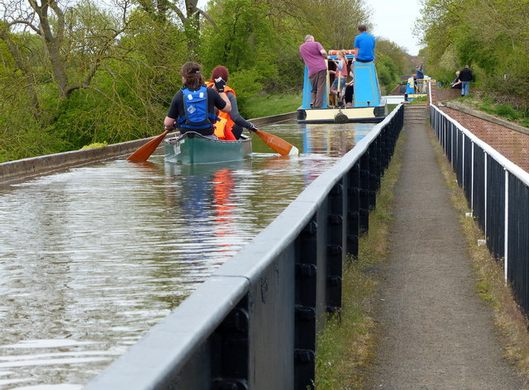


The canal is carried in iron troughs supported on  brick pillars. The troughs were constructed by bolting together 14-foot by five-foot flanged cast iron plates. It is possible to walk across the aqueduct on the towpath which has parapet alongside it (and is at the level of the base of the trough) but if on a boat there is no parapet on the canal side and the water comes very close to the top of the trough. The trough is too narrow to allow boats to pass without building up a bow wave in front and for horse drawn boats this created a distinct barrier to the passage across the viaduct. Later cast iron viaduct designs benefited from the experience of this example.

There are two more similar, but shorter, iron trough type aqueducts on this four-mile stretch of the canal. The Great Western Railway owned the aqueduct for a time and they fitted a pipe to the trough to allow water to be withdrawn to fill up steam locomotives below.

16 October 2022 - DICK'S LANE SPLIT BRIDGE - ENGLAND


DICK'S LANE 

SPLIT BRIDGE 

- ENGLAND -


G'day folks,

Here is a great example of the inventive canal bridges that were deliberately split down the middle. 

When the South Stratford Canal was being built between 1813 and 1816, financial difficulties resulted in some innovative cost-saving measures. Among these were the characteristic split bridges.


These were made of cast iron and two separate cantilevered decks projected from each side of the canal, from brick and stone abutments. A narrow gap was left down the middle. The horse-drawn narrow boats using the canal would approach the bridge and the horse would walk round the outside while a crew member fed the tow rope down the slot in the middle. This innovative idea allowed the boat to pass without unhitching the rope.

This saved a lot of money since, as well as allowing pre-fabrication, the bridge did not have to be wide enough to have a tow path under it. These were “accommodation bridges,” built to maintain an existing right of way when the canal was built and had to be built at the expense of the canal company. They were not capable of carrying heavy loads but were adequate for their purpose.

There are several examples of this type of bridge on the South Stratford Canal. Dick’s Lane Bridge is one of the best preserved and illustrates the inventiveness of the 18th- and 19th-century canal builders.


26 July 2022 - ROVE TUNNEL - ABANDONED CANAL TUNNEL in FRANCE


ROVE TUNNEL

 - ABANDONED CANAL 

TUNNEL in FRANCE -


G'day folks,

Welcome to the longest canal tunnel in the world, abandoned in the 1960s. 

Between 1911 and 1916, the Rove Tunnel was built to link the Marseille Harbor to the Rhone River. But it wasn’t until 1926, after twenty years of work and a World War, that the tunnel was finally opened for use, surviving a little under 40 years before collapsing in 1963.


The longest canal tunnel in the world, the Rove Tunnel passes through Berre Lake (adjacent to the Mediterranean to the west of Marseille) and Martigues (a commune in the southeastern part of France, to the northwest of Marseille), and stretches about 4.5 miles in length and 72 feet in width, which, before it was closed to public use, enabled about two ships to cross inside.

Although it has been abandoned for years, a project has been launched to bring this tunnel back to life by using it as a salty water supply for the Berre Lake, which is slowly drying.


5 September 2020 - FAIRYTALE VILLAGE WITHOUT ROADS IN THE NETHERLANDS


 FAIRYTALE VILLAGE 
WITHOUT ROADS 
IN THE NETHERLANDS

G'day folks,

You are going to love this place. Nicknamed “Venice of the Netherlands”, this small town is littered with hundreds of canals and century old houses. 

The only difference between Venice and this quaint community is that you will not find a single gasoline engine here. There are no roads in Giethoorn, there isn’t a need for loud and disruptive cars. It is just a laid back community that travels on foot and when needed leisurely floats down the canal. This town is straight out of a fairy tale.


It is very quiet here in Giethoorn, the loudest noise heard is often a quacking duck or rustling bird, and all boats here are powered by electricity.  You can drift down a side street, or rather just a smaller canal, to observe a resident casually strolling through the neighborhood.


 You will float underneath several delicate wooden bridges as you observe the intricate thatched roofs of the old farm houses that make up the community.  In earlier times, tiled roofs were a sign of wealth due to thatched roofs being cheaper. Today, the exact opposite is true.Due to the lack of roads, most homes not accessible by car so the post man delivers mail via boat.


 When the canals freeze over in the winter, residents gracefully travel by ice skating in place of their dinghies.


  This fairy tale like town is located in the province of Overijssel, positioned in the east of the Netherlands. There are more than 60 miles of canals to explore making the number one tourist attraction in Giethoorn boating.


 The name Giethoorn means “the horns of goats”. The first inhabitants discovered hundreds of goat horns on the land which the community is now built on. The town was founded in 1230 by fugitives from the Mediterranean who subsequently stumbled upon vast quantities of peat moss in the ground. 


Clancy's comment: Wow. What a peaceful place. Love it!

I'm ...


9 January 2020 - HIDDEN CANAL BENEATH MANCHESTER


HIDDEN CANAL 
BENEATH MANCHESTER

G'day folks,
 An abandoned canal route lies hidden under the streets of Manchester. 

Hidden tunnels lurk beneath the streets of Manchester, England. These lost veins of transportation were once part of a much-anticipated local canal.


Opened in 1839, the Manchester and Salford Junction Canal was created to link together two of the city’s main waterways. Doing this would help speed up the transportation process, as without the canal, the cargo had to be carted via land between the Mersey and Irwell Navigation and the Rochdale Canal.


But unfortunately for the canal, its timing wasn’t quite right. It was built during the rise of the railways, which rendered it largely unnecessary not long after it opened. It was abandoned in 1922. Its ends were sealed, and parts of it were later buried beneath Great Northern Warehouse and Granada Studios 25 feet underground, drained and converted into tunnels.


These tunnels still exist, almost forgotten due to their concealed nature. During World War II, sections were converted into air raid shelters, with evidence of this history still adorning the tunnel walls to this day.


Clancy's comment: Again, we find something that was built, but then abandoned. 

I'm ...