Showing posts with label NEW YORK. Show all posts

9 February 2023 - SEISMIC STATION BELOW THE BRONX


SEISMIC STATION 
BELOW THE BRONX

G'day folks,
 
 An unassuming stone building houses New York City's oldest seismic station almost 30 feet below the Bronx.

Fordham University’s Rose Hill campus is home to the oldest seismic station in New York City, and one of the oldest in the United States. Installed in the basement of the university’s main administrative building in 1910, it continues to chart seismic activity from all over the world to this day.

The station is maintained by Fordham’s physics department, where data is transmitted to the adjacent academic building, Freeman Hall. While mainly used by the physics department, that data is available to students across several disciplines, notably environmental science.

Originally, data was gathered using a Wiechert seismograph, a precarious pendulum-dependent machine that graphed vibrations using a system of levers, kerosene-smoked paper, a weight, and a rod. It was so sensitive that in order to avoid skewing data, a horse was kept on campus to maintain the grass outside of the station instead of usual lawn-mowers.

Of course, this seismograph has since been replaced by computerized broadband seismometers, which lie in a vault nearly 30 feet below the ground, picking up trembling of the Earth’s tectonic plates and even of trains heading to Grand Central from the nearby Metro-North Fordham stop.
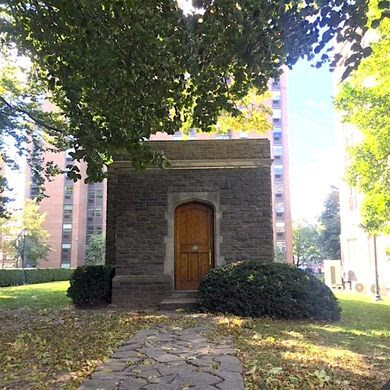


About a decade after that first basement seismograph, Fordham constructed a new seismic station using money donated by William Spain, who then named it after his son, William, a physics student of the university who died some years before. While the actual seismograph is subterranean, it is inside a small stone cottage flanked by trees and wildflowers with a stone path leading to the entrance. There is a bronze plaque of St. Emidio on the observatory’s side, the patron saint of protection against earthquakes.

Today, the William Spain Seismic Observatory, using a strong motion detector, partners with a U.S. government program to assess earthquake risk in metropolitan areas. This particular data is also streamed to a government data repository in Boulder, Colorado. Fordham is also a member of the regional Lamont Cooperative Seismic Network, which allows the 21 other seismic-observatory members across the eastern U.S. to share data and equipment like geophones and seismometers for further research projects.

10 January 2023 - BLACK GRAVEYARD HIDDEN IN NEW YORK CAR PARK


 BLACK GRAVEYARD 

HIDDEN IN 

NEW YORK CAR PARK


G'day folks,

An historic Black graveyard is hidden in the parking lot of one of America's largest malls.  

The hulking Palisades Mall is among the largest “mega malls” in the United States. The vast concrete complex opened in 1998, swiftly becoming known as one of the ugliest malls in the country. Described by the New York Times as a, “series of interlocking coffins…lacking any discernible architectural theme,” the mall would be grim enough itself, were it not for the fact that there’s a small, historic cemetery lying largely unnoticed in the parking lot.

Around 20 million shoppers descend on the Palisades Mall every year, most of whom probably have no idea they’re passing by Mount Moor Cemetery, a Black graveyard listed on the National Register for Historic Places that lies dwarfed in the shadow of the Target parking lot and a Dick’s Sporting Goods.


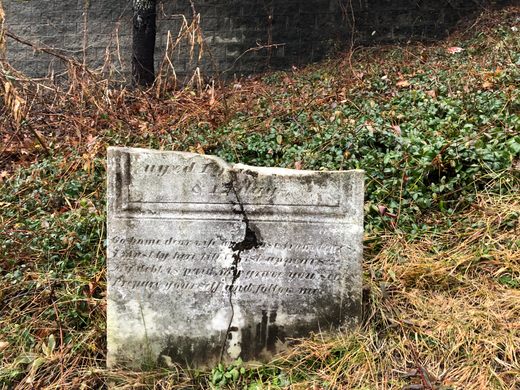
Mount Moor was deeded in July, 1849, as a “burying ground for colored people.” The sloping hill is the final resting place for around 90 Black Americans, including veterans of the Civil War, the Spanish-American War, the two World Wars and the Korean War. 

The rise of the mega mall saw many family-run stores that been had been around for generations lost for good. The landscape and social history of many small towns were paved over to make way for these concrete cathedrals to consumer capitalism. And Mount Moor,, bounded by the New York State Thruway and Routes 59 and 303, soon fell under the greedy eyes of property developers. 


When Syracuse-based Pyramid Companies announced its intention to build one of the largest malls in America, it found the small, historic cemetery right in the middle of their plans. Offers to have the graves disinterred and relocated to another cemetery were swiftly met with short shrift. A reported offer of $100,000 to sell the cemetery was rejected by the Mount Moor Cemetery Association, who work doggedly to preserve and take care of the historic site. 

The property developers were forced to build their colossus around the tiny cemetery, which today can still be found on the sloping ground overlooking the car park. It is cared for diligently by members of the association and the descendants of those buried there. 

One particular grave belongs to Lafayette Logan, who fought in the Civil War with the Massachusetts 54th Regiment, the first Black regiment mustered by the North. Immortalized in the 1989 Academy award winning film Glory, he perhaps deserves more a dignified final resting place than in the shadow of a giant Bed Bath & Beyond. 


11 August 2022 - ANOTHER ABANDONED TUBERCULOSIS HOSPITAL


ANOTHER ABANDONED

TUBERCULOSIS HOSPITAL


G'day folks,

Sadly, here is yet another beautiful building going to waste. An abandoned tuberculosis hospital moulders on into an uncertain future. 

Located behind fencing on private property in Perrysburg, New York, are the remains of the J.N. Adam Memorial Hospital. They still stand, despite having laid empty for years, yet another historic hospital site that’s too expensive to remove or rehabilitate.


The hospital was opened in 1912 by a former mayor of Buffalo, New York, James Noble Adam, who also owned the J.N. Adam & Co. department store. Its primary purpose was to treat victims of tuberculosis. This hospital was known for what was called the “Sun cure,” or “heliotherapy.” This involved relying on the rays from the Sun to help cure the patients of their disease. 

In 1960, the hospital was converted from a tuberculosis hospital into an institutional mental facility. It finally closed its doors for good in 1993 and has not been reopened since. Officials have looked into tearing down or refurbishing the remaining structures at the site, but since both options would cost millions of dollars to implement, no one has been willing to pay, and the site continues to deteriorate.


4 July 2022 - THE 1929 WALL STREET CRASH


THE 1929 WALL

 STREET CRASH


G'day folks,

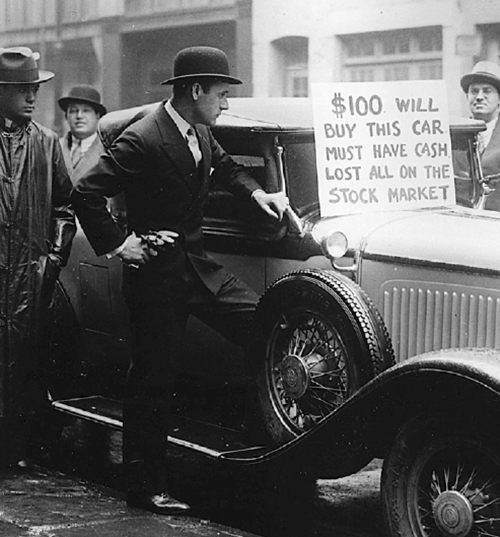
A record 12,894,650 shares were sold on  October 24 1929,  as panic gripped the Wall Street stock market in New York. It was to be known as Black Thursday, but far worse was to come.

On October 28 the market went into freefall with losses as high as $5billion being reported. The next day – Black Tuesday – prices completely collapsed amid panic selling, triggering losses of between $10-$15billion. Millions of Americans saw their life savings disappear.

Prices continued to drop, leading to losses of a staggering $30billion by mid-November. The market hit rock bottom on November 23 after which prices began to stabilise, meaning that at last the 1929 Wall Street crash was over. But it took 23 years for the market to recover.

It all came about after a huge economic boom enjoyed during the “Roaring Twenties” and the “Jazz Age.” It was a time of “spend, spend, spend” bolstered by easy credit schemes and widespread borrowing by consumers.

It was also a time of “live now, pay later” and the stock market was no exception. Brokers encouraged buying shares “on margin”, which meant using borrowed money.

As a result, Wall Street saw an extended period of rising share prices, known as the Long Bull Market.

Inevitably, the chickens came home to roost as the economy began to contract. Professional investors then started to sell, causing prices slowly to fall. As they saw what was happening smaller investors, concerned about paying off their loans, also began to sell. So prices on the market fell even further, generating rising panic that led to the Wall Street Crash.

In turn, this brought about the Great Depression with numerous bank closures, mass unemployment, homelessness, hunger and despair for millions of Americans. Peaking in 1933, it would last for ten years until the Second World War broke out in 1939.

This was not the first time that Wall Street had been plunged into turmoil. The first crash of the New York Stock Exchange, known as the Panic of 1901, was caused by a fight for control of the Northern Pacific Railroad. As businessmen E.H. Harriman and James J. Hill battled for the firm, stocks in dozens of other rail companies tumbled, eventually dragging down the whole market.


There were further Wall Street crashes in 1907, 1937, 1962, 1987, 1989, 1997, 2000, 2002, 2007, 2008, 2010, 2015 and, of course, the worldwide market slump caused by the coronavirus COVID-19 in 2020.

Long before any of these, the first recorded financial crash came in 1637 when Tulip Mania reached its climax in Holland.

The first tulip bulb was imported into Holland from Turkey in 1593 and after a few years they became a status symbol for the country’s upper classes.

As demand grew, so did the prices and people began to buy and sell tulip bulbs just to make money. As stories spread of huge profits to be made, more and more people jumped on the bandwagon causing the prices to skyrocket.

In 1633, a single bulb of Semper Augustus was selling for an unbelievable 5,500 guilders (about $3,000). By the first month of 1637, this had doubled to 10,000 guilders. Historian Mike Dash in his 1999 book, Tulipomania: The Story of the World’s Most Coveted Flower and the Extraordinary Passions It Aroused, puts this sum in context:

“It was enough to feed, clothe and house a whole Dutch family for half a lifetime, or sufficient to purchase one of the grandest homes on the most fashionable canal in Amsterdam for cash, complete with a coach house and an 80ft (25m) garden – and this at a time when homes in that city were as expensive as property anywhere in the world.”

The buying and selling of bulbs usually took place in taverns but the trading disappeared almost overnight in February, 1637. Most speculators could no longer afford to purchase even the cheapest bulbs and an auction had failed to produce any buyers.

As doubts grew that the prices were sustainable demand disappeared and the bulbs tumbled to a tenth of their former values. Fear and panic spread quickly, causing the bubble to burst in just a few days.

The tulip bulb crash threw the Dutch economy into economic depression that lasted for many years.

28 June 2022 - THE MYSTERIOUS BOOKSHOP in MANHATTAN


THE MYSTERIOUS 

BOOKSHOP in MANHATTAN


G'day folks,

The world’s oldest and biggest bookstore stocking only mystery, crime fiction, espionage, and thrillers. 

Mysteries have always been around and always been popular, but they haven’t always been respected. Otto Penzler has had a significant hand in that transformation. He’s probably the most important figure in the history of mystery fiction who’s never written a mystery story. 

You get into Otto Penzler’s New York office through a door in the Mysterious Bookshop, the world’s oldest and biggest bookstore focusing on mystery, crime fiction, espionage, and thrillers. The door is roped off with a big X made of yellow police tape reading CRIME SCENE DO NOT CROSS. Down a flight of stairs, his office is a low-ceilinged basement cube with floor-to-ceiling bookshelves on all four sides, stocked with anthologies and first editions as well as a random sampling of mass-market hardcovers and paperbacks. If the office was a store by itself, it would be the second-best mystery bookstore in the world. 

Penzler is the owner of the Mysterious Bookshop (founded 1979) as well as The Mysterious Press, a publishing imprint he founded in 1975, and mysteriouspress.com, his ebook publisher. He has published most of the greats of mystery and crime fiction: Raymond Chandler, James M. Cain, James Ellroy, Ross Thomas, Patricia Highsmith, Ross Macdonald, Ed McBain. Any of the major authors he hasn’t published are probably at least good friends of his.


The Mysterious Bookshop itself. Today the store is down in Tribeca, on a block that doesn’t suggest anything important in the literary world. It’s next to a Le Pain Quotidien and a few doors down from a 7-Eleven. (It was first located on 56th Street in Manhattan, in a building Penzler owned because it was cheaper to buy—New York was different back then.) 


Inside, every square inch of walls leading up to what must be 20-foot ceilings are packed with any book in which someone violently dies. There is an entire section for Sherlock Holmes books, including the many spinoffs written by dozens of authors. There are copies of long-defunct detective magazines like Black Mask. There is an entire section for what Penzler calls bibliomysteries—mystery books involving mysterious books. Murdered librarians, valuable manuscripts, that kind of thing.

The bookstore is not twee. There are no props, aside from the caution tape; no pranks, no cute designs or artworks. This is a temple to the noble mystery, a place where people who can name all of Donald E. Westlake’s pseudonyms talk about one of the most enduring genres in the history of literature.


30 June 2022 - TUNNEL NUMBER 3 - MANHATTAN, NEW YORK


TUNNEL NUMBER 3

 - MANHATTAN, NEW YORK -


G'day folks,

Deep under Manhattan is the largest construction project in city history. So far, the project has taken the lives of 23 workers, or "a man a mile." 

The state of New York began digging this tunnel in 1970 to provide water to the city from its upstate source.

When completed, the tunnel will be over 60 miles long, snaking across the city from Yonkers across Central Park, the East River and Roosevelt Island and ending up in Astoria, Queens. 


The construction project costed over $6 billion and was not finished until 2020. The costs for the ambitious project have already been high with 23 workers losing their lives to the tunnel, averaging about one life each mile.


14 June 2022 - PARKSVILLE , NEW YORK - ONCE A THRIVING COMMUNITY


PARKSVILLE , NEW YORK 

- ONCE A THRIVING COMMUNITY -


G'day folks,

This Central New York ghost town was once a prosperous railroad community.  

Located in the town of Liberty, New York, Parksville garnered substantial attention at the turn of the 20th century with the establishment of The Ontario & Western Railway (O&W). The O&W provided easy and direct transportation to the picturesque Catskill region, where the industry was booming and tycoons were building stately summer homes and hotels.

What was once a peaceful village became a bustling destination lined with high-end resorts and covetable shopping. But patrons would eventually lose interest in the O&W railroad in favor of the Hamptons and the Jersey Shore. Today, visitors to Parksville will find a quiet, withered town of mostly abandoned buildings.

Parksville’s origins can be traced back to the early 19th century when pioneering families from the New England area migrated to Sullivan County, New York. Among the earliest settlers was William Parks, who kickstarted the town’s industry by building mills and cultivating a community. Though Parks and his family were not the first to migrate to the hamlet since named Parksville—the Parksville Planning Committee lists Martin and Eber Hall as the first to have arrived—Parks’ lasting influence on the area bestowed on him the honor of the derivative name, Parksville.

Parksville attracted new residents who would continue to develop business in the region and form a small but prosperous community of merchants and mill workers. From the 19th and into the 20th century, the O&W railway line would facilitate the popularity and growth of the Catskills on a large scale, and until the Great Depression, Parksville was a preferred summer destination for city dwellers in search of a peaceful country escape. 


Soon, Parksville would no longer be so peaceful. More than 100 hotels and resorts were built, and so many visitors flocked to Parksville that traffic jams in the town center were a regular sight. A number of the hotels closed their doors in the aftermath of the Great Depression, but the largest resorts—the Young’s Gap Hotel, the Prospect Inn, and the Grand Hotel, amongst a few others—remained in operation. In fact, the Young’s Gap, a beloved Parksville mainstay, would remain open into the 1960s, even through a steep decline in tourism with the steadily decreasing popularity of the O&W railway.

Route 17, a new highway that directed traffic through town, would briefly pique renewed interest in Parksville. In the late 80s and 90s, a group of local business owners tried to revive the town with a scattering of cafés, restaurants, and shops, but their success was short-lived. Route 17 became Interstate 86 which rerouted vehicles out of Parksville, so travelers had to make the town a pointed destination rather than it being an impromptu pitstop on their way through.

Today, Parksville is all but abandoned. While none of the original hotels, restaurants, or shops that once adorned the streets are still open, passersby can pay their respects to William Parks and his family, who are buried in the 19th century Baptist Church Cemetery. 


Update as of December 2020: A restoration effort is underway at the site. 

12 June 2022 - THE SITE OF THE WOODSTOCK FESTIVAL


THE SITE OF THE 

WOODSTOCK FESTIVAL


G'day folks,

Welcome to the dairy farm in upstate New York where nearly half a million people gathered for three days of peace and music in 1969. 

On August 15th, 16th, and 17th, 1969, an estimated 450,000 people from all over America descended on Max Yasgur’s 600-acre dairy farm in Bethel, New York, for the Woodstock Music and Art Fair. The festival was billed as “An Aquarian Exposition in White Lake, NY: 3 Days of Peace & Music.” 

It is hard to overstate Woodstock’s legend. It has gone down in history for its epic musical performances, the mind-blowing size of the audience, countless logistical and technical challenges, traffic jams, drugs, rain, mud, occasional nudity, and the hippie ideals of peace and love. It was, above all, a joyful celebration that stands as the defining moment of the 1960s counterculture generation.


For those three days, some of the greatest musicians in the country descended upon this rural Catskills town (and notably not the town of Woodstock, New York, located nearby.) They included Richie Havens, Sweetwater, Tim Hardin, Ravi Shankar, Arlo Guthrie, Joan Baez, Carlos Santana, the Grateful Dead, Creedence Clearwater Revival, Janis Joplin, Sly and the Family Stone, The Who, Jefferson Airplane, Joe Cocker, The Band, Blood, Sweat and Tears, Crosby, Stills, Nash & Young, Sha Na Na, Jimi Hendrix, and many more.

Today, the historic music festival is marked with a small monument that offers a panoramic view of the original festival site. The site is adjacent to the Bethel Woods Center for the Arts, which contains the Museum at Bethel Woods, which features displays and artifacts related to the Woodstock festival and the 1960s counterculture that it came to represent.


Clancy's comment: Ah, those were the days ...

I'm ...