Showing posts with label TRANSPORT. Show all posts

29 July 2022 - RIFLE SIGHT NOTCH - COLORADO


RIFLE SIGHT NOTCH 

- COLORADO -


G'day folks,

 This old train trestle and collapsed tunnel once allowed the railroad to negotiate the steep slopes of the Colorado Rockies. 

Colorado’s mountains do not lend themselves well to the building of railroads. Due to the limitation of grade, engineers had to develop novel approaches for getting trains up and down steep canyons and high mountains. This often involved building trestles and digging tunnels, or combining both to make what was known as a loop. 


By passing the tracks across a high trestle traversing a narrow gap, gradually spiraling around the mountain then back under the trestle to complete the loop, the trains could navigate the high elevation of the Rocky Mountains. One of the few remaining examples of such a loop is the Rifle Sight Notch on the Rollins Pass route near Winter Park.

Looping around Spruce mountain, the route passes over Tunnel 33 on a 3-mile loop at a 2.5 percent grade, rather than take a 2-mile route that is more direct but includes 8 percent grades that are impossible for trains to negotiate. The loop allowed the train to gain or lose 175 feet of elevation per mile. Yet even with this gentle grade, trains managed to fall off the tracks with frightening regularity on this section of the Moffat Road. Evidence of at least two wrecks can still be found on the western approach to Tunnel 33.

From the pass, the trestle looks like the notch in a rifle sight, which is how it got its name. The tunnel under the trestle caved in following the closure of the route in 1928. The trestle—one of only three left on the Moffat Road—is unstable, but it remains as a testament to the engineering know-how needed to cross Colorado’s rugged mountains.


21 July 2022 - DEVIL'S SLIDE TRESTLES - COLORADO


DEVIL'S SLIDE TRESTLES 

- COLORADO -


G'day folks,

These decaying bridges 1,000 feet high are a reminder of the skill it took to cross the Colorado Rockies by rail. 

Built in 1905 at a total elevation of 11,600 feet on the edge of South Boulder Canyon in the Colorado Rockies, the Devil’s Slide Trestles cling to the side of a mountain with only oblivion between them and the waters of Middle Boulder Creek nearly 1,000 feet below. 


The twin train trestles were part of a harrowing and dangerous railroad that climbed up and over the Colorado Front Range to connect Denver to Winter Park and Salt Lake. This route was part of the historic Moffat Road, one of the highest standard-gauge, non-cog railroads built in the United States. For two decades, the trestles provided an unnerving passage to passengers of the Denver & Salt Lake Railway, until the route was abandoned in 1928 with the opening of the 6.3-mile Moffat Tunnel.

In 1955, the road was opened to automobile traffic following the removal of the train tracks in 1938. But this did nothing to alleviate the unsettling experience of crossing these high bridges. Following the collapse of a tunnel in 1990, the trestles, decaying from nearly 100 years of Colorado’s extreme weather, were closed to automobile and pedestrian traffic. Today, the trestles are not safe to cross, but can be seen by hiking or mountain biking the trail out to the site from either the east or west side of the pass. Looking at the twin trestles you can imagine what it was like to traverse these rickety bridges, with nothing but air between you and the cold waters of Middle Boulder Creek.


22 June 2022 - ANCIENT AQUEDUCT IN ITALY


ANCIENT AQUEDUCT

 IN ITALY 


G'day folks,

For centuries this cliffside aqueduct was believed to be of Roman origin, but it actually dates to the medieval era. 

Far in the northwest corner of Italy, in the town of Antey-Saint-AndrĂ©, an ancient, little-known aqueduct hugs the hillside. Dating back to the ninth century, the medieval aqueduct, known as Ru Du Pan Perdu, was originally built as an irrigation canal. The structure would collect water falling from mountainside streams and funnel it to the agricultural land below. The name Ru Du Pan Perdu literally means “channels of lost bread” and indicates that the laborers who built the aqueduct were likely never paid for their work and therefore did not complete the project.


The site became a popular spot on the European “Grand Tour.” From the 17th to the mid-19th centuries, European wealthy young people would embark on these Grand Tours across Europe and the Middle East, often spending months or even years away. One such tourist, Edward Whymper, who climbed the Matterhorn in 1865, wrote about seeing the aqueduct in his diary: “One sees from the path, at several places on the right bank of the valley, groups of arches which have been built high against the faces of the cliffs.”

At the time, almost everyone thought these impressive arches were Roman, not medieval. Guide books of the era repeated the falsehood. But Whymper correctly guessed the aqueduct was a later construction. He wrote, “the work has not the usual Roman solidity. The arches have always seemed to me to be the remains of an unfinished work.”

Today, the aqueduct is visited far less frequently than in the 19th-century. But for those willing to make the trek, the structure also offers stunning views of the surrounding Alps.


13 June 2022 - STUNNING MILLAU VIADUCT - FRANCE


STUNNING 

MILLAU VIADUCT 

- FRANCE -


G'day folks,

The world's tallest bridge is also possibly the most elegant. 

Millau Viaduct is the world’s tallest bridge, a claim based on the height of the towers, which are taller than the Eiffel Tower. The height of the bridge deck itself is only the 17th tallest in the world, yet driving over it still feels like you’re literally in the clouds.


This cable stay bridge is on the E11, a popular motorway route between Calais and the French and Spanish Mediterranean coasts. It’s 890 feet from the road deck to the valley below, and the views are fantastic when it is not shrouded in cloud (which it commonly is).

The architects of this bridge have created a thing of wonder. How did anybody build it? In fact many of the engineering aspects of the bridge were already worked out before the architects were given the brief to make the bridge look so good. Building this bridge really was a team effort; the list of famous engineering companies involved is too long to include here. The story of the construction process is available widely but it is a great experience to read about at the visitor centre while enjoying an excellent view of the bridge itself.


17 October 2021 - FIRST BUS PASSENGERS WERE FRENCH


FIRST BUS PASSENGERS 

WERE FRENCH


G'day folks,

The first public buses began to run in 1662 – an idea probably 200 years ahead of its time. The service, introduced in Paris, was abandoned in 1675 and public transport did not return to the streets of any major city until 1895.

The idea was promoted by Blaise Pascal who was a man of many talents: physicist, philosopher, mathematician, inventor, author – the list went on. The Governor of Poitou, the Duke of Ronanes, thought it was such a good idea that he decided to back it and had seven horse-drawn carriages built, each capable of carrying eight passengers.

The scheme received royal blessing when King Louis XIV granted the Duke a monopoly, which meant that any competitors would face having their horses and vehicles confiscated.

The scene was set, then, for a grand opening ceremony of the service on 18 March and the Carosses a Cinq Sous, as the buses were called, began work. So a ride in the carriage (carosse) cost five sous, a sou being the least valuable coin in the French currency.

There are conflicting theories concerning the failure of the enterprise. One researcher thought that the service was very well received at first but since people were riding for amusement only, after a few weeks the popularity of the buses waned and the carriages faded into oblivion.

Elsewhere, it was suggested that the new mode of transport was taken up by fashionable members of Parisian society who crowded out the less advantaged citizens. Nobility and gentry were allowed to ride the coaches, but not soldiers and peasants. 


Blaise Pascal


As a result, the poor decided that buses were not for them and when the "trendy set" became bored the service was discontinued.

Pascal is best known today for other achievements: an early calculating machine and work on atmospheric pressure (Pascal's Law).

Wired Magazine reports that he also contributed numerous theorems in geometry and binomial mathematics, laying the groundwork for Fermat, Leibniz and Newton, and inspiring the name of a 20th-century programming language. His letters and philosophical works are still read, studied and admired.

Clancy's comment: There ya go. Busses are now a vital form of transport around the globe. 

I'm ...


23 November 2020 - PORTRAITS OF STRANGERS TAKEN ON AN iPHONE


PORTRAITS OF STRANGERS
 TAKEN ON AN iPHONE

G'day folks,


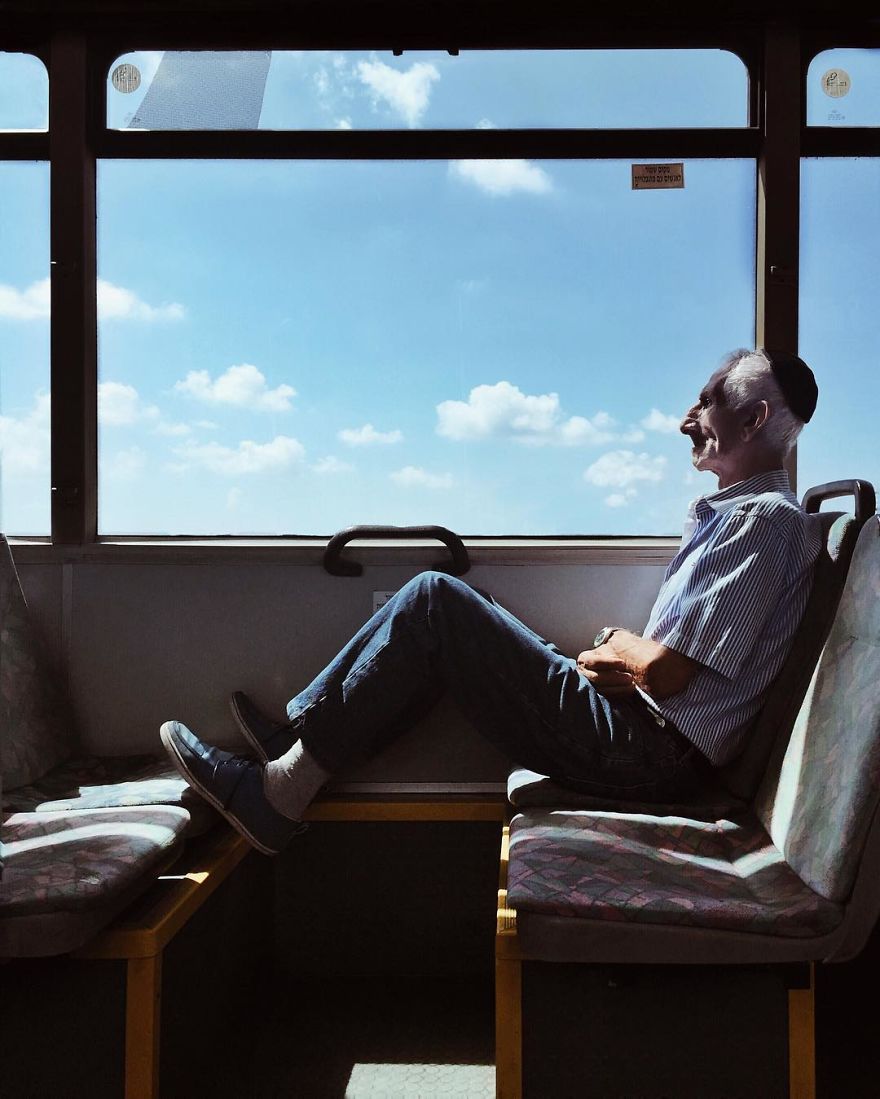
Most of us take some sort of public transportation to work. You can see a lot of different and interesting people there. Most of them are usually busy thinking about the day ahead, daydreaming, busy with their phones or books.

Dina Alfasi a mother of a 15-year-old and an Israeli engineer who works in a hospital, takes advantage of these moments to capture simple but beautiful portraits of strangers lost in thought. On her daily commute to work, she uses her iPhone to photograph simple moments of life.

"I'm inspired by the little moments that happen every day. My work is a testament to telling stories through a single photo and proof that all you need is just to look around to find magic moments," said Dina. Now, let's see her magnificent work ...


Clancy's comment: Wow. Magnificent shots. Love ya work, Dina. I've taken quite a few shots like these during my travels. One is below ...

I'm ...