Showing posts with label France. Show all posts

6 November 2022 - THE HEROINE OF DUNKIRK


THE HEROINE 

OF DUNKIRK


G'day folks,

The "Heroine of Dunkirk" rescued over 7,000 Allied troops during the historic World War II evacuation. 

In May of 1940, hundreds of thousands of Allied troops found themselves stranded on the beaches of Dunkirk, France. The German forces had cut them off and surrounded them, leaving them trapped between their encroaching enemies and the sea. All hope seemed lost, until a fleet of over 800 civilian boats and ships were mobilized in a miraculous rescue effort to evacuate the stranded soldiers.

The civilian fleet was able to rescue around 338,000 trapped Allied soldiers from the hands of the advancing German forces. Over 7,000 were transported across the channel by a single vessel, the PS Medway Queen paddle steamer. The ship’s role in the historic rescue earned it the well-deserved nickname of the “Heroine of Dunkirk.” Its service was so well respected that when the person contracted to scrap the ship found out its history, he refused to finish the job.


One of 20 paddle steamers that participated in the evacuation, the Medway Queen made seven trips, more than any other small vessel. On its last trip, while alongside the dock in Dunkirk, one of the ship’s paddle boxes was badly damaged in a collision with a destroyer that had been displaced by the force of an explosion. Medway Queen limped home carrying 400 members of the French rearguard.

The ship wasn’t destined to be a wartime vessel. It was built in 1924 in Troon, Scotland, for use as a ferry. It served on the Medway and the Thames Estuary before being requisitioned in World War II as a minesweeper. However, it was the ship’s role in the Dunkirk evacuation that earned it a place in British maritime history.

After the war, the ship returned to civilian use until 1963, when it was due to be scrapped in Belgium. However, when the ship breaker heard that Medway Queen had taken part at Dunkirk, he refused to continue with the job. The ship was sold and used as a floating restaurant and nightclub on the Isle of Wight until it was replaced by a bigger vessel in 1970. Under private ownership, the hull started to leak and the ship sank in the River Medina in 1978, where it remained until it was recovered in 1984.

After nearly two decades, the ship was eventually restored to its former glory in 2013.  Although mobile, Medway Queen is now tied up as a museum ship alongside Gillingham Pier. It’s the last remaining mobile estuary paddle steamer in the United Kingdom.
8 November 2022 - SECRET PASSAGES IN FRENCH MONASTERY


SECRET PASSAGES 

IN FRENCH MONASTERY


G'day folks,

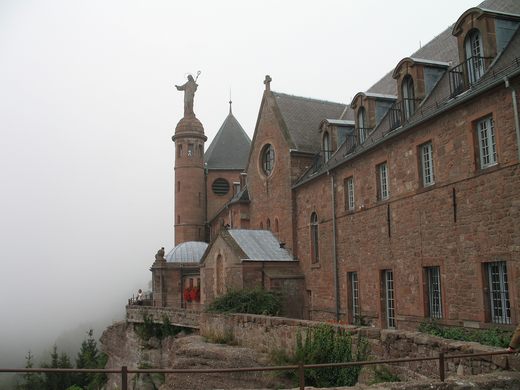
This is an ancient monastery, containing a locked room and secret passages, involving a mysterious book heist. 

“I’m afraid my burning passion overrode my conscience. It may appear selfish, but I felt the books had been abandoned. They were covered with dust and pigeon droppings and I felt no one consulted them any more. There was also the thrill of adventure — I was very scared of being found out.”

In 2003, Stanislas Gosse admitted to the theft of over 1,000 ancient and rare books from a locked private library in a monastery perched 2,500 feet up in the Vosges mountains in France. In order to accomplish this feat, he climbed exterior walls and hidden stairways into a long-forgotten medieval passageway with secret access behind library cupboards. He then sneaked into the library, chose his victims, and left through the same route. He was not a professional thief out for money — all the books were found safely in his tiny apartment. He was a local teacher who stumbled across a map to the secret passages in the city archives and couldn’t resist the thrill.


The picturesque and remote Mont Sainte-Odile is encircled by 10 kilometer walls, the ruins of fortifications called Mur Païen. The monastery/convent dates to the 7th century AD, and is dedicated to St. Odile of Alsace, who was born blind, but miraculously gained her eyesight after angelic intervention. The buildings have been destroyed and rebuilt many times, most recently in the 1600s, and again in 1853. None of the monks nor staff at the building were aware of the existence of secret passages until the books started disappearing.


The theft of the books had not gone unnoticed, but since the room was firmly locked and off limits to the public, for two years the means and method remained a mystery. It was only after the exterior windows were blocked, and locks replaced, that police determined that there must be another entrance to the room. Finally the secret was discovered when a section of bookcase swung back to reveal the secret space. Rope ladders led up to the roof and then out into other rooms more commonly open to the public. It is thought that the secret passages may have originally been built to allow senior members of the monastery to listen in on monk’s conversations inside what was then the common room.

After setting up hidden cameras to catch him in the act, police arrested Gosse, still carrying climbing rope and three suitcases full of books. He received a fine, a suspended prison sentence, and was assigned community service — helping catalog the books in the library at Sainte-Odile.

23 October 2022 - GILLETTE - THE SHAVING PIONEER


GILLETTE 

- THE SHAVING PIONEER -


G'day folks,

Safety razor pioneer King Camp Gillette, who was born in 1855, may have made millions from his business but he was a Utopian Socialist at heart. 

So much so that he dreamed of the day when all industry would be taken over by a single corporation owned by the public, and that everyone in the United States would live in a giant city called Metropolis powered by Niagara Falls.

Gillette envisaged setting up a company to make this vision come true and offered Theodore Roosevelt a million dollars if he would run the operation. The former President declined.

Ancestors of the strangely named King Camp Gillette were French Huguenots who moved to England, then in the 17th Century to the newly established Massachusetts Bay Colony. After King was born in 1855 the family moved from Wisconsin, where they had settled, to Chicago, where he was raised.

He became a travelling salesman of hardware and in 1895, while honing a “cut-throat” razor so that he could shave before starting work, he thought how much better it would be to avoid this dangerous and tedious daily task by using a replaceable razor.

Men had been grappling with the problem for centuries. Prehistoric cave drawings show that clam shells, sharpened flints and even shark’s teeth had been used for shaving. Gillette’s ideas were rather more sophisticated, even if they were not new.

The first safety razor was in fact invented in the 1880s by the Kampfe Brothers of New York, and as writer Brennan Kilbane of Allure magazine noted: “Gillette did not invent the razor, nor the safety razor, nor the concept of disposable blades, but he was the first to patent it. His economic legacy is best felt in the frustration that heats your face when you realise your $22 razor blade set requires you to continually repurchase a $36 eight-pack of refills.”


This all stems from advice given to the young entrepreneurial Gillette by an employer: “Invent something that will be used and thrown away so that the customer will keep coming back.”

Gillette's disposable blades created a new and lucrative retail concept in which razors were sold quite cheaply so that consumers would be locked into the need to continuously purchase relatively expensive blades. The selling technique would become known as the ‘razor and blades model’ and is perhaps most associated today with the printers and ink market.

In its first year of trading in 1903, the Gillette Safety Razor Company sold 51 razors and 168 blades. By the end of 1904, it had produced 90,000 razors and 12,400,000 blades. Gillette’s innovative sales strategy – selling the razors at a loss but making profit on the blades – would turn him into a multi-millionaire.

The fabulously wealthy King Camp Gillette died in 1932, aged 77. Today, the highly successful Gillette brand is owned by the US-based multi-national Procter & Gamble company which purchased the business in 2005 for a staggering $57 billion.

30 August 2022 - 'LA COUPOLE' - HITLER'S SECRET BUNKER


'LA COUPOLE' 

- HITLER'S SECRET BUNKER  -


G'day folks,

This bunker in northern France was built by Nazi German forces with the intention of launching up to 50 V2 rockets at London each day. 

A one million ton concrete dome constructed on the side of a chalk quarry with underground storage for the rockets, fuel supply, a liquid oxygen production facility, electricity generators and housing for the garrison. This is La Coupole, a massive remnant of World War II located five kilometers from Saint-Omer in France.

La Coupole was built between 1943 and 1944 by Nazi German forces in France. It was meant to serve as a launch base for V-2 rockets directed against London and southern England, and is the earliest known precursor to modern underground missile silos.


There were paths leading from outside, through rocket height doors into the interior assembly area. Inside, the rockets could be serviced and assembled safely, shielded from Allied bombing by the massive dome and and a chalk hill. V-2 rockets were mass-produced by people deported from the Dora concentration camp in the underground factory known as Mittelwerk.

A small railway supply tunnel would lead to all of the underground workings and a large octagonal chamber over 100 feet under the dome. The octagonal chamber has a diameter of 41 meters. The height to the underside of the dome is 24 meters. Seven stories high for fueling and preparation of the rockets. When ready to fire, the rockets would be rolled down the giant tunnels, Gustav and Gretchen, through the five-foot-thick solid steel exterior doors and launched.

On July 17, 1944 an attack was carried out by Allied Royal Air Force bombers with what was then new six-ton “Earthquake” Tallboy bombs. Although the dome remained intact, the RAF bombers dropped their bombs all around the dome. Three exploded next to the tunnels, one burst just under the dome, and another burst in the mouth of one tunnel. The whole hillside collapsed, undermining the dome support, and covering up the two rocket vertical entry ways. The resulting damage led to the site being abandoned.

The bunker remained empty and unused until the mid-1990s. In 1997 it opened to the public as a museum. Exhibits tell the story of the German occupation of France during World War II, the V-weapons, and the history of space exploration.


24 August 2022 - INVERTED BOAT HOUSES - FRANCE


INVERTED 

BOAT HOUSES 

- FRANCE -


G'day folks,

These rustic holiday homes are made from discarded fishing boat hulls.  

A holiday destination in Equihen-Plage, in the North of France, is reviving an old tradition of building houses out of discarded boat hulls. In the past, this type of unconventional abode was made by poor fishermen and, in some cases, their widows.

The hulls, after receiving a waterproof coating of tar, become the roofs. They’re then raised on small brick-and-mortar walls that only allow for a small bit of headroom. Doors and windows are then cut out from the hulls. The interiors of these houses, which are typically single-room, are quite dark and cramped.


This kind of house was mainly used by fishermen in the 19th and 20th centuries as makeshift shelters or cheap homes. Today, they serve as a niche tourist attraction.

Most of the original boat houses were destroyed during World War II, and it seemed that this piece of coastal heritage would be lost forever. But in the 1990s, interest in the houses resurged, leading some to reconstruct inverted boat houses and use them as rustic holiday accomodations.

3 August 2022 - THE DAY THE BIKINI ARRIVED


THE DAY THE 

BIKINI ARRIVED


G'day folks,

Millions of men would come to be grateful that Frenchman Louis Réard, a car mechanic, had an unlikely sideline in the 1940s – he also looked after his mother’s lingerie boutique in Paris. And from there he created the bikini, which was unveiled in 1946.

Up to that point, the most revealing bathing costume on the market displayed a mere sliver of flesh at the midriff. A scornful Réard thought women should be more daring, especially with a spirit of “doing your own thing” taking hold across Europe after the chains of war had finally been broken and people were beginning to enjoy a new taste of freedom.

Adding to the pressure for change was the drive by clothing manufacturers and designers to produce new ranges that would reflect the free-spirited mood of the times.

Rising to the challenge, Réard created a bathing costume using no more than 30 inches of fabric, the bottom half made basically from two triangles of cloth held together with string and the top half no more than a skimpy bra.

He thought the design would be “highly explosive” and, inspired by American atomic bomb tests that had started to take place off the Bikini Atoll in the Pacific Ocean, he cheekily called his swimwear “the bikini”.


Now he needed to market it. But finding a model prepared to appear in public wearing his scandalously skimpy creation proved to be quite a challenge. Finally, he recruited 19-year-old exotic dancer Micheline Bernardini who had no qualms at all about parading semi-naked for all to see.

Expecting big headlines after the launch at a Paris swimming pool, Réard designed a bikini for Micheline printed appropriately, as he thought, with newspaper type.

Another French designer, Jacques Heim, had produced a competing swimsuit which he called the “atom” and described it as “the world’s smallest bathing suit.” But Réard’s creation was considerably smaller and he advertised it as “smaller than the world’s smallest bathing suit.”

Shockingly for many people, it was also the first time that the wearer’s navel had been exposed.

There was a lot of initial resistance to the bikini; indeed it was banned on beaches in Spain and Italy for a time and was considered unacceptable in the United States. But more and more women wanted one and they appeared in increasing numbers on Europe’s beaches as each summer passed.

A significant breakthrough come in 1958 when Brigitte Bardot, the so-called “sex kitten” of the age, exploded onto cinema screens flaunting a bikini in her iconic film, And God Created Woman.

In the US, barriers were broken in 1960 when pop star Bryan Hyland scored a major worldwide hit with a novelty number which told of his girl dressed only in an “Itsy Bitsy Teenie Weenie Yellow Polkadot Bikini.”

Louis Réard, who insisted that a two-piece wasn’t a genuine bikini “unless it could be pulled through a wedding ring,” continued selling them from his shop in Paris until 1980. He died in 1984 at the age of 88.

1 August 2022 - THE WORLD'S MOST FAMOUS CHEESE CAVES


THE WORLD'S MOST 

FAMOUS CHEESE CAVES 


G'day folks,

Welcome to the world's most famous cheese caves. 

According to legend a young shepherd boy fell asleep in a cave while enjoying his lunch. When he awoke he saw a beautiful woman scamper past the opening of the cave. Entranced by her beauty he ran after her leaving behind his meagre lunch of bread and cheese. Months later he returned to find the cheese had grown a unique blue mold. In a moment noted in gustatory history he took a bite. His daring, so the story goes, led to the creation of blue-veined cheeses.


In traditional French cheese-making the cheese-maker leaves a local loaf of sourdough bread, teeming with starter cultures, in underground caves rich with penicillium roqueforti. He lets the bread get moldy then grinds up the moldy loaf and mixes the breadcrumbs with the milk curd. The cheeses are then aged in the caves where the bread went moldy; this encourages the development of blue veins. Most cheese-makers now use a penicillium roqueforti that is made in labs because it makes for more consistent veining.

The name Roquefort is synonymous with the caves in the Averyon department in southern France, where the cheeses are still aged. In order to be legally called “Roquefort,” the cheeses must adhere to a number of rules established by the federal standards of the Appelation d’Origine.

Local archeological evidence of cheese-making (mainly ancient cheese strainers) date back to 2000 B.C.E. According to Pliny, the Roman scholar, Roquefort was already world-famous around 76 C.E. Furthermore, these specific caves have been used since at least 900 C.E. for the production of Roquefort.

The Société des Caves de Roquefort, where 60% of Roquefort is aged, are open to the public year-round. The hours vary greatly, so visit the website for more details.


26 July 2022 - ROVE TUNNEL - ABANDONED CANAL TUNNEL in FRANCE


ROVE TUNNEL

 - ABANDONED CANAL 

TUNNEL in FRANCE -


G'day folks,

Welcome to the longest canal tunnel in the world, abandoned in the 1960s. 

Between 1911 and 1916, the Rove Tunnel was built to link the Marseille Harbor to the Rhone River. But it wasn’t until 1926, after twenty years of work and a World War, that the tunnel was finally opened for use, surviving a little under 40 years before collapsing in 1963.


The longest canal tunnel in the world, the Rove Tunnel passes through Berre Lake (adjacent to the Mediterranean to the west of Marseille) and Martigues (a commune in the southeastern part of France, to the northwest of Marseille), and stretches about 4.5 miles in length and 72 feet in width, which, before it was closed to public use, enabled about two ships to cross inside.

Although it has been abandoned for years, a project has been launched to bring this tunnel back to life by using it as a salty water supply for the Berre Lake, which is slowly drying.


11 June 2022 - 100,000 SOLDIERS OF TRABUC CAVES - FRANCE


100,000 SOLDIERS 

OF TRABUC CAVES

 - FRANCE -


G'day folks,

This army of concretions is an unexplained geological phenomenon unlike anything else in the world. 

There are countless caves around the globe, but the Trabuc Caves in southern France are unique among them all, due to a mysterious and stunning geological oddity known as the “100,000 Soldiers.”

This unexplained natural wonder stands out within the all-around beautiful Trabuc Caves, the largest network of underground passages in the Cévennes. Thousands upon thousands of strangely short concretions are clustered together in a small area; standing side by side, they resemble an enormous silent army of soldier figurines. The first explorers to come across this awesome site called it an army of 100,000 soldiers, and the name stuck.


This kind of geological formation has not been found anywhere else in the world. And still today, geologists don’t know how these formations were created. Stalagmites (on the ground) and stalactites (on the ceiling) are commonly found in pairs; the dripping water from the ceiling creates stalactites that fall to the ground and create stalagmites. But in the case of the 100,000 Soldiers, the concretions blanket the cave floor without any stalactites above. Scientists have posed theories over the years, but none ever sufficiently explained the geological anomaly. Its origin remains a scientific mystery to this day.

The splendor of the Trabuc Caves doesn’t stop at the 100,000 Soldiers. The network is adorned with a colorful rainbow of minerals, waterfalls, and pools, and it has a long and rich history. The caves have been known and used since antiquity, though it wasn’t until the 1950s that an artificial tunnel was dug allowing easy access into the cavern. The underground tunnels provided shelter for smugglers in the Middle Ages, and Huguenots during the religious wars in the 18th century. Scientific exploration of the caves started in 1823. By now, around six miles of caves have been explored, but speleologists expect the subterranean network to cover two or three times that size, as the limestone rock here is just an incredible maze.


13 June 2022 - STUNNING MILLAU VIADUCT - FRANCE


STUNNING 

MILLAU VIADUCT 

- FRANCE -


G'day folks,

The world's tallest bridge is also possibly the most elegant. 

Millau Viaduct is the world’s tallest bridge, a claim based on the height of the towers, which are taller than the Eiffel Tower. The height of the bridge deck itself is only the 17th tallest in the world, yet driving over it still feels like you’re literally in the clouds.


This cable stay bridge is on the E11, a popular motorway route between Calais and the French and Spanish Mediterranean coasts. It’s 890 feet from the road deck to the valley below, and the views are fantastic when it is not shrouded in cloud (which it commonly is).

The architects of this bridge have created a thing of wonder. How did anybody build it? In fact many of the engineering aspects of the bridge were already worked out before the architects were given the brief to make the bridge look so good. Building this bridge really was a team effort; the list of famous engineering companies involved is too long to include here. The story of the construction process is available widely but it is a great experience to read about at the visitor centre while enjoying an excellent view of the bridge itself.


6 June 2022 - GHOST TOWN COMING BACK TO LIFE


GHOST TOWN COMING

 BACK TO LIFE


G'day folks,

 Half a century after it was abandoned, this ghost town is coming back to life. 

On the shores of the Salagou Lake, the ruins of the village of Celles are slowly coming back to life. In 1968, the village was emptied of its inhabitants to make way for the creation of the lake, which was going to rise to an altitude of 150 meters (492 feet), drowning the buildings. But plans changed, and the water never rose past 139 meter (456 feet) . Its inhabitants were kicked out for nothing. 

The village was looted and squatted for several years, and the buildings fell into ruin. But after over 50 years, three new families signed leases to move back into Celles in September 2019 and begin the process of rebuilding. 


The ruins are currently fenced off, but visitors can still walk through the village streets along the shores of the Salagou. The plan for rebuilding is ambitious. New residents were selected based on a business project or company that they will bring to the town, and being issued long-term leases designed to prevent real estate speculation. According to the terms of these leases, all tourist-facing business will take place in a single, communally run building. The town is also building social housing. 

Celles is located in southeastern France, about 50 kilometers (30 miles) from the city of Montpellier. In the summer, the lake is a popular local destination for hiking and swimming. But Joëlle Goudal, the current mayor of Celles, wants to make sure that the village is first and foremost a place where people live, rather than a tourist attraction. “People were expropriated for this land,” she says. “It’s out of the question to let people today make money off of the people who were forced to leave.” 


24 May 2022 - BIGGEST BANK ROBBERY IN FRANCE


BIGGEST BANK 

ROBBERY IN FRANCE


G'day folks,

Albert Spaggiari, the mastermind behind the biggest-ever bank robbery in France,  died leaving no clue as to the whereabouts of the stolen millions.

Spaggiari, born in 1932, was a tearaway, constantly in trouble for stealing. His father died when he was three and his mother, who ran a lingerie shop, quickly remarried, but the boy hated his stepfather. He left home at 17 to join the Parachute Regiment, which was fighting Ho Chi Minh’s communist army in Indochina.

Spaggiari was a tough soldier, wounded twice and decorated for bravery. But his old weakness resurfaced and in 1953 he was arrested after breaking into a milk bar in Hanoi to steal the takings. He was sent back in irons to France and jailed.

By the late 1960s Spaggiari seemed to have turned over a new leaf, married a nurse and moved to the South of France where he opened a photography shop in Nice. His charm and talent soon put him in increasing demand for society and other weddings.

But he longed for action and he had itchy fingers. And when he learned that the sewers of Nice ran close to the walls of the Société Générale bank, plans for a daring robbery began to form in his mind.

First, as a precaution, he rented a safety box in the bank's vault and planted in it a loud alarm clock set to go off at midnight. Spaggiari wanted to make sure there were no acoustic or seismic detection alarms to spoil his plans.

He need not have worried. Like the owners of the Titanic, who thought the ship unsinkable, the bank thought its vault was impregnable.

Next he recruited a gang of villains from Marseilles who headed into the sewers. For two months in the summer of 1976 they waded each night through human waste, digging an eight-meter tunnel which Spaggiari demanded was shored up as well as a mine shaft.


On the Friday night of the three-day Bastille Day weekend they broke through into the vault, sealed its door shut from the inside with a welding gun, and broke open 371 safety deposit boxes before leaving on Monday morning.

The bank did not know what was in the boxes, so the value of the haul would never be known. Estimates ranged from 30 million to 100 million francs in cash and jewels.

When locksmiths brought in by the astonished bank managed to open the door they found deposit boxes scattered across the floor, the remains of meals eaten by the gang, and a message painted on the wall: “Sans Armes, ni Violence, ni Haine” (without weapons, violence or hate).

A few weeks later, acting on a tip-off, the police arrested one of the thieves who named the entire gang, including Spaggiari. He was on a trip to the Far East accompanying the Mayor of Nice as a photographer and was arrested when the returning plane touched down.

At his trial, Spaggiari asked to see the judge in his chambers. There, he suddenly ran to a window, flung it open and jumped out. “Au revoir,” he shouted with a wave, then roared away sitting on the back of an accomplice’s motor cycle. The French police never saw him again.

In his absence the judge gave him a life sentence. Spaggiari spent the rest of his days drifting between South America and Europe and is believed to have returned to France occasionally to see his wife. When he died of lung cancer in 1989 he had been living in Italy under a false name for a number of years.

In 2008 a French biopic of Spaggiari, "Sans arme, ni haine, ni violence", was released in the cinemas. It portrayed him as part comic fantasist and part daring thief, marooned by a hotel pool in Argentina.

Spaggiari wrote a book about the robbery in 1977, translated into English as “Sewers of Gold.” Another book, “The Heist of the Century” by French journalists René-Louis Maurice and Jean-Claude Simoën was given a partial re-write by English thriller author Ken Follett.

Clancy's comment: Mm ... I wonder where the money went?

I'm ...