In October 1943, Greek People’s Liberation
Army guerrillas captured 77 German soldiers on a patrol mission,
following an ambush in the mountains outside Kalavryta, southern Greece.
After negotiations for a prisoner exchange failed, the captives were
executed in a local ravine, with only two making a lucky escape
undetected.
In response, commanding General Karl Von Le Suire ordered Unternehmen Kalavryta,
a guerrilla cleanup operation that included terrible reprisals aimed
at the local civilian population. Troops from the 117th Jaeger Division,
a unit with previous counter insurgency experience in what was then
occupied Yugoslavia, converged to the town of Kalavryta from all
directions, burning and looting 50 villages along the way and executing
143 male civilians.
Upon reaching Kalavryta on December 13, 1943, the soldiers began
setting the town ablaze. They then gathered the town’s entire population
at the schoolyard and separated them in two groups. All able men age 13
and upward were led to a hill outside the town, while women, the
elderly, and small children were locked inside the schoolhouse.
At noon, the schoolhouse was set on fire with over 200 people inside,
while at the hill, the soldiers began executing the 461 men by machine
gun fire. The action was coordinated by flares, so the men would die in
full view of the burning town, and within earshot of the screaming
women, children, and elders, now surrounded by flames. While the
execution was taking place on the hill, the panicked, choking prisoners
managed to smash through the school’s doors and escape in a frantic
stampede, while others threw their children outside the windows of the
burning building to save them.
Only 13 men survived the execution, injured or hiding under the
bodies of the dead, while soldiers roamed the hill, delivering the
coup-de-grace. After the soldiers’ departure, the escaped women,
children, and elderly reached the blood-soaked hillside, where they
discovered the grim fate of their male relations. Without any tools or
farm animals left in their looted households, they began dragging the
bodies to the cemetery nearby or digging shallow graves with their
hands.
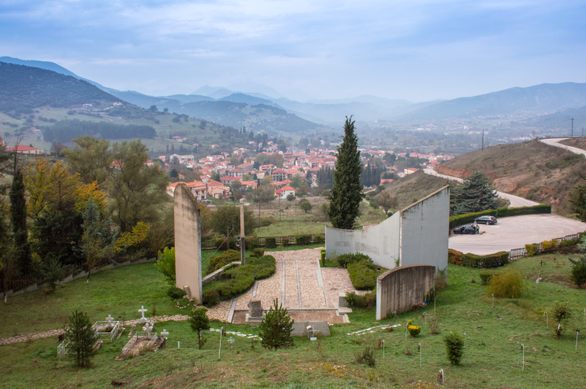
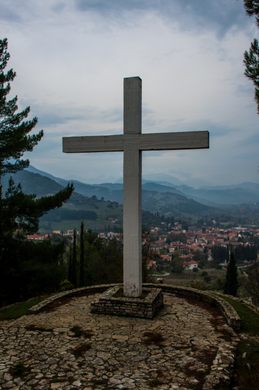
Today, a solemn memorial complex stands on the hill where the
execution took place. It includes a large cross, ossuary, the harrowing
sculpture of a lamenting woman of Kalavryta, as well as some on-the-spot
graves that remained on site since that day. The Kalavryta schoolhouse
has been converted to a museum displaying everyday and personal items
that survived the town’s destruction, as well as photos and eyewitness
accounts that testify to the atrocious conduct of the 117th Jaeger
Division.