Showing posts with label HITLER. Show all posts

14 August 2022 - HITLER'S EXPLOSIVES FACTORY


HITLER'S EXPLOSIVES

 FACTORY


G'day folks,

Hidden in the forest are the crumbling, graffiti-covered remains of the factory where most of Germany's explosives were produced during World War II. 

During World War II, the Wehrmacht produced many of their explosives at a factory in the town of Bobingen in southern Germany. Run by the arms company Dynamit AG, the Fasan explosives factory was built in the 1930s. In 1939, a new facility was built in the forest near the village. The factory is long abandoned, but its crumbling walls still stand among the trees, where they are being slowly reclaimed by nature.

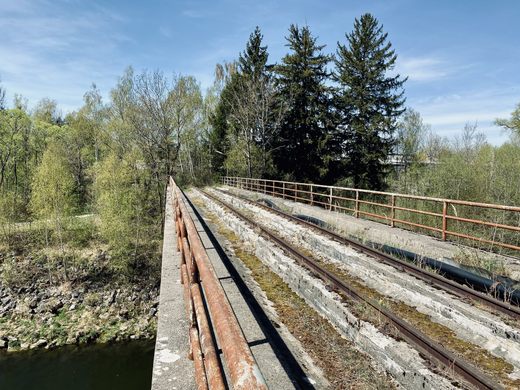
The original factory, known as Fasan I, was located on the eastern bank of the river Wertach. The secondary facility, Fasan II, was across the river in the western area, a railway bridge that can still be seen today was built. The two plants were scattered across the premises to avoid larger damages in case of an accidental explosion, and also to hide it from aerial reconnaissance by foreign adversaries. 


Fasan I consisted of 65 buildings and was originally only a testing facility designed to check out a large-scale industrial production of explosive materials, Fasan II consisted of only 25 buildings for the later mass production. During World War II, Fasan was used to produce hexogen, an organic compound that was used to create powerful explosives. In 1945, up to 300 tons of hexogen were produced per month at Fasan.

After the arrival of the U.S. Army in 1945, the factory was closed down. Today only one of Fasan II’s factory halls is publicly accessible—the remains of Fasan I are located on private property. 

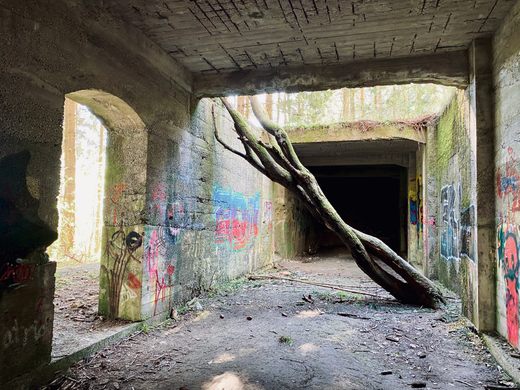
Since then, nature has taken over of the former factory hall: Trees grow up from the floor through the ceiling and cover the roof.  Graffiti covers the walls and the explosive-resistant concrete partitions that divide the hall into three sections. The first two are partially exposed by daylight through the broken ceiling. For the third section a flashlight is required, especially as sometimes it is filled with ground water.

30 August 2022 - 'LA COUPOLE' - HITLER'S SECRET BUNKER


'LA COUPOLE' 

- HITLER'S SECRET BUNKER  -


G'day folks,

This bunker in northern France was built by Nazi German forces with the intention of launching up to 50 V2 rockets at London each day. 

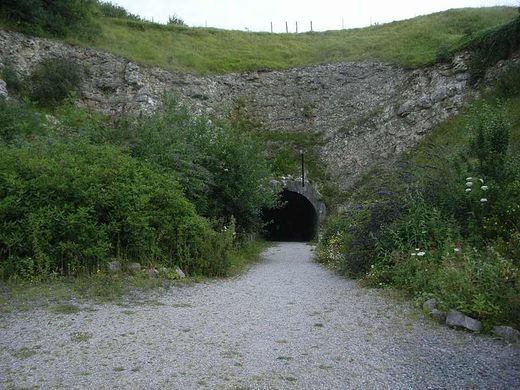
A one million ton concrete dome constructed on the side of a chalk quarry with underground storage for the rockets, fuel supply, a liquid oxygen production facility, electricity generators and housing for the garrison. This is La Coupole, a massive remnant of World War II located five kilometers from Saint-Omer in France.

La Coupole was built between 1943 and 1944 by Nazi German forces in France. It was meant to serve as a launch base for V-2 rockets directed against London and southern England, and is the earliest known precursor to modern underground missile silos.


There were paths leading from outside, through rocket height doors into the interior assembly area. Inside, the rockets could be serviced and assembled safely, shielded from Allied bombing by the massive dome and and a chalk hill. V-2 rockets were mass-produced by people deported from the Dora concentration camp in the underground factory known as Mittelwerk.

A small railway supply tunnel would lead to all of the underground workings and a large octagonal chamber over 100 feet under the dome. The octagonal chamber has a diameter of 41 meters. The height to the underside of the dome is 24 meters. Seven stories high for fueling and preparation of the rockets. When ready to fire, the rockets would be rolled down the giant tunnels, Gustav and Gretchen, through the five-foot-thick solid steel exterior doors and launched.

On July 17, 1944 an attack was carried out by Allied Royal Air Force bombers with what was then new six-ton “Earthquake” Tallboy bombs. Although the dome remained intact, the RAF bombers dropped their bombs all around the dome. Three exploded next to the tunnels, one burst just under the dome, and another burst in the mouth of one tunnel. The whole hillside collapsed, undermining the dome support, and covering up the two rocket vertical entry ways. The resulting damage led to the site being abandoned.

The bunker remained empty and unused until the mid-1990s. In 1997 it opened to the public as a museum. Exhibits tell the story of the German occupation of France during World War II, the V-weapons, and the history of space exploration.


17 August 2022 - HITLER'S SECRET BUNKER IN NORTHERN FRANCE


HITLER'S SECRET BUNKER 

IN NORTHERN FRANCE


G'day folks,

Underneath a chalk hill in France lies what Hitler hoped would be the underground launching base for a devastating new weapon. 

The Forteresse de Mimoyecques exists as a frightening example of the Führer’s ambition.

Hidden underground in the Northern French hamlet of Landrethun-le-Nord lurked a very grim threat intended to aim directly into the heart of the British capital. A subterranean bunker with a series of tunnels that connected to five shafts that inclined upwards, this secret complex was to be the placeholder for 25 new, experimental weapons that would all be pointing straight at London. 

The V3 was a massive super gun, designed to be capable of firing explosive projectiles at the rate of 600 rounds per hour. The V3, codenamed Hochdruckpumpe (High Pressure Pump) was developed by Reich Minister of Armaments and War Production Albert Speer, and regardless of its prototype status, absolutely delighted Hitler. Giving the weapon’s development and employment his full support despite the absence of any firing trials, the Führer also had to consider the type of engineering base such a weapon would need to be consistently fired for any amount of time.


The solution presented itself as an underground launching base, supported by the already existing railroad. Ammunition storage galleries, five drifts capable of clustering 5 V3’s each, and a network of tunnels were installed once the hill was excavated, built by over 5,000 German workers as well as hundreds of miners and Soviet prisoners. Construction began in September 1943 and had a target date of March 1944, but relentless bombing from the Allies thwarted the deadline. French agents had an inkling that something was afoot in the hill by late 1943, but without the proper intelligence, they couldn’t get close enough to the site to uncover the goings-on, and the Germans went on diligently building.

However, the ambitious undertaking that could have easily devastated London wasn’t meant to be. The high-reaching project couldn’t withstand the relentless shelling, and when Mimoyecques became the focus of the Allied air forces, the site was so bombarded that the Germans were forced to desert what they were sure would be their game-changing advantage. By July, 1944, the tunnels had been collapsed and and the majority of the bunker was destroyed. 

After several attempts by the British to safely demolish the substantially solid bunker (thoroughly pissing off the French who were not invited to discuss the site’s fate) the complex was finally closed off through demolition. Private owners eventually reopened the tunnels as a museum in 1984 by gaining access through one of the five drifts that was meant to hold the super guns. The museum serves as a memorial as well as a sanctuary to a large colony of rare bats.


26 April 2022 - FAKE NEWS FOOLED HITLER ON D-DAY


 FAKE NEWS FOOLED

 HITLER ON D-DAY


G'day folks, 

 The biggest land, air and seaborne invasion the world has ever known was launched on June 6th 1944. Codenamed Operation Overlord, everybody now knows it as D-Day.

One hundred and fifty six thousand American, British and Canadian troops sailed to France from England and stormed the beaches of Normandy. They then began a relentless, dogged and bloody drive all the way to Berlin, pushing back the fearsome German military machine and finally bringing an end to the Second World War.

It was no picnic. The 50-mile stretch of coast where the landings took place was heavily fortified by Hitler’s forces, and his soldiers, who had never known defeat, put up staunch resistance.

An element of surprise worked in the Allies’ favour. Hitler believed that an invasion would come along France’s northern coast, but he did not know where. He had put Field Marshal Erwin Rommel in charge of defence operations, including completion of the Atlantic Wall, a 2,400-mile fortification of bunkers, landmines, beach and sea obstacles.

In England, meanwhile, deception was the name of the game – on a massive scale. It included an imaginary army of a million men, supposedly led by America’s General George Patton and headquartered in the UK across from Calais – the shortest distance between England and France.

With the use of double agents, bogus radio transmissions and other means the Germans were made aware of this "army". They were also briefed over other possible invasion sites including Greece, the Adriatic coast of Yugoslavia, the south of France, the Biscay Bay coast of France, through the Low Countries, or via Norway and Denmark. Hitler moved garrisons into all these places.


It was, according to ‘America in WWII’ magazine, “the greatest deceptive enterprise ever seen in a war. Tent cities were created all over eastern England. There were fake mess halls, hospitals, ammo depots, and even sewage treatment farms. Fuel depots were constructed and parks for trucks, tanks, jeeps, and ambulances were laid out.”

Like the buildings, the tanks, trucks and other “vehicles” were made of fabric and wood or were rubber inflatables. Soldiers used tools to make tread and tyre marks for the benefit of spying German planes. It was vital to let Luftwaffe reconnaissance planes through to see the mock preparations on the ground, but not let their flights seem suspiciously easy.

On top of all that, the deceptions extended to England’s ports and waterways with the help of the British movie industry, which was called in to make fleets of dummy landing craft. The resulting “vessels”, made of wood or fabric and floating on oil drums, were “moored” in harbours and rivers and looked convincing to German pilots at 33,000 feet.

The subterfuge even extended to “letters” in local newspapers from clergymen complaining about the terrible behaviour of some of the “foreign troops.”

All of this shifted much German attention away from Normandy and so, on June 6, 1944 the Supreme Commander of the Allied Forces, America’s General Dwight D. Eisenhower, gave the order for the invasion to begin.

Even as troops began wading ashore along the Normandy beaches, the fooled Germans still believed that the major assault would come at Calais and that Normandy was a feint. Hitler personally ordered the tanks and infantry of the German 15th Army to stay at Calais. And other reinforcements on the way to Normandy were diverted to the port.

Official figures record that 4,414 Allied troops lost their lives in the D-Day invasion, with another 10,000 wounded or missing. But it enabled the great Allied march across Europe to begin.

By late August all of Northern France, including Paris, had been liberated from German control. Next came Germany itself, where the Allies would meet Soviet troops moving in from the east. The following spring, on May 8, 1945, Nazi Germany offered unconditional surrender. Hitler had committed suicide a week earlier, on April 30.

What does the ‘D’ in D-Day stand for? In military parlance it simply refers to the “day” on which an offensive would occur. The “D” is just a placeholder for the date and allows the entire operation to be scheduled in detail long before a definite day for the attack has been set. So, if anything, 'D' stands for 'Day' or 'Date.' The phrase was first used during the First World War.

Clancy's comment: What a massive event. 

I'm ...


20 February 2022 - HITLER'S DIARIES FAIL TEST


HITLER'S DIARIES 

FAIL TEST


G'day folks,

"Hitler's Diaries Discovered!" screamed the front page of the German magazine Stern in April 1983. More conservatively, the Sunday Times in London – which had agreed to pay Stern £600,000 to share in the glory of this stunning story – offered its readers a "world exclusive" on "The Secrets of Hitler's War."

German journalist Gerd Heinemann had told Stern that 62 volumes of diaries written by the Führer between 1932 and 1945 had been recovered from a plane crash in East Germany at the end of the war. The magazine paid out £2.5 million for them.

But it turned out they were fake – created by Konrad Kajau, a notorious Stuttgart forger and antiques dealer calling himself Herr Fischer.

Before paying out, Stern had employed experts to compare handwriting in the "diaries" with other examples of Hitler's writing. They concluded, to Stern's initial great satisfaction, that all were written by the same person. They were right, but it later turned out that the "genuine" Hitler handwriting they looked at had also been forged by Kajau!


In London, Rupert Murdoch's Sunday Times had turned for assurance to historian Hugh Trevor-Roper who enjoyed huge academic prestige after publication in 1947 of his book, "The Last Days of Hitler".

He told bosses at the newspaper he was satisfied that the "diaries" were genuine.

Trevor-Roper later became skeptical, however, and expressed his doubts when Stern admitted it did not know the identity of the East German source supplying the volumes.

With suspicion mounting, and amid fears of possibly facing charges of illegally circulating Nazi propaganda, Stern submitted three of the volumes to West German police for examination.


Forensic analysis quickly revealed that they were fakes, the paper and ink used for the "diaries" not being available until well after the war. They had actually been produced between 1981–83 by Kujau, who had previously forged and sold paintings which he also claimed were the work of Hitler.

Heidemann, making the most of his opportunities, had been creaming off money from Stern by inflating the sums that he claimed had been demanded by Kujau. So, after the forgery was revealed, he was convicted of fraud and, like Kujau, was sentenced to 42 months in prison.

As a result of the "Hitler Diaries" fiasco, two top editors at Stern were fired. And the reputation of Hugh Trevor-Roper, who became Lord Dacre and died in 2003, never fully recovered.

But Kujau, brazen and opportunistic, never looked back. After his release from prison, not wishing to waste his skills, he opened a gallery selling his “genuine forgeries” of paintings by Hitler, Rembrandt, Dali, Monet, Van Gogh, and other masters. The works sold at high prices and became so popular that other forgers moved in and began to produce counterfeit reproductions of his counterfeits!

Clancy's comment: I guess it had to happen, eh?

I'm ...


25 March 2022 - WHAT HAPPENED TO ADOLF HITLER'S BODY?


WHAT HAPPENED TO 

ADOLF HITLER'S BODY?


G'day folks,

He boasted that his Third Reich would last for a thousand years. But Adolf Hitler, who would go down in history as an evil tyrant, shot himself on this day, probably after taking poison, painfully aware of the disintegration of his twelve-year-old regime and with his capital city reduced to ruins and rubble.

As the Second World War was coming to a close the desperate Führer tried to wage war by telephone from his bunker beneath his headquarters, the Chancellery building in Berlin, issuing futile orders to his defeated generals.

The 3,000-square-foot underground bunker, completed in 1942, was basically an extension of the Chancellery’s air raid shelter. It consisted of two levels and 18 rooms. However, Hitler had his favourite architect, Albert Speer, build an additional bunker under the Chancellery’s garden.

It was finished in October 1944 and was known as the Führerbunker. And it was here, alongside his wife of a few hours, that Hitler ended his life.


For three months military advisers had been urging the Führer to abandon the bunker and flee to his Eagle’s Nest retreat high above the Bavarian Alps at Berchtesgaden. But he refused to leave his underground lair, remaining there for about 100 days.

It is believed he feared the possibility of capture and being put on display – dead or alive – by his enemies, especially the Russians.

Just a few days before Hitler’s 56th and final birthday on April 20, the Russians arrived at the edge of Berlin. By April 24, they had the city completely surrounded as the Americans and the British moved closer.

By April 29, knowing all was lost, Hitler was preparing for death, taking with him his 33-year-old companion Eva Braun who had flown from Munich to Berlin earlier that month to be with the man she worshipped.

They had been together since 1932 when Braun, an attractive young photography assistant at the time, came under Hitler’s spell. Urged by Hitler to leave the bunker for her own safety, she refused, allegedly saying: “Do you think I will let you die alone?”

Despite her dedication, her chances even now of Hitler yielding completely to her charms seemed unlikely if his earlier words were to be believed.

Author Gitta Sereny tells in her book 'Albert Speer: His Battle With Truth' how the architect was dining one night with Hitler, Eva Braun at his side. The Nazi leader said that a highly intelligent man should always choose a primitive and stupid woman:

"Imagine if on top of everything else I had a woman who interfered with my work! In my leisure time I want to have peace. I could never marry."

Nevertheless, shortly after midnight on April 29, 1945, Hitler did marry Eva Braun, a minor official from the Propaganda Ministry having been summoned to conduct the ceremony in the bunker.

A few hours later Hitler dictated his last will and a Political Testament. The statement laid all blame for the war on "international Jewry" and urged all Germans to continue fighting.

The will, dated 4am, 29th April, 1945, declared: "As I did not consider that I could take responsibility, during the years of struggle, of contracting a marriage, I have now decided, before the closing of my earthly career, to take as my wife that girl who, after many years of faithful friendship, entered, of her own free will, the practically besieged town in order to share her destiny with me.

"I myself and my wife - in order to escape the disgrace of deposition or capitulation - choose death. It is our wish to be burnt immediately on the spot where I have carried out the greatest part of my daily work in the course of a twelve years' service to my people."

The next day, 30th April, with the Russians less than a city block away, Hitler and Braun ate their final meal. Shortly after 3pm, they said goodbye to the staff in the bunker and retired to their private chambers, taking with them revolvers and thin glass vials of cyanide.

There was a loud gunshot at about 3.30. After waiting a few minutes, Hitler’s valet, Heinz Linge, opened the door and saw the Führer almost upright in a sitting position on a blood-soaked sofa.

It was assumed that Hitler had made certain of death by using his pistol on himself after biting the cyanide vial. Blood had trickled from a small hole in his right temple. The pistol lay on the floor where it had dropped from his right hand.

Eva Braun lay beside him, but she had made no use of the revolver at her side, preferring to take the poison instead.

Later, Radio Hamburg announced that "our Führer Adolf Hitler died for Germany in his command post in the Reich Chancellery this afternoon, fighting to his last breath against Bolshevism".


The bodies of Hitler and Braun were wrapped in blankets and carried to the Chancellery garden. There, one of the Führer's personal assistants, SS Officer Otto Günsche, doused the bodies in petrol and burned them, in accordance with Hitler’s final orders.

What happened to the charred remains is still uncertain. Hitler's men buried them in a nearby shallow bomb crater where apparently they were discovered by the Russians. The remains were then transported to the city of Magdeburg, south-west of Berlin, after being buried and exhumed several times by Russian soldiers.

Finally, the story goes, they were buried in the courtyard of the Russian counter-intelligence agency's facility in Magdeburg and remained there for 25 years.

When control of the city was handed to East Germany in 1970, the KGB exhumed and fully cremated the remains fearing that Hitler's burial site could become a place of worship for supporters of fascist ideas. The ashes were then scattered in the River Elbe. So it is said. But nobody knows for sure.

Clancy's comment: Have we learnt anything from all this? I don't think so. 

I'm ...


20 September 2021 - AMERICAN WOMAN KISSES HITLER AT BERLIN GAMES


AMERICAN WOMAN KISSES

 HITLER AT BERLIN GAMES


G'day folks,

An American woman spectator at the 1936 Berlin Olympics, finding Adolf Hitler “so friendly and gracious”, leaned over and kissed him, and there were ungracious consequences for the Fuehrer’s guards.

It happened during the 1500 metres freestyle swimming event, which was being watched by 40-year-old Carla de Vries, an American tourist who went to the Games with her husband.

She was intrigued to see Hitler sitting at the front of his box and tried several times to get near so that she could take a photograph, but each time she was blocked by Black Guards.

She managed, though, to break through the cordon during the excitement of the finish of the race, shook Hitler’s hand and then kissed him, while the crowd rocked with laughter.

Hitler, seemingly in high spirits, joined in the fun, clapping his hands as the woman returned triumphantly to her seat.

Mrs de Vries said later: “I simply embraced him because he appeared so friendly and gracious. I don’t know why I did it. Certainly, I hadn’t planned such a thing. It’s just that I’m a woman of impulses, I guess.


“It happened when I went down to take Hitler’s picture with my small movie camera. He was leaning forward, smiling, and he seemed so friendly that I just stepped up and asked for his autograph, which he wrote on my swimming ticket.

“He kept on smiling and so I kissed him. People sitting near his box began to cheer and applaud so loudly that I ran back to my husband and told him we had better leave.”

On protection duty that day were members of the Schutzstaffel, the Black Guards who were to form the much-feared SS. But on this occasion they could not even stop the advances of a middle-aged woman.

An unsmiling and ungracious Hitler later saw to it personally that several of them were dismissed and others demoted.


Clancy's comment: My mother was chosen to compete in those games, but didn't attend. I doubt she would have kissed Hitler if she'd attended.

I'm ...


11 September 2021 - HITLER AND THE EIFFEL TOWER


HITLER AND THE EIFFEL TOWER


G'day folks,

Alexandre Gustave Eiffel  became a civil engineer responsible for the tower that bears his name and which became the iconic symbol of Paris – and, indeed, France itself. But he also played an important role in building the equally iconic symbol of the United States – the Statue of Liberty.


The Eiffel Tower was built as the main exhibit of the 1889 Exposition Universelle (World’s Fair), held to commemorate the centennial of the French Revolution. Eiffel designed and oversaw construction of the project, which was completed on 31 March, 1889.

The tower remained the world’s tallest man-made structure for 41 years until the completion of the Chrysler Building in New York in 1930. The original plan was that it would be dismantled after 20 years but it was saved because of its use as a wireless telegraph transmitter.

It also went on to become a growingly popular attraction despite fears by critics at the start that it would be an ugly structure dominating the Paris skyline.

Such was its status in 1940 that it was one of the first locations where Adolf Hitler chose to be photographed after he invaded France in 1940.

Interestingly, though the French could do nothing about Hitler's presence, Resistance fighters were determined that the Fuhrer would not have the satisfaction of ascending the structure – so the lift cables were cut before the Germans got there. Reaching the top then meant a climb of 1,665 steps.

Nazi soldiers were nevertheless ordered to climb to the summit and hoist the swastika – which they managed to do. But the flag was so large it blew away after a few hours and had to be replaced by a smaller one. Hitler's reaction is not recorded.

Early in his career, Eiffel had built a number of bridges for the French railway network and had developed a reputation as a man who knew a thing or two about wind resistance. Just the man to tackle the problems posed by a giant statue designed to stand in New York Harbor.

The Statue of Liberty, a gift from the people of France to the people of the United States, was designed by French sculptor Frédéric Auguste Bartholdi and built by Eiffel. It was dedicated in 1886.

To make the edifice stable, Eiffel came up with a four-legged pylon structure which would support the copper sheeting that made up the body of the statue. The entire structure was assembled at his works in Paris, then dismantled and shipped to the United States in crates.

But he will probably be best remembered for the Eiffel Tower – a structure that was lucky to survive the Second World War. In August 1944, Allied troops were advancing towards Paris and it became obvious that the Germans would soon be driven out.


A furious Hitler sent orders to General Dietrich von Choltitz, the military governor of Paris, to turn the city into rubble – including the Eiffel Tower. Thankfully, Choltitz did not carry out the command.

The much-loved tower is 324 metres tall (including antennas) and weighs 10,100 tonnes.

The French car manufacturer Citroen treated it as a giant billboard between 1925 and 1934 using a quarter of a million light bulbs to emblazon their name on the structure. The Guinness Book of Records recorded it as the world’s biggest advertisement.

But perhaps the most bizarre incident involving the tower came in 2008. A woman with an objects fetish "married" the Eiffel Tower, changing her name to Erika La Tour Eiffel in honour of her "partner". The "bride," who was at one time a US soldier, was obviously attracted by strong, silent types.

There's no telling what Gustave Eiffel would have made of it all. He died in 1923, aged 91.

Clancy's comment: I'm glad his tower survived so I could visit it and view Paris.

I'm ...