Showing posts with label BOATS. Show all posts

24 August 2022 - INVERTED BOAT HOUSES - FRANCE


INVERTED 

BOAT HOUSES 

- FRANCE -


G'day folks,

These rustic holiday homes are made from discarded fishing boat hulls.  

A holiday destination in Equihen-Plage, in the North of France, is reviving an old tradition of building houses out of discarded boat hulls. In the past, this type of unconventional abode was made by poor fishermen and, in some cases, their widows.

The hulls, after receiving a waterproof coating of tar, become the roofs. They’re then raised on small brick-and-mortar walls that only allow for a small bit of headroom. Doors and windows are then cut out from the hulls. The interiors of these houses, which are typically single-room, are quite dark and cramped.


This kind of house was mainly used by fishermen in the 19th and 20th centuries as makeshift shelters or cheap homes. Today, they serve as a niche tourist attraction.

Most of the original boat houses were destroyed during World War II, and it seemed that this piece of coastal heritage would be lost forever. But in the 1990s, interest in the houses resurged, leading some to reconstruct inverted boat houses and use them as rustic holiday accomodations.

16 August 2022 - WEIRD HOUSEBOATS OF SHOREHAM


WEIRD HOUSEBOATS

 OF SHOREHAM


G'day folks,

Welcome to a motley, fantastical agglomeration of unlikely houseboats along the Shoreham-by-Sea riverbank. 

Normality ebbs away as you edge along the river path revealing a hodgepodge of has-been boats restored and reimagined. 

Shoreham-by-Sea is a small beach town at the mouth of the River Adur that is often overlooked thanks to its vicinity to more popular weekend destinations like Brighton or Littlehampton which is all the better for the motley, fantastical agglomeration of unlikely houseboats that have accrued on the riverbank.

What has grown along the “Bloomin’ Adur” is a unique bridge between land and sea of cobbled treasures made from another’s trash. The obscure houseboat art collective has been growing since the end of World War II, when decommissioned military ships were retired to Shoreham’s tidal mud flats. Today there are some 50 to 60 boats to be found at the site and, since the structures are waterborne, few building regulations apply, meaning owners can unleash their greatest structural/architectural/artistic fancies in the midst of a wild, natural setting. 


The result is a labyrinthine dream afloat a gaudy Gaudi vision made with love and a lot of hard work. Some highlights include: the Verda, which is made of parts and portions of seven or eight different boats, as well as two buses and a Reliant Robin; the Dodge, which incorporates an old fire engine and is available for rent on Airbnb, making it one of the most magically odd apartments ever conceived; the Clive, a former World War II Motor Torpedo Boat (with an aeroplane fashioned on top, of course) now home to a huge workshop and pop-up cafe; and the Fische, a mid-century German minesweeper that having been designed for a crew of 30 now provides its owners with more-than-ample living space.

The Verda, Dodge, and Clive (as well as five others) are all owned by Hamish, a creative crafter of second-hand materials as well as a leading light in the Shoreham houseboat community. The Verda is not only his home, but also includes a community social space that hosts meditation, yoga, film nights, live music, markets, healing sessions, and even a monthly pub night. Hamish is also the guy to talk to if you want to volunteer to get involved in the ongoing creation and maintenance of a unique neighborhood that seems to exist outside of familiar reality.


6 July 2022 - SOLO AROUND THE WORLD IN 1898


SOLO AROUND THE

 WORLD IN 1898 


G'day folks,

Joshua Slocum stepped ashore at Newport, Rhode Island in 1898 after sailing alone around the world. He was the first person to achieve such a feat and did it, he wrote, “because I was amused by the assertions that it could not be done.”

What made the voyage even more remarkable was that Slocum accomplished it in a decrepit 37-foot (11.2m) fishing boat which he had rebuilt and named Spray.

Showing himself to be a fine writer as well as an extraordinary sailor, Slocum told of his adventure in a book called Sailing Alone Around The World. In it he described his departure from Boston, Massachusetts:

“I had resolved on a voyage around the world, and as the wind on the morning of April 24, 1895 was fair, at noon I weighed anchor, set sail, and filled away from Boston . . . The twelve o'clock whistles were blowing just as the sloop shot ahead under full sail . . . and swung past the ferries with lively heels . . .

“A thrilling pulse beat high in me. My step was light on deck in the crisp air. I felt there could be no turning back, and that I was engaging in an adventure the meaning of which I thoroughly understood.

“The day was perfect, the sunlight clear and strong. Every particle of water thrown into the air became a gem, and the Spray, making good her name as she dashed ahead, snatched necklace after necklace from the sea . . .

“We have all seen miniature rainbows about a ship’s prow, but the Spray flung out a bow of her own that day, such as I had never seen before. Her good angel had embarked on the voyage; I so read it in the sea.”
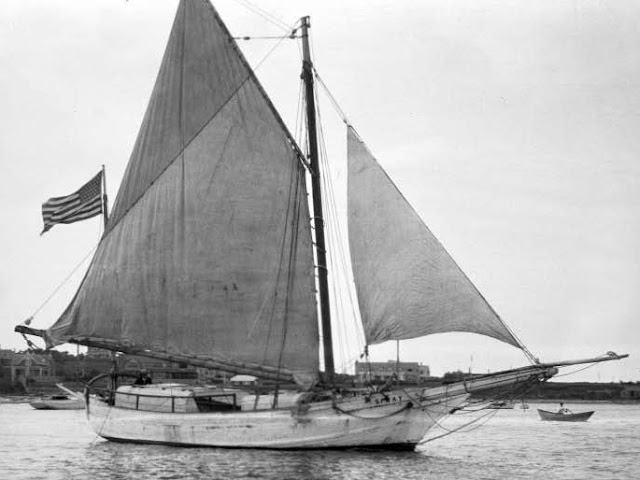


More than three years later, on June 27, 1898, Slocum ended his voyage at Newport, Rhode Island. His route had taken him to Nova Scotia, the Azores, Gibraltar, South America, Samoa, Australia, South Africa and the West Indies. He had sailed 46,000 miles (74,000 km) in three years, two months, and two days.

Astonishingly, his return was almost unhailed – but only because the Spanish-American war was raging at the time and occupying almost everyone’s attention. In fact, the harbour had been mined against the possibility of a Spanish naval attack, adding to Slocum’s difficulties.

Describing the final leg of his incredible journey he wrote: “It was close work but it was safe enough as long as the Spray hugged the rocks, and not the mines.”

Born in 1844 in Nova Scotia, Slocum first went to sea at the age of 16 aboard a merchant ship to Ireland. The sea was then in his blood and he spent the rest of his life travelling to ports around the world. During an extended stay in the US he became a naturalised American citizen.

By 1909, Slocum had told friends that his next adventure would be to explore the Orinoco, Rio Negro and Amazon rivers, but on November 14, that year he set sail in the Spray for the West Indies on one of his usual winter voyages.

He was never seen or heard from again. In July 1910, his wife issued a statement saying she believed that her husband, who had never learnt to swim, was lost at sea. In 1924, Joshua Slocum was legally declared dead.

9 March 2020 - Tha Bak Bomb Boats - Laos


Tha Bak Bomb Boats
 - Laos -

G'day folks,

Lao villagers have recycled bomber fuel tanks from the Vietnam War and turned them into very, very strong boats. 

If you’re familiar with Lao villages, there isn’t much at Tha Bak that stands out from all the others. Yet, if you take your time to stop by the bridge over the Namkading River and look around, you may be able to spot some missile-like boats in the river.


They are not missiles, but their shape is no coincidence, for they used to be fuel tanks on U.S. B-52 bombers, which dropped a massive amount of ordnance all over the region in the 1960s and ’70s, at the height of the Vietnam War. 

The high quality of this wartime scrap metal didn’t go unnoticed, and Tha Bak villagers started turning the spherical debris into boats—very, very durable boats.

It is possible to pay to take a spin in one of these so-called bomb boats. Of note, northwest of Tha Bak is Nam Kading National Diversity Park, and Nam Kading River is a major entry point.  Bomb boats will probably be unable to go past the rapids, but up to that point, it can be an interesting ride.


Clancy's comment: Ingenious and so tough. They certainly won't rust. 

I'm ...