Showing posts with label SHIPS. Show all posts

16 January 2023 - ANCIENT STONE GRAVES SHAPED LIKE SHIPS - SWEDEN


ANCIENT STONE GRAVES 

SHAPED LIKE SHIPS 

- SWEDEN  -


G'day folks,

Welcome to ancient stone graves shaped like ships provided a Viking-like burial to carry the dead to the afterlife. 

Gotland is a Swedish island brimming with ancient structures, from Visby’s medieval city wall to a roughly 5,000-year-old megalithic tomb. Some of the most fascinating sights are the stone burial “ships,” or skeppssättningar, found throughout the island. These ancient gravesites date from the late Bronze Age, between 1100 and 400 BC. 


The boat-shaped stone monuments were generally used as burial spots for an important member of this coastal community. The person would be cremated and their bones beaten to dust. These remains would then be collected in a stone urn and buried inside the ship. It is believed that this was done to equip the dead with everything they had in life and to facilitate the journey to the afterlife.

The stone ships in the village of Gnisvärd are among the best preserved examples of the ritual in Gotland, and one of them is also the largest on the island. Made of around 100 tall stones, it stretches 148 feet (45 meters) long. The site contains three ships in total that are erected one after another as if going in a ghostly precession. The lead ship is pointed toward an ancient megalithic tomb, the only one in Gotland. Archaeologists believe this was done to “moor” the newer graves to an old revered place.

6 November 2022 - THE HEROINE OF DUNKIRK


THE HEROINE 

OF DUNKIRK


G'day folks,

The "Heroine of Dunkirk" rescued over 7,000 Allied troops during the historic World War II evacuation. 

In May of 1940, hundreds of thousands of Allied troops found themselves stranded on the beaches of Dunkirk, France. The German forces had cut them off and surrounded them, leaving them trapped between their encroaching enemies and the sea. All hope seemed lost, until a fleet of over 800 civilian boats and ships were mobilized in a miraculous rescue effort to evacuate the stranded soldiers.

The civilian fleet was able to rescue around 338,000 trapped Allied soldiers from the hands of the advancing German forces. Over 7,000 were transported across the channel by a single vessel, the PS Medway Queen paddle steamer. The ship’s role in the historic rescue earned it the well-deserved nickname of the “Heroine of Dunkirk.” Its service was so well respected that when the person contracted to scrap the ship found out its history, he refused to finish the job.


One of 20 paddle steamers that participated in the evacuation, the Medway Queen made seven trips, more than any other small vessel. On its last trip, while alongside the dock in Dunkirk, one of the ship’s paddle boxes was badly damaged in a collision with a destroyer that had been displaced by the force of an explosion. Medway Queen limped home carrying 400 members of the French rearguard.

The ship wasn’t destined to be a wartime vessel. It was built in 1924 in Troon, Scotland, for use as a ferry. It served on the Medway and the Thames Estuary before being requisitioned in World War II as a minesweeper. However, it was the ship’s role in the Dunkirk evacuation that earned it a place in British maritime history.

After the war, the ship returned to civilian use until 1963, when it was due to be scrapped in Belgium. However, when the ship breaker heard that Medway Queen had taken part at Dunkirk, he refused to continue with the job. The ship was sold and used as a floating restaurant and nightclub on the Isle of Wight until it was replaced by a bigger vessel in 1970. Under private ownership, the hull started to leak and the ship sank in the River Medina in 1978, where it remained until it was recovered in 1984.

After nearly two decades, the ship was eventually restored to its former glory in 2013.  Although mobile, Medway Queen is now tied up as a museum ship alongside Gillingham Pier. It’s the last remaining mobile estuary paddle steamer in the United Kingdom.

27 July 2022 - SHIP OF GOLD DISAPPEARS


SHIP OF 

GOLD DISAPPEARS


G'day folks,

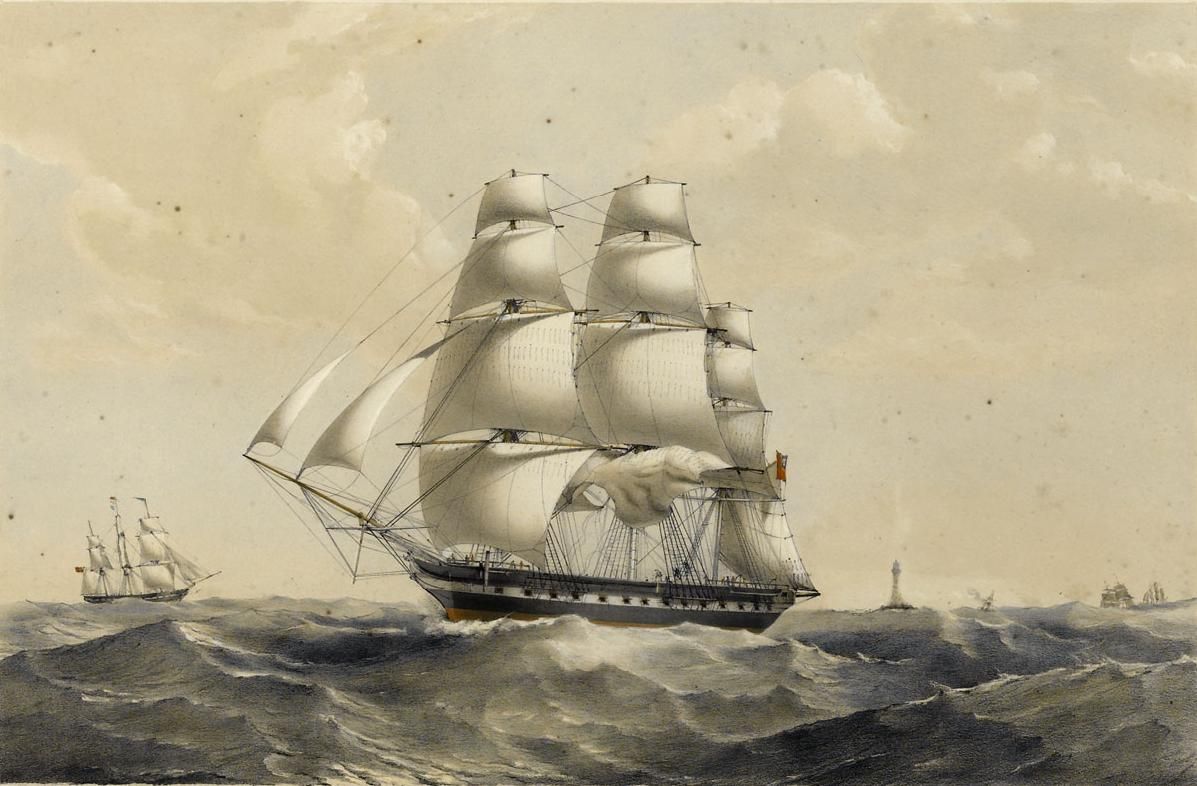
 The frigate Madagascar left Melbourne for London in 1853 with more than 150 passengers and crew. She also had nearly three tons of gold on board – and was never seen again.

The Madagascar was a sturdy British merchant vessel built in 1837, used for carrying soldiers to India as well as passengers looking for an exotic holiday on the Indian sub-continent.

But by the 1850s, Victoria was in the grip of a gold rush and the Madagascar found it had a new role. Instead of being packed with troops for India, the ship was crammed with would-be pan-handlers and rock-pickers heading for Melbourne, convinced that there were fortunes to be made.

So much so, that after arrival in Melbourne in 1853, 14 members of the crew resigned after deciding to stay in Australia. Captain Fortescue William Harris could find only three replacements for the return journey. The skeleton crew faced a busy time of it because 110 passengers had signed up to travel back to England.

In the hold, the Madagascar carried a box of specie, eight boxes of silver, nine boxes of sovereigns (about 60,000 gold coins), 86 boxes of gold dust and nuggets, making a total weight of 68,390 ounces (nearly three tons) and all valued at about £250,000.

In addition, a large cargo of flour, rice, wool and timber was taken on board.

Preparations to sail on August 10 were dramatically interrupted when police came on board and began to search the vessel. A bushranger called John Francis was arrested on a charge of robbery, and Captain Harris was told to delay his departure.


The following day two other passengers were arrested on related charges. The ship was allowed to sail on the afternoon of August 12. It left the port, never to be seen again.

There has been much speculation about what happened to the Madagascar. One theory is that the wool on board spontaneously combusted – such a tragedy had happened before. There was the possibility that the ship had been wrecked by a freak wave or, Titanic-style, sunk after colliding with an iceberg.

There was also a growing belief that criminals on board, undetected by the police in port, had taken over the ship. But a more plausible explanation is that the vessel was the victim of pirates who would have sunk the Madagascar after relieving it of its treasure.

In 1997 Australian researcher Gerald Crowley discovered artefacts – knives, spoons, nails, and so on – on the remote atoll of Anuanuaro in French Polynesia. He believes they are from the Madagascar.

His theory is that the ship was hijacked in the Pacific, turned north, and sunk on the atoll, 1,500 kilometres south-east of Tahiti.

"There's a wreck there. We're beyond doubt," he said a few years later . . .“but I can't prove it.”


19 April 2022 - BA 64 - THE OLDEST STEEL SHIP IN ICELAND


BA 64

 - THE OLDEST STEEL 

SHIP IN ICELAND -


G'day folks,

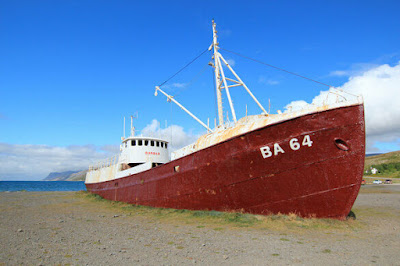
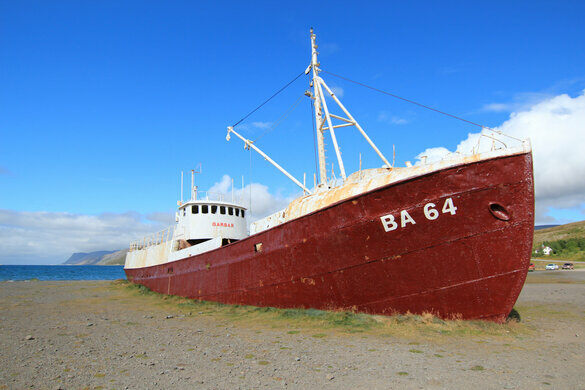
The oldest steel ship in Iceland has been beached for years and is now a rusting ruin. 

Launched the same year that the Titanic met its final fate, the whaling ship that came to be known as Garðar BA 64 was a hulking hybrid of a ship, having both a powerful steam engine in addition to traditional sails.

Originally known as the Globe IV, the large ship was completed in Norway in 1912 as a state-of-the-art-at-the-time whaling vessel. The hull was specially reinforced to break through the icy Southern seas in which it operated and the powerful engine kept the boat sailing even in calm waters. During its active lifetime it was sold around to a number of different countries before finding an Icelandic owner after World War II. Once whaling restrictions became more widespread, Garðar BA 64 (a name it finally received in 1963) was used for fishing herring in the waters off of Iceland. 


 After decades in faithful service to its bevy of owners, Garðar BA 64 was finally deemed unsafe for service in 1981 and as opposed to being scuttled, the old ship was run aground in Skápadalur Valley where it remains to this day, falling apart bit by bit. It is now a popular site for photographers and anyone looking for a lovely mix of Icelandic scenery and industrial ruin.
 
 
Clancy's comment: An old warrior laid to rest.

I'm...


27 March 2022 - POLLY WOODSIDE - AUSTRALIA


POLLY WOODSIDE

 - AUSTRALIA -


G'day folks,

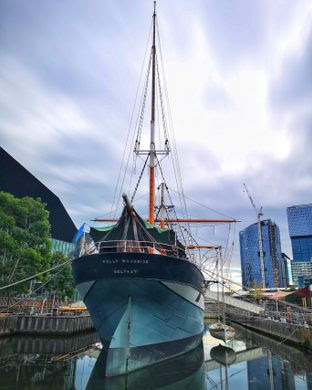
This historic tall ship traveled 1.5 million miles around the globe, and once did duty as the mythical pirate ship in Peter Pan. 

Launched from the same Belfast shipyards some 25 years before the Titanic, the Polly Woodside was a three-masted, iron-hulled barque designed not for luxury but as a global workhorse, and it ended its days as an ignominious coal lighter in Melbourne.

With only maps, compass, and a sextant to rely on, some ships left on a voyage and were never seen again, though the Polly had an exceptional safety record: Only eight sailors met their end on her watch.

The Polly was little more than a wreck when it was saved and restored by National Trust of Australia volunteers as the last of its kind. The ship was restored to 90 percent accuracy from recreated blueprints, and opened as a living museum in 1978.


It is docked permanently alongside a small but excellent museum, which has many mementos from crew life onboard including diaries, letters, pictures, flags, sails and tools.

Once onboard you can smell the tar still used to waterproof the deck, and then see how the officers and regular crew lived uncomfortable lives—a separate bathroom being a luxury only the captain was allowed.

If it’s windy day you might hear the thrash of rigging, or below deck, the creaking groan of the wood.    

Post-retirement, the Polly had a brush with the big screen when she was temporarily renamed the Jolly Roger when Australian actors Hugh Jackman and Levi Miller did press for Pan, the 2015 family fantasy movie retelling of the classic tale by J. M. Barrie.

Clancy's comment: I visited this ship many years ago and was very impressed. 

I'm ...


26 March 2022 - MILLIONAIRE SAVED KIDS ON THE LUSITANIA


MILLIONAIRE SAVED 

KIDS ON THE LUSITANIA


G'day folks,

American multi-millionaire Alfred Vanderbilt died a hero trying to save women and children aboard the liner Lusitania, which was sunk by a German U-boat in 1915.

The ship, owned by the Cunard Line, was built to dominate the highly lucrative transatlantic passenger trade. Launched in 1906, it was completed the following year as the largest ship in the world weighing 31,550 tons.

The maiden voyage of the 787 feet (240 metres)-long liner took place on September 7, 1907, when she sailed from Liverpool in England to New York City. On this day the ship was reversing that voyage and was heading to the UK from New York with 1,959 passengers and crew on board.

But it was the time of the First World War and Germany, with a formidable fleet of submarines – or U-boats – was attempting to stop vital supplies reaching the UK across the Atlantic. Germany had declared the seas around the UK a war zone and warned that Allied ships in the area would be sunk without warning.

Nobody seriously thought this threat would apply to a non-military luxury passenger liner such as the Lusitania, especially as she would be bound to have many neutral Americans on board.

But Germany took a different view and its embassy in the United States had placed a warning in 50 American newspapers, including those in New York, explaining the dangers of sailing to the UK. It read:

Notice!

Travellers intending to embark on the Atlantic voyage are reminded that a state of war exists between Germany and her allies and Great Britain and her allies; that the zone of war includes the waters adjacent to the British Isles; that, in accordance with formal notice given by the Imperial German Government, vessels flying the flag of Great Britain, or any of her allies, are liable to destruction in those waters and that travellers sailing in the war zone on the ships of Great Britain or her allies do so at their own risk.

Imperial German Embassy Washington, D.C., 22 April 1915.

Some New York newspapers had printed the warning directly next to Cunard’s list of departure dates, and as the Lusitania got under way the dock was crowded with reporters. They saw that despite the German threat the ship was packed with passengers.

Clearly they believed that a luxury liner with no obvious military value would not be a target. Two other factors boosted confidence. First, Cunard had declared the Lusitania to be the “fastest and largest steamer now in the Atlantic service”. So, in the highly unlikely event of a threat, it was thought, she could outpace any German vessel and thus escape danger.

Secondly, several rich and famous people such as Alfred Gwynne Vanderbilt and wine merchant George “Champagne King” Kessler had come on board, inspiring confidence. Obviously they would have had access to high-level information warning them if danger really did exist.


William Turner, the captain of the Lusitania, known as "Bowler Bill" because he usually wore a bowler hat when ashore, received advice from the British Admiralty on how to avoid making his ship an easy target. He was urged to alter course every few minutes at irregular intervals so that the evasive tactic of zigzagging would thwart any attempt by U-boats to plot the Lusitania’s course.

Captain Turner ignored the advice and on the afternoon of May 7, just off a headland near Kinsale, County Cork, Ireland, a torpedo fired by a German U-boat exploded amidships on the Lusitania’s starboard side. It was followed by a second explosion, possibly caused by damage to the ship’s steam engines.

Eighteen minutes later, the Lusitania had disappeared beneath the waves and 1,198 people, including 128 American citizens, were drowned. Of the 1,959 passengers and crew only 761 survived.

The victims included Alfred Vanderbilt who, during those 18 minutes, had performed extraordinary acts of courage. He could not swim but made no attempt to push through the crowd and get into a lifeboat.

Instead, he and his valet calmly helped several women and children to safety. According to reports a steward saw Vanderbilt “vainly attempting to rescue a hysterical woman” and shouted to him: “Hurry Mr. Vanderbilt, or it will be too late!” Vanderbilt did not listen and continued to help women and children.

A report in the New York Times four days later told of how a woman passenger overheard the tycoon say to his valet: “Find all the kiddies you can.” According to the report the man rushed off collecting children and as he brought them to Vanderbilt “the millionaire dashed to the boats with two little ones in his arms at a time.”

The report added that “when he could find no more children he went to the assistance of the women and placed as many as he could safely in the boats. He continued his efforts until the very end.”

Vanderbilt was last seen helping a nurse put on a lifebelt, but before he could finish securing it they were both washed off the deck. The body of the 37-year-old millionaire was never found.

President Woodrow Wilson had announced at the start of the war that the United States would remain neutral and he was supported by a majority of the American people.

But the sinking of the liner and the loss of so many passengers, including those 128 Americans, caused a wave of indignation across the  United States and it was expected that a declaration of war would follow. The Government, however, clung to its policy of neutrality and its reaction to the sinking simply amounted to three separate notes being sent to Berlin condemning the German submarine war policy.

To placate America, the Germans gave an informal assurance to President Wilson that there would be no repeat of the Lusitania incident and they would end their “sink on sight” policy. They did so on September 18, 1915.

It was, however, re-introduced on February 1, 1917 and by April of that year, five American merchant ships had been sunk, causing the United States to declare war. The sinking of the Lusitania became an iconic symbol in military recruiting campaigns.

Alfred Vanderbilt’s grandson grew up on stories of his grandfather’s gallantry. As a 65-year-old public relations executive, Alfred Vanderbilt III told the Irish Times in April, 2021: “He spent his last minutes trying to save the children on the Lusitania. I can’t think of anybody braver. How do you do that?”

Answering his own question, the grandson added: “He had been brought up to do the right thing. He saw his moment and he took it. What I have heard from my family over and over again is what a wonderful man he was. It is not as if he was a bad guy who got a good reputation because of his death. He was really a loving and caring man.”


Clancy's comment: Very interesting. I bet many would not be so heroic.

I'm ...


6 May 2021 - INTERESTING FACTS ABOUT THE TITANIC


INTERESTING FACTS 

ABOUT THE TITANIC

G'day folks,

We've all heard about it, but here are some interesting facts.

April 15, 1912 — On her maiden voyage from Southampton to New York, the passenger liner Titanic hit an iceberg and sank on this day in history, resulting in the world’s worst peacetime shipping disaster.

Five days earlier the toweringly impressive ship — eleven storeys high, a sixth of a mile long and weighing 46,328 gross tons — slipped her moorings at Southampton to the cheers of awestruck crowds. She was the pride of the White Star Line, the biggest ship the world had seen, and certainly the best.

 For a single crossing the “millionaire suites” cost up to £870 ($1,200) — equivalent to about £44,000 ($62,000) today — and were designed, as one newspaper reported, “for the financial giants of our time: men who could lightly pay for this single voyage the year’s keep of ten British families.”

There was no shortage of takers for the ship's wondrous facilities. Leaders of industry, finance and commerce and figures from British and European aristocracy were joined by members of some of the wealthiest families in the United States.

They included Benjamin Guggenheim, whose fortune lay in mining, smelting and banking; Isidor Straus, whose money came from commerce and banking and his partnership in the famous Macy's department store; George Widener, son of tramway magnate P A B Widener, said to be the wealthiest man in Philadelphia; Charles Melville Hays, president of the Canadian Grand Truck Railroad; and John Jacob Astor, perhaps unkindly described by one journalist as “the world's greatest monument to unearned income.”

Astor had divorced in 1909 and two years later, at the age of 45, married 18-year-old Madeleine Force, a girl younger than his son, Vincent. Society was outraged and Astor went abroad with his young bride to escape criticism. They were now returning, Madeleine five months’ pregnant and Astor anxiously wondering if he would be able to regain his old position in New York society.

They and some 2,200 other souls were enjoying their sumptuous surroundings when, at 11.40pm on the fifth night out, lookout Fred Fleet, peering from the crow’s nest into a calm, clear night bursting with stars, spotted something directly ahead.


Walter Lord, in his book A Night to Remember, tells dramatically what happened next: “At first it was small, but every second it grew larger and closer. Quickly, Fleet banged the crow’s nest bell three times — the warning of danger ahead. At the same time he phoned the bridge. ‘What did you see?’ asked a calm voice at the other end. ‘Iceberg right ahead,’ replied Fleet.

“For the next 37 seconds Fleet watched the ice draw nearer. Now they were almost on top of it and still the ship didn’t turn. The ‘berg towered wet and glistening far above the forecastle deck and Fleet braced himself for a crash. Then, miraculously, the bow began to swing to port. At the last second the stern shot into the clear and the ice scraped swiftly by along the starboard side. It looked to Fleet like a close shave.”

He was mistaken. The jarring of a collision brought Captain Edward J Smith rushing from his cabin to the bridge, resulting in an exchange recounted at the subsequent inquiry in New York: “Mr Murdoch, what was that?”

“An iceberg, sir. I hard-a-starboarded and reversed the engines and I was going to hard-a-port around it, but she was too close.”

“Close the emergency doors,” Smith snapped. But First Officer William Murdoch had already thrown the switch that sent the massive doors crashing into place. The ship was divided into 16 watertight compartments which could be sealed by these doors in the event of an accident. This feature, in addition to the Titanic’s double bottom, prompted the Shipbuilder magazine to describe the great vessel, in what turned out to be a haunting epitaph, as “practically unsinkable.”

More colourfully, passenger Mrs Albert Caldwell, who boarded at Southampton, remembered asking a crewman if the ship really was safe. “Lady,” he replied, “God himself could not sink this ship.”

Thomas Andrews, managing director of Harland & Wolff, builders of the ship, made a tour of inspection and found that the first five compartments were flooding, suggesting a 300ft gash.

Andrews, wrote Walter Lord, explained to the captain what this meant: “The Titanic can float with any two of her 16 compartments flooded. She can even float with her first four compartments gone, but she cannot float with her first five compartments full.

"The bow will sink so low that water in the fifth compartment must overflow into the sixth. When this is full, it will overflow into the seventh, and so on. It is a mathematical certainty — the ship is doomed.”

As the crew began loading passengers into the pitifully few lifeboats, Second Officer Charles Lightoller was supervising the loading on a strict “women and children only” basis. He was at the centre of a much reported incident when John Jacob Astor helped his wife into boat No 4 then asked if he could join her. “She is,” he said, “in a delicate position.”

“No, sir,” Lightoller told him. “No men are allowed in these boats until the women are loaded first.” Astor had a fortune of $4,250 cash in his pocket at this time. “It was about as much use to him,” wrote Geoffrey Marcus in The Maiden Voyage, “as the $150 million he possessed ashore.”

There were 16 lifeboats, plus four “collapsibles”. Altogether, they could carry 1,178 people. But there were more than 2,200 aboard the Titanic.

One man who did step into a boat — he insisted at the subsequent British and American inquiries that it was being lowered, there was room in it and there was no one else around — was the White Star Line chairman J Bruce Ismay.

He later came under fierce criticism, summed up by Rear Admiral A T Mahan, speaking to reporters: “So long as there was a soul that could be saved, the obligation lay upon Mr Ismay that that one person — and not he — should have been in the boat.”

While the drama was unfolding, members of the ship’s orchestra helped to keep up morale by playing ragtime tunes. One of the myths that grew was that as the ship went down the musicians played the hymn Nearer My God to Thee.


Clancy's comment: Interesting accounts at the time. Bigger ain't always better, eh?

I'm ...