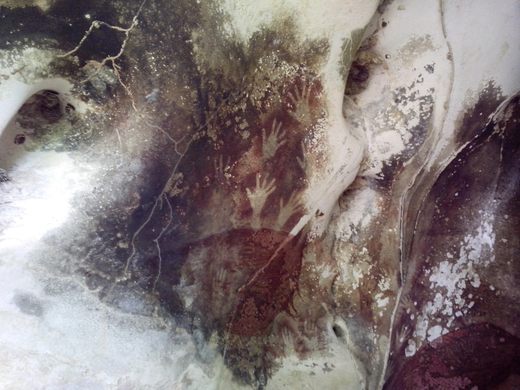
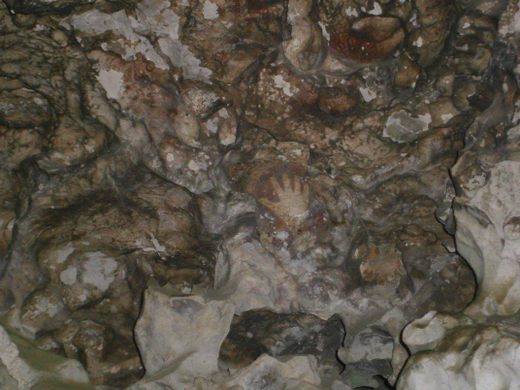
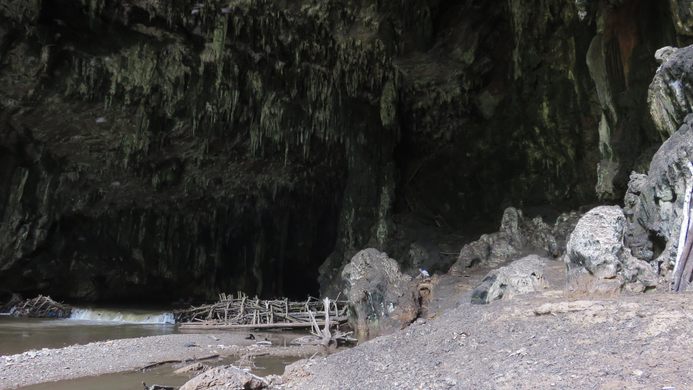
Uncovered in 1989, this jungle cave in the Tapir Mountain Nature Reserve is accessible via an hour’s ride from San Ignacio, Belize,
and a walk for another hour across shallow rivers and through jungle.
Here one arrives at the Actun Tunichil Muknal or “ATM” cave mouth. To
gain access to the cave, one must swim in and then wade up the cave
river for another kilometer.
Walking a further kilometer and a half in the cave, past huge
boulders and cavernous rooms (one known as “The Cathedral”), to the back
of the cave system, you find the skeletons of the ritual sacrifices
made by the Maya to their gods more than a thousand years ago.
The skeletons range in age from one year old to adult. Four of those
sacrificed are infants between the ages of one and three, some stuffed
into crevices and small adjoining caves. There is one child of seven, a
teenager of 15 (who appears to have been bound before being killed), a
20-year-old, and numerous adults between the ages of 30 and 45. Many of
the younger skeletons show signs of cranial deformation or “skull
shaping,” giving their heads a slightly elongated alien look.
Almost all were killed by blunt trauma to the head—some had their
entire skulls crushed. While the precise dating of the skeletons is
difficult (due to their being essentially cemented to the cave floor by
calcite) most of the pottery found at the site dates from between 700
and 900 AD, which is likely when the bodies found here were sacrificed.
Farther into the cave is perhaps the most famous of these long-dead
Maya: the skeleton of a 17-year-old boy best known as the “The Crystal
Maiden.” Though the owner of the skeleton was initially believed to be a
female (due to its small size and slight frame), closer examination of
the bones has revealed features that suggest they were male. (Some tour
guides allegedly refer to it as “The Crystal Prince.”)
The skeleton is unique in its positioning and the fact that two
vertebrae are crushed. Researchers believe this person may have died in a
particularly violent manner before being thrown or tossed onto the
ground, where their body has lain for at least the last 1,100 years. The
skeleton has been there so long, in fact, that it has completely
calcified, giving the bones a sparkling, slightly plump look that
inspired the crystalline nickname.
It is unknown what the circumstances of the sacrifices were, though
some believe they were to appease the rain god Chac, or possibly the
gods of the underworld. Another theory holds that these were believed to
be witches (possibly suffering from some kind of mental or physical
ailments) and that leaving them unburied in the cave would ensure that
their spirits were trapped there.
Other items found in the cave include ceramics, marked with “kill
holes,” and cave formations carved by the Maya, such as silhouettes of
faces and animals. The cave is also home to Amblypygi or “whip spiders”
and other predatory spiders.
Due to the inaccessibility and the calcification process of the cave,
many of the relics have been preserved just as they were left and very
little has been removed from the cave since it was discovered. (Some
things were looted early on.)
The name Actun Tunichil Muknal translates as “Cave
of the Crystal Sepulchre,” and the locals know it as “Xibalba” after the
Mayan underworld. The Crystal Cave was traditionally believed to be an
entrance to hell, a deep fissure in the earth filled with rivers of
blood and scorpions. This was the domain of the Mayan death gods, the
subterranean court of the Lords of Xibalba. Often referred to as demons,
these 12 deities had names like “Stabbing Demon” and “Skull Staff,” and
inflicted a range of maladies on people including sickness, pain, and
fear.
ATM cave is one of the few protected places in Belize, with only a
few guides authorized to lead tours. Be very careful, however, as none
of the skeletons or pottery are roped off, and one tourist has already
accidentally stepped on and broken one of the skulls.