Showing posts with label NAZISM. Show all posts

29 October 2022 - NAZI CONCENTRATION CAMP MEMORIAL - FRANCE


NAZI CONCENTRATION 

CAMP MEMORIAL 

 - FRANCE -


G'day folks,

Today, this former Nazi concentration camp stands as a poignant memorial to the victims of fascism, and a warning from history. 

Surrounded by the picturesque forests of Alsace sprawls a sinister leftover of the Nazi occupation of France, the Natzweiler-Struthof concentration camp. Prior to the arrival of Nazi occupying forces, this area was commonly used by local Alsatian people as a popular spot for picnics during summer and in winter such activities as skiing and sledging, however, the German invasion of France put an end to all that. 


The geology of the area had been identified as being of great strategic interest to the Nazis even before their invasion of France, due to the pink granite that could be mined there. (This type of granite was a favored building material of the edifices and monuments of the Nazi period).

The remoteness of this site had also been recognized as an “ideal location” for a concentration camp. In 1941, after the invasion and occupation of France, Natzweiler-Struthof was constructed on the personal orders of Heinrich Himmler, the head of the SS.

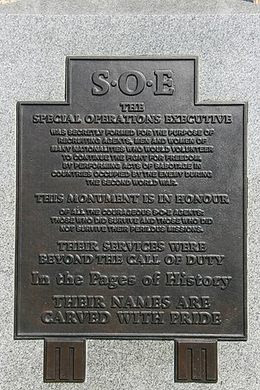
Natzweiler-Struthof was a camp used primarily for the internment of political opponents of the Nazi regime in the German-occupied territories of Western Europe such as captured French, Dutch, Belgian and Scandinavian resistance fighters. It was also to be the final destination of British spies and agents of the S.O.E. who had been captured and interrogated.

Such prisoners were classified by the Nazis as being “Nacht und Nebel” (“Night and Fog”), because upon arrest by the Gestapo or SS they would be sent directly to a concentration camp (thus “vanishing into night and fog”) without their families having ever being informed of their whereabouts. These measures were intended by the Nazis to prevent resistance figures from being made into “martyrs” and to discourage popular support for resistance, which they greatly feared.


Prisoners sent to Natzweiler-Struthof camp would either be immediately executed or worked to death slowly through starvation over an extended period in which they were forced to produce war munitions or to labor in the mining of granite, which would then be sent by rail back to Germany.

As the Nazis began to face defeat and the Allied forces pushed eastward into the Alsace region, the camps were largely abandoned. Prisoners were evacuated and sent on a death march into Germany to the larger camps of Auchswitz and Dachau.

From 1941 to 1944. approximately 52,000 prisoners ended up in Natzweiler-Struthof camp. Some 22,000 met their deaths here, including the famous French resistance leaders Andree Borrell and Charles Delestraint and S.O.E agents such as Vera Leigh, Diana Rowden, and Sonia Olschanezky.

A famous survivor of the camp was the Slovenian writer Boris Pahor who wrote poignantly of his experiences as a prisoner at Natzweiler-Struthof in his moving autobiographical novel Necropolis, published in 1967.


28 October 2022 - KALAVRYTA SACRIFICE MEMORIAL - GREECE


KALAVRYTA 

SACRIFICE MEMORIAL 

- GREECE -


G'day folks,

Here is a solemn reminder of the infamous World War II war crime that massacred almost all the men in a small Greek town. 

In October 1943, Greek People’s Liberation Army guerrillas captured 77 German soldiers on a patrol mission, following an ambush in the mountains outside Kalavryta, southern Greece. After negotiations for a prisoner exchange failed, the captives were executed in a local ravine, with only two making a lucky escape undetected. 

In response, commanding General Karl Von Le Suire ordered Unternehmen Kalavryta, a guerrilla cleanup operation that  included terrible reprisals aimed at the local civilian population. Troops from the 117th Jaeger Division, a unit with previous counter insurgency experience in what was then occupied Yugoslavia, converged to the town of Kalavryta from all directions, burning and looting 50 villages along the way and executing 143 male civilians.


Upon reaching Kalavryta on December 13, 1943, the soldiers began setting the town ablaze. They then gathered the town’s entire population at the schoolyard and separated them in two groups. All able men age 13 and upward were led to a hill outside the town, while women, the elderly, and small children were locked inside the schoolhouse. 

At noon, the schoolhouse was set on fire with over 200 people inside, while at the hill, the soldiers began executing the 461 men by machine gun fire. The action was coordinated by flares, so the men would die in full view of the burning town, and within earshot of the screaming women, children, and elders, now surrounded by flames. While the execution was taking place on the hill, the panicked, choking prisoners managed to smash through the school’s doors and escape in a frantic stampede, while others threw their children outside the windows of the burning building to save them. 


Only 13 men survived the execution, injured or hiding under the bodies of the dead, while soldiers roamed the hill, delivering the coup-de-grace. After the soldiers’ departure, the escaped women, children, and elderly reached the blood-soaked hillside, where they discovered the grim fate of their male relations. Without any tools or farm animals left in their looted households, they began dragging the bodies to the cemetery nearby or digging shallow graves with their hands. 

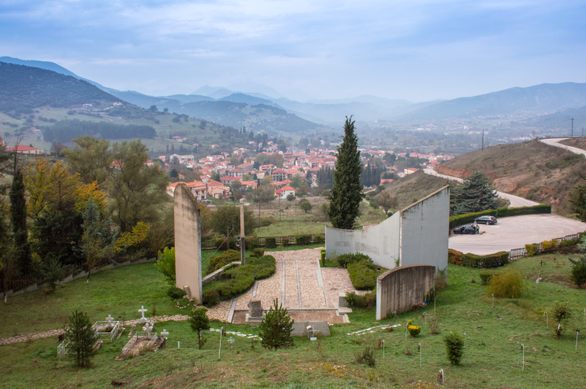
Today, a solemn memorial complex stands on the hill where the execution took place. It includes a large cross, ossuary, the harrowing sculpture of a lamenting woman of Kalavryta, as well as some on-the-spot graves that remained on site since that day. The Kalavryta schoolhouse has been converted to a museum displaying everyday and personal items that survived the town’s destruction, as well as photos and eyewitness accounts that testify to the atrocious conduct of the 117th Jaeger Division.   

27 October 2022 - STATUE TO HONOUR SECRET AGENTS - ENGLAND


STATUE TO HONOUR 

SECRET AGENTS 

- ENGLAND -


G'day folks,

Here, a bronze bust commemorates the heroism of the secret agents who led covert operations against the Nazis. 

Only a short distance from the headquarters of the MI6, the British secret intelligence service, stands a small plinth topped by the bronze bust of a defiant-looking young woman. In a city full of monuments this rather unassuming memorial is often passed by, barely inviting a disinterested glance from pedestrians. But it shouldn’t be.

Behind this monument is a moving story that commemorates the heroism of the men and women who served as secret agents and risked their lives to defeat the Nazis during World War II. One such woman was Violette Szabo, who sacrificed her life in the field in order to fight fascism. 

Born in 1921 in Paris, Szabo grew up in London during the Great Depression. At the outbreak of the Second World War, she joined the Women’s Land Army and the Auxillary Territorial Service where she met and married a Free French corps soldier and gave birth to a daughter. Szabo’s husband was later drafted to North Africa where he was killed in action during the battle of El Alamein, an event that led Szabo to join the Special Operation Executive (S.O.E.) intelligence agency.


Due to her fluency in French, Szabo was considered to be a valuable asset for the wartime intelligence operations and underwent extensive training as a field agent, learning everything from how to conduct espionage and reconnaissance missions, to how to use effective sabotage skills, weapons, and explosives in guerilla warfare. She embarked on her first mission to Nazi-occupied France in 1944 to gather intelligence on local factories that were being used to produce war materials. It was hoped that any information gathered from behind enemy lines would greatly improve allied strategic bombing raids and buy valuable time for Britain. The operation, however, did not go to plan. The Gestapo captured and interrogated a British spy who under torture revealed sensitive information.

With the mission compromised, Szabo and her team were forced to hurriedly return to England in an RAF spy plane before the SS could hunt them down. During the escape, the plane was almost shot down by several Nazi anti-aircraft guns but luckily managed to reach the safety of England.


Only two months later, Szabo was back in the field for her second mission, which was to act as liaison with a group of local French-resistance partisans and to lead operations in sabotaging German communication lines. The mission was of top strategic importance to the Allied forces as its objective was to delay the Nazi military response to the Normandy D-Day landings, which were then imminent. Under cover of darkness, Szabo was parachuted behind enemy lines with two fellow spies and made contact with the resistance, but it became immediately apparent that the S.O.E. had vastly overestimated the capability of the partisans. 

It was therefore decided that Szabo should be transferred to another resistance unit further south, and she set off right away. But due to poor intelligence gathered by the partisans, the group was unaware an SS unit was close by. What’s more, the resistance’s insistence on using cars for travel meant they naturally aroused the suspicions of the German forces. Upon meeting a roadblock the car was stopped, and realizing they were trapped, the spies fled from the car on foot into nearby fields with the soldiers in hot pursuit.  

Szabo twisted her foot while running and, unable to keep up, encouraged the others to run for safety while she kept the Germans pinned down with covering fire from behind an apple tree. Showing enormous bravery she used her Sten submachine gun against the pursuers for over 30 minutes and succeeded in killing a Nazi corporal and wounding several German soldiers, thus allowing her comrades time to escape.  Eventually, however, she ran out of ammunition, and before she could take her life with a cyanide pill was captured and dragged off to be interrogated by the SS. 

A German officer was apparently so impressed with her bravery that he congratulated her and put one of his cigarettes in her mouth offering to light it. Szabo reputedly spat out the cigarette and then spat in his face demanding that her hands be untied so that she could smoke one of her own cigarettes. Her interrogation lasted four hours in which she was subjected to horrific torture and sexual violence before she was sent by train to Ravensbrück concentration camp. 

In Ravensbrück, Szabo endured the inhuman conditions and harsh physical labor with an indomitable resilience, and even kept up the morale of the other imprisoned resistance fighters by beginning to organize an escape from the camp. Unfortunately, in February 1945 the Germans discovered her plans and she was taken to the execution block where she was shot and killed. Szabo was only 23 years old when she died, but in her short life she had shown tremendous bravery in her devotion to the cause of defeating fascism. 

28 May 2022 - ANNE FRANK'S DIARY


ANNE FRANK'S

 DIARY


G'day folks,

Anne Frank received a present on her 13th birthday. It was a diary and the entries she would go on to make in it would make her tragically short life an inspiration to millions. 

Her first words, written on that day, were: “I hope I shall be able to confide in you completely, as I have never been able to do in anyone before, and I hope that you will be a great support and comfort to me.”

The daughter of a Jewish industrialist, Anne was born in 1929 as Annelies Marie Frank at Frankfurt, Germany. Her father, Otto, was a German businessman who served as a lieutenant in the German army during the First World War.

But amid rising anti-Semitism and Nazi persecution of Jews, Otto moved his family to Amsterdam in the autumn of 1933. The Franks were among 300,000 Jews who fled Germany between 1933 and 1939.

In Amsterdam Otto ran a company called Opekta that sold spices and pectin used in the manufacture of jam.

Anne and her sister Margot went to a local school and were relatively happy. That began to change on 10 May 1940 when the German army invaded the Netherlands.

Two years later, on 5 July 1942, Margot received an official summons to report to a Nazi work camp. Her father was having none of it so the next day the Frank family went into hiding, moving into a secret annex in the offices of Otto's company.

Hiding alongside them were another Jewish family and, later, a Jewish dentist. They all spent two years in this hiding place, never once stepping outside. The entrance to the annex was concealed by a large bookcase.

Four of Otto’s loyal employees brought food and other necessities as well as news about the outside world. They knew that if they were caught they would be executed for helping Jews, but they did it anyway.

Anne passed much of the time reading and writing in her diary. She started each entry with the words “Dear Kitty”, an imaginary friend. Written over the course of two years, the diary details the time that her family spent in hiding as well as the feelings of a frustrated and “ordinary” teenager, struggling to live in a confined space.

For all its passages of despair, the diary is essentially a story of faith, hope and love in the face of hate. On 15 July 1944 Anne wrote: “It's difficult in times like these: ideals, dreams and cherished hopes rise within us, only to be crushed by grim reality. It's a wonder I haven't abandoned all my ideals, they seem so absurd and impractical. Yet I cling to them because I still believe, in spite of everything, that people are truly good at heart.

“It’s utterly impossible for me to build my life on a foundation of chaos, suffering and death. I see the world being slowly transformed into a wilderness, I hear the approaching thunder that, one day, will destroy us too, I feel the suffering of millions.

“And yet, when I look up at the sky, I somehow feel that everything will change for the better, that this cruelty too will end, that peace and tranquility will return once more. In the meantime, I must hold on to my ideals. Perhaps the day will come when I’ll be able to realise them!”

Anne’s suffering was to take a decisive plunge on the morning of 4 August 1944 when the Gestapo stormed into the secret annex and arrested everyone inside. For years it was believed that someone called the Germans and told them that Jews were living in the Opekta premises.

However, the identity of this alleged caller was never confirmed and a later theory suggests that the Nazis may have discovered the annex by accident while investigating reports of ration-coupon fraud and illegal employment at Opekta.

The occupants of the annex were taken to a transit camp in the Netherlands. Because they were in hiding when arrested they were considered to be criminals and were punished with hard labour.


Then it was on to the notorious Auschwitz concentration camp in Poland. Upon arrival at Auschwitz, all men were separated from their families and all prisoners considered unfit for work were sent to the gas chambers, along with everyone under the age of fifteen. Anne had turned fifteen three months before being captured so she was spared.

Women and girls not selected for immediate death – Anne being one of them – had to strip naked and were then disinfected. Their heads were shaved and an identity number tattooed on their arms. Anne and Margot spent several months enduring hard labour at Auschwitz, lifting heavy stones and cutting rolls of turf.

During the winter of 1944, the two sisters were transferred to Bergen-Belsen concentration camp in Germany, without their mother, Edith, who fell ill and died of hunger at Auschwitz.

At Bergen-Belsen diseases such as typhoid fever raged through the camp and in early 1945 a typhus epidemic killed about 17,000 prisoners including, it is believed, Anne and Margot – just a few weeks before the camp was liberated by British forces. The exact date of Anne’s death is not known but it is thought she died in either February or March of that year.

Otto was held at Auschwitz until its liberation in January 1945 and afterwards returned to Amsterdam, learning of his wife’s death en route. He learned of his daughters’ deaths in July 1945 after meeting a woman who had been at Bergen-Belsen with them.

Following the arrest of those in the annex, Anne’s diary was retrieved by Miep Gies, one of the trusted friends who had helped the Franks during their time in hiding. Gies gave the diary to Otto in July 1945 following confirmation of Anne’s death by the Red Cross.

Otto eventually gathered the strength to read it. He was awestruck by what he read and later had it published. "There was revealed a completely different Anne to the child that I had lost," he wrote in a letter. "I had no idea of the depths of her thoughts and feelings."

Published as The Diary of a Young Girl, the work has been translated into as many as 70 languages and more than 30 million copies.

Anne Frank's diary endures, not only because of the remarkable events she described, but due to her extraordinary gifts as a storyteller and her indefatigable spirit through even the most horrific of circumstances.

Clancy's comment: Reading her diary inspired me to visit her home in Amsterdam, but my journey did not stop there ... 

I'm ...


2 March 2022 - SHOES ON THE DANUBE PROMENADE - HUNGARY


SHOES ON THE 

DANUBE PROMENADE 

- HUNGARY -


G'day folks,

A trail of iron footwear stands as a monument to the thousands executed along this riverbank during WWII. 

In October of 1944, Hitler overthrew the leader of the Hungarian government, Miklos Horthy, and replaced him with Ferenc Szalasi.

Szalasi, whose ideology closely followed Hitler’s, immediately established the Arrow Cross Party - a fascist, anti-semitic organization that brutally and publicly terrorized the Jews in Budapest by beating and killing them. Nearly 80,000 Jews were expelled from Hungary in a death march to the Austrian border and approximately 20,000 Jews were brutally shot along the banks of the Danube River. The victims were forced to remove their shoes at gunpoint (shoes being a valuable commodity during World War II) and face their executioner before they were shot without mercy, falling over the edge to be washed away by the freezing waters.


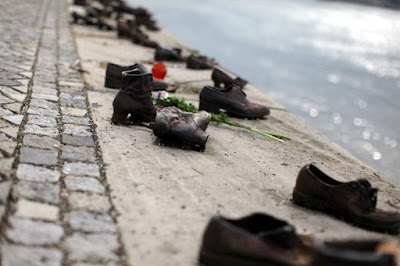
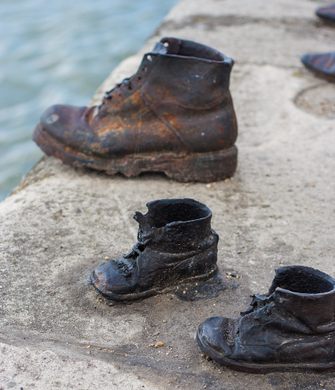
Shoes on the Danube Promenade is a haunting tribute to this horrific time in history, created by film director Can Togay and the sculptor, Gyula Pauer. Installed along the bank of the Danube River in Budapest, the monument consists of 60 pairs of 1940s-style shoes, true to life in size and detail, sculpted out of iron.

This memorial is simple yet chilling, depicting the shoes left behind by the thousands of Jews who were murdered by the Arrow Cross. The style of footwear - a man’s work boot; a business man’s loafer; a woman’s pair of heels; even the tiny shoes of a child - were chosen specifically to illustrate how no one, regardless of age, gender, or occupation was spared. Placed in a casual fashion, as if the people just stepped out of them, these little statues are a grim reminder of the souls who once occupied them - yet they also create a beautiful place of reflection and reverence.

At three points along the memorial are cast iron signs with the following text in Hungarian, English, and Hebrew: “To the memory of the victims shot into the Danube by Arrow Cross militiamen in 1944–45. Erected 16 April 2005.”

Clancy's comment: Lest we forget.

I'm ...


14 May 2014 - ODETTE SANSOM


ODETTE SANSOM

G'day folks,

Today I feature a woman you've probably never heard of - ODETTE SANSOM. Who is she and what was her great claim to fame?


Odette Sansom 1912 – 1995

The spy who worked as an SOE operative in occupied France. Captured and sent to Ravensbruck concentration camp, but survived the war.

Odette Sansom was born in France, but later moved to England. In 1941 she responded to requests by the War Office for people to send photographs of France. These photographs encouraged the War office to recruit Odette into the Special Operations Executive SOE; the SOE was responsible for training agents to be dropped into France.

After receiving basic training in England, she was taken to France by boat in October 1942. For over a year, Odette, using the codename Lise, worked as radio operator, for group leader Peter Churchill. Radio Operators was one of the most dangerous task, as the Gestapo were always on the lookout for radio signals. The fact she survived undetected for over a year is testimony to her care and professionalism.


 Betrayal of Odette Sansom

 She was betrayed by a double agent, 'Colonel Henri' in April 1943. Colonel Henri was a German officer who claimed he wished to work for the allies. Despite, Odette's suspicions, his involvement led to her arrest.


She was taken to Fresnes Prison in Paris, where she was interrogated and tortured on many separate occasions. The torture involved, beatings, having her toe nails torn out and her spine branded by a hot iron. Yet, despite the torture and pressure she remained firm to her story. She maintained she, not Peter Churchill, was the leader; she also refused to give any information about other members. Eventually, she was sentenced to death and sent to Ravensbruck concentration camp for her execution.

However, her execution was never carried out. The Gestapo believe that her 'husband' Peter Churchill was related to Winston Churchill. The SS wanted to keep her as a bargaining tool. During her internment she suffered brutal treatment including long periods of solitary confinement in the dark. But, eventually the camp was overrun and she won her freedom as the Camp commandant tried to use her as a hostage.

After the War 

Despite her appalling treatment, she was not over consumed with bitterness. Instead after the war, she worked for various charities seeking to lessen the pain of war. For her service, she was awarded the George Cross. Her humility meant she was not keen on accepting the award, but she did accept it on behalf of all agents who suffered during the war. She briefly married, Peter Churchill, before marrying her third husband Geoffrey Hallowes. She died in 1995 aged 83.


Quote on Odette Sansom

Of all the women who took part in special operations in France, Odette - as she was universally known in spite of having borne three married surnames in her lifetime - perhaps best symbolized the indomitable spirit of resistance to Nazism. 

Captured by the Gestapo in France and consigned after being cruelly tortured in Paris's notorious Fresnes prison, to Ravensbrück concentration camp, she emerged emaciated, weak and gravely ill at the end of the war. But in the years that followed, her undiminished mental and moral energy, combined with a complete absence of bitterness towards her tormentors and the nation that had spawned them, became a beacon to others who had suffered disfigurement, pain or bereavement. Indeed the theme of her post-war working life, with its service to various charities and help for the underprivileged, was the healing of those wounds, both physical and mental, which had been inflicted upon individuals by the war. 

Her George Cross, she always maintained, was not to be regarded as an award to her personally, but as an acknowledgment of all those known and unknown, alive or dead, who had served the cause of the liberation of France. Her wartime experiences had taught her two great truths; that suffering is an ineluctable part of the human lot, and that the battle against evil is never over. 


 Female SOE Agents in the Second World War

As well as Odette Sansom there were numerous other female 'spies' who served in the SOE as secret agents in occupied France they include:
  • Violette Szabo
  • Andrée Borrel,
  • Sonia Olschanezky,
  • Vera Leigh
  • Diana Rowden.
  • Nancy Wake


Clancy's comment: I've always loved spy stories, especially ones based on fact. This lady showed great courage at a young age.

I'm ...


Think about this!