Showing posts with label NAZIS. Show all posts

8 February 2023 - TATYANA MARKUS MEMORIAL - UKRAINE


TATYANA MARKUS

 MEMORIAL

 - UKRAINE -


G'day folks,

Welcome to a tribute to a Ukrainian heroine who went undercover and killed several Nazi operatives. 

Tatyana Yossifovna Markus was born in Ukraine in 1921 and lived only for 22 years, but within that short span of time, she became a formidable underground agent the Nazis feared.

In 1941, when the Germans entered the city of Kyiv, a young Markus was there to greet them, congratulatory flowers in hand. Instead of graciously handing them over to the triumphant soldiers, she threw them, and the grenades hidden underneath them, at the approaching contingent, killing four soldiers. Her father threw a second grenade, to prevent them from retaliating. 

In the tumultuous times of war, father and daughter had become members of the Kyiv underground, resisting Nazi rule. But her father was caught and killed shortly after the grenade incident.

Markus got further entrenched into the movement and took on the alias of Tatyana or Tatiana Markusidze, the daughter of a Georgian prince who had been killed by the Bolsheviks.

With this tragic (fake) backstory, she purported to hate the Soviet Union and joined the Germans. A young beautiful operative, she won the confidence of several German officials and gathered information that helped the Ukrainian rebels kill them. She even worked in a German officers’ mess and often lured soldiers into isolated areas and killed them herself.


With a number of Nazi soldiers dead, the Gestapo launched an operation to identify and catch her. As she was escaping, in August 1942, she was caught and interrogated brutally for more than five months, which intensified when her Jewish identity was discovered. But despite the torture, she refused to provide them with any information about her comrades. She was then killed in January 1943 and, according to some accounts, her body was thrown into the notorious Babi Yar ravine, where thousands were massacred by the Germans.

A few years later, in 1946, a Communist Party district report dealing with the period of occupation included her and spoke about the “brave Komsomol girl who knew no fear, Tanya Marcus, who was known as Markusidze. An active member in the sabotage movement, she personally killed dozens of soldiers, officers, and collaborators. She carried out very responsible operations on behalf of the organization by preparing sabotage operations, etc.”

After the fall of the Soviet Union, a statue of this courageous young woman who gave her life in the fight against the Nazis was unveiled in Babi Yar in 2009, just a few years after she was honored as a “Heroine of Ukraine.”

Let's hope this statue is still standing!

26 October 2022 - THE HEYDRICH TERROR MEMORIAL - PRAGUE


THE HEYDRICH 

TERROR MEMORIAL

 - PRAGUE -


G'day folks,

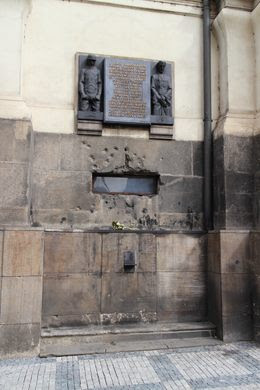
Bullet holes in a church wall are a reminder of the violence that followed the assassination of a high-ranking Nazi officer. 

On May 27, 1942, Deputy Reich Protector Reinhard Heydrich—known as ‘the Butcher of Prague” and the right-hand man of Nazi leader Heinrich Himmler—was attacked by British-trained Czech paratroopers in Operation Anthropoid, and died of his injuries a week later. This was one of the only assassinations of a high-ranking Nazi official to have succeeded, and the consequences were swift and cruel.

In the aftermath of the attack, 13,000 people were imprisoned and interrogated. Mistakenly believing the perpetrators were connected with the village of Lidice, the Nazis murdered over 5,000 people and also burned and leveled the entire town to the ground, even after realizing the connection had been a false lead. They even destroyed the village cemetery, dug up the dead, and changed the course of the river so that “nothing was to remain” of Lidice. 


After the assassination, the Czech paratroopers hid in the church’s crypt for three weeks until their hiding place was betrayed. Some 750 German soldiers surrounded the church, attempting to gas them out and then flooding the crypt with fire hoses through a tiny gap in the wall. Three paratroopers were killed in the fight; the other four took their own lives rather than surrender. The priest and bishop who sheltered the soldiers were later murdered by the Nazis. In 1945, the Czech traitor who betrayed their hiding place was arrested for treason and executed.


In the crypt itself, now a small museum dubbed the National Memorial to the Heroes of the Heydrich Terror,  you can still see bullet holes and shrapnel scars on the walls. There are also signs of the paratroopers’ last desperate efforts to dig an escape tunnel to the sewer. Outside, the narrow gap in the wall of the crypt where the Germans inserted their fire hoses is still covered with bullet marks. The last words of the paratroopers were reportedly, “We will not surrender. Never. We are Czech.”


30 October 2022 - GESTAPO INTERROGATION MEMORIAL - ATHENS, GREECE


GESTAPO INTERROGATION

 MEMORIAL

 - ATHENS, GREECE -


G'day folks,

This is the site where hundreds of Greeks were tortured by the Nazi secret police, but is now a cosmetics store. 

When the German army invaded and occupied Athens in April 1941, it began enacting laws to control the local population. Many Greeks resisted these laws, and the Greek Resistance Movement was soon organized, known as one of the fiercest resistance groups in World War II Europe. When the resistance began having an impact on the occupation, the Germans sought retribution.


The Nazi occupation force included the ruthless Gestapo, which requisitioned a building at 6 Merlin Street in central Athens to act as its headquarters. The site served as the primary interrogation center of the secret police, outfitted with torture chambers and prison cells. Those suspected of being members of the resistance, or committing individual acts of defiance, were brought to this hellish place.

Hundreds of individuals who passed through the doors of the building were either tortured to death or sent to the nearby concentration camp of Chaidari. The Nazis left many of the bodies hanging from trees for days, guarded by local collaborators, to send the message that acts of defiance would be dealt with swiftly and without mercy.

When the Germans withdrew from the city in October 1944, the building returned to civilian use. In the 1980s, it was converted to a shopping center, and the site of the former Gestapo building now houses a beauty retail chain; the area where the torture chambers were is now full of cosmetic displays.


This eerie place now tells the story of a dark chapter in human history that should not be forgotten. Outside the building is a memorial to those that were detained, tortured, or killed at 6 Merlin. The memorial includes a carving of a bound prisoner, one of the original torture chamber doors, and several plaques. One of the plaques reads, “Free people were led through this door.”

17 September 2022 - FORMER NAZI ANTI-AIRCRAFT TOWERS - BERLIN


FORMER NAZI

 ANTI-AIRCRAFT TOWERS 

- BERLIN -


G'day folks,

These former Nazi anti-aircraft towers offer a singular view of the north of Berlin in the summer, and a sanctuary for bats in winter. 

Volkspark Humboldthain is a large landscaped park in the Gesundbrunnen area of north Berlin, built in the 1870s to commemorate the 100th birthday of the Prussian polymath and explorer Alexander von Humboldt. In addition to an open-air swimming pool, rose and sculpture garden, vineyard and several playgrounds, its main attractions are the two historic flak towers at the top of a World War II air-raid shelter, a monstrous concrete structure from the early 1940s that offers a singular view of the north of Berlin.


The flak towers were built by personal order of Adolf Hitler in 1940. Following the first lethal air raids of the Royal Air Force on German cities, thousands of air-raid shelters were built all across the German Reich. This massive construction effort included building so-called flak towers, huge above-ground blockhouse towers equipped with anti-aircraft guns. Eight of these structures were built in Berlin, Hamburg, and Vienna. Flak is the abbreviation of Fliegerabwehrkanone, which literally translates to “aircraft defense cannon.”

These massive concrete structures served a dual purpose: The flaks were to defend nearby factories against Allied aerial attacks and the air-raid shelters to protect 10,000s of local civilians. Much of the original park was destroyed to make room for the towers, which were built using scores of forced laborers who worked around the clock. Due to the nearby factories, which the anti-aircraft towers were built to protect, the Humboldthain area was a key target for British and American bombers. Many of the forced laborers perished during the raids.

After the war, French soldiers took down all but two of these defensive structures. The two northern towers were spared because demolition was considered too dangerous. The nearby train tracks to the north were under Soviet administration and damaging them could have sparked a diplomatic situation. In the years after 1945, Allied troops transported 1.4 million cubic meters of wartime debris to what was once Humboldthain park, creating two hills of rubble that covered most of the remaining concrete structures. This was common practice in Berlin after the war and several such rubble hills were created, including Teufelsberg (Devil’s Mountain) in Grunewald and Großer Bunkerberg (Large Bunker Hill) in the Friedrichshain district. The two Humboldthain hills were named Humboldthöhe (Humboldt Heights) and the 29-hectare park was restored to its former glory in the 1950s. The open-air swimming pool was also built during that time and remains open to this day.


Today, Humboldthöhe is completely covered in trees. In the summer, when the trees are in full leaf, the massive bunker is almost invisible except for the two flak towers and the large aluminum sculpture by artist Arnold Schatz, which was put up in 1967. It symbolizes the two German states during the Cold War and the persisting hope for reunification. Before enjoying the view, visitors must hike up 100 meters of serpentine to the top of the tower. On the way up, there is a members-only climbing wall of the German Alpine Club.

While the view from the leafy hills, the rose garden, and the swimming pool make Humboldthain park a natural summer destination, visiting in autumn and winter also has its perks. For one, when the trees on the hill’s south side lose their leaves, the towers offer a great view of the city center south of the hill. Second, the bunker becomes a sanctuary for bats. Hundreds of the little flying mammals spend their winters in the depths of the bunker, which is why guided tours are only offered between April and October. During that time, it is possible to take tours of two of the massive bunker’s seven stories. All other stories are inaccessible due to debris. 

26 September 2022 - MEDIEVAL FRESCOES REVEALED DURING WW11


MEDIEVAL FRESCOES 

REVEALED 

DURING WW11


G'day folks,

When occupying Nazi troops detonated a mine below, medieval frescoes were revealed in this small cliff-side hermitage in Italy.  

The Eremo di San Cataldo (Hermitage of Saint Cataldus) is built into a steep cliff by the road connecting Contigliano to Cottanello in the region of Sabina, northeast of Rome.

Its origins are unclear, and some historians believe that it could date back as far as the 10th century, a time when the nearby Abbey of Farfa controlled the region. However, it is first mentioned in the 16th century, along with the attribution to Saint Cataldus, seventh-century Bishop of Rochau and patron saint of the southern city of Taranto. The reason for this connection is obscure, and many theories have been discussed as to why this saint was chosen.

The present staircase to the site was built in 1888, along with the main road. It leads to the church, the only structure that survives today, partially dug into the rock.


The church plan is rather simple, with a vestibule and a frescoed chapel with an altar made of the famous local red marble from Cottanello (which was also used in the construction of St. Peter’s Basilica in the Vatican), crowned by an upper floor with a bell tower.

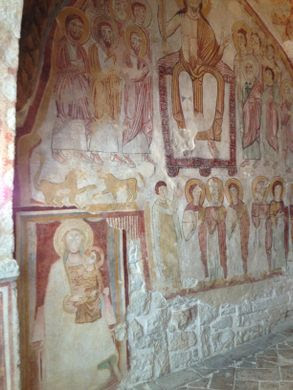
The 11th- and 12th-century frescoes were discovered by chance after 1944, when the Germans detonated a mine on the road below, shattering the plaster holding Baroque frescoes that had been painted over them in the 17th century. The older, more valuable frescoes beneath include a remarkable Redeemer fresco, on the left side of the chapel, painted in a very Byzantine style. A Greek tau symbol painted in the fresco has been attributed to St. Francis, who traveled widely in Sabina, where he founded four monasteries. 

31 May 2022 - FORT STACHELBERG - TRUTNOV, CZECHIA


FORT STACHELBERG

 - TRUTNOV, CZECHIA -


G'day folks,

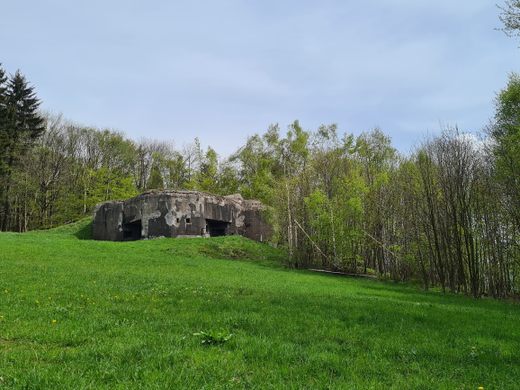
This fortress was designed to prevent a Nazi invasion but was never used.  

From 1935 to 1938, Czechia began building fortifications on its border with Nazi Germany. Most of these fortifications were located in the so-called Sudetenland, the mountainous region between Czechia and Germany which was mostly inhabited by ethnic Germans.


Of course, the Sudetenland was famously surrendered to Hitler in 1938 under the British policy of appeasement, meaning that these fortifications were never finished and ultimately never used. Nevertheless, the structures continue to stand as an open-air museum and an interesting hiking area, complete with a weekend Biergarten overlooking the Sudety low-mountain range.

Most of the interesting sites are in the core area of the fortress, a hilltop area open to the public. Although most of the smaller bunkers are free to visit, the largest contains a museum which is accessible for a small fee. Several smaller bunkers can also be found in the woods and hillsides, along with a popular hiking and biking path on the other side of the street.

Clancy's comment: Countless precautions like these were built for protection. 

I'm ...


1 May 2022 - THE SECRET MISSION OF RUDOLF HESS


 THE SECRET MISSION

 OF RUDOLF HESS

G'day folks,

 Hitler's deputy, Rudolf Hess, mysteriously parachuted into Scotland on this day intending to negotiate a peace deal with the British. He did so without the knowledge of the Führer, who was absolutely livid when he heard the news.

Hess had met the Duke of Hamilton at the Berlin Olympics in 1936 and learned that the duke was a member of a far-right group who were interested in a "German-English agreement."

He hoped that Hamilton would arrange for him to meet King George VI, believing he could persuade the king to sack Winston Churchill, then Britain could make peace with Germany and join forces against the Soviet Union.

At 6,000 feet and within 30 miles of the duke's residence near Glasgow, Hess bailed out of the Messerschmitt that he had piloted by himself and parachuted safely to the ground. His first contact was a Scottish farmer who was told in English by Hess: "I have an important message for the Duke of Hamilton."

Interrogated at an army barracks, he proposed that the British should allow Germany to dominate Europe, in return for which the British Empire would be safe from attack by Adolf Hitler. He insisted that German victory in the war was inevitable and threatened that the British people would be starved to death by a blockade around the country unless his generous peace offer was accepted.

Hitler quickly issued a statement saying that his deputy was mentally disordered and "a victim of hallucinations." He immediately stripped Hess of all the ranks he held in the Nazi party including being a party member and secretly ordered him shot on sight if he ever returned to Germany.

Hess was born Rudolf Walter Richard Hess in Alexandria, Egypt, in 1894, the son of a Bavarian wholesaler and exporter. He did not live in Germany until he was 14.

When the First World War broke out in 1914 he enlisted in the 7th Bavarian Field Artillery Regiment as an infantryman, was wounded several times and won the Iron Cross in 1915.

Sharing Hitler's stab-in-the-back notion that Germany's failure to win the 1914-18 war was caused by a conspiracy of Jews and Bolsheviks rather than a military defeat, Hess joined the Nazi party in 1920 and quickly became Hitler’s friend and confidant.

He was at Hitler’s side in November 1923 for the Beer Hall Putsch, a failed Nazi attempt to seize control of the government of Bavaria. While the pair were serving time in jail for this attempted coup, Hess helped Hitler write his book, Mein Kampf, which became a foundation of the Nazis' political platform.


After the Nazi seizure of power in 1933, Hess was appointed Deputy Führer and as well as appearing on Hitler’s behalf at speaking engagements and rallies, he signed into law much of the legislation that stripped German Jews of their rights.

Hess’s peace proposals met with no response from the British government and he was held prisoner until the end of the war.

In 1946 he was sent for trial at Nuremberg where he was acquitted on charges related to war crimes and crimes against humanity, but convicted of crimes against peace.

In his final speech to the judges he continued to display loyalty to Hitler, declaring: "It was granted me for many years to live and work under the greatest son whom my nation has brought forth in the thousand years of its history.

"Even if I could, I would not expunge this period from my existence. I regret nothing. If I were standing once more at the beginning I should act once again as I did then, even if I knew that at the end I should be burnt at the stake."

He was sentenced to life imprisonment and with other Nazi leaders sent to Spandau Prison in Berlin. After 1966 he was the only prisoner there. Hess was held as Prisoner No. 7, always denied parole, and hanged himself in the grounds of the jail on 17 August 1987 at the age of ninety-three.

After his death the prison was demolished to prevent it from becoming a neo-Nazi shrine.

Clancy's comment: A sad tale of a sad time. Lest we forget those who perished.

I'm ...


25 March 2022 - WHAT HAPPENED TO ADOLF HITLER'S BODY?


WHAT HAPPENED TO 

ADOLF HITLER'S BODY?


G'day folks,

He boasted that his Third Reich would last for a thousand years. But Adolf Hitler, who would go down in history as an evil tyrant, shot himself on this day, probably after taking poison, painfully aware of the disintegration of his twelve-year-old regime and with his capital city reduced to ruins and rubble.

As the Second World War was coming to a close the desperate Führer tried to wage war by telephone from his bunker beneath his headquarters, the Chancellery building in Berlin, issuing futile orders to his defeated generals.

The 3,000-square-foot underground bunker, completed in 1942, was basically an extension of the Chancellery’s air raid shelter. It consisted of two levels and 18 rooms. However, Hitler had his favourite architect, Albert Speer, build an additional bunker under the Chancellery’s garden.

It was finished in October 1944 and was known as the Führerbunker. And it was here, alongside his wife of a few hours, that Hitler ended his life.


For three months military advisers had been urging the Führer to abandon the bunker and flee to his Eagle’s Nest retreat high above the Bavarian Alps at Berchtesgaden. But he refused to leave his underground lair, remaining there for about 100 days.

It is believed he feared the possibility of capture and being put on display – dead or alive – by his enemies, especially the Russians.

Just a few days before Hitler’s 56th and final birthday on April 20, the Russians arrived at the edge of Berlin. By April 24, they had the city completely surrounded as the Americans and the British moved closer.

By April 29, knowing all was lost, Hitler was preparing for death, taking with him his 33-year-old companion Eva Braun who had flown from Munich to Berlin earlier that month to be with the man she worshipped.

They had been together since 1932 when Braun, an attractive young photography assistant at the time, came under Hitler’s spell. Urged by Hitler to leave the bunker for her own safety, she refused, allegedly saying: “Do you think I will let you die alone?”

Despite her dedication, her chances even now of Hitler yielding completely to her charms seemed unlikely if his earlier words were to be believed.

Author Gitta Sereny tells in her book 'Albert Speer: His Battle With Truth' how the architect was dining one night with Hitler, Eva Braun at his side. The Nazi leader said that a highly intelligent man should always choose a primitive and stupid woman:

"Imagine if on top of everything else I had a woman who interfered with my work! In my leisure time I want to have peace. I could never marry."

Nevertheless, shortly after midnight on April 29, 1945, Hitler did marry Eva Braun, a minor official from the Propaganda Ministry having been summoned to conduct the ceremony in the bunker.

A few hours later Hitler dictated his last will and a Political Testament. The statement laid all blame for the war on "international Jewry" and urged all Germans to continue fighting.

The will, dated 4am, 29th April, 1945, declared: "As I did not consider that I could take responsibility, during the years of struggle, of contracting a marriage, I have now decided, before the closing of my earthly career, to take as my wife that girl who, after many years of faithful friendship, entered, of her own free will, the practically besieged town in order to share her destiny with me.

"I myself and my wife - in order to escape the disgrace of deposition or capitulation - choose death. It is our wish to be burnt immediately on the spot where I have carried out the greatest part of my daily work in the course of a twelve years' service to my people."

The next day, 30th April, with the Russians less than a city block away, Hitler and Braun ate their final meal. Shortly after 3pm, they said goodbye to the staff in the bunker and retired to their private chambers, taking with them revolvers and thin glass vials of cyanide.

There was a loud gunshot at about 3.30. After waiting a few minutes, Hitler’s valet, Heinz Linge, opened the door and saw the Führer almost upright in a sitting position on a blood-soaked sofa.

It was assumed that Hitler had made certain of death by using his pistol on himself after biting the cyanide vial. Blood had trickled from a small hole in his right temple. The pistol lay on the floor where it had dropped from his right hand.

Eva Braun lay beside him, but she had made no use of the revolver at her side, preferring to take the poison instead.

Later, Radio Hamburg announced that "our Führer Adolf Hitler died for Germany in his command post in the Reich Chancellery this afternoon, fighting to his last breath against Bolshevism".


The bodies of Hitler and Braun were wrapped in blankets and carried to the Chancellery garden. There, one of the Führer's personal assistants, SS Officer Otto Günsche, doused the bodies in petrol and burned them, in accordance with Hitler’s final orders.

What happened to the charred remains is still uncertain. Hitler's men buried them in a nearby shallow bomb crater where apparently they were discovered by the Russians. The remains were then transported to the city of Magdeburg, south-west of Berlin, after being buried and exhumed several times by Russian soldiers.

Finally, the story goes, they were buried in the courtyard of the Russian counter-intelligence agency's facility in Magdeburg and remained there for 25 years.

When control of the city was handed to East Germany in 1970, the KGB exhumed and fully cremated the remains fearing that Hitler's burial site could become a place of worship for supporters of fascist ideas. The ashes were then scattered in the River Elbe. So it is said. But nobody knows for sure.

Clancy's comment: Have we learnt anything from all this? I don't think so. 

I'm ...


17 January 2022 - ANNE FRANK - MASTER STORYTELLER


ANNE FRANK 

- MASTER STORYTELLER -


G'day folks,

 Anne Frank received a present on  her 13th birthday. It was a diary and the entries she would go on to make in it would make her tragically short life an inspiration to millions. 

Her first words, written on that day, were: “I hope I shall be able to confide in you completely, as I have never been able to do in anyone before, and I hope that you will be a great support and comfort to me.”

The daughter of a Jewish industrialist, Anne was born in 1929 as Annelies Marie Frank at Frankfurt, Germany. Her father, Otto, was a German businessman who served as a lieutenant in the German army during the First World War.

But amid rising anti-Semitism and Nazi persecution of Jews, Otto moved his family to Amsterdam in the autumn of 1933. The Franks were among 300,000 Jews who fled Germany between 1933 and 1939.

In Amsterdam Otto ran a company called Opekta that sold spices and pectin used in the manufacture of jam.

Anne and her sister Margot went to a local school and were relatively happy. That began to change on 10 May 1940 when the German army invaded the Netherlands.

Two years later, on 5 July 1942, Margot received an official summons to report to a Nazi work camp. Her father was having none of it so the next day the Frank family went into hiding, moving into a secret annex in the offices of Otto's company.

Hiding alongside them were another Jewish family and, later, a Jewish dentist. They all spent two years in this hiding place, never once stepping outside. The entrance to the annex was concealed by a large bookcase.

Four of Otto’s loyal employees brought food and other necessities as well as news about the outside world. They knew that if they were caught they would be executed for helping Jews, but they did it anyway.

Anne passed much of the time reading and writing in her diary. She started each entry with the words “Dear Kitty”, an imaginary friend. Written over the course of two years, the diary details the time that her family spent in hiding as well as the feelings of a frustrated and “ordinary” teenager, struggling to live in a confined space.

For all its passages of despair, the diary is essentially a story of faith, hope and love in the face of hate. On 15 July 1944 Anne wrote: “It's difficult in times like these: ideals, dreams and cherished hopes rise within us, only to be crushed by grim reality. It's a wonder I haven't abandoned all my ideals, they seem so absurd and impractical. Yet I cling to them because I still believe, in spite of everything, that people are truly good at heart.

“It’s utterly impossible for me to build my life on a foundation of chaos, suffering and death. I see the world being slowly transformed into a wilderness, I hear the approaching thunder that, one day, will destroy us too, I feel the suffering of millions.

“And yet, when I look up at the sky, I somehow feel that everything will change for the better, that this cruelty too will end, that peace and tranquility will return once more. In the meantime, I must hold on to my ideals. Perhaps the day will come when I’ll be able to realise them!”


Anne’s suffering was to take a decisive plunge on the morning of 4 August 1944 when the Gestapo stormed into the secret annex and arrested everyone inside. For years it was believed that someone called the Germans and told them that Jews were living in the Opekta premises.

However, the identity of this alleged caller was never confirmed and a later theory suggests that the Nazis may have discovered the annex by accident while investigating reports of ration-coupon fraud and illegal employment at Opekta.

The occupants of the annex were taken to a transit camp in the Netherlands. Because they were in hiding when arrested they were considered to be criminals and were punished with hard labour.

Then it was on to the notorious Auschwitz concentration camp in Poland. Upon arrival at Auschwitz, all men were separated from their families and all prisoners considered unfit for work were sent to the gas chambers, along with everyone under the age of fifteen. Anne had turned fifteen three months before being captured so she was spared.

Women and girls not selected for immediate death – Anne being one of them – had to strip naked and were then disinfected. Their heads were shaved and an identity number tattooed on their arms. Anne and Margot spent several months enduring hard labour at Auschwitz, lifting heavy stones and cutting rolls of turf.

During the winter of 1944, the two sisters were transferred to Bergen-Belsen concentration camp in Germany, without their mother, Edith, who fell ill and died of hunger at Auschwitz.


At Bergen-Belsen diseases such as typhoid fever raged through the camp and in early 1945 a typhus epidemic killed about 17,000 prisoners including, it is believed, Anne and Margot – just a few weeks before the camp was liberated by British forces. The exact date of Anne’s death is not known but it is thought she died in either February or March of that year.

Otto was held at Auschwitz until its liberation in January 1945 and afterwards returned to Amsterdam, learning of his wife’s death en route. He learned of his daughters’ deaths in July 1945 after meeting a woman who had been at Bergen-Belsen with them.

Following the arrest of those in the annex, Anne’s diary was retrieved by Miep Gies, one of the trusted friends who had helped the Franks during their time in hiding. Gies gave the diary to Otto in July 1945 following confirmation of Anne’s death by the Red Cross.

Otto eventually gathered the strength to read it. He was awestruck by what he read and later had it published. "There was revealed a completely different Anne to the child that I had lost," he wrote in a letter. "I had no idea of the depths of her thoughts and feelings."

Published as The Diary of a Young Girl, the work has been translated into as many as 70 languages and more than 30 million copies.

Anne Frank's diary endures, not only because of the remarkable events she described, but due to her extraordinary gifts as a storyteller and her indefatigable spirit through even the most horrific of circumstances.

Clancy's comment: Having read her book as a teen, I visited the place where she hid in Amsterdam. From there, I went on to visit four concentration camps in Europe, and I'm still reading books about this horrible period. Sadly, decades later, we have learnt nothing. 

I'm ...