Showing posts with label WARS. Show all posts

23 February 2022 - TALASEA AIRSTRIP - NEW GUINEA


TALASEA AIRSTRIP 

- NEW GUINEA -


G'day folks,

Two World War II aircraft lie within the jungle around this abandoned runway. 

The South Pacific is littered with relics leftover from World War II. Military tunnels snake beneath tiny towns. Planes and equipment lie sunken beneath the water, cloaked in coral. Dense tangles of jungle hold more forgotten wartime treasures, like this abandoned airfield.

Originally built by the Australian army as a small landing strip, Talasea was occupied by both the Japanese and Americans during the second World War, changing hands between them. Too small to accommodate fighter planes, the airfield was used as an emergency landing strip in the later part of the war.

In early September 1944, the landing strip saw its final pieces of action. On September 3, 1944, an American B-25H bomber took off from Stirling Island with the objective of locating and destroying any remaining Japanese ships of the South Coast of New Britain. While the mission was a success, the B-25H aircraft incurred engine trouble, and rather than risk the flight back to its base, the captain made the decision to make an emergency landing at Talasea.


 In a similar mission less than a week later, a Lockheed Ventura was dispatched to bomb a Japanese-occupied airstrip near Rabaul. The Lockheed’s mission was successful, but one engine failed on the return journey. As the crew knew the plane wouldn’t make it all the way back to base, they too made the decision to land at Talasea.

Shortly after the war ended, the airstrip at Talasea was abandoned. Palm oil plantations sprung up around Talasea in the 1960s, and nature gradually encroached around the planes. Today, the airstrip is virtually unrecognizable from its former runway glory.

The land still holds tidbits of its wartime past, however, as both the B-25 bomber and Lockheed remain in their final resting places. While exploring on foot, make your way through the overgrown bush, and you’ll reach the B-25H bomber, resting on its undercarriage atop a bed of lush greenery.

Fewer than 40 yards to the west lies the Lockheed Ventura. With the Allied star still barely visible on its side, you can still walk inside the plant-filled undercarriage and imagine the tight spaces where the pilots and crew would have sat.

Clancy's comment: History lying in-state.

I'm ...


24 January 2022 - PATUXAI WAR MONUMENT in VIENTIANE, LAOS


 PATUXAI WAR MONUMENT

 in VIENTIANE, LAOS


G'day folks,

This one of my favourite cities and countries in Asia. 

When the USA donated cement and funds to expand the airport in Laos, the Laotians built a massive monument instead.  

Patuxai is a massive war monument and triumphal arch in the center of Vientiane, Laos. It was completed in 1968, using funds donated by the United States – funds that were meant to be used for the construction of an airport.

Patuxai, meaning Victory Gate in English (and variously written as Patuxay, Patousai and Patusai), was built between 1957 and 1968 in memory of the Laotian soldiers who died during World War II and the war of independence from France in 1949.

It’s also known as the Arc de Triomphe of Vientiane due to its resemblance to the Arc de Triomphe in Paris. Patuxai, however, is slightly taller than its Parisian counterpart, has four gates rather than two, and is covered in distinctly Laotian designs.

The exterior of the monument is decorated with traditional Laotian motifs, including Buddhist symbols, Hindu deities and female spirits of the clouds and waters known as apsaras. The ceilings beneath the four arches are decorated with further depictions of Hindu gods, such as Brahma and Vishnu, and mythological creatures like the mythical bird-woman Kinnaree and the three-headed elephant Erawan.

On top of Patuxai, meanwhile, sit five towers, again built in the traditional Laotian style. Four of these are located on each corner of the monument, while a fifth rises up from the center, higher than the rest. These five towers are decorated with flower motifs and each is topped with a golden finial.


 Needless to say, the construction of the Patuxai monument was a costly project. The Laotian government, however, managed to fund the bulk of the effort with money donated from the United States – despite that money having been donated for an entirely different project.

In the 1950s, the United States provided Laos with funds and a huge amount of concrete for the expansion of the city’s airport, which could then serve as a base for US fighter jets during the Vietnam War. But the funds and concrete arrived before any contract had been signed, so the Royal Laotian Government decided to build a massive triumphal arch, rather than an airport serving foreign interests. For this reason, locals jokingly refer to Patuxai by another name: the Vertical Runway.

No mention of this is made on the sign attached to Patuxai. But the sign is strangely honest in other ways, stating that the monument was never actually completed due to the country’s turbulent history, and that “From a closer distance, it [Patuxai] appears even less impressive, like a monster of concrete.” Not a glowing appraisal, but refreshingly frank.

Clancy's comment. Wonderful city, wonderful people. Below, you'll find a snap of me some years back in Vientiane.

I'm ...


17 January 2022 - ANNE FRANK - MASTER STORYTELLER


ANNE FRANK 

- MASTER STORYTELLER -


G'day folks,

 Anne Frank received a present on  her 13th birthday. It was a diary and the entries she would go on to make in it would make her tragically short life an inspiration to millions. 

Her first words, written on that day, were: “I hope I shall be able to confide in you completely, as I have never been able to do in anyone before, and I hope that you will be a great support and comfort to me.”

The daughter of a Jewish industrialist, Anne was born in 1929 as Annelies Marie Frank at Frankfurt, Germany. Her father, Otto, was a German businessman who served as a lieutenant in the German army during the First World War.

But amid rising anti-Semitism and Nazi persecution of Jews, Otto moved his family to Amsterdam in the autumn of 1933. The Franks were among 300,000 Jews who fled Germany between 1933 and 1939.

In Amsterdam Otto ran a company called Opekta that sold spices and pectin used in the manufacture of jam.

Anne and her sister Margot went to a local school and were relatively happy. That began to change on 10 May 1940 when the German army invaded the Netherlands.

Two years later, on 5 July 1942, Margot received an official summons to report to a Nazi work camp. Her father was having none of it so the next day the Frank family went into hiding, moving into a secret annex in the offices of Otto's company.

Hiding alongside them were another Jewish family and, later, a Jewish dentist. They all spent two years in this hiding place, never once stepping outside. The entrance to the annex was concealed by a large bookcase.

Four of Otto’s loyal employees brought food and other necessities as well as news about the outside world. They knew that if they were caught they would be executed for helping Jews, but they did it anyway.

Anne passed much of the time reading and writing in her diary. She started each entry with the words “Dear Kitty”, an imaginary friend. Written over the course of two years, the diary details the time that her family spent in hiding as well as the feelings of a frustrated and “ordinary” teenager, struggling to live in a confined space.

For all its passages of despair, the diary is essentially a story of faith, hope and love in the face of hate. On 15 July 1944 Anne wrote: “It's difficult in times like these: ideals, dreams and cherished hopes rise within us, only to be crushed by grim reality. It's a wonder I haven't abandoned all my ideals, they seem so absurd and impractical. Yet I cling to them because I still believe, in spite of everything, that people are truly good at heart.

“It’s utterly impossible for me to build my life on a foundation of chaos, suffering and death. I see the world being slowly transformed into a wilderness, I hear the approaching thunder that, one day, will destroy us too, I feel the suffering of millions.

“And yet, when I look up at the sky, I somehow feel that everything will change for the better, that this cruelty too will end, that peace and tranquility will return once more. In the meantime, I must hold on to my ideals. Perhaps the day will come when I’ll be able to realise them!”


Anne’s suffering was to take a decisive plunge on the morning of 4 August 1944 when the Gestapo stormed into the secret annex and arrested everyone inside. For years it was believed that someone called the Germans and told them that Jews were living in the Opekta premises.

However, the identity of this alleged caller was never confirmed and a later theory suggests that the Nazis may have discovered the annex by accident while investigating reports of ration-coupon fraud and illegal employment at Opekta.

The occupants of the annex were taken to a transit camp in the Netherlands. Because they were in hiding when arrested they were considered to be criminals and were punished with hard labour.

Then it was on to the notorious Auschwitz concentration camp in Poland. Upon arrival at Auschwitz, all men were separated from their families and all prisoners considered unfit for work were sent to the gas chambers, along with everyone under the age of fifteen. Anne had turned fifteen three months before being captured so she was spared.

Women and girls not selected for immediate death – Anne being one of them – had to strip naked and were then disinfected. Their heads were shaved and an identity number tattooed on their arms. Anne and Margot spent several months enduring hard labour at Auschwitz, lifting heavy stones and cutting rolls of turf.

During the winter of 1944, the two sisters were transferred to Bergen-Belsen concentration camp in Germany, without their mother, Edith, who fell ill and died of hunger at Auschwitz.


At Bergen-Belsen diseases such as typhoid fever raged through the camp and in early 1945 a typhus epidemic killed about 17,000 prisoners including, it is believed, Anne and Margot – just a few weeks before the camp was liberated by British forces. The exact date of Anne’s death is not known but it is thought she died in either February or March of that year.

Otto was held at Auschwitz until its liberation in January 1945 and afterwards returned to Amsterdam, learning of his wife’s death en route. He learned of his daughters’ deaths in July 1945 after meeting a woman who had been at Bergen-Belsen with them.

Following the arrest of those in the annex, Anne’s diary was retrieved by Miep Gies, one of the trusted friends who had helped the Franks during their time in hiding. Gies gave the diary to Otto in July 1945 following confirmation of Anne’s death by the Red Cross.

Otto eventually gathered the strength to read it. He was awestruck by what he read and later had it published. "There was revealed a completely different Anne to the child that I had lost," he wrote in a letter. "I had no idea of the depths of her thoughts and feelings."

Published as The Diary of a Young Girl, the work has been translated into as many as 70 languages and more than 30 million copies.

Anne Frank's diary endures, not only because of the remarkable events she described, but due to her extraordinary gifts as a storyteller and her indefatigable spirit through even the most horrific of circumstances.

Clancy's comment: Having read her book as a teen, I visited the place where she hid in Amsterdam. From there, I went on to visit four concentration camps in Europe, and I'm still reading books about this horrible period. Sadly, decades later, we have learnt nothing. 

I'm ...


14 December 2021 - LOCOMOTIVE CAPTURED AS PRISONER OF WAR IN 1942


LOCOMOTIVE  CAPTURED AS 

PRISONER OF WAR IN 1942


G'day folks,

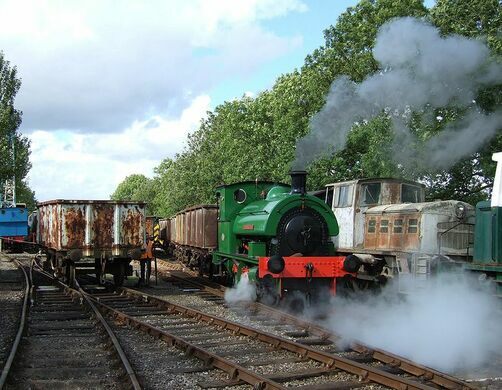
A locomotive that was captured as a prisoner of war is now recognized as a WWII memorial.  

Though it may look bright and colorful like a child’s toy train, the Singapore locomotive witnessed one of the darkest events in British military history. It, along with about 80,000 Allied servicemen, were taken as prisoners of war when the Japanese invaded Singapore in 1942.

Built in Scotland, the locomotive arrived in the Singapore Naval Dockyard three years before the start of World War II. The train—and the men who worked it—did not fare easily once the war began. It suffered severe damage when the Japanese sieged Singapore in February of 1942. Even now, its right hand cylinder cover and boiler cladding sheets bear the scars of the bullet and shrapnel damage it endured.


 The train remained in Singapore, though a number of the Allied prisoners who were captured along with it were forced to work on the so-called “Burma-Siam Death Railway,” which was immortalized in the film Bridge on the River Kwai. When the war ended, more than 100 Japanese officials who oversaw the railroad’s construction were tried and convicted as war criminals.

After the war, the locomotive continued to work in the Singapore Naval Dockyard until, in December 1953, it came home to the United Kingdom for use at Chatham Dockyards in Kent. The Singapore later became the first working steam locomotive in the Rocks by Rail collection at the Rutland Railway Museum. It served a brief stint at the Imperial War Museum in Duxford before returning to Rutland with its own memorial service. The locomotive was then declared a registered war memorial and was adorned with plaques dedicated to the Allied prisoners of war who suffered in the Far East.

Clancy's comment: Long may it rest, and long may those who were killed in Singapore rest.

I'm ...


12 October 2021 - THE MY LAI MASSACRE


THE MY LAI

 MASSACRE 


G'day folks,

Considered by many to be one of the most shameful episodes in American military history, the My Lai massacre in Vietnam took place in 1968. Hundreds of defenceless civilians – mainly women and children – were shot dead by US soldiers.

My Lai will forever remain a haunting event in America’s conscience and will burn to the surface in any discussion or appraisal of this prolonged conflict.

The Vietnam War, as America knows it, or the “War Against the Americans to Save the Nation” as Washington’s former enemies called it, began in 1954 and lasted until 1975, although direct American involvement ended in 1973.

But there had been fighting in the country for decades, with the Vietnamese rebelling against French colonial rule.

In 1954, France decided to pull out and at the Geneva Conference that year it was agreed the country would be “temporarily” divided along the 17th parallel – thus creating communist North Vietnam and non-communist South Vietnam. Much to the anguish of the United States.

The White House, fervently opposing communism, supported the “domino theory” which basically stated that if one country fell to communism, its neighbour would follow, then its neighbour, and so on.


Richard Nixon, vice-president at the time to President Eisenhower, explained the theory in more detail: “If Indochina falls, Thailand is put in an almost impossible position. The same is true of Malaya with its rubber and tin. The same is true of Indonesia.

“If this whole part of South East Asia goes under communist domination or communist influence, Japan, which trades and must trade with this area in order to exist, must inevitably be oriented towards the communist regime.”

True or not, North Vietnam had a single aim – to unify the country under a communist regime modelled on those of Russia and China. South Vietnam preferred to align with the West.

The result was that the Soviet Union and China poured weapons, supplies and advisers into the North, while America supplied military advisers to the South. By 1959 there were about one thousand of them there, but President John F Kennedy, elected in 1960, had increased the number to 16,000 by the time of his death in 1963.

That same year North Vietnam sent 40,000 soldiers to fight in the South. In response, President Lyndon Johnson was to send in combat units for the first time. By 1964 there were 184,000 American troops in Vietnam – a figure that would climb significantly year by year. By 1969 it had risen to more than 500,000.


As the vicious and ugly war wore on, shortly after dawn on March 16 1968, three platoons of US troops belonging to “Charlie Company” were dropped from helicopters into the Son My area. They were on a search-and-destroy mission with orders to kill National Liberation Front (North Vietnamese) soldiers – called Viet Cong or VC by the US troops – who were reported to have been active in the area.

US Army commanders had advised that all who were found in the area could be considered Viet Cong or active sympathisers, and the troops were ordered to destroy their village.

1 Platoon, commanded by Lieutenant William Calley, was sent to My Lai – home to about 700 people. Calley was told he could expect to find members of the NLF in the area.

In fact, they found a village occupied only by women, children and old men – all of whom were rounded up into groups. After a search of their huts revealed only three or four weapons and no sign of the enemy, Calley ordered his men to open fire on the villagers, he himself shooting indiscriminately into the groups.

Mothers tried to shield their children but were shot, and the little ones also gunned down as they tried to run away. Calley was reported to have dragged dozens of people, including young children, into a ditch before executing them with a machine gun. Many women were raped and the village was burned to the ground.

US soldier Varnado Simpson testified in December 1969: “Everyone who went into the village had in mind to kill. We had lost a lot of buddies and it was a VC stronghold. We considered them either VC or helping the VC.”

However, not a single Viet Cong combatant was found there. "As a matter of fact," Private Michael Bernhardt would testify, "I don't remember seeing one military-age male in the entire place, dead or alive.”

None of this became known to the outside world until November 1969 when a US soldier, Paul Meadlo, was interviewed on television and admitted killing “ten or fifteen men, women and children” at My Lai. The full horror of the event then began to emerge and it soon became clear that many hundreds of villagers had been killed.

A number of US soldiers were charged with the killings but all – except for Lieutenant William Calley – were acquitted or had the charges against them dropped.

Calley, who had spoken earlier of “my troops getting massacred and mauled by an enemy I couldn’t see, an enemy I couldn’t feel, I couldn’t touch. . .” put forward the defence that he was in My Lai to hunt out communists and to destroy communism and that he was “only carrying out my orders, which were to hunt out the NLF.”

It was true that “Charlie Company,” to which Calley belonged, had earlier lost five men killed by booby traps and others had been wounded by these unseen weapons.

But Calley was found guilty of killing 109 civilians and sentenced to life imprisonment. However, after an intervention by President Richard Nixon this prison sentence was changed to house arrest. Three years later, Calley was granted his release by a federal judge.

The number of people killed at My Lai is disputed. A memorial there lists 504 names with ages ranging from one to eighty-two years. An official US army investigation settled on a figure of 347.

After the US withdrew its troops from the country in 1973, fighting continued until South Vietnam surrendered to North Vietnam on April 30, 1975. On July 2, 1976, Vietnam was reunited as the Socialist Republic of Vietnam. It resumed diplomatic relations with the US in 1995.

Clancy's comment: Mm ... war is hell! Reminds me of what is currently happening in Afghanistan.

I'm ...


27 December 2020 - HENRY DUNANT CHANGED THE WORLD FOR THE BETTER


HENRY DUNANT CHANGED 

THE WORLD FOR THE BETTER


G'day folks,

The Battle of Solferino (June 24, 1859) was one of the largest and most decisive battles during the Second Italian War of Independence, a battle with nearly 260,000 collective participants.


The excruciating battle lasted for over 9 hours, resulting in nearly 5,000 killed, over 23,000 wounded and many more missing and captured. One of the witnesses of the battle’s aftermath was Swiss businessman Henry Dunant, who was on a business trip while passing through Solferino. Overwhelmed by what he had seen - thousands of bodies scattered through the battlefield with no one to help the wounded or bury the dead, Dunant couldn’t remain a passive bystander, so he organized the local civilians to provide assistance to the wounded and sick, and arranged the funds to build a field hospital.


Revolutionary for the time, Dunant didn’t just save soldiers from the Austrian or the Allied French and Sardinian side, he urged to help everyone under the slogan Tutti fratelli, which means “all are brothers”. Ultimately, Dunant recorded his experiences of the aftermath of the battle in the book ‘A Memory of Solferino’, which became the inspiration for the Red Cross Movement. For being a co-founder of the movement that helps everyone and for his humanitarian accomplishments at Solferino and beyond, Dunant was awarded the Nobel Peace Prize in 1901.


Clancy's comment: Well done, Henry.

I'm ...