Showing posts with label PRAGUE. Show all posts

26 October 2022 - THE HEYDRICH TERROR MEMORIAL - PRAGUE


THE HEYDRICH 

TERROR MEMORIAL

 - PRAGUE -


G'day folks,

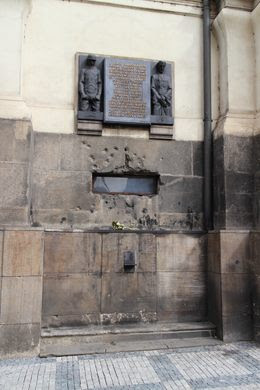
Bullet holes in a church wall are a reminder of the violence that followed the assassination of a high-ranking Nazi officer. 

On May 27, 1942, Deputy Reich Protector Reinhard Heydrich—known as ‘the Butcher of Prague” and the right-hand man of Nazi leader Heinrich Himmler—was attacked by British-trained Czech paratroopers in Operation Anthropoid, and died of his injuries a week later. This was one of the only assassinations of a high-ranking Nazi official to have succeeded, and the consequences were swift and cruel.

In the aftermath of the attack, 13,000 people were imprisoned and interrogated. Mistakenly believing the perpetrators were connected with the village of Lidice, the Nazis murdered over 5,000 people and also burned and leveled the entire town to the ground, even after realizing the connection had been a false lead. They even destroyed the village cemetery, dug up the dead, and changed the course of the river so that “nothing was to remain” of Lidice. 


After the assassination, the Czech paratroopers hid in the church’s crypt for three weeks until their hiding place was betrayed. Some 750 German soldiers surrounded the church, attempting to gas them out and then flooding the crypt with fire hoses through a tiny gap in the wall. Three paratroopers were killed in the fight; the other four took their own lives rather than surrender. The priest and bishop who sheltered the soldiers were later murdered by the Nazis. In 1945, the Czech traitor who betrayed their hiding place was arrested for treason and executed.


In the crypt itself, now a small museum dubbed the National Memorial to the Heroes of the Heydrich Terror,  you can still see bullet holes and shrapnel scars on the walls. There are also signs of the paratroopers’ last desperate efforts to dig an escape tunnel to the sewer. Outside, the narrow gap in the wall of the crypt where the Germans inserted their fire hoses is still covered with bullet marks. The last words of the paratroopers were reportedly, “We will not surrender. Never. We are Czech.”


6 October 2018 - EMIL ZATOPEK – CHAMPION ON AND OFF THE TRACK


 EMIL ZATOPEK 
– CHAMPION ON 
AND OFF THE TRACK -

G'day guys,

Welcome to some interesting facts about an amazing athlete; on and off the track.

Emil Zatopek was a Czechoslovak athlete who won three gold medals at the 1952 Helsinki Olympics (5,000m, 10,000m and marathon). He was noted for his relentless training regime which involved a pioneering use of interval training. A hero in his native Czechoslovakia he was an influential member in the Communist Party, however, he was later expelled for supporting the democratic movement of 1968 and as a consequence was forced to work in dangerous mining jobs. He was rehabilitated in 1990 by Czech President Václav Havel. Zatopek is considered one of the greatest athletes and sporting personalities of the Twentieth Century.

Emil Zatopek was born in Czechoslovakia in 1922. His working-class parents, Frantisek and Anzeka had eight children in all. The large family meant family finances were spread thinly and Emil was always conscious of living close to the poverty line.

As a child, Zatopek was a bright, independently minded spirit, with an unusual power of memory. Many friends said an abiding characteristic of the young Zatopek was his willingness to try everything differently.

In 1937, just short of his 15th birthday, Zatopek left his hometown to work in the large Bata factory in Zlin. For the time, it was a reasonable job, though very disciplined and somewhat repetitive.


Aged 18, he had no interest in running but on one occasion was picked by his company to join a race. Despite his protestations that he was unfit, he was forced to start the race and ended up coming second out of 100. This began his interest in running, and within four years he was representing Czechoslovakia. The second world war and the German occupation of Czechoslovakia meant he lost some of the best years of his career. But, during the war, he was able to persevere with his training and make significant improvements.

 After the Second World War, he joined the new Czechoslovakia army, who were sympathetic to allowing him time to train – especially as international success followed. In 1948, he became a household name winning the 10 km in the austerity London Olympics. He also finished second in the 5 km, though many felt that running with greater reserve in the heats may have enabled him to win.

After the 1948 Olympics, Zatopek’s dominance of middle-distance running grew – leading to several world records. On 29 September 1951, Emil Zatopek became the first person to run 20 kilometres in under one hour and broke four world records in one breathtaking race. By the end of 1953, he held eight world running records—the only man in history to hold so many records at the same time. In total, he set 18 world records.

1952 Helsinki Olympics

In 1952, Emil Zatopek achieved one of the greatest Olympic feats of all time – something that will probably never be reproduced. He won gold in the 5km, 10km and then at the last moment decided to run his first ever marathon. Despite no previous experience at the distance, he won the race by over two minutes. This triple Olympic gold remains an unprecedented achievement. The amazing feature of this Olympics was that two months before the Olympics, doctors advised him not to race because of an infected gland.  Zatopek ignored the doctors’ advice.


Another incident shortly before the 1952 Olympics also illustrates Zatopek’s willingness to take an unorthodox stance. In 1952, Czechoslovakia was in the throes of great political oppression, with many people put in jail and executed for ‘suspect’ political views. Stalinist purges were widespread and even athletics was not immune. Just eight months prior, the entire national ice hockey team were arrested and eight players sentenced to a total of 77 years – their crimes were supposedly contemplating defection.

Shortly before the Olympics, Stanislav Jungwirth was excluded from the national team on the grounds his father was in prison for political offences. But, Zatopek was infuriated and told the Ministry of Sports that “If Standa does not go nor will I”

 Zatopek’s stance was brave and perhaps foolhardy, as the consequences could have been severe. It was also remarkable given what was at stake for Zatopek and he was widely tipped to be favourite for at least two Olympic golds. In the end, the Ministry of Sports climbed down and allowed both Standa and Zatopek to travel. However, a dossier was made on Zatopek for his possible punishment after the games. It was with this threat hanging over his head, that Zatopek competed in the Olympics. His unique triple of Olympic golds gave Zatopek a public popularity which saved him from further punishment, a lesser athlete would probably have fared very differently.


Zatopek was not just an Olympic champion, but a gregarious character who spontaneously built up relationships and goodwill with athletes from other countries. In the 1952 Helsinki Olympics, it was Zatopek who embodied the Olympic ideal – often allowing westerners into the separate Warsaw Pact Olympic accommodation.

To Zatopek, the Olympics was significant for its ideals of international friendship. He learnt to speak several languages and easily struck up conversations with people from around the world. He had a deeply generous spirit – frequently helping out strangers or people who came to see him in his Prague flat.

 Emil Zatopek Running Style


Emil Zatopek threw everything into his running and this was reflected in his agonising facial expressions. His running style was often criticised for being gangly, inefficient and unattractive, but Zatopek retorted you don’t win any prizes for looks in a running race. He ignored his critics and retained his unique style throughout his career.


Emil Zatopek’s Training

Emile Zatopek was renowned for his hard training routines. He would train whatever the weather and push himself through punishing training routines to get the best out of himself. He is said to have done 400-metre intervals up to 80 times in one training session. In many ways, Zatopek was a great pioneer of interval training – making short, hard intense efforts. His philosophy was to develop speed and then be able to repeat this over a long period of time. 

 The Aussie Connection

As well as being a great runner, Emil was legendary for his generous heart and good nature. The great Australian runner Ron Clarke had achieved many spectacular achievements in athletics, but, an Olympic gold had always eluded him. When Ron Clarke went to visit Zatopek, Zatopek accompanied him to the airport. At the last moment, Zatopek thrust something into his hand. Clarke thought it might be some secret document, but, when he got on the plane he was shocked to see an Olympic gold medal with a note from Zatopek saying simply ‘Because you deserve it’.


Clancy's comment: Wow, you have to admire a man who gave a gold medal to one of his competitors.
Love ya work, Emil!

I'm ...


9 November 2013 - PRAGUE, CZECH REPUBLIC


PRAGUE, CZECH REPUBLIC

G'day folks,

I often feature some great city of the world. Today I present PRAGUE, CZECH REPUBLIC.


PRAGUE
Prague is one of the most beautiful cities in Europe in terms of its setting on both banks of the Vltava River, its townscape of burger houses and palaces punctuated by towers, and its individual buildings.

The Historic Centre represents a supreme manifestation of Medieval urbanism (the New Town of Emperor Charles IV built as the New Jerusalem). The Prague architectural works of the Gothic Period (14th and 15th centuries), of the High Baroque of the 1st half of the 18th century and of the rising modernism after the year 1900, influenced the development of Central Europe, perhaps even all European architecture. Prague represents one of the most prominent world centres of creative life in the field of urbanism and architecture across generations, human mentality and beliefs.

Prague belongs to the group of historic cities which have preserved the structure of their development until the present times. Within the core of Prague, successive stages of growth and changes have respected the original grand-scale urban structure of the Early Middle Ages. This structure was essentially and greatly enlarged with urban activities in the High Gothic period with more additions during the High Baroque period and in the 19th century. It has been saved from any large-scale urban renewal or massive demolitions and thus preserves its overall configuration, pattern and spatial composition.

In the course of the 1100 years of its existence, Prague’s development can be documented in the architectural expression of many historical periods and their styles. The city is rich in outstanding monuments from all periods of its history. Of particular importance are Prague Castle, the Cathedral of St Vitus, Hradćany Square in front of the Castle, the Valdgtejn Palace on the left bank of the river, the Gothic Charles Bridge, the Romanesque Rotunda of the Holy Rood, the Gothic arcaded houses round the Old Town Square, the High Gothic Minorite Church of St James in the Stark Mĕsto, the late 19th century buildings and town plan of the Nave Mĕsto.

As early as the Middle Ages, Prague became one of the leading cultural centres of Christian Europe. The Prague University, founded in 1348, is one of the earliest in Europe. The milieu of the University in the last quarter of the 14th century and the first years of the 15th century contributed among other things to the formation of ideas of the Hussite Movement which represented in fact the first steps of the European Reformation. As a metropolis of culture, Prague is connected with prominent names in art, science and politics, such as Charles IV, Petr Parléř, Jan Hus, Johannes Kepler, Wolfgang Amadeus Mozart, Franz Kafka, Antonín Dvořák, Albert Einstein, Edvard Beneš (co-founder of the League of Nations) and Václav Havel.


History of Prague through the Centuries

9th century


- The Prague Castle is founded around 880 by prince Bořivoj of the Premyslid dynasty.
- Prague is established.
- Some members of the Premyslid dynasty embrace Christianity brought to the Czech lands by Cyril
- and Methodius, the "apostles of the Slavs".


10th century


- Foundations are laid to St. Vitus Rotunda and the Vyšehrad Castle.
- The Prague bishopric is founded in 973.


11th century


- Vratislav II becomes the first Czech king in 1085 but remains subordinate to the Holy Roman Empire
- and the German king.


12th century


- The first stone bridge over the Vltava, Judith Bridge, is built in 1172.


13th century


- The Old Town (Staré město) is founded in 1231.
- The Lesser Town (Malá Strana) is founded in 1257.


14th century - Prague's Golden Age


- John of Luxembourg rules the country (1310-1346).
- The Prague Castle Area (Hradčany) is founded around 1320.
- The Old Town Hall is founded in 1338.
- Judith Bridge collapses in a flood in 1342.
- Charles IV rules the country (1346-1378) and will be remembered as the most beloved Czech king.
- Prague becomes one of the most prosperous cities in Europe and the cultural capital of Central
- Europe.
- The Prague bishopric is upgraded to an archbishopric.
- Construction of St. Vitus cathedral begins.
- The New Town (Nové město) is founded in 1348.
- Charles University is established in 1348 and becomes the first university in Central Europe.
- Charles IV elected Holy Roman Emperor in 1355; Prague becomes the capital of the Holy Roman
- Empire.
- Construction of Charles Bridge begins in 1357.


15th century


- The Hussite wars are sweeping the country from 1419 to 1437 as a result of the religious conflicts
- between the Hussites and the Roman Catholic Church. Many historical artifacts are destroyed and
- the Prague Castle deteriorates.


16th century and Prague's Second Golden Age


- The reign of the Habsburg dynasty begins in 1526 and the seat of power moves to Vienna.
- Prague Castle is reconstructed in the Renaissance style and a number of recreational sites are added
- (the Royal Garden, the Belvedere, the Ballgame Hall, etc.)
- Rudolf II, Holy Roman Emperor, is crowned the Czech king in 1575 and moves his court back to
- Prague in 1583. Prague becomes the center of science and alchemy and earns the nickname "Magic
- Prague". Many famous scientists are attracted to Prague, such as astronomers Tycho de Brahe and
- Johannes Kepler.


17th century


- The Protestant uprising begins in 1618.
- Protestants are severely defeated in the Battle of the White Mountain (bitva na Bílé hoře) in 1620.
- The Dark Age of the Czech history (doba temna) begins.
- Prague loses importance and the Prague Castle deteriorates.


18th century


- The four independent urban areas of Prague (Old Town, Malá Strana, Hradčany, New Town) are
- united by Joseph II in 1784.
- A Czech nationalist movement called the National Revival (národní obrození) begins in 1784.
- The Czech language, culture and national identity are being brought back to life.
- Joseph II issues the Edict of Tolerance in 1781, granting political and religious rights to religious
- minorities.


19th century


- The Industrial Revolution begins.
- A railway between Vienna and Prague opens in 1845.
- The growing industry results in an increase of Prague's Czech population as people move to the city
- from the countryside.
- Josefov is added to Prague's historical center in 1850.
- The National Revival continues. Czech institutions are established to celebrate the Czech history
- and culture: the National Theater opens in 1868, the National Museum opens in 1890.


20th century


- The Austro-Hungarian empire falls in 1918 and Prague becomes the capital of independent
- Czechoslovakia.
- Prague Castle becomes the seat of the first president of Czechoslovakia, Tomáš Garrigue Masaryk.
- Prague becomes close with Paris between WWI and WWII.
- Prague and the rest of the country are occupied by Nazi Germany during World War II (1939-1945).
- The Prague Uprising and liberation by the Soviet Red Army end World War II in 1945.
- The Communist Party seizes power after the February 25, 1948 coup d'etat.
- Alexander Dubček, secretary of the Communist Party, attempts to create "socialism with a human
- face", culminating in the spring of 1968 ("Prague Spring").
- "Prague Spring" fails and five Warsaw Pact member countries invade Czechoslovakia on August 21,
- 1968.
- The Velvet Revolution starts in Prague on November 17, 1989 and brings an end to communism.
- Czechoslovakia becomes a democratic country.
- Václav Havel, former dissident, is elected president in the country's first democratic elections
- in January 1990.
- Czechoslovakia splits into two independent countries, Czech Republic and Slovakia on January 1,
- 1993. Prague becomes the capital of the Czech Republic.
- Václav Havel is elected first president of the Czech Republic in January 1993.
- The Czech Republic joins NATO in 1999.
- In 2002, the Czech Republic is approved to become a member of the European Union.
- The Czech Republic is accepted into the European Union on May 1, 2004.


Clancy's comment: A great city with enormous history. Well worth a visit ...

I'm ...


Think about this!