Showing posts with label ANCIENT. Show all posts

18 July 2023 - HUNDREDS OF RUINS IN IRELAND - RATHCROGHAN


HUNDREDS OF RUINS

 IN IRELAND 

- RATHCROGHAN  -


G'day folks,

This ancient Irish landscape boasts hundreds of legendary ruins. 

Rathcroghan, or Cruachan Aí, is an archaeologist’s dream. Found in the center of County Roscommon, it contains about 240 identified archaeological sites packed within an area of about 2.5 square miles.

This landscape confidently bears witness to nearly 5,500 years of continuous settlement. The earliest known monument is a small court tomb from the early Neolithic Period. Bronze and Iron Age burial mounds dot the earth. You’ll also find traces of massive feats of late Iron Age architecture such as the Rathcroghan Mound and the Mucklaghs earthworks as well as early historic settlement sites and religious foundations. The later medieval period sees Rathcroghan divided into a large matrix of field systems, evidence of the pastoral farming practice common to this region from prehistory up to the present day.


This area, perhaps unsurprisingly, is also one of the key theaters of Ireland’s impressive collection of intoxicating mythology and literature. It boasts the mythological gateway into the Irish Otherworld: the cave of Oweynagat. Uaimh na gCat (Gaelic for “Cave of the Cats”) is the origin place of the pre-Christian seasonal celebration of Samhain, the Celtic precursor to modern Halloween.

Rathcroghan is the starting point for a whole series of Iron Age heroic cattle raiding tales, known as na Tána. Indeed, the central tale of the Ulster Cycle of Irish mythology, an Táin Bó Cúailnge, Ireland’s greatest epic, rises out of Rathcroghan, at the behest of the famous Iron Age Warrior Queen Medb (Maeve) of Connacht. Medb is a vital part of this landscape, and of the West more generally, and her capitol and palace are reputed to be located on the Rathcroghan landscape. These stories record the deeds of Ireland’s heroes, such as Cú Chulainn, Fráoch, the Morrigan, Conor Mac Nessa, Ferdia, and Medb herself.

Many of these archaeological sites retain links to these heroic tales through their names, among them Reilig na Rí (the Cemetery of Kings), Caiseal Mhanannán (the stone fort of Manannán mac Lír, god of the sea), Rath na dtarbh (the fort of the bulls), Daithí’s Stone, and more. Hearing these stories, told on this earthen canvas, is the perfect way to understand the previous generations who walked this sacred landscape.

16 January 2023 - ANCIENT STONE GRAVES SHAPED LIKE SHIPS - SWEDEN


ANCIENT STONE GRAVES 

SHAPED LIKE SHIPS 

- SWEDEN  -


G'day folks,

Welcome to ancient stone graves shaped like ships provided a Viking-like burial to carry the dead to the afterlife. 

Gotland is a Swedish island brimming with ancient structures, from Visby’s medieval city wall to a roughly 5,000-year-old megalithic tomb. Some of the most fascinating sights are the stone burial “ships,” or skeppssättningar, found throughout the island. These ancient gravesites date from the late Bronze Age, between 1100 and 400 BC. 


The boat-shaped stone monuments were generally used as burial spots for an important member of this coastal community. The person would be cremated and their bones beaten to dust. These remains would then be collected in a stone urn and buried inside the ship. It is believed that this was done to equip the dead with everything they had in life and to facilitate the journey to the afterlife.

The stone ships in the village of Gnisvärd are among the best preserved examples of the ritual in Gotland, and one of them is also the largest on the island. Made of around 100 tall stones, it stretches 148 feet (45 meters) long. The site contains three ships in total that are erected one after another as if going in a ghostly precession. The lead ship is pointed toward an ancient megalithic tomb, the only one in Gotland. Archaeologists believe this was done to “moor” the newer graves to an old revered place.

6 December 2022 - WHERE THE DEAD SEA SCROLLS WERE FOUND


WHERE THE DEAD SEA 

SCROLLS WERE FOUND


G'day folks,

The Dead Sea Scrolls were discovered in the ruins of this ancient monastic community. 

The story of Qumran began in the second century BC when the Essenes settled in this remote spot near the Dead Sea. The Essenes were an all-male Jewish sect that lived in Israel from the 2nd century BC until the fall of the second temple in 70. They lived a monastic life, and strictly observed the rules of Moses as they were written in the Torah.

It is thought that about 200 people lived in Qumran, sharing meals, studying scripture and keeping their own calendar. The Romans conquered Qumran in 68, destroyed it, and the Essenes dispersed, leaving the ruins largely abandoned for almost 2,000 years.


In 1947, Bedouins came across several ancient scrolls stored in jars inside a cave in the desert near Qumran, which was the beginning of a significant discovery. Archeologists began to explore the area and between 1947 and 1956 found a total of 20 complete scrolls and some 16,000 fragments of manuscripts spread across 12 caves. The scrolls found include books from the Hebrew Bible, non-biblical religious texts, and detailed descriptions of the daily life of the Essenes people. Today, the collection is widely known as the Dead Sea Scrolls.


A visit to the Qumran National Park gives us a peek into this mysterious historical story. Thanks to the arid climate of the Dead Sea Valley, the ruins of Qumran village were very well preserved. The complex includes remnants of an aqueduct, water reservoirs, kitchens, a watch tower, and a gathering hall. There is a museum at the site that houses archeological finds from excavations at the site. The caves can be viewed from an observation deck, but the entrance to the caves is not permitted to the public.


4 December 2022 - MYSTERIOUS STONE ALTARS FOUND IN ITALY


MYSTERIOUS STONE 

ALTARS FOUND IN ITALY


G'day folks,

Ancient, mysterious stone altars are hidden among wild woods in central Italy. 

In the foothills of the Cimini Mountains, near the village of Bomarzo—renowned for its 16th century Renaissance garden—there is a wild woodland known as the Selva di Malano (Malano forest). The gentle sloping landscape, where wild oak forests mingle with hazelnut orchards, suddenly gives way to deep canyons and ravines, and ancient stone altars are hidden among the trees.


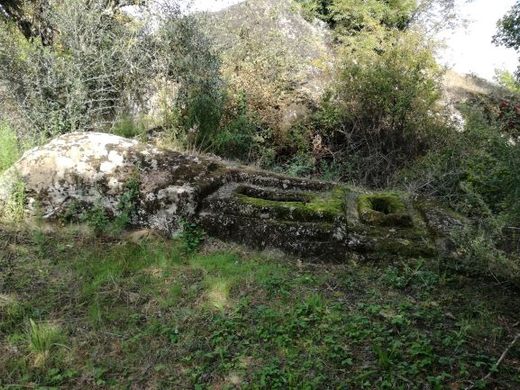
It was most likely the Etruscans who carved the massive volcanic rocks that were cast here from volcanic eruptions and fashioned them into these mysterious altars. A few structures stand out: the two stones known as Sasso del Predicatore (Preacher’s Stones) and the even more mysterious cubic altar, a perfectly shaped cube which defies any logical explanation.

The two stones are very similar in shape, consisting of a staircase carved in the rock leading to an upper level where the altars would have been located. Additionally, the cubic altar even preserves a cross-shaped inscription which might indicate cardinal points. According to several scholars, the altars might have been used by the Etruscans for religious rites (such as the observation of birds) and astronomical observations.


Other minor altars were turned into tombs by Roman freedmen (the inscriptions are sometime visible), such as the so-called Coelius tomb where the inscription reads: “D. Coelius D. L. Alexander / Quintia P. L. Hilara,” or “Decimus Coelius Alexander, freedman of Decimus and Quintia Hilaria freedwoman of Publius.” On the top of the tomb, two burial recesses were carved to preserve the ashes of the two individuals. Several Roman tombs have also been reported around the area, with carvings and Latin inscriptions, but their location is often difficult to pinpoint due to the absence of trails and signs.

One especially interesting monument has, unfortunately, become inaccessible in recent years since it is now on private, fenced property. However, it can be spotted emerging from the hazelnut trees: the ruins of San Nicolao, a medieval Benedictine monastery built over three Roman tombs. The ruins consist of a Romanesque church, a coenobium, and a fortified building built directly on top of a massive block of stone. The three tombs are located at the base of the stone and are beautifully decorated with architectural details.

3 November 2022 - AMAZING PREDJAMA CASTLE - SLOVENIA


AMAZING 

PREDJAMA CASTLE 

- SLOVENIA -


G'day folks,

This castle has a secret tunnel which withstood a siege until its owner was killed by the Holy Roman Empire, whilst sitting on the toilet. 

Built directly into a rocky cliff face, Predjama Castle, or Predjamski grad in Slovenian, was considered virtually impenetrable when it was constructed in the 13th century. However, a few centuries later the structure’s fortifications were put to the test when a robber baron started a war with the Habsburgs and was forced to hole up in the castle for over a year.


According to legend, Erazem Lueger and his family had taken over the Gothic Predjama castle in the late 15th century. Acquiring land and power, Erazem had become a well-known robber baron in the region. However, he quickly grew too big for his britches, murdering the kinsman of Frederick III, the Holy Roman Emperor. With the strength of all of his forces, Frederick came after Lueger, and forced him into hiding in his castle.

Despite the Emperor’s superior forces, the rebellious Lueger had both brains and a secret tunnel between the castle and the nearby Postojna Cave. For an entire year and one day, Lueger snuck out of the castle and replenished food and drink through the tunnel from a nearby town. Finally, after surviving for so many days, one of his servants sold him out.

Waiting for Lueger to use the outhouse on a high floor of the outside face of the castle, the servant raised a flag and one single shot from a cannon blasted the baron off the toilet.


The castle has been completely reconstructed many times over the years. With a Renaissance-style remaining, the Gothic facade and the legend of Erazem Lueger are often forgotten. However, the Postojna Cave is still in use, allowing visitors to relive the siege and covert activities of a knight who crossed the wrong royal family of Europe. Another peculiar fact is that the cave under the Castle is the home to a colony of bats.

31 October 2022 - ANCIENT ROCK DRAWINGS IN CALIFORNIA


ANCIENT ROCK DRAWINGS

 IN CALIFORNIA


G'day folks,

The oldest pictographs on this decorated rock formation in California's Carrizo Plain date back as many as 4,000 years. 

Within California’s Carrizo Plain lies Painted Rock, a smooth marine sandstone rock formation in the shape of a horseshoe. From the outside, while large and uniquely shaped, it may still seem rather unremarkable; entering inside the “horseshoe,” however, reveals a fascinating (and mysterious) relic of history and culture that’s still up for debate today.

Adorning the interior of the rock formation are Native American pictographs whose dates of creation span thousands of years and represent the work of multiple tribes. The content depicted by each tribe varied, but figures, motifs, and mandalas can all be spotted, among other elements and geometrical forms.


Not much else can be said for certain. Debates persist about which groups lived on the land (though the creators are believed to be from the Chumash, Salinan, and Yokuts tribes), and the true meanings of the symbols and pictographs can only be inferred. Based on anthropological research, it is believed that the art came to be during a shaman’s ritual activities involving trance and hallucinations in an altered state of consciousness. However, even this remains an area of debate surrounding Painted Rock today, owing to the varying roles and definitions of the shaman across different societies.

Unfortunately, due to a lack of sufficient preservation efforts, centuries of vandalism dating back to the 18th century have taken a significant toll on the pictographs. Engravings from early Spanish settlers and Portuguese rancheros, carvings from 20th-century white settlers, graffiti, and even a shotgun blast have all worked to deface the site. And there’s more than just human activity to worry about—even natural forces like erosion and burrowing animals have contributed to the decline of the rock art over the years.


While efforts have been made to curtail abuse of the art, including legal protection and surveillance, many feel that the damage has been done. Still, Painted Rock perseveres as an enduring record of Native American culture that has survived centuries of adversity–and it’s even still used for ceremonial activities today.

18 October 2022 - AMAZING INDIGENOUS PETROGLYPHS IN NEVADA


AMAZING INDIGENOUS

 PETROGLYPHS IN NEVADA


G'day folks,

Welcome to one of the few remaining indigenous petroglyph sites in Nevada. 

 The petroglyphs at Mt. Irish are one of the few indigenous sites found in Nevada that give visitors an important look into the people that lived in the region since roughly 1000 B.C.


The petroglyphs, pottery shards, and other items found at the site are believed to date back to between 1 and 1500. The petroglyphs are carved into the rocks, where the so-called desert varnish is removed from the stone to reveal brighter colored rock beneath. Most of the drawings are of bighorn sheep, which are thought to have been a staple food for the indigenous cultures. There are also drawings of people and abstract symbols such as water and spirals.

In many ways, the site is similar to the Yerbas Buenas petroglyph site in northern Chile. This site, which is over 4,000 miles away is situated in a similar low-lying rock formation and is covered with petroglyphs of llamas and people. This suggests that not only these people were distantly related, but also that their culture remained mostly the same during their long migration southward.


6 October 2022 - ANCIENT PETROGLYPHS IN UTAH, USA


ANCIENT PETROGLYPHS

 IN UTAH, USA


G'day folks,

Welcome to a unique collection of drawings that represent Fremont Native American culture. 

These beautifully preserved petroglyphs are just north of Vernal, at McConkie Ranch in Dry Fork Canyon. These panels cover 200 feet along a cliff face in the Navajo formation. It’s believed the petroglyphs were crafted somewhere between 1-1200 CE. They are excellent examples of Fremont Native American culture. 


The images include various people and symbols along with large renditions of the various animals that populated the region. Many are also numbered, detailing where various archaeologists have worked across the site. 

The petroglyphs can be easily reached by several trails with signs and ropes that mark the way. The trails are easy to traverse. The entire trek is just over a mile hike roundtrip.  

29 September 2022 - ANCIENT ROMAN RUINS FOUND BENEATH LIBRARY - ITALY


ANCIENT ROMAN RUINS 

FOUND BENEATH LIBRARY

 - ITALY -


G'day folks,

The remains of an ancient Roman city are hidden underneath Bologna's beautiful public library. 

When the Romans designed the city of Bologna in the 2nd and 3rd century BC, they really built it to last. And last it did: Excavation of the historic center of Bologna in the 1990s uncovered the two main streets built during the Roman Empire, still intact beneath the gorgeous Salaborsa Library in the city’s most popular piazza.


The Salaborsa Library (Biblioteca Salaborsa) is a modern space housed within a beautiful historic building, sitting on top of an extraordinary piece of history. You can see the underground ruins from the main room in the library, through the clear glass panes in the floor. It’s worth getting a closer look though, so head downstairs to the small museum to further explore this hidden remnant of antiquity.


Before you enter the archaeological area, there is a timeline of the history of Bologna, at the end of which is a door. Through the door, you are transported back in time, surrounded by ancient building foundations, a well, and even an ancient sewage system. A kind Italian guide may even be available to point out the different layers of history, which are clearly visible in the remarkably preserved structures. The deepest, oldest levels of the ruins may date back even earlier than the founding of Bologna, suggesting a settlement already existed here before the Romans.