Showing posts with label TEMPLES. Show all posts

26 November 2022 - STUNNING LAKE TEMPLE in BALI


 STUNNING 

LAKE TEMPLE

 in BALI


G'day folks,

I found this temple and massive lake by pure accident, whilst riding my motorbike, searching for things to photograph.This tiny lake temple is dedicated to a water goddess and seems to float on the surface.

Bali’s Pura Ulun Danu Bratan temple pokes up out of the waters of Lake Bratan as though it is simply the peak of some much larger temple just beneath the water. While it is as starkly humble as it seems, its importance to the community would seem to back up that grander fantasy. 


Constructed in 1633, the temple is devoted to the goddess of the lake, Ida Batara Dewi Ulun Danu, in Balinese. The pair of relatively small pagodas that sit on the lake’s waters act as the mother shrines to a countless series of smaller shrines set up at various points downstream. The lake itself has been the main reservoir for a large portion of central Bali for ages and is thus not only functionally very important but also holy to many. In order to keep the waters clean and flowing, the temples on the lake are devoted to the goddess Dewi Danu whose demesne includes rivers, lakes, and other waters. There are also fertility idols at the site of the temples due to the area’s legendary potency and virility, which is also attributed to the waters of the lake.


Visitors to the Pura Ulun Danu Bratan site will first pass through an ornate temple structure on land before being able to board a canoe directly to the pagodas, which seem to almost float right on the water. The little buildings actually sit on a pair of small lake islands; however, the visual effect is nonetheless impressive. The site is popular among those looking to take in Bali’s most beautiful temples, but the meditative quietude of the lake backdrop is likely enough to make up for the presence of any strangers.        


25 December 2021 - WAT ARUN - THE TEMPLE of DAWN


WAT ARUN

 - THE TEMPLE of DAWN -


G'day folks,

This dazzling Buddhist temple was constructed from over one million ceramic tiles salvaged from a British shipwreck. 

Rising like a glittering palace over the western side of the Chao Phraya River, Wat Arun is one of Thailand’s most spectacular and oldest temples. The site is renowned for its colorful, glazed ceramic tiles (reportedly over one million of them) and its ornate central spire (or prang) that currently towers at over 260 feet (about 80 meters).

What makes the temple particularly unusual is the origin of its tiles: they were originally broken bits of Chinese dishes that were salvaged from a British shipwreck. The found porcelain pieces were then crafted into ornate flower petals and embedded into the prang to produce a glittering effect under the sun.

Named “The Temple of Dawn” during the Ayutthaya Period (1768), King Taksin came across the original site by boat after returning back from battle with the Burmese army. As he approached the city at sunrise, the king named the glittering spectacle after the Hindu god Aruna (who is the charioteer of the Sun god Surya). Later, King Rama III added the elaborate ceramic tiles, tiny seashells, Buddha statues, as well as its signature central pagoda spire.

Despite its name, the full scope of Wat Arun is perhaps best appreciated at sunset from the river. While visitors can see temple’s design touches in detail by day (including several Buddha statues and four other spires), it’s particularly beautiful when lit up to a radiant, glowing silhouette at night. If you do, however, visit during the day, it’s best to arrive right when the gates open at 8:30am or late afternoon just before sunset.  


 “Wat Arun’s full official name is Wat Arun Ratchawararam Ratchawaramahawihan – but you’re never going to remember that, let alone pronounce it!,” Pintida Harnpanpongse of Tourism Authority of Thailand tells Atlas Obscura. “It’s considered as one of the most iconic, most recognizable, and most beautiful temples in Thailand because of its unique design, fine craftsmanship, colorful decorated spires, and its majestic riverside location that stands right across from Wat Pho (the Temple of Reclining Buddha).”


 The central tower (prang) is said to symbolize Mount Meru—the home of the gods in Hindu cosmology and the center of the physical and spiritual universe—with its grand tiered design that resembles a stairway to heaven. “Surrounding the Prang there are three rows of statues: on the bottom row there are demons representing hell, the middle row [depicts] monkeys and represent the earth, and the top row are angels representing heaven,” says tour guide Thippy Thepthewi. “The Prang was built with similarity to Khmer architecture, but actually it is our Thai Rattanakosin style, since its slimmer and taller with indentions in the corner (which differ from the Khmer style).”

Wat Arun has also recently underwent an extensive three-year renovation to restore the Chinese porcelain tiles and seashells, as well as the base of the pagoda. 

Clancy's comment: If circumstances were different, I would be in this city today. This temple is also mentioned in my current book. 

Oh, Merry Christmas everyone.

I'm ...


27 December 2021 - WHITE BUDDHA TEMPLE - THAILAND


WHITE BUDDHA TEMPLE

 - THAILAND -


G'day folks,

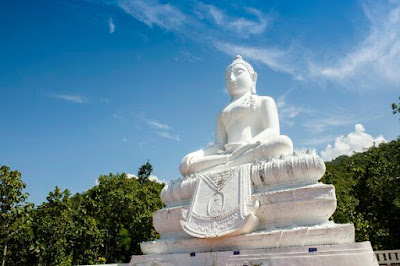
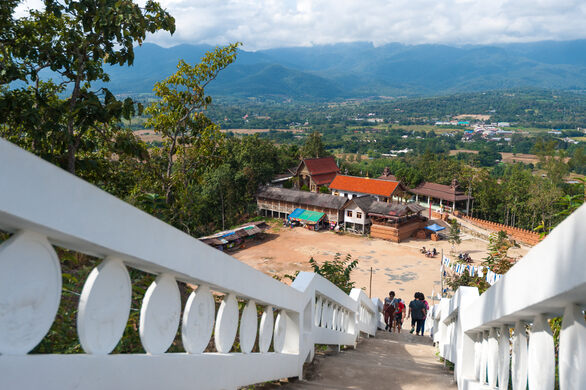
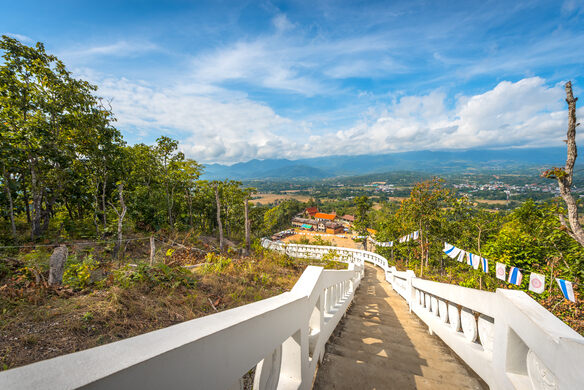
A meditative walk up 353 stairs leads to a majestic white Buddha overlooking Pai.  

With its villas and rice paddies, yoga studios and organic eats, the mountain city of Pai is a bohemian backpacker’s dream. Located roughly three to four hours from Chiang Mai by bus or car, Pai is known for its spiritual sites, including the White Buddha Temple.

Perched high up on the mountainside in the Mae Hong Son Province, you can catch a glimpse of the elegant white statue from all around the city of Pai. Getting to the top, however, requires a bit of effort—353 steps, to be exact. 


 In the rainy season, the walk up isn’t that bad—even if you’re not all that athletic. The key is to pace yourself as you ascend the stairs, especially under the hot sun at midday or when the humidity is high. Bring extra water along for the journey, just in case you get dizzy when you reach the top. You can buy beverages beforehand from a vendor at the base of the stairs.

Once you’re at the top, you can catch lush views of the surrounding mountains and rice paddies, as well as a breathtaking sunset just behind the mountains. The White Buddha faces west, so you simply have to look back to see it. It’s also a particularly peaceful place at sunrise. Visitors can light candles in front of the White Buddha and meditate anywhere on the large tiled platform that surrounds its base. 


Clancy's comment: It seems like a long walk up those stairs, but there are others that are much longer. Trust me!

I'm ...


11 July 2021 - OLDEST PREHISTORIC UNDERGROUND TEMPLE IN MALTA


OLDEST PREHISTORIC UNDERGROUND

 TEMPLE IN MALTA


G'day folks,

Built around 2,500 BC, the Hypogeum in Malta is the oldest prehistoric underground temple in the world. 
 
The island of Malta has several Megalithic Temples and this structure is easily one of the most remarkable ones. A UNESCO World Heritage Site, the Hypogeum is one of the world’s best-preserved prehistoric sites and contains halls, chambers and passages carved out of rock. Archeologists believe that the Hypogeum was used as a temple as well as a sanctuary and a necropolis in prehistoric times. 
 

The complex is divided into three levels - the upper level (3600-3300 BC), the middle level (3300-3000 BC), and the lower level (3150 -2500 BC). Amazingly, the lower level has a room that is 10.6 meters (35 ft) underground. The structure was rediscovered in 1902 and was restored over mid-2016 to early 2017. It was declared a UNESCO World Heritage Site in 1980.


Clancy's comment: This is an extraordinary ancient place to find. 

I'm ...


21 May 2021 - TCHOGHA ZANBIL PALACE AND TEMPLE, IRAN


TCHOGHA ZANBIL PALACE

 AND TEMPLE, IRAN

G'day folks,

Tchogha Zanbil or Choga Zambil is a ruined palace and temple complex of the ancient Elamite city of Dur Untashi in Iran.
 
 Built in 1250 BC, the temple was founded by the Elamite king Untash-Napirisha (1275-1240 BC). The primary feature of the complex is a gigantic ziggurat (a rectangular stepped tower built to honor the main god of the city) dedicated to the Elamite divinities Inshushinak and Napirisha. 
 

Outside of Mesopotamia, the ziggurat at Tchogha Zanbil remains the best-preserved monument of this type. Incidentally, the city was never completed and was attacked and damaged by the Assyrian king Ashurbanipal around 640 BC. 
 
The temple complex was excavated between 1946 to 1962 by archaeologist Roman Ghirshman after prospectors for an oil company discovered it in 1935.
 
Clancy's comment: I find the dates gob smacking. Built in 1250 BC!

I'm ...


30 May 2021 - THE TEMPLE of APOLLO


THE TEMPLE of APOLLO


G'day folks,

The Temple of Apollo is located at Delphi, the center of the Ancient Greek world, and was built on the location of two earlier temples. 
 
The temple was first built around the 7th century BC by the two iconic architects Trophonios and Agamedes and was rebuilt after a fire in the 6th century BC. The temple was of the Doric order and had 6 columns at the front, and 15 columns at the flanks. 
 

In 373 BC, the Temple of Apollo was destroyed by an earthquake and was rebuilt for the third time in 330 BC. Even after so many centuries, the foundations of the iconic temple still survive today along with several Doric columns that are made of porous stone and limestone. Not much is known about the temple’s interior arrangement. However, ancient writers have mentioned that the walls of the temple were inscribed with the aphorisms of the seven sages.


Clancy's comment: I've been to many of these temples in Europe. When visiting these sites, I tried to imagine what it was like back in the day when they were active.  

I'm ...


25 May 2021 - TEMPLE OF APOLLO, GREECE


TEMPLE OF APOLLO, GREECE


G'day folks,

The Temple of Apollo is located at Delphi, the center of the Ancient Greek world, and was built on the location of two earlier temples. 
 
The temple was first built around the 7th century BC by the two iconic architects Trophonios and Agamedes and was rebuilt after a fire in the 6th century BC. The temple was of the Doric order and had 6 columns at the front, and 15 columns at the flanks. In 373 BC, the Temple of Apollo was destroyed by an earthquake and was rebuilt for the third time in 330 BC. Even after so many centuries, the foundations of the iconic temple still survive today along with several Doric columns that are made of porous stone and limestone. 
 

Not much is known about the temple’s interior arrangement. However, ancient writers have mentioned that the walls of the temple were inscribed with the aphorisms of the seven sages.
 
 
Clancy's comment: I can only imagine what it looked like when it was built.

I'm ...


10 May 2021 - LUXOR TEMPLE, EGYPT


LUXOR TEMPLE, EGYPT


G'day folks,

This temple is Located on the east bank of the Nile River in Luxor, in the ancient city of Thebes. 
 
The Luxor Temple was built in 1,100 and 1,600 BC during the reigns of several pharaohs - Amenhotep III (1390-52 BC), Tutankhamun (1336-27 BC), and Horemheb (1323-1295 BC), and then added to by Rameses II (1279-13 BC). The temple was dedicated to the three Egyptian gods Amun, Mut, and Chons, and is considered the largest and most important site in ancient Egypt. The Luxor temple served as a place of worship for nearly 3,500 years and was also the center of the festival of Opet (ancient Egyptian festival of the second month of the lunar calendar). 
 

According to Egyptian legends, the Luxor Temple was “the place of the First Occasion,” where the god Amun experienced a rebirth. Today, the massive Great Colonnade Hall is one of the most vital remains of this vast temple complex.
 
Clancy's comment: The age of these temples is gob smacking. 

I'm ...


5 May 2021 - TEMPLE OF AMADA, EGYPT


TEMPLE OF AMADA, EGYPT


G'day folks,

The Temple of Amada is one of the oldest temples in Egypt and was first constructed by Egyptian pharaoh Thutmose III of the 18th dynasty, sometime around the 15th century BC. 
 

Dedicated to the gods Amun and Ra-Horakhty, the temple is considered to be one of the earliest examples of Egyptian temple architecture in the area of the Middle Nile. While it was originally constructed on the east bank of the Nile, the Temple of Amada was moved in the 1960s and '70s to a higher site on Lake Nasser to protect it from flooding. 
 
One of the most significant features of the temple is a relief along with two important inscriptions describing the military feats of the pharaohs who built it - Tuthmosis III and his son Amenhotep II. While the temple is quite small and dilapidated, it is still quite fascinating and vibrant from inside.


Clancy's comment: Imagine moving a temple this old?

I'm ...