Showing posts with label RAILWAYS. Show all posts

10 November 2022 - SIERRA LEONE'S NATIONAL RAILWAY MUSEUM


SIERRA LEONE'S 

NATIONAL RAILWAY MUSEUM


G'day folks,

After Sierra Leone's railways shut down in 1974, a collection of engines and other artifacts spent decades hidden away in this old workshop—now a museum. 

The Sierra Leone railroad system was built in 1897, with one line to Daru in the eastern part of the country (and a small branch to Makeni the largest town in the north).

The railroad system operated until 1974, then shut down due to a combination of increased car traffic and country policy. Since that year, some of the locomotives were bought and shipped to Wales, the others were kept in the capital city of Freetown. They were stored in the former train workshop, with the intention to convert it into a museum.


The collection survived despite years of neglected upkeep, and the workshop turning into a shelter during Sierra Leone’s civil war. From 1992 to 2002, some 50,000 people lost their lives and hundreds of thousands more lost their homes. Many of those displaced people found the former workshop complex and turned it into a temporary shelter.

 After the war’s end, the collection of railway engines was located and restoration work began. A team set about cleaning and repairing the engines as well as the workshop space. The museum officially opened in 2005, and has continued to grow since then. The museum shows maps of the railroads, their history, and photos of the stations. One of the unusual items in the museum’s collection is a couch specially made for Queen Elizabeth II to use while traveling through the country in 1961 (she never wound up using it), located on a tank locomotive built in 1915.

2 September 2022 - RUSTED RAILWAY MUSEUM IN ETHIOPIA


 RUSTED RAILWAY

 MUSEUM IN ETHIOPIA


G'day folks,

Rusting railcars and locomotive equipment fill this Ethiopian train graveyard. 

Usually when a rail line is decommissioned, the cars and equipment simply disappear, sold off or thrown away, but this old Ethiopian line has been turned into a sort of rusty folk museum.  

The Railway Station at Dire Dawa was the only formal waystation on the railway line which operated from Djibouti on the coast to Addis Ababa in the Ethiopian highlands. The railway line which was constructed and operated by a French company the Chemin de Fer Ethiopien began operations in the reign of Emperor Menelik II and was completed in 1929.


The Railway Line ceased running in the early 2000s and is currently being upgraded into a more modern service. However, when the service stopped, most of the rolling stock, trains, and carriages ended up in the Dire Dawa Station where a museum of sorts has been established.

The museum is a wonderful collection of train memorabilia slowly decaying in the Ethiopian sun. One will receive a tour from the curator, an elderly man who was employed by the railway and speaks a smattering of English, fluent Amharic, and good French, the operational language of the railway. French signs can still be seen hanging in the workshops and there are railway carriages from the 1st, 2nd, and 3rd classes dating from the 1950s. There are a selection of diesel engines and some minor gems such as the rusted shell of an Italian locomotive from the 1940s and some wagons supposedly gifted to the former Communist regime by Mugabe and used to transport tanks.

Wandering around, with bee-eaters providing little bursts of color as they flit between the old telegraph wires, the curator is perfectly happy for all the exhibits to be handled and clambered on, actively encouraging people to “get in,” unafraid that a little bit more of an engine may crumble into the rust colored soil.


25 July 2022 - ABANDONED RAILWAY TUNNEL - ARIZONA


ABANDONED 

RAILWAY TUNNEL

 - ARIZONA -


G'day folks,

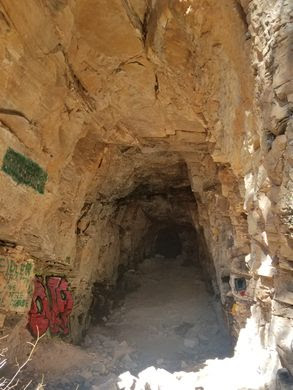
A partial tunnel blasted into a steep ridge is all that remains of a failed railway across Arizona.  

In 1881, businessman James Eddy was struck by inspiration. Northern Arizona was connected to the rest of the country by transcontinental railways and was dense with ponderosa pine forests and a burgeoning timber industry. Southern Arizona, meanwhile, was even more populated, and the isolated mining boomtowns in the deserts were home to some of the richest silver and copper veins in the world. If he could connect the south to the railroad network in the north, he would stand to make a fortune.

The benefit of connecting the two halves of the state would be twofold: sending much-needed lumber and supplies to the communities in the south, and freighting mined minerals back north where they could more easily be shipped to the industrial centers on the coasts. Only one thing stood in the way of Eddy’s plan: the Mogollon Rim.


The southern boundary of the Colorado Plateau, an elevated region that crosses into four states, is the Mogollon Rim, a massive ridge of steep slopes that cross much of Arizona. When Eddy formed the Arizona Mineral Belt Railroad company, his engineers calculated that to run a railway across the Mogollon Rim at a gentle enough grade for trains he would need to create a tunnel 3,100 feet long and 16 feet wide.

In 1883, work on the tunnel began. Over 40 men spent all summer blasting a passage through the rock. Only 70 feet of the tunnel had been completed, however, when the company ran out of funds and the work came to a halt. Eddy spent the next several years finding investors and hyping the railroad project, managing to get another 35 miles of track laid when the money ran dry and the work stopped again, this time for good.

Over the subsequent years, the 35 miles of track south of Flagstaff were torn up by locals who reused the scrap. Today, the only remaining evidence of Eddy’s ambitious but failed project is the partially completed tunnel deep in the Tonto National Forest. Other than some graffiti near the entrance, it still looks more or less exactly as it did when the Arizona Mineral Belt crews left it in 1883. The crumbling structure to the right of the tunnel entrance is the remains of the powder house where the workers stored their explosives while blasting through the ridge.


21 July 2022 - DEVIL'S SLIDE TRESTLES - COLORADO


DEVIL'S SLIDE TRESTLES 

- COLORADO -


G'day folks,

These decaying bridges 1,000 feet high are a reminder of the skill it took to cross the Colorado Rockies by rail. 

Built in 1905 at a total elevation of 11,600 feet on the edge of South Boulder Canyon in the Colorado Rockies, the Devil’s Slide Trestles cling to the side of a mountain with only oblivion between them and the waters of Middle Boulder Creek nearly 1,000 feet below. 


The twin train trestles were part of a harrowing and dangerous railroad that climbed up and over the Colorado Front Range to connect Denver to Winter Park and Salt Lake. This route was part of the historic Moffat Road, one of the highest standard-gauge, non-cog railroads built in the United States. For two decades, the trestles provided an unnerving passage to passengers of the Denver & Salt Lake Railway, until the route was abandoned in 1928 with the opening of the 6.3-mile Moffat Tunnel.

In 1955, the road was opened to automobile traffic following the removal of the train tracks in 1938. But this did nothing to alleviate the unsettling experience of crossing these high bridges. Following the collapse of a tunnel in 1990, the trestles, decaying from nearly 100 years of Colorado’s extreme weather, were closed to automobile and pedestrian traffic. Today, the trestles are not safe to cross, but can be seen by hiking or mountain biking the trail out to the site from either the east or west side of the pass. Looking at the twin trestles you can imagine what it was like to traverse these rickety bridges, with nothing but air between you and the cold waters of Middle Boulder Creek.


13 April 2022 - SEIKAN TUNNEL - JAPAN


SEIKAN TUNNEL

 - JAPAN -


G'day folks,

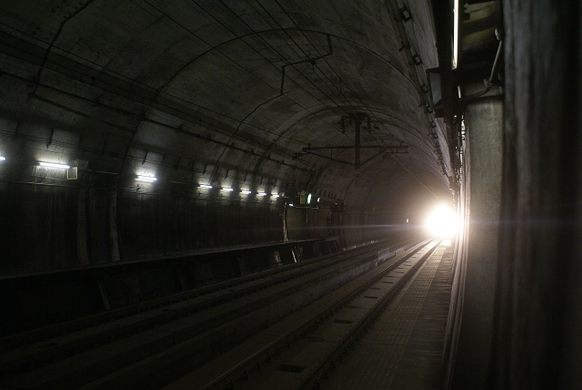
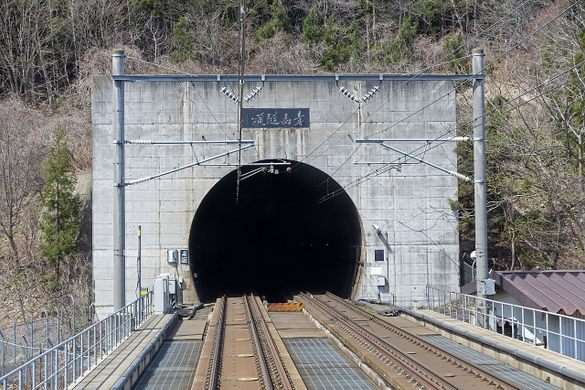
This is the world's longest tunnel with an undersea section.  

As early as 1946, Japan began looking at ways to build a fixed connection between the main island of Honshu and the nation’s second largest island to the north, Hokkaido. After decades of surveying and construction, the Seikan Tunnel was finally completed in 1988, becoming the world’s longest tunnel with an undersea segment.

Before the existence of the tunnel, ferries provided transport between the two islands. After the Tōya Maru Typhoon of 1954, which sank five ferries and killed 1,430 passengers, a more concerted investigation began into the feasibility of a tunnel that would run beneath the seabed to connect the two islands.

Work on the tunnel began in 1971. Building the tunnel, which was designed with a cross-section capable of carrying Japan’s Shinkansen (bullet train) network, was a massive undertaking. During the whole construction process, 34 workers died because of cave-ins, flooding, and other accidents.

Work began with the pilot tunnel, which had a diameter of 16.35 feet. Excavation began at both ends, eventually meeting in the middle in January 1983.


Work on the entrance to the main tunnel began in August 1982. Workers then drilled and blasted their way through the seabed, using almost 3,300 tons of explosives. The submarine section was completed in March 1985. Two undersea stations were built, one on the coast of each island, to serve as escape points in the event of an emergency.

The Seikan Tunnel was opened in March 1988, at a total cost of around US$7 billion (almost 12 times the original budget). It runs for a total length of 33.46 miles, 14.5 miles of which are under the seabed, at a depth of 790 feet below sea level. That makes it the longest tunnel in the world with an undersea section (at 23.5 miles, the Channel Tunnel is the longest underwater tunnel in the world, but Seikan is longer overall, and deeper). The Seikan Tunnel was the world’s longest railway tunnel until the opening of the Gotthard Base Tunnel in Switzerland in December 2016.


Today, about 50 freight trains and 30 Shinkansen bullet trains pass through the tunnel every day, carrying more than two million tons of cargo each year. But freight trains and high-speed bullet trains are not the best of traveling companions, especially in the tunnel.

The Hayabusa Shinkansen series, a Japanese bullet train with a top speed of 199 miles per hour, has to slow down to 87 miles per hour in the tunnel to avoid disrupting the freight trains. At full speed, the wind pressure created when the two trains cross paths could cause the freight trains to spill their loads. Ways to manage this situation, and to raise the speed limit, are still being investigated.

Clancy's comment: I love train travel in Japan. 

I'm ...


8 April 2022 - DONNER PASS TUNNELS - CALIFORNIA


DONNER PASS TUNNELS 

- CALIFORNIA -


G'day folks,

The now-abandoned tunnels were built for the transcontinental railroad on the route where the first wagon train entered California.  

Theodore Judah was a man with a dream, and his was to build a railroad through the Central Pacific, routed via the Sierra Nevada mountains. In the mid-19th century, the civil engineer surveyed a large stretch of the route to be used and found funds to make the transcontinental railroad a reality.

A series of now-abandoned tunnels were completed in August 1867, and the first train passed through it in 1868. Unfortunately, Judah did not live to see this happen; he died in 1863 during an eastbound voyage in connection with his dream project.


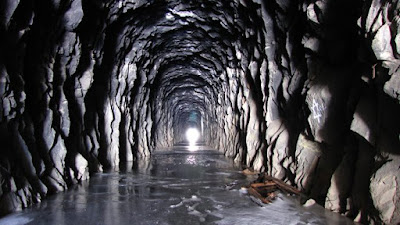
The tunnels at Donner Pass were constructed by Chinese laborers and took more than 15 months of hard work to finish. A dozen tunnels were some of the most treacherous parts of the transcontinental railroad, linking the rail networks of Omaha, Nebraska, to the West Coast at Oakland. They were constructed through the use of hand drilling, black powder, and nitroglycerin (leading to an untold number of worker deaths).

The tunnels were used by trains for 125 years, until 1993 when the line was rerouted through a new tunnel running through Mount Judah, named after the railroad pioneer. The Donner Pass and the tunnels are named after the Donner Party, a group of explorers en route to California who became stranded in the Sierra Nevada region due to heavy snow and resorted to cannibalism to survive.

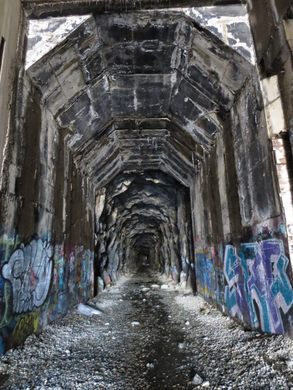
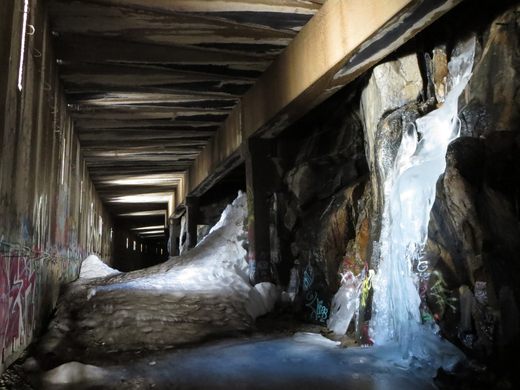
The tunnel and snow shed now sit abandoned and, despite being on private property, are a popular place for curious hikers and snowshoers. Tunnel #6, which took tens of thousands of hours to complete, is the most famous of the tunnels. Tunnels #7 and #8, along with the China Wall, which was built to hold up the trains as they transitioned between two tunnels, are the other parts of the system that are commonly visited. A walk through the dark tunnels, with light pouring in only at points where the wall has openings, can be an eerie experience. Ancient petroglyphs can also be found nearby and are marked with a plaque.

Clancy's comment: You have to admire people with vision.

I'm ...


27 November 2021 - WATER-POWERED FUNICULAR RAILWAY


WATER-POWERED 

FUNICULAR RAILWAY 


G'day folks,

A rare water-powered funicular uses a huge tank of water and gravity to do its work. 

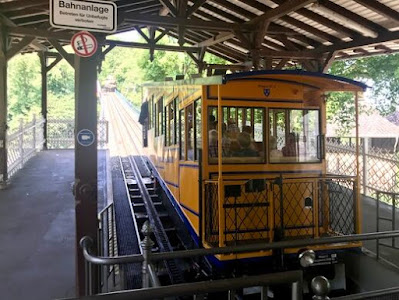
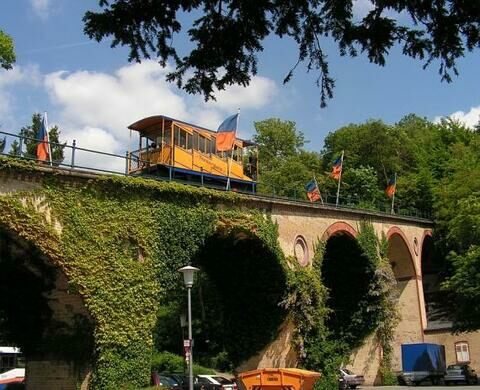
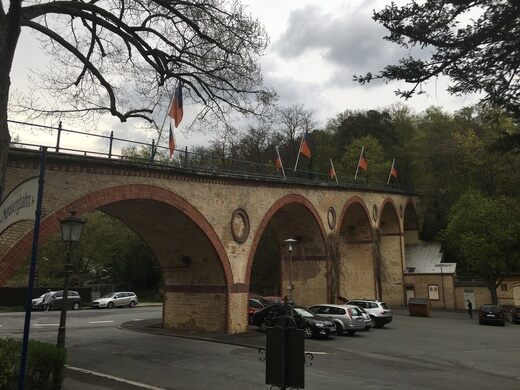
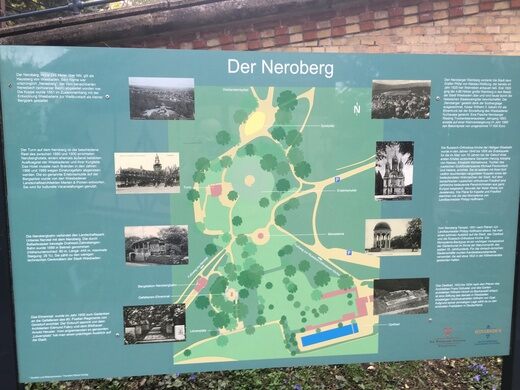
A 440 metres long funicular railway in the city of Wiesbaden linking Neroberg hill to its north, Nerobergbahn opened in 1888, and is one of the few remaining funiculars to use water propulsion.

At the upper station, tanks on the downbound car are filled with up to 7,000 litres of water in order to ensure that it is heavier than the upbound car. The downbound car then pulls the upbound car uphill under the power of gravity and by means of a 452 m long steel cable. When the downbound carriage arrives at the lower station, the water is discharged and pumped back uphill.


 In 1939, it was planned to convert the line to electric propulsion, and to provide larger cars, but the outbreak of World War II prevented this. The line was taken out of service in 1944 due to war damage, but service was restarted in 1948. In 1988 the line was protected as a technical monument by the State of Hesse.


 Nerobergbahn is operated only in the summer months as there is danger of freezing in the winter.

Clancy's comment: Amazing, eh?

I'm ...


14 May 2020 - ABANDONED RAILWAY STATION IN PENNSYLVANIA, U.S.A


ABANDONED RAILWAY 
STATION IN
 PENNSYLVANIA, U.S.A 

G'day folks,

Welcome to a train station that was abandoned by the coal industry and was later converted into a cocktail bar. 


The City of Wilkes-Barre, like many mining settlements, fell into a deep depression when the nearby anthracite coal breakers closed. However the last existing train station hung on as a cocktail bar until it too was abandoned. 


Wilkes-Barre was once a thriving coal mining town turned city in the Wyoming Valley of North Eastern Pennsylvania. Once the mines started to all close or fold  in the 1970s due to low demand, the city was been left to gather dust. The Central Railroad of New Jersey’s (CNJ) passenger train station, which stands in the shadow of the once mighty and still ornate defunct Stegmier Brewery is still a very recognizable landmark along Wilkes-Barre Blvd.. Left unused for some time plans for it’s reuse and restoration have been made and broken time after time. 


Once dwarfed by the noisy breakers, buildings and railroad infrastructure of both the Central Railroad of New Jersey and the Lehigh Valley Railroad’s servicing facilities it is now left to be only one of the few reminders in the downtown of what had been the bustling Railroad and Anthracite coal industry.


 Once on the list of historic landmarks, the station was built in 1868, passenger service halted in 1961 and was shuttered  in 1972 by the CNJ after the last of the operating breakers, the Huber breaker in Ashley, Pennsylvania closed leaving the railroad yard it was attached to mostly empty and ready for closure .


It lived for a time as a cocktail bars called “The Station” and a club joint called  “Banana Joe’s”. Two old pullman cars were converted into hotel rooms, bars, and even a dance floor, but now even the station and bar lie in ruins and left to vandals and the elements. The elaborate Rococco flourishes and grand staircases still remain however.

As of 2016, a developer bought the property and is slowly restoring the station to its former glory.


Clancy's comment: Sad, eh? Some of the old stations in Australia have been totally refurbished and they look sensational.


I'm ...