Showing posts with label ETHIOPIA. Show all posts

25 September 2022 - THE CHURCH IN THE SKY - ETHIOPIA


THE CHURCH 

IN THE SKY

 - ETHIOPIA -


G'day folks,

Reaching the "Church in the Sky" requires scaling the cliff face of a sandstone pinnacle with a 650-foot drop. 

If you think going to a normal church can be an enlightening experience, imagine going to worship in a rock-hewn painted cave atop a towering sandstone pinnacle, only reachable via a daredevil climb with 650-foot drops on all sides. 


At Abuna Yemata Guh in northern Ethiopia, this risky and thrilling experience is common practice for a few dedicated priests. The monolithic place of worship is said to be the world’s most inaccessible and dangerous church, reachable only by a 45-minute ascent.

The journey has cliff faces to scale, rickety bridges to cross, and narrow ledges to traverse. After crossing through the valley that underlies the church, you must ascend the half-mile-high sandstone pinnacle, searching for rare footholds to avoid the long drop. Adding to the general sense of dread, the route passes by an open-air tomb filled with the skeletal remains of deceased priests (although it’s said that none of the priests died from falling off the cliff).

If the intense climb and the gorgeous view of the valley below aren’t enough to take your breath away, the interior of the church surely will. The cave’s ceiling is covered by two beautiful frescoes, featuring intricate patterns, religious imagery, and the faces of nine of the twelve apostles of Christ. The church also contains an Orthodox Bible with vibrant, colorful sheets made of goatskin. Abuna Yemata Church is so sacred that some Ethiopian parents even risk bringing their babies all the way to the top of the cliff to have them baptized there.


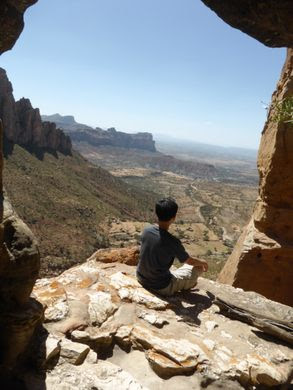


The church is named after Father Yemata, a priest who carved the church out of the cliff face in the 5th century. Some say he chose the high location to escape enemies, while others believe it was an attempt to find true divinity. Either way, his rock-hewn masterpiece has provided a unique opportunity for Ethiopian Christians to demonstrate their commitment to their faith in epic fashion.

12 September 2022 - THE HOTTEST PLACE ON EARTH - ETHIOPIA


THE HOTTEST PLACE 

ON EARTH 

- ETHIOPIA -


G'day folks,

Welcome to the hottest place on the planet. 

In the north of Ethiopia, hours from any populated area, is a vast expanse of brutal landscape unlike anywhere else in the world.

Dallol, in the Danakil Depression, is a boiling, salt-formed world completely hostile to human visitors. The Danakil Depression, also known as the Afar Depression, holds the distinction of being one of the lowest and hottest parts of the world.


On top of average temperatures of 94 degrees Fahrenheit, Dallol itself is surrounded by boiling hot springs, bringing hot minerals and toxic gas bubbles to the surface. Despite making Dallol uninhabited, these geological forces have actually made the area somewhat picturesque, coloring the lowlands with rusty orange, yellow, and green salt formations.

Dallol is extremely unwelcoming to inhabitation. However, a number of people have still ventured into the region for work, due to the high deposits of table salt in the area. Expeditions funded by Europe prior to World War I were shut down and dismantled throughout the first half of the 20th century. Later attempts by American, Indian, and Italian companies have resulted in thousands of mines throughout the region, but no permanent settlement.

Although it is now uninhabited, small structures made of salt bricks were created by the Afar people, when they were employed by mining companies throughout the 20th century. However, the majority of these have been abandoned and few traces of these settlements still exist.

Near the Dallol area in the same region is Erta Ale, the “Gateway to Hell,” a smoking volcanic terrain complete with its own lava lakes. It is an equally harsh and unforgiving environment, and nearly impossible to reach without great difficulty.


2 September 2022 - RUSTED RAILWAY MUSEUM IN ETHIOPIA


 RUSTED RAILWAY

 MUSEUM IN ETHIOPIA


G'day folks,

Rusting railcars and locomotive equipment fill this Ethiopian train graveyard. 

Usually when a rail line is decommissioned, the cars and equipment simply disappear, sold off or thrown away, but this old Ethiopian line has been turned into a sort of rusty folk museum.  

The Railway Station at Dire Dawa was the only formal waystation on the railway line which operated from Djibouti on the coast to Addis Ababa in the Ethiopian highlands. The railway line which was constructed and operated by a French company the Chemin de Fer Ethiopien began operations in the reign of Emperor Menelik II and was completed in 1929.


The Railway Line ceased running in the early 2000s and is currently being upgraded into a more modern service. However, when the service stopped, most of the rolling stock, trains, and carriages ended up in the Dire Dawa Station where a museum of sorts has been established.

The museum is a wonderful collection of train memorabilia slowly decaying in the Ethiopian sun. One will receive a tour from the curator, an elderly man who was employed by the railway and speaks a smattering of English, fluent Amharic, and good French, the operational language of the railway. French signs can still be seen hanging in the workshops and there are railway carriages from the 1st, 2nd, and 3rd classes dating from the 1950s. There are a selection of diesel engines and some minor gems such as the rusted shell of an Italian locomotive from the 1940s and some wagons supposedly gifted to the former Communist regime by Mugabe and used to transport tanks.

Wandering around, with bee-eaters providing little bursts of color as they flit between the old telegraph wires, the curator is perfectly happy for all the exhibits to be handled and clambered on, actively encouraging people to “get in,” unafraid that a little bit more of an engine may crumble into the rust colored soil.