Showing posts with label SWEDEN. Show all posts

23 January 2023 - VIKING SILVER DISCOVERED IN SWEDEN


 VIKING SILVER 

DISCOVERED IN SWEDEN 


G'day folks,

Buried beneath an unassuming Gotland farm was the largest collection of Viking silver, mostly of Islamic origin. 

In 1999, a TV crew accompanied archaeologist Jonas Ström and numismatist Kenneth Jonsson to an unassuming farm on Gotland, Sweden’s largest island. After a farmer had discovered a Viking coin, roughly 150 coins and artifacts had been unearthed. The crew got the footage they wanted and left the site, but Ström and Jonsson stayed behind, continuing their unofficial search with a metal detector. In less than half an hour, they discovered two massive caches of Viking treasure.


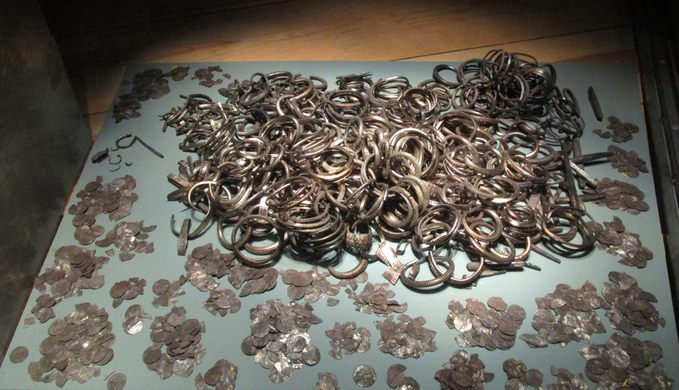
They immediately asked for permission to officially excavate the site, and over 2,000 people reportedly visited the farm the first weekend after the dig was made public. A third cache was soon discovered, and by the end of the excavation, 67 kilograms (148 pounds) of silver and 20 kilograms (44 pounds) of bronze artifacts had been dug up. 

The hoard, believed to have been buried beneath a ninth-century outhouse, consisted of coins, ingots, and jewelry items such as rings, bangles, and necklaces. Of the 14,295 coins discovered here, as many as 14,200 of them were centuries-old Islamic dirhams. The remaining 95 were an assortment of Nordic, Byzantine, and Persian coins. A few were contemporary counterfeits.

Perhaps most compelling was the discovery of “the Moses Coin.” Minted in the Khazar Kingdom around 800, the coin imitates the design of the silver dirham, but mentions Moses rather than Muhammad in its inscription, offering some archaeological evidence for the popular yet unconfirmed claim that Khazar rulers converted to Judaism.

The Spillings Hoard is the largest Viking hoard ever discovered. Its treasures are now on display at Sweden’s Gotland Museum.


16 January 2023 - ANCIENT STONE GRAVES SHAPED LIKE SHIPS - SWEDEN


ANCIENT STONE GRAVES 

SHAPED LIKE SHIPS 

- SWEDEN  -


G'day folks,

Welcome to ancient stone graves shaped like ships provided a Viking-like burial to carry the dead to the afterlife. 

Gotland is a Swedish island brimming with ancient structures, from Visby’s medieval city wall to a roughly 5,000-year-old megalithic tomb. Some of the most fascinating sights are the stone burial “ships,” or skeppssättningar, found throughout the island. These ancient gravesites date from the late Bronze Age, between 1100 and 400 BC. 


The boat-shaped stone monuments were generally used as burial spots for an important member of this coastal community. The person would be cremated and their bones beaten to dust. These remains would then be collected in a stone urn and buried inside the ship. It is believed that this was done to equip the dead with everything they had in life and to facilitate the journey to the afterlife.

The stone ships in the village of Gnisvärd are among the best preserved examples of the ritual in Gotland, and one of them is also the largest on the island. Made of around 100 tall stones, it stretches 148 feet (45 meters) long. The site contains three ships in total that are erected one after another as if going in a ghostly precession. The lead ship is pointed toward an ancient megalithic tomb, the only one in Gotland. Archaeologists believe this was done to “moor” the newer graves to an old revered place.

7 May 2022 - ABANDONED RAILWAY TUNNEL IN SWEDEN


ABANDONED RAILWAY 

TUNNEL IN SWEDEN


G'day folks,

It was meant to help transport wounded soldiers to a secret underground hospital. 

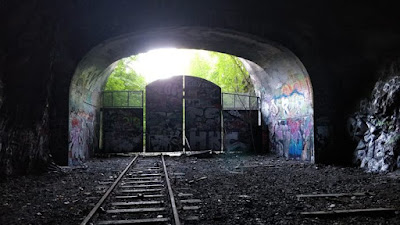
An old overgrown train track and tunnel with an intriguing history hide close to one of Stockholm’s most popular bathhouses.

The old industry track was built between 1925 and 1940. It stretches from the top northeastern tip of the Södermalm and arcs to the southwest. It begins near the harbor, as the idea was that wounded men arriving via ship to the harbor could be ferried away to an underground disaster center hidden beneath the hospital.


But no ships full of wounded World War II soldiers ever arrived. The railway did see some violence, though, as it was one of the places bombed by the Soviets during the February bombings of 1944.

The city has made several requests to remove the train tracks to construct houses in their place. The request keeps being denied, leading the city to find other uses for the space. Marathons have been held there, as well as theater shows and art exhibits. Proposed plans for the tunnel include a pedestrian path, concert hall, and even a ski trail.

Clancy's comment: It always staggers me when I read about the infrastructures constructed during our major wars.

I'm ...


11 August 2019 - Pelle Svanslös Crosswalk in Sweden


Pelle Svanslös 
Crosswalk in Sweden

G'day folks,

This might surprise you. 

The road signs in front of Carolina Rediviva Library in Uppsala have something unusual: cats. On closer look, you might notice the adult cat leading kittens has no tail. He isn’t just an ordinary bobtail cat. He’s Pelle Svanslös (“Peter No-Tail” in English), a popular character from a children’s book series with the same name.


The Pelle Svanslös series—there are 12 books in total—was written by Gösta Knutsson between 1939 and 1972. As his name suggests, Pelle has no tail. A rat bit his tail off when he was a kitten. But despite this mean mishap, Pelle grows into a kind-hearted young cat. He has been loved by many Swedish children for decades.


Pelle and his feline friends live in Uppsala, Sweden, where the author also lived for many years of his life. To mark the cat’s popularity, Uppsala added some features related to the children’s literature star around the city, such as a statue, a peep-hole (his residence), and these crossing signs.


Clancy's comment: Mm ... I wonder if my local library will do something for me when I die?

I'm ...


22 May 2019 - THE ROYAL BURIAL MOUNDS IN SWEDEN


THE ROYAL BURIAL 
MOUNDS
 IN SWEDEN

G'day folks,

Welcome to some facts about ancient burial mounds for royalty in Sweden.

Dating back to the 5th and 6th centuries, the Royal Mounds of Gamla Uppsala have been shrouded in mystery for generations. Some believed the three large mounds to be gods Thor, Odin, and Freyr, others thought them to be the burial sites of legendary kings, while some people believed them to be, well, simply natural lumps of dirt. The latter speculation angered Swedish King Karl XV, and in 1830 he commissioned a widely publicized excavation to settle the matter once and for all.


Headed by Bror Emil Hildebrand, the first archaeological dig of the Eastern Mound confirmed that it was indeed a burial site, though findings were less than spectacular: A clay pot of burned bones and some burial gifts. They believed it to be a grave for either a young woman or a young man and a woman. The second excavation in 1874 of the Western Mound yielded more impressive findings of warrior equipment, luxury weaponry, as well as a prominent man dressed in a suit of golden threads. This grave was confirmed to date back to the 6th century.

Though archaeologists were unable to identify the bodies of the mounds, they are quite certain the mounds belonged to a royal dynasty. As Sweden’s oldest national symbols, the Royal Mounds have retained their significance, especially emphasized by a trip from Pope John Paul II in 1989. The three mounds are known today as the Eastern, Middle, and Western Mounds.


Clancy's comment: There ya go. Interesting, eh? I bet you are glad you now know what the mounds were for.

I'm....


21 May 2019 - THE FLOGSTA SCREAM IN SWEDEN


THE FLOGSTA SCREAM
 IN SWEDEN

G'day folks,

I bet you will love this informative post. A nightly tradition fills the streets of Flogsta, Sweden, with a collective scream.

The Flogsta Scream occurs every night at 10 p.m. when university students living in Uppsala’s Flogsta neighborhood stop what they’re doing and let out a collective scream from their windows, balconies, and rooftops.


It’s a tradition that dates back to the 1970s, though details regarding how or why the tradition started are difficult to come by. The most extensive account of the Flogsta Scream comes from Wikipedia, which postulates that the Flogsta Scream may have started as a way to blow off steam during exam periods or possibly to commemorate a student who committed suicide. The article, however, cites no sources and additional information is scarce.


Still, it’s a useful thing to know, should you find yourself on a nighttime stroll in Uppsala, that the spontaneous shrieks from the nearby dormitories are no cause for alarm.


Clancy's comment: It's probably good for them. Man, there are heaps of times when we all feel like screaming. However, it probably sounds like a mass murder.
I'm ...


20 October 2017 - SWEDEN’S COLLECTION OF AMERICAN CARS


SWEDEN’S COLLECTION
 OF AMERICAN CARS

G'day folks,

This post relates to more cars that have been collected and deserted. The “Raggare” movement, which emerged from a post-war youth counterculture mainly in Sweden and parts of Norway, is known for its undying love of vintage American hot rod cars and 1950s pop culture.

Deep in the Swedish woods, there lies an army of more than a thousand abandoned cars, decaying since the 1950s. The land was once owned by two brothers who opened a scrapyard business for cars left behind by U.S servicemen in Sweden and around Europe after WW2. Disassembling the cars and selling them off to Norway for parts was big business in Sweden at the time. Norway had been left a poor country after the war and car parts were near impossible to get. Junkyards popped up all along the Swedish border and Norwegians were their best customers.


The brothers who owned Båstnäs lived on the land and continued selling abandoned American cars up until the 1980s. Today you can still the see the forgotten cars strewn around the land, filling the fields surrounding the brothers’ two dilapidated homes.

While many Swedes are demanding the country’s junkyards be removed and the forests cleaned up, ironically, environmentalists are pleading for them to stay, arguing that wildlife have made nests in the automobile remains. And if they get their way, the cars will remain until they’re dust.


“Ragga” roughly means “to pick up girls” in Swedish and they were known to do just that; pick up impressionable young women in one town and find new ones in the next, having their “bad boy” way with them in the back seat of the car along the way.


Today, the Raggare have quite a different reputation, met with amusement or only mild disapproval by modern mainstream society. There’s been some controversy about the raggare seen waving the Confederate flags while driving their old muscle cars, but to quote an article published last year by Jalopnik about the car culture, “like most cultural icons, the Confederate flag doesn’t translate fully when its taken overseas … and in Sweden, it’s both a symbol of America and rebellion, and not of anything with scary undertones.”

Now,  check out these pearlers.


Clancy's comment: Amazing, eh? So much steel, and so many spare parts for some keen enthusiast who is restoring one of these icons.

I'm ...


29 February 2016 - ALFRED NOBEL


ALFRED NOBEL

G'day folks,

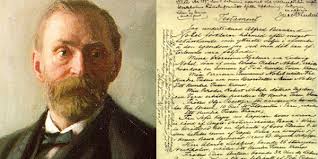
No doubt you have heard of the Nobel Prize, but do you know anything about the man behind the prize?  Alfred Bernhard Nobel was a Swedish chemist, engineer, innovator, and armaments manufacturer. He was the inventor of dynamite. On the anniversary of Alfred Nobel's death, which coincides with the Nobel Peace Prize Award Ceremony, here's a look at some surprising facts about Nobel's life and legacy.

 You may know that after a lifetime of working with explosives, Alfred Nobel wanted the fortune he'd earned to be used to create Nobel Prizes in the fields of chemistry, medicine, physics, literature and peace. However, there's much more to this 19th century scientist's story. Here are a few surprising facts about Nobel's life (and death):


A Benevolent Misanthrope

For a man who would establish prizes that celebrate the best in human accomplishment, at times Alfred Nobel had very little enthusiasm for people.
Nobel, who suffered from chronic bad health, lived a lonely life; he preferred not to entertain and once wrote that "numerous friends are to be found only among dogs." In addition, the people he met in his career often frustrated him, as competitors tried to appropriate his work on multiple occasions.

Yet Nobel didn't completely give up on humanity, as his prizes indicate. He once wrote: "I am a misanthrope, but exceedingly benevolent."


Nitroglycerin Man

 Nobel's reputation and fortune were built on his work with nitroglycerin. He invented an igniter that made it possible to control the unstable compound's explosions, then figured out how to combine nitroglycerin with silicon-containing earth in order to create the more stable dynamite. Later in his career, Nobel also used nitroglycerin to make blasting gelatin and ballistite (smokeless powder).

In Nobel's lifetime, nitroglycerin was also found to have medicinal uses. And when Nobel experienced heart problems himself, doctors directed him to take the compound. Nobel recognized the absurdity of the situation, noting, "[I]t seems an irony of fate that they should be prescribing nitroglycerin internally for me!"


 Nobel the Playwright


Nobel had a lifelong appreciation for literature. He often wrote poetry, and also drafted a few novels. And shortly before his death, he completed a play, Nemesis, that was based on the story of a 16th century noblewoman who'd killed her abusive father. Nobel wrote that he thought his work was "rather good," and 100 copies of the play were made for distribution. 

 After Nobel died in 1896, family members tried to destroy those copies because they felt the play could undermine his reputation. Despite these efforts, three copies survived, and in 2005 Nemesis premiered at a theater in Stockholm.

However, though Nobel was a man of many talents, apparently his skills did not include writing drama — so don't feel bad if you missed the show. A Guardian article about the premiere stated: "According to the show's director, Rikard Turpin, Nemesis is a lurid parade of torture, rape and incest that features a drug-induced vision of the Virgin Mary, a conversation with Satan and ends in a 40-minute torture scene."


 Nobel and Peace


Throughout his life, Nobel didn't see his work with explosives as something he had to atone for. Most of his nitroglycerin products were put to use in fields like mining and communications (though ballistite was used in firearms). Of course there were military applications for all his explosives, but Nobel felt that "there is nothing in our world that cannot be misused."

In addition, Nobel believed that increases in destructive power might lead to peace. In 1890, he wrote, "On the day when two armies will be able to annihilate each other in one second, all civilized nations will recoil from war in horror and disband their forces." And Nobel, who was friends with peace activist Bertha von Suttner, told her, "Perhaps my factories will put an end to war sooner than your [peace] congresses."

However, Nobel's views did evolve to the point that he chose to establish the Nobel Peace Prize in order to honor those who "have done the most or the best work for fraternity between nations, for the abolition or reduction of standing armies, and for the holding and promotion of peace conferences" — a decision that many attribute at least in part to his ongoing discussions with von Suttner. In 1905, she won the Peace Prize herself.


 Feared Being Buried Alive


In the 19th century, it wasn't uncommon for people to worry about being live burial (Edgar Allan Poe's "The Premature Burial" was published in 1844). In fact, Nobel's father was afraid of such a fate — at one point, he wanted to build a coffin that allowed its occupant to call for help, just in case.

It turns out that Nobel shared his father's fears of being entombed alive, and placed instructions in his will to prevent this: "It is my express will and injunction that my veins shall be opened after my death." Only after "competent doctors [had] noted definite signs of death" did Nobel want his body cremated.

 A Confusing Will


Given the importance of Nobel Prizes today, it's hard to imagine a world without them. Yet issues with Nobel's last testament mean that's almost what happened.

Nobel didn't like lawyers — he felt they made a living "by inducing people to believe that a straight line is crooked" — and he therefore wrote his will without any legal counsel. This helps explain why Nobel never checked to make sure that the groups he selected would be willing to do the work needed to award Nobel Prizes.

In addition, Nobel wanted the bulk of his fortune to establish a fund for these prizes, yet he didn't provide specifics about how that fund would be administered. Yet more issues arose because some family members were not happy to lose out on what would've been a large inheritance. 

Obviously these problems were eventually resolved. However, it took time, which is why the first prizes were not awarded until 1901, five years after Nobel's death.


  Clancy's comment: Mm ... Where there is a Will, there is a family.

I'm ....