Showing posts with label RUINS. Show all posts

18 July 2023 - HUNDREDS OF RUINS IN IRELAND - RATHCROGHAN


HUNDREDS OF RUINS

 IN IRELAND 

- RATHCROGHAN  -


G'day folks,

This ancient Irish landscape boasts hundreds of legendary ruins. 

Rathcroghan, or Cruachan Aí, is an archaeologist’s dream. Found in the center of County Roscommon, it contains about 240 identified archaeological sites packed within an area of about 2.5 square miles.

This landscape confidently bears witness to nearly 5,500 years of continuous settlement. The earliest known monument is a small court tomb from the early Neolithic Period. Bronze and Iron Age burial mounds dot the earth. You’ll also find traces of massive feats of late Iron Age architecture such as the Rathcroghan Mound and the Mucklaghs earthworks as well as early historic settlement sites and religious foundations. The later medieval period sees Rathcroghan divided into a large matrix of field systems, evidence of the pastoral farming practice common to this region from prehistory up to the present day.


This area, perhaps unsurprisingly, is also one of the key theaters of Ireland’s impressive collection of intoxicating mythology and literature. It boasts the mythological gateway into the Irish Otherworld: the cave of Oweynagat. Uaimh na gCat (Gaelic for “Cave of the Cats”) is the origin place of the pre-Christian seasonal celebration of Samhain, the Celtic precursor to modern Halloween.

Rathcroghan is the starting point for a whole series of Iron Age heroic cattle raiding tales, known as na Tána. Indeed, the central tale of the Ulster Cycle of Irish mythology, an Táin Bó Cúailnge, Ireland’s greatest epic, rises out of Rathcroghan, at the behest of the famous Iron Age Warrior Queen Medb (Maeve) of Connacht. Medb is a vital part of this landscape, and of the West more generally, and her capitol and palace are reputed to be located on the Rathcroghan landscape. These stories record the deeds of Ireland’s heroes, such as Cú Chulainn, Fráoch, the Morrigan, Conor Mac Nessa, Ferdia, and Medb herself.

Many of these archaeological sites retain links to these heroic tales through their names, among them Reilig na Rí (the Cemetery of Kings), Caiseal Mhanannán (the stone fort of Manannán mac Lír, god of the sea), Rath na dtarbh (the fort of the bulls), Daithí’s Stone, and more. Hearing these stories, told on this earthen canvas, is the perfect way to understand the previous generations who walked this sacred landscape.

29 September 2022 - ANCIENT ROMAN RUINS FOUND BENEATH LIBRARY - ITALY


ANCIENT ROMAN RUINS 

FOUND BENEATH LIBRARY

 - ITALY -


G'day folks,

The remains of an ancient Roman city are hidden underneath Bologna's beautiful public library. 

When the Romans designed the city of Bologna in the 2nd and 3rd century BC, they really built it to last. And last it did: Excavation of the historic center of Bologna in the 1990s uncovered the two main streets built during the Roman Empire, still intact beneath the gorgeous Salaborsa Library in the city’s most popular piazza.


The Salaborsa Library (Biblioteca Salaborsa) is a modern space housed within a beautiful historic building, sitting on top of an extraordinary piece of history. You can see the underground ruins from the main room in the library, through the clear glass panes in the floor. It’s worth getting a closer look though, so head downstairs to the small museum to further explore this hidden remnant of antiquity.


Before you enter the archaeological area, there is a timeline of the history of Bologna, at the end of which is a door. Through the door, you are transported back in time, surrounded by ancient building foundations, a well, and even an ancient sewage system. A kind Italian guide may even be available to point out the different layers of history, which are clearly visible in the remarkably preserved structures. The deepest, oldest levels of the ruins may date back even earlier than the founding of Bologna, suggesting a settlement already existed here before the Romans.

15 December 2021 - CHACO CULTURE NATIONAL HISTORICAL PARK - NEW MEXICO


CHACO CULTURE NATIONAL 

HISTORICAL PARK - NEW MEXICO


G'day folks,

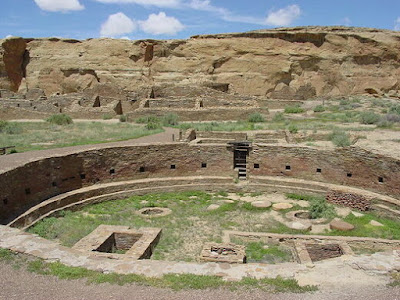
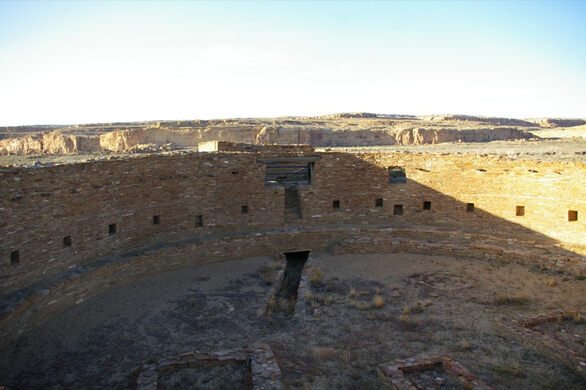
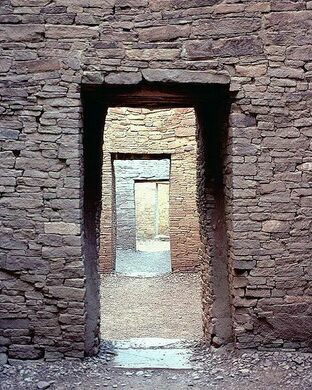
A phenomenal assembly of pueblos in New Mexico is the most complete example of ancient ruins north of the border. 

An ancient and mystical place, Chaco Canyon is a fragile and vital piece of pre-Columbian cultural and historical preservation.

The canyon of the Chacoans was once the cultural hub for Ancient Pueblo Peoples. Huge, intricate compounds showing in their construction evidence of archeoastronomy with several of the buildings aligned to capture the cycles of the sun and moon. The canyon’s 15 complexes also contained the largest buildings north of Mexico until the 19th century. The Chacoans and their complicated, astronomically-influenced architecture thrived between the years 900 and 1150, likely moving on due to a climate change that delivered a drought that lasted half a century.

The Chacoan complexes cover a nine-mile span along the canyon floor. The Northside is home to nine of the “Great Houses,” of which there are 14 altogether. The latest Great House is Pueblo Bonito, a four-story-high complex with 650 rooms, taking up almost two whole acres of land with its girth, its massive scale indicative of the spiritual importance the Great Houses held. Most of the houses facing South are well constructed, many-roomed structures which seem to be carefully aligned. Pueblo Bonito sits directly on the East-West line, an axis that captures the passage of the equinox sun.


Smaller and more numerous than the Great Houses are the kivas. Some greater than others, the kivas held worshippers and contained both religious centers and dwellings. Some still standing, some remain only as foundation ruins, the park is said to contain 2,400 identified archeological sites, few of them have currently been excavated. Along with the complexes that served the city as homes and religious buildings, the site has a massive structure that is believed to have been a dam, elaborate pictographs, and tens of thousands of artifacts have been discovered just in the few excavations that have taken place. 

Today, the park has an observatory and hosts regular night sky programs on summer weekends, as well as special observances of the solstices and equinoxes in the great kivas. Although the park is usually closed from dusk until dawn, campsites are available.

Due to the delicate condition of the erosion-prone site, some parts of the park are closed to the public, but much of it can be seen by car, or from the hiking trails provided at the visitors center. 

Clancy's comment: This site looks monstrous, and I'd love to visit it.

I'm ...


21 May 2021 - TCHOGHA ZANBIL PALACE AND TEMPLE, IRAN


TCHOGHA ZANBIL PALACE

 AND TEMPLE, IRAN

G'day folks,

Tchogha Zanbil or Choga Zambil is a ruined palace and temple complex of the ancient Elamite city of Dur Untashi in Iran.
 
 Built in 1250 BC, the temple was founded by the Elamite king Untash-Napirisha (1275-1240 BC). The primary feature of the complex is a gigantic ziggurat (a rectangular stepped tower built to honor the main god of the city) dedicated to the Elamite divinities Inshushinak and Napirisha. 
 

Outside of Mesopotamia, the ziggurat at Tchogha Zanbil remains the best-preserved monument of this type. Incidentally, the city was never completed and was attacked and damaged by the Assyrian king Ashurbanipal around 640 BC. 
 
The temple complex was excavated between 1946 to 1962 by archaeologist Roman Ghirshman after prospectors for an oil company discovered it in 1935.
 
Clancy's comment: I find the dates gob smacking. Built in 1250 BC!

I'm ...


28 April 2021 - GOBEKLI TEPE, TURKEY - OLDEST TEMPLE IN THE WORLD


GOBEKLI TEPE, TURKEY 

- OLDEST TEMPLE IN THE WORLD -


G'day folks,

Göbekli Tepe is often referred to as the first temple or the oldest temple in the world. 
 
Built in 10th millennia BC, this massive, ancient temple in Turkey is made out of pillars structured into great stone rings. This remarkable stone temple was built by prehistoric people (hunter-gatherers) on a hilltop and is considered the oldest human-made place of worship ever discovered. 
 

Göbekli Tepe is older than written language and was built even before the beginning of agriculture and animal farming. Interestingly, the site was initially dismissed by anthropologists who believed it to be a medieval grave. However, Klaus Schmidt of the German Archaeological Institute visited the site in 1994 and felt that there was something massive hidden underneath. This proved true as radiocarbon dating confirmed that Göbekli Tepe was built 11,500 years ago and is truly one of the most monumental archaeological discoveries in recent history.
 
 
Clancy's comment: Amazing discovery, eh?

I'm ...


29 April 2020 - KAISER QUARRY RUINS IN CALIFORNIA


 KAISER QUARRY RUINS 
IN CALIFORNIA

G'day folks,

Once again, I've found another business that has been overtaken by a forest. An abandoned car and strange wooden debris are among the scattered remains of the old sand and gravel quarry. 

Visitors to the Sibley Volcanic Regional Preserve know it for its staggering geological history, incredible views, and the famous Mazzariello Labyrinth at the peak of Round Top Trail.

But not many know that the preserve was once used as a Kaiser Sand and Gravel quarry, during the boring of the Caldecott Tunnel between 1929 and 1937. The Mazzariello Labyrinth itself is located in an old quarry, which is why the earth around it is exposed.


In 1936, the quarry was transformed into one of the first three East Bay Regional Parks, Round Top Park. It remained as Round Top Park (named after Round Top peak, formed by volcanic debris) until 1958, when it was renamed Sibley Regional Volcanic Preserve in honor of Robert Sibley, one of the founders of the parks.


Today, a few scattered artifacts recall a time when the area was a bustling quarry. An abandoned 1971 Opel 1900 Sedan is gnawed away by the elements, likely the ruin of a tumble off the old quarry road years after it had been out of use. The road was later converted into a trail and some bits of the old concrete can still be made out as you walk the path.


Further down the trail is a type of wooden stable structure of uncertain origin, along with industrial debris including pipes, tin roofing, barrels, chairs, bits of ceramic and glass, and the remnants of past structures. There are also some spookier finds at the site, including pillows and stacked cow bones. Perhaps a werewolf curls up here at night?


Clancy's comment: Another place to visit with my camera.

I'm ...


26 April 2020 - PORTLAND CEMENT PLANT RUINS in TEXAS


 PORTLAND CEMENT PLANT
 RUINS in TEXAS

G'day folks,

A tall smoke stack and boarded-up buildings are all that's left of this pioneering plant.  


These industrial ruins offer an up-close encounter with a cement plant that spurred the use of a new type of building material out west. Though the plant was short-lived, its legacy has endured thanks to both buildings it left behind and the ones its product help build.


In 1880, the Portland Cement Plant opened in San Antonio, becoming the first plant of its kind west of the Mississippi River. It was built to dig and process blue argillaceous limestone, which was believed to be a natural cement rock. The business grew throughout the 1880s until it became the Alamo Cement Company.


The cement processed on this spot helped build the Texas State Capitol building in Austin, as well as many other prominent structures around the state. By 1908, however, the resources at the site had already been depleted. The company changed places, abandoning the plant as it moved on to more lucrative grounds.

The giant smoke stack, which was built in 1889, still remains, even though its days of sending smoke and steam billowing into the air are long gone. Several of the smaller buildings are boarded up and have plants growing out of their roofs, proof that nature is trying to reclaim the site. Wandering around the ruins reveals graffiti like names and love notes carved into the bricks. A peek through the windows of the buildings offers a glimpse of some original cement processing equipment.


The cement plant left more in its wake than just these ruins. The company also abandoned its enormous quarry, which was later transformed into the Japanese Tea Garden.


Clancy's comment: I often wonder why these old places have never been transformed into some other enterprise. The buildings alone look marvellous.

I'm ...