Showing posts with label CASTLES. Show all posts

22 February 2023 - SPANISH ARTIST BUILDS CASTLE


 SPANISH ARTIST 

BUILDS CASTLE


G'day folks,

 People spend their whole lives looking for whatever it is that makes a perfect home. For some, it’s as simple as a walk-in closet or space in the yard for an herb garden that looks just so. For others, nothing can compare to grandiose dreams of a seaside villa or a mountain chalet. Not so for Francisco Gonzalez Grajera.

Francisco Gonzalez Grajera was an artist and he did not want a normal home.


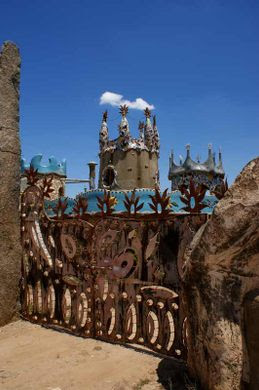
So Francisco set about building something special, with his bare hands, that would satisfy his creativity both while he lived there and while he built it. Before long, he had created a startlingly unique estate – one that fits right in with the whimsical outsider art sculpture house of Peter Buchs, or Ed Leedskalnin’s coral castle.

Clad in elaborate mosaics built in the trencadis style of broken tiles, the house of Francisco Gonzalez is a sprawling castle-shaped villa, flanked with towering ramparts and spires made to look like the points of a massive royal crown. Tourists now drop by the Gonzalez home, still a private residence, just to see the odd house the locals always talk about.

If you were to speak to Francisco himself, he would tell you there’s nothing odd about this place. To Francisco, it’s just home.


3 November 2022 - AMAZING PREDJAMA CASTLE - SLOVENIA


AMAZING 

PREDJAMA CASTLE 

- SLOVENIA -


G'day folks,

This castle has a secret tunnel which withstood a siege until its owner was killed by the Holy Roman Empire, whilst sitting on the toilet. 

Built directly into a rocky cliff face, Predjama Castle, or Predjamski grad in Slovenian, was considered virtually impenetrable when it was constructed in the 13th century. However, a few centuries later the structure’s fortifications were put to the test when a robber baron started a war with the Habsburgs and was forced to hole up in the castle for over a year.


According to legend, Erazem Lueger and his family had taken over the Gothic Predjama castle in the late 15th century. Acquiring land and power, Erazem had become a well-known robber baron in the region. However, he quickly grew too big for his britches, murdering the kinsman of Frederick III, the Holy Roman Emperor. With the strength of all of his forces, Frederick came after Lueger, and forced him into hiding in his castle.

Despite the Emperor’s superior forces, the rebellious Lueger had both brains and a secret tunnel between the castle and the nearby Postojna Cave. For an entire year and one day, Lueger snuck out of the castle and replenished food and drink through the tunnel from a nearby town. Finally, after surviving for so many days, one of his servants sold him out.

Waiting for Lueger to use the outhouse on a high floor of the outside face of the castle, the servant raised a flag and one single shot from a cannon blasted the baron off the toilet.


The castle has been completely reconstructed many times over the years. With a Renaissance-style remaining, the Gothic facade and the legend of Erazem Lueger are often forgotten. However, the Postojna Cave is still in use, allowing visitors to relive the siege and covert activities of a knight who crossed the wrong royal family of Europe. Another peculiar fact is that the cave under the Castle is the home to a colony of bats.

22 September 2022 - THE MAGNIFICENT ROCCA SFORZESCA - ITALY


THE MAGNIFICENT 

ROCCA SFORZESCA 

- ITALY -


G'day folks,

This castle was once the home of one of the most powerful women of the Renaissance.  

Rocca Sforzesca is a stunning example of the evolution of castles and fortifications between the Middle Ages and the Renaissance. Its origins date back to 1261 when a 10 tower structure was built on the remains of a pre-existing tower from the 11th-century. At the end of the 15th-century, the rectangular towers proved to be completely unsuitable for countering firearms, such as cannons. Between 1472 and 1484 the towers were changed into thicker circular structures and renovated by the Sforza family, along with the rest of the castle. 

One of the ancient rectangular towers is still recognizable, incorporated with the south-east tower while the central one, il Mastio, was maintained.


At the end of the 15th-century Caterina Sforza, one of the most important female figures of the Renaissance, also known as Lady of Imola and Forli, lived in the castle. She was an example of Machiavellian resoluteness. Niccolò Machiavelli, the famous diplomat and writer wrote that in 1488 she came under attack and her enemies threatened to kill her sons. To avoid this fate, she climbed to the top of the castle, raised her dress, and shouted, “Kill them if you will, I have the means to make many more!”

Between 1499 and 1500 Cesare Borgia, Duke of Valentine and the illegitimate son of Pope Alessandro VI, attacked the region and conquered Rocca Sforzesca. He later captured Sforza in the castle of Forli’, as she put up a final stand with weapons in hand. Many legends and tales have arisen over the centuries about Sforza.

It was said that Sforza, named by many “Tygre” the Tiger of Imola and Forli’, used to throw her enemies into the well of Rocca Sforzesca, which was reinforced with sharp blades. Another story claimed that she built the castle with the help of the devil. Local residents say that her ghost appears to visitors who get too close to her treasure hidden in the castle’s dungeon.

Perhaps the most popular legend states that during a full moon, it’s possible to see her standing on the wall of Rocca, waiting for the arrival of the Borgia army. She was also an expert in alchemy and wrote the book, Liber de experimentiis Catherinae Sfortiae.


13 September 2022 - MAJESTIC CASTLE of ROCCASCALENGNA - ITALY


MAJESTIC CASTLE 

of

 ROCCASCALENGNA

 - ITALY -


G'day folks,

This precariously perched fortress was once ruled by a crow-worshipping baron. 

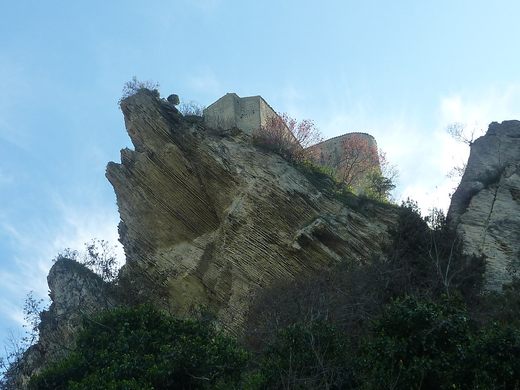
Roccascalegna is a small village in the Majella region of Abruzzo in central Italy. The village, thought to be founded by the Lombards around 600, sits at the foot of the impossibly-built Castle of Roccascalegna.

This extraordinary fortress is perched on the edge of a massive basalt cliff, and was likely built to guard the Secco Valley below. The rocky outcrop looks out over lush meadows and olive orchards, but the idyllic setting has a rough past. In the centuries since it was first built, the valley has seen several invasions and pirate incursions from the Adriatic coast.


Starting in the 15th century, the fortress was rebuilt and enlarged, but over time its fortunes changed. Around 1700 the castle was largely abandoned, and years of neglect, weather, and looting led it to a state of disrepair. In 1985, the town of Roccascalegna took ownership of the structure and began restoration works that took more than 10 years to complete.

The castle’s most famous legend is that of the Corvo de Corvis, or the Crow Baron, who, in the 17th century, introduced the right of jus primae noctis, which held that all newlywed brides of his fiefdom were obligated to lie with him on their wedding night. Stories say the baron was stabbed to death, either by one of the brides or her husband in disguise, and upon dying he left a bloody mark on the walls which could never again be washed away. Some claim that the mark is still visible within the castle, as is the restless spirit of the Baron.

Nowadays, visitors can visit the keep, the inner courtyard, the prison, the chapel, and the castle walls, which provide an exceptional view on the landscape below, which includes Majella National Park. As of 2018, you can also rent the castle as an event venue for €100 (about $110).


5 September 2022 - ANCIENT MALBORK CASTLE - POLAND


ANCIENT MALBORK CASTLE

 - POLAND -


G'day folks,

This 13th century Gothic brick castle is the largest in the world by surface area. 

Sprawled over 51 acres, the Castle of the Teutonic Order in Malbork (better known as Malbork Castle) was built by knights of the Teutonic Order. They first came to the Baltic region as missionaries, ostensibly to convert the pagans to Christianity. In time they grew in wealth and influence, periodically challenged the authority of local rulers, acquired vast swathes of land and built fortified monasteries. Malbork Castle was the seat of power of the Teutonic Knights for over 150 years, and their Grand Masters resided in the impressive palace.


Instead of a single structure, Malbork Castle is a complex of three castles encircled by formidable defensive walls that are connected by gates and bridges. The complex’s entrance gate is located at the Lower Castle, which historically housed the stables, the armory, workshops, and a brewery.

The Middle Castle was where the Grand Masters lived and entertained. The Great Refectory is a massive 450-square-foot hall with under-floor heating, a magnificent vaulted ceiling, and high Gothic windows. Lavish banquets were held in the great hall. In one of the Grand Master’s private rooms, one can admire a ceiling painted with a delicate grapevine motif.

The High Castle was primarily a monastic residence. Of interest is the privy tower, the first of its kind commissioned by the knights and later replicated in other castles built by them. The knights worshipped at St. Mary’s Church, which is accessed through an elaborately carved doorway. It has a striking vaulted apse and beautiful, though fading, murals decorating the walls. A medieval well sits in the middle of the courtyard, a source of water in times of a siege. It suffered near destruction during World War II and has since been meticulously restored. It was designated a UNESCO World Heritage site in 1997.


10 August 2022 - AMAZING CORVIN CASTLE - ROMANIA


AMAZING 

CORVIN CASTLE 

- ROMANIA -


G'day folks,

This fairy-tale castle would make Dracula (who is said to have been imprisoned there) jealous. 

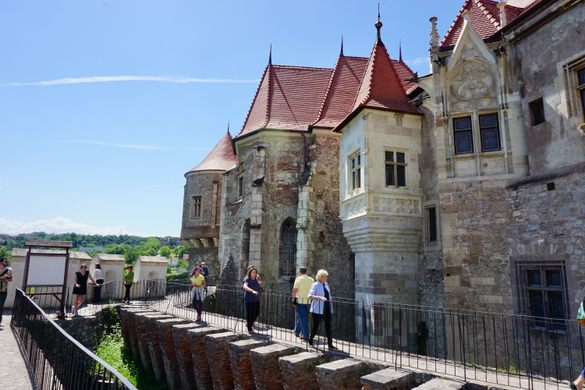
In the heart of Transylvania, one of Europe’s largest castles looks like it sits atop a rocky bluff with nothing but a thin bridge allowing access. But this is Corvin Castle, which looks like something straight out of a fairytale, largely because restorers thought that it should. 

Built in the mid-15th century, the castle was the work of military leader John Hunyadi, who constructed the tall structure over the remains of a keep built by Charles I.


Corvin Castle is split into three large areas: The Knight’s Hall, the Diet Hall, and the circular stairways. Each of these three parts is surrounded by both circular and rectangular towers that were used for both defense and as a prison. 

The elaborate architecture was designed in a rich gothic style that accentuates the already impressive structure. The castle was kept in regal condition during Hunyadi’s lifetime, but after he died, the castle fell into swift decline.

It was not until the 17th century that there was more interest in restoring this medieval castle. As the restoration work began, the workers redesigned the castle to reflect what they considered a gothic castle should look like, which explains much of its currently fanciful look.

A number of legends are associated with the castle. Though this is likely untrue, tourists are told that Vlad the Impaler spent some seven years in the dungeons of Corvin Castle, a stay which resulted in his eventual madness. 

22 September 2020 - ABANDONED VILLAGE OF MODERN CASTLES IN TURKEY


ABANDONED VILLAGE 
OF 
MODERN CASTLES IN TURKEY

Hundreds of Disney-like castles being built for wealthy Gulf investors have just got their new residents. Ghosts. The Burj Al Babas residential area project in Turkey’s northern Bolu province began in 2014, but its developer, the Sarot Group, has failed to come up with the required amount of money for finishing the medieval castles.


The Sarot Group was recently slapped with a court-ordered bankruptcy ruling over the Burj Al Babas’ $27 million debt. The suburb project was designed to include 732 chateau-style villas, swimming pools, Turkish baths, health and beauty centers, a shopping center and a mosque, according to its website. And even though customers from Qatar, Bahrain, Kuwait, United Arab Emirates, and Saudi Arabia have bought around 350 of the 587 kitsch villas built, it’s not enough.


“We couldn’t get about 7.5 million dollars receivables for the villas we have sold to Gulf countries,” Hurriyet newspaper quoted Sarot Group Chairman Mehmet Emin Yerdelen. “We applied for bankruptcy protection but the court ruled for bankruptcy. We will appeal the ruling.”


The court also ordered the group to stop all construction immediately leaving a site full of abandoned houses, but Yerdelen remains hopeful. “The project is valued at $200 million,” he said. “We only need to sell 100 villas to pay off our debt. I believe we can get over this crisis in four to five months and partially inaugurate the project in 2019.”


 Now, check out these castles ...


Clancy's comment: Wow. Extraordinary-looking suburb, and none of them have a moat.

I'm ...