Showing posts with label GRAVES. Show all posts

16 January 2023 - ANCIENT STONE GRAVES SHAPED LIKE SHIPS - SWEDEN


ANCIENT STONE GRAVES 

SHAPED LIKE SHIPS 

- SWEDEN  -


G'day folks,

Welcome to ancient stone graves shaped like ships provided a Viking-like burial to carry the dead to the afterlife. 

Gotland is a Swedish island brimming with ancient structures, from Visby’s medieval city wall to a roughly 5,000-year-old megalithic tomb. Some of the most fascinating sights are the stone burial “ships,” or skeppssättningar, found throughout the island. These ancient gravesites date from the late Bronze Age, between 1100 and 400 BC. 


The boat-shaped stone monuments were generally used as burial spots for an important member of this coastal community. The person would be cremated and their bones beaten to dust. These remains would then be collected in a stone urn and buried inside the ship. It is believed that this was done to equip the dead with everything they had in life and to facilitate the journey to the afterlife.

The stone ships in the village of Gnisvärd are among the best preserved examples of the ritual in Gotland, and one of them is also the largest on the island. Made of around 100 tall stones, it stretches 148 feet (45 meters) long. The site contains three ships in total that are erected one after another as if going in a ghostly precession. The lead ship is pointed toward an ancient megalithic tomb, the only one in Gotland. Archaeologists believe this was done to “moor” the newer graves to an old revered place.
18 November 2022 - THE HARDY TREE - LONDON


THE HARDY TREE 

- LONDON -


G'day folks,

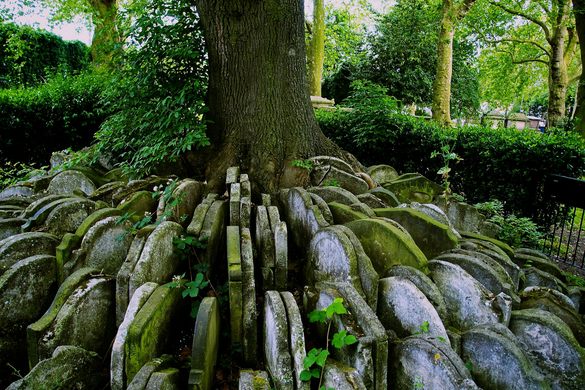
This churchyard arbor is surrounded by hundreds of gravestones placed there by author Thomas Hardy. 

Inside an ancient London churchyard, an ash tree is encircled with hundreds of overlapping gravestones placed there by classic novelist Thomas Hardy.

The cemetery alongside London’s St. Pancras Old Church, which is considered by many to be one of England’s oldest places of Christian worship, is the site of a number of fascinating stories—for one, Mary Shelley and Percy Bysshe Shelley planned their elopement there while visiting Mary’s mother’s grave. But perhaps one of its most striking oddities is the Hardy Tree, an ash tree surrounded by hundreds of weathered gravestones, layered practically on top of one another. How did they come to be arranged in this way?


In the mid-1860s, Britain’s rail system was experiencing immense growth, and London was outgrowing its existing lines. In order to accommodate the growing population of commuters, an expansion was planned—directly affecting the graveyard at St. Pancras.

 In order to make way for the new train line, an architecture firm was contracted to perform the sensitive task of exhuming the remains and reburying them at another site. In the tradition of dumping rather unpleasant work on those lowest on the totem pole, the job was promptly assigned to their young employee, Thomas Hardy, who in the following decades would publish many classic novels such as Far from the Madding Crowd and Tess of the D’Urbervilles.

After the essential duty was completed, there remained hundreds of headstones, along with the question of what to do with them. Hardy’s solution was to place them in a circular pattern around an ash tree in the churchyard in a spot that would not be disturbed by the railway. One can only speculate as to how he arrived at this decision, but over the years the tree has absorbed many of the headstones, life and death melding into one image of grotesque and gothic beauty, preserved for centuries.


4 October 2022 - THE GRAVE IN THE ROAD - HEARNE, TEXAS


THE GRAVE IN THE ROAD 

- HEARNE, TEXAS -


G'day folks,

This one-woman cemetery was a small civil rights victory. 

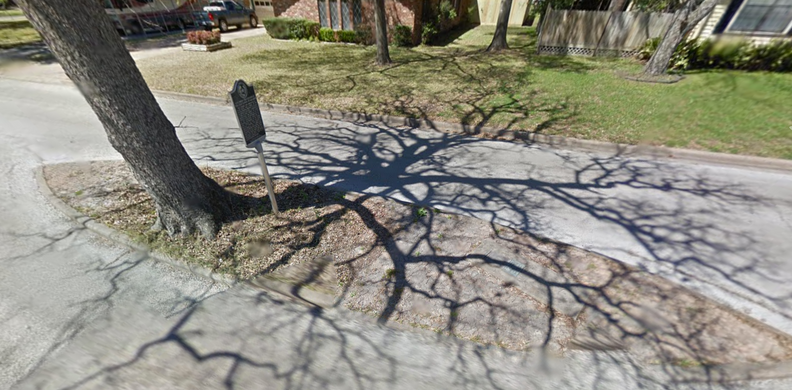
The town of Hearne is known as “The Crossroads of Texas” because it sits at the intersection of several highways and railroads. The little town used to be a hub of transport and commerce, but is now fairly sleepy pit stop. Amid the suburban houses and grassy lawns though, there is an unusual sight: a body buried in the middle of the street.


The lone grave is marked by a sizable oak and a two plaques set in an almond-shaped median. The first marker reads: “COME YE BLESSED”. The second: “TO THE MEMORY OF  ‘OUR MOTHER’ HOLLIE TATNELL 1859 – 1911”, and below that, “MRS. GEORGIA E. GARTER Washington D.C. ANDREW L. HUNTER M. D. Marlin, Texas”. 

According to the scant history that exists, Hollie Tatnell was born a slave in Texas. Upon her death in 1911, she was buried in Hearne’s colored cemetery, which had allegedly originated as a slave burying ground. Hollie would have been one of the last people interred at the cemetery as it was closed in 1912.

When real estate developers purchased the land in 1947 they edged out the families of color in the neighborhood, who were forced to exhume and rebury the remains of their ancestors in the cemetery. The only family that refused to budge was Hollie Tatnell’s children, Georgia and Andrew. The developers, eager to move forward, had to construct a median around Hollie’s diagonal grave. As proof of their triumph, the Tatnell children placed the second marker on their mother’s grave in addition to her original headstone.


In 2007 the median also received a sign from the Texas Historical Commission, denoting it as a Historic Texas Cemetery despite only containing the remains of one person. “This single grave,” it reads, “serves as a reminder of the area’s early African-American community and of the sanctity of burial grounds.”

14 May 2022 - HEADSTONE-EATING TREES - USA


HEADSTONE-EATING 

TREES


G'day folks,

The rogue roots are gradually consuming some of the historic marble grave markers in this famous cemetery.  

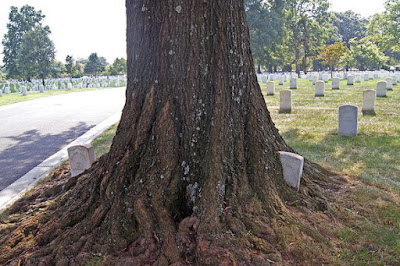
Arlington National Cemetery is hallowed ground for the U.S. Armed Forces, with around 400,000 burials since 1864 representing every American war. The sprawling rows of white marble headstones and grassy lawns are shaded by more than 8,600 majestic trees. As a work of landscape architecture, the effect is inspiring.

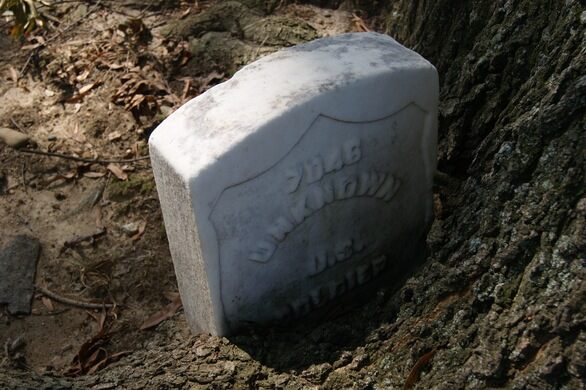
But a few rogue trees are currently in the process of consuming some of the headstones. You can see it here and there in the older parts of the cemetery, where the marble markers are thickly embedded in the arboreal roots and stick out of the timber like stubby molars. Find A Grave puts the count at 11 afflicted markers, with most of the entombed having served in the Civil War, World War I, or World War II.


 The headstone absorption is actually progressing much more rapidly than it would initially appear. The case of Corporal Chas Ippel is a prime example. Find a Grave has photos dated from 2008 that show the stone as relatively unmolested, with the inscribed text still clearly readable. However, as of September 2017, a nearby willow oak’s roots have expanded by inches and begun to absorb the grave. Now all that’s readable is “S IPPEL.” Anecdotal calculations suggest that the tree will eat another character from the inscription every year.

When the tree eventually dies, it will be interesting to see how authorities handle the embedded stone. Perhaps some future chainsaw-wielding arborist will be asked to wade into the solid timber in search of the lost marker.

Clancy's comment: Mm ... I spent hours walking around this hallowed ground when I worked in Washington DC. 

I'm ...


22 November 2021 - THE RED BARON'S GRAVE


THE RED BARON'S 

GRAVE


G'day folks,

Baron Manfred von Richthofen—known simply as the ‘Red Baron’—was a famed fighter pilot in the German Air Force during World War I.

Credited with 80 air combat victories, the Red Baron met his demise when he was shot by a soldier in April 1918. It is surmised that Gunner W. J. “Snowy” Evans—a soldier with the Royal Australian Artillery— is likely the one to have killed the famed pilot. 


 Six pilots of a similar rank served as pallbearers at his first funeral. He was later moved to a cemetery in Berlin. There, a huge monument was placed on his grave by the Nazi government. After the war, it fell on the Soviet side of the line where the headstone and memorial were shot numerous times as people fled to West Berlin so in the early 1970s the family moved the Baron one last time to the family plot in Wiesbaden. Each year there is a memorial service around the anniversary of when he was shot down. 


Clancy's comment: He had some great victories, but all wars suck.

I'm ...


23 October 2019 - THE FASCINATING LONDA BURIAL CAVES IN INDONESIA


THE FASCINATING LONDA 
BURIAL CAVES IN INDONESIA

G'day folks,

The unique funeral practices of the Toraja can be seen here with graves carved into caves and hung off cliffs. 


The Toraja are an ethnic group indigenous to South Sulawesi, Indonesia. Dutch colonizers Christianized them in the early 1900s, but their culture has continued to revolve heavily around the celebration of death, and they have some of the most complex and unique funeral practices in the world.


When a loved one dies, their body is often kept in the family’s home for months—sometimes years—before eventually being buried in graves carved into the sides of the caves or hung from the outside on cliffs. The corpses are periodically removed to perform the Ma’nene ceremony, where the corpses are cleaned, redressed, and exhibited in the village before being reinterred with things they will need in the afterlife: clothes, cigarettes, and money.


The funeral ceremony itself, known as Rambu Solo, is a multi-day affair filled with mourning, traditional dance, cock fights, and ritual animal sacrifice, followed by a huge feast. The higher the deceased’s status in society, the more extravagant and lengthy the ceremony.


There are multiple cave burial sites that can be visited in Tana Toraja, but the most accessible to visitors is Londa. Locals rent lanterns at the entrances, and for an extra fee, will guide you through the tunnels, speaking about the residents.


Clancy's comment: Fascinating, eh?
I'm ...


17 October 2019 - UNUSUAL BURIAL GROUNDS IN PARIS


UNUSUAL BURIAL
 GROUNDS IN PARIS

G'day folks,

Stripes of human ashes cover a back lawn in the most sought-after burial grounds in Paris. 


The thin white lines that stretch across a grassy knoll near the crematorium at Père Lachaise Cemetery have confused many onlookers. Though the lines may look like some sort of chalky dust, they’re actually the human cremains of thousands of people.


It isn’t free for Parisians to add their ashes to the lines, but it’s a more affordable option for those who wish to be interred in the famous cemetery but don’t want to pay for a costly burial. It’s also a more eco-friendly option. The cremains, which stripe a plot of land near the back of the cemetery, nurture and fertilize the grass as they integrate with the earth.


Being laid to rest in one of the world’s most sought-after cemeteries is no easy task. Over one million bodies, including those of cultural icons and artists like Oscar Wilde and Jim Morrison, are buried within the grounds. That number doesn’t even include those whose bodies were cremated, their remains either stored within the columbarium or sprinkled onto the back lawn.


There’s a long waiting list to get in, and only those who are native to the city or happened to die there are accepted. Even Parisians who do manage to score a burial plot will most likely one day be exhumed after a few decades to make room for a new corpse.


Clancy's comment: Wow. I never knew about this.


I'm ...


28 February 2019 - THE GRAVE OF C.S. LEWIS


THE GRAVE 
OF
 C.S. LEWIS

G'day folks,
 The bones of C.S. Lewis, one of the 20th century’s literary greats, rest within a peaceful cemetery. Nearby, an etched glass window bearing characters from his most famous fantasy world adds a whimsical touch of childhood magic to the churchyard.


The grave of C.S. Lewis lies within the cemetery of the Holy Trinity Church in Headington Quarry just outside of Oxford. He was buried there in November of 1963, and even today it’s common to find flowers placed atop his tombstone.

C.S. Lewis is best known for his beloved fiction novels, notably The Chronicles of Narnia, The Screwtape Letters, and The Space Trilogy. He is also known for his popular works of non-fiction Christian apologetics, including Mere Christianity and The Problem of Pain.


 Lewis was educated at Oxford University, which is only a couple miles from the churchyard. After serving in World War I, he returned to Oxford to become a tutor and fellow in English Literature at Magdalen College. He was one of the “Inklings” that brought weekly fractions of the fantasy realm to the town’s local haunts.


Influenced by close friend J.R.R. Tolkien and others, Lewis returned to Anglicanism in 1930 and began attending Holy Trinity Church. The famous writer was a regular at the church’s 8:00 a.m. service, which he chose because of his dislike of organ music. In 1992, a gorgeous etched glass window featuring beloved Narnia characters was installed in the church. The fantasy scene is located adjacent to the pew where he always sat.


Clancy's comment: I doubt they will include a special etched glass window for me in our local church. If they do, I hope they include a bottle of wine and a pen.

I'm ...