Showing posts with label WAR. Show all posts

7 July 2022 - SPAIN'S WAR AGAINST THE U.S.A.


SPAIN'S WAR

 AGAINST THE U.S.A.


G'day folks,

 Explorer Christopher Columbus landed on Cuba's northeastern coast in 1492 and claimed the island for the new Kingdom of Spain, which had sponsored his journey of discovery. For the Cuban people, there followed 400 years of slavery, degradation and rebellion.

Here’s what Columbus wrote about them in his diary: “They brought us parrots and balls of cotton and spears and many other things, which they exchanged for glass beads and hawks’ bells.

“They willingly traded everything they owned. They do not bear arms, and do not know them, for I showed them a sword, they took it by the edge and cut themselves out of ignorance. They have no iron.

“They would make fine servants. With fifty men we could subjugate them all and make them do whatever we want.”

This became the policy of the Spanish who took over Cuba following Columbus’s discovery. Resentment simmered among the islanders but it was not until 1868 that a major rebellion erupted resulting in what became known as the Ten Years' War, with 200,000 Spanish casualties.

In 1892 the Cuban Revolutionary Party was formed with the aim of achieving independence from Spain. The Spanish reacted with suppression, creating “reconcentrados” – fortified towns that are seen as forerunners of the Second World War concentration camps. Up to 400,000 Cubans died from starvation and disease in the “reconcentrados”.

As rioting took hold in Havana, the United States sent in a battleship – the USS Maine – “to protect American interests”. But within days of anchoring in Havana harbour the Maine was ripped apart by an explosion, killing three quarters of the crew – about 250 men.

The cause of the explosion was never established but some American newspapers – particularly William Randolph Hearst’s New York Journal – had no doubt: it must have been a Spanish mine.

As hysterical headlines poured off the presses, public opinion veered towards war amid chants of “Remember the Maine! To Hell with Spain!” Congress demanded independence for Cuba and authorised the use of force to achieve such an end.

Spain at first severed diplomatic relations but then on April 24, 1898 declared war against the United States. The next day Congress in turn declared war on Spain.

The war lasted for ten weeks, America’s far superior forces inevitably gaining victory over the Spanish.


Probably the most famous encounter came on July 1 when Colonel Theodore Roosevelt – who was to become US President in 1901 – led the 1st United States Volunteer Cavalry, known as the “Rough Riders,” in the Battle of San Juan Hill. He did so carrying a pistol recovered from the Maine.

Task & Purpose, a military and veteran-focused website, reports: “[It was] a bloody struggle to gain the high ground above enemy naval concentrations in the harbor of nearby Santiago de Cuba.

“The action cost [the US] over 1,000 soldiers – nearly five times as many as the Spanish – but despite the grave loss of life, Roosevelt overtook the enemy position and carried the day.”

Two days later the Spanish fleet was destroyed at the Battle of Santiago de Cuba, leading to surrender of the city.

After the war Spain and the United States signed the Treaty of Paris under which Spain ceded Puerto Rico, the Philippines, and Guam to the US for $20 million and Cuba became a protectorate of the United States.


It gained independence from the US in 1902 and would not hit international headlines again until President John F. Kennedy faced down Soviet leader Nikita Khrushchev in the Cuban Missile Crisis of 1962.

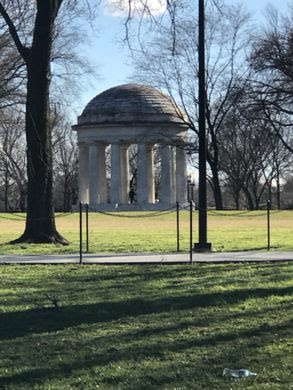
9 July 2022 - FORGOTTEN WAR MEMORIAL - WASHINGTON D.C.


FORGOTTEN WAR 

MEMORIAL 

- WASHINGTON D.C. -


G'day folks,

Welcome to an overlooked memorial honoring the local Washington residents who died in World War I.

The first letters started a month after the war ended. People were writing the government with the idea of building a monument honoring the more than 26,000 Washington, D.C. residents who had served in World War I. Thirteen years later in 1931, the D.C. War Memorial was dedicated by President Herbert Hoover. This little-known monument is the only memorial dedicated to District residents on the National Mall.

Frank and Janet Noyes, a prominent newspaper family at the time, agreed to fund the project. Janet also had a hand in the design, proposing that the monument replace an old wooden bandstand in West Potomac Park. The new memorial would even resemble a bandstand: She suggested a domed marble memorial that would honor the dead and be available for military bands to use to play tribute to these soldiers.

Six years after the war ended, the first planning committee for the memorial met, and building began another four years later. Since the memorial was to honor local veterans, the people of D.C. thought it was important to use a local construction company. “Construction of the war memorial by out-of-town agencies would violate the principle and do injustice of the people of our city,” noted the District’s Chamber of Commerce president Harry King. A local builder was chosen from the bids, and the 47-foot-tall monument, comprised of 12 columns supporting a domed roof, was finally erected.


Rather than the initial idea of honoring all of the D.C. residents who served, the monument pays tribute to the 499 Washington residents who died in the war. Besides being dedicated to D.C. residents, the monument has another distinction; in an unusual move for the time, the inscription includes the names of both men and women.

The first concert held in the monument was during its dedication on November 11, 1931.  It was lead by noted composer John Phillip Sousa, and the space became a popular gathering spot for visitors to listen to music. However, as musical tastes changed, the kind of music that filled the bandstand wasn’t bringing the crowds it used to, and concerts happened there much less often. The monument, because of its off the beaten path location, or changing entertainment tastes, or a little of both, went through a period of neglect. In 2003, the memorial was declared one of D.C.’s most endangered places by the DC Preservation League.

In 2010, $3.6 million was dedicated to restore and upgrade the space. This hidden treasure, tucked among the trees, honors the veterans of a war that is quickly fading from public memory.


22 November 2021 - THE RED BARON'S GRAVE


THE RED BARON'S 

GRAVE


G'day folks,

Baron Manfred von Richthofen—known simply as the ‘Red Baron’—was a famed fighter pilot in the German Air Force during World War I.

Credited with 80 air combat victories, the Red Baron met his demise when he was shot by a soldier in April 1918. It is surmised that Gunner W. J. “Snowy” Evans—a soldier with the Royal Australian Artillery— is likely the one to have killed the famed pilot. 


 Six pilots of a similar rank served as pallbearers at his first funeral. He was later moved to a cemetery in Berlin. There, a huge monument was placed on his grave by the Nazi government. After the war, it fell on the Soviet side of the line where the headstone and memorial were shot numerous times as people fled to West Berlin so in the early 1970s the family moved the Baron one last time to the family plot in Wiesbaden. Each year there is a memorial service around the anniversary of when he was shot down. 


Clancy's comment: He had some great victories, but all wars suck.

I'm ...


7 October 2021 - NATURE DESTROYS GUNBOAT DIPLOMACY IN 1889


NATURE DESTROYS GUNBOAT 

DIPLOMACY IN 1889


G'day folks,

Gunboat diplomacy was at its height in 1889. Tension was high with an act of war seemingly imminent. 

 Three warships from America and three from Germany were jostling for position in a small harbour in the South Pacific, observed by yet another warship – from Britain.

They had been intimidating each other for months as the major powers struggled for control of the Samoan Islands in an attempt to extend their influence and grasp commercial opportunities in the region.

The outcome of this ultimate confrontation was uncertain, but it seemed that a broadside from one of the ships, possibly with catastrophic consequences, was inevitable. Then nature intervened.

The waters of Apia harbour, where the eyeball to eyeball encounter was taking place, had been growing choppier by the minute and soon the crews found themselves at the centre of a violent cyclone.

Two of the German ships were bodily picked up by the storm and smashed together. The third was flung high onto a beach and wrecked, the same fate being met by one of the American warships. The other two US vessels were hurled against a reef and wrecked. Six merchant ships which were also in the harbour were also destroyed, bringing a total death toll of more than 200.


After the tragic hurricane it was left to the Samoans to carry on independently, the super-powers seemingly licking their wounds, until ten years later when the Americans and the Germans split the islands between them. After the First World War, the German territory was taken under New Zealand administration. Western Samoa became an independent nation in 1962 but American Samoa remains a part of the US territories.

Hurricanes and storms continue to pound the islands, though, almost like an expression of anger.

Clancy's comment: Mm ... always have respect for nature.

I'm ...


11 September 2021 - HITLER AND THE EIFFEL TOWER


HITLER AND THE EIFFEL TOWER


G'day folks,

Alexandre Gustave Eiffel  became a civil engineer responsible for the tower that bears his name and which became the iconic symbol of Paris – and, indeed, France itself. But he also played an important role in building the equally iconic symbol of the United States – the Statue of Liberty.


The Eiffel Tower was built as the main exhibit of the 1889 Exposition Universelle (World’s Fair), held to commemorate the centennial of the French Revolution. Eiffel designed and oversaw construction of the project, which was completed on 31 March, 1889.

The tower remained the world’s tallest man-made structure for 41 years until the completion of the Chrysler Building in New York in 1930. The original plan was that it would be dismantled after 20 years but it was saved because of its use as a wireless telegraph transmitter.

It also went on to become a growingly popular attraction despite fears by critics at the start that it would be an ugly structure dominating the Paris skyline.

Such was its status in 1940 that it was one of the first locations where Adolf Hitler chose to be photographed after he invaded France in 1940.

Interestingly, though the French could do nothing about Hitler's presence, Resistance fighters were determined that the Fuhrer would not have the satisfaction of ascending the structure – so the lift cables were cut before the Germans got there. Reaching the top then meant a climb of 1,665 steps.

Nazi soldiers were nevertheless ordered to climb to the summit and hoist the swastika – which they managed to do. But the flag was so large it blew away after a few hours and had to be replaced by a smaller one. Hitler's reaction is not recorded.

Early in his career, Eiffel had built a number of bridges for the French railway network and had developed a reputation as a man who knew a thing or two about wind resistance. Just the man to tackle the problems posed by a giant statue designed to stand in New York Harbor.

The Statue of Liberty, a gift from the people of France to the people of the United States, was designed by French sculptor Frédéric Auguste Bartholdi and built by Eiffel. It was dedicated in 1886.

To make the edifice stable, Eiffel came up with a four-legged pylon structure which would support the copper sheeting that made up the body of the statue. The entire structure was assembled at his works in Paris, then dismantled and shipped to the United States in crates.

But he will probably be best remembered for the Eiffel Tower – a structure that was lucky to survive the Second World War. In August 1944, Allied troops were advancing towards Paris and it became obvious that the Germans would soon be driven out.


A furious Hitler sent orders to General Dietrich von Choltitz, the military governor of Paris, to turn the city into rubble – including the Eiffel Tower. Thankfully, Choltitz did not carry out the command.

The much-loved tower is 324 metres tall (including antennas) and weighs 10,100 tonnes.

The French car manufacturer Citroen treated it as a giant billboard between 1925 and 1934 using a quarter of a million light bulbs to emblazon their name on the structure. The Guinness Book of Records recorded it as the world’s biggest advertisement.

But perhaps the most bizarre incident involving the tower came in 2008. A woman with an objects fetish "married" the Eiffel Tower, changing her name to Erika La Tour Eiffel in honour of her "partner". The "bride," who was at one time a US soldier, was obviously attracted by strong, silent types.

There's no telling what Gustave Eiffel would have made of it all. He died in 1923, aged 91.

Clancy's comment: I'm glad his tower survived so I could visit it and view Paris.

I'm ...


3 September 201 - MEN FOUND IN FOREST 40 YEARS AFTER VIETNAM WAR


MEN FOUND IN FOREST 40 

YEARS AFTER VIETNAM WAR


G'day folks,

This is a sad story of survival. 

A very small child taken into the jungle and raised there. Sounds a lot like the plot from Tarzan, doesn’t it? But this is no movie. About 40 years ago during the Vietnam War, Ho Van Thanh was seen running into the woods with his then-infant son Ho Van Lang. At this point of the story you may ask ‘Where the child’s mother was?’. The answer to that question is pretty sad. A bomb exploded in his home during the war with the United States, killing his wife and two other children. An eyewitness reported seeing him grab his two-year-old son, Ho Van Lang, and run into the forest. Ho Van Tri, Tranh’s youngest son was left behind and rescued by relatives.

Fast forward 40 years to some villagers from the Tay Tra district out in the jungle looking for firewood. They noticed a strange bird-nest-like-hut built in a small clearing, near a stream. They decided to check it out and found two men living there. One was a weak 82-year-old man who could communicate in Cor ethnic minority language, but his 41-year-old son, who was wearing a loin cloth made from tree bark, only spoke a few words. The villagers alerted the authorities who later confirmed the two mysterious jungle dwellers were indeed Ho Van Tranh and Ho Van Lang.

Ho Van Thanh and his son were taken to the Tra Kem Village, where his youngest son is now taking care of them.

 According to Thanh Nien News, it was Ho Van Tri, Tranh’s youngest son, who was left behind on that sad day in 1973 and rescued by relatives, who first found his father and brother 20 years ago, but he could not talk them into returning home.


He brought them salt and oil every year after that, but they never accepted him, and whenever he came with other villagers to convince them to come home, they ran into hiding.

 Tranh’s nephew, Ho Ven Bien, told the local press they are very sad and clearly want to go back to their forest home. “My uncle doesn’t understand much of what is said to him, and he doesn’t want to eat or even drink water. We know he wants to escape my house to go back to the forest, so we have to keep an eye on him now,”


Their daily diet included cassava, corn, and wild leaves, but the villagers also found a one hectare field planted with sugar cane, near their six-meter high wooden hut. The two men have had very little contact with the outside world during the last 40 years so you can only imagine how hard it is for them to be around so many people in a new environment.


 The two real-life Tarzan’s also made their own knives, axes, and arrows for hunting.


Clancy's comment: Mm ... I'd have left them there, but made sure they had what they needed.

I'm ...