Showing posts with label CIVIL RIGHTS. Show all posts

4 October 2022 - THE GRAVE IN THE ROAD - HEARNE, TEXAS


THE GRAVE IN THE ROAD 

- HEARNE, TEXAS -


G'day folks,

This one-woman cemetery was a small civil rights victory. 

The town of Hearne is known as “The Crossroads of Texas” because it sits at the intersection of several highways and railroads. The little town used to be a hub of transport and commerce, but is now fairly sleepy pit stop. Amid the suburban houses and grassy lawns though, there is an unusual sight: a body buried in the middle of the street.
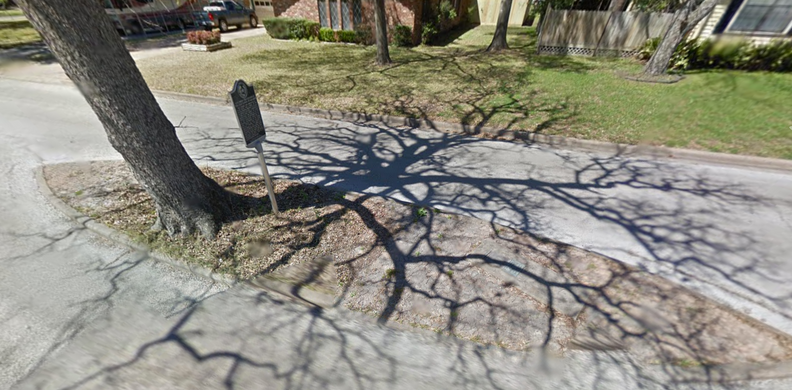


The lone grave is marked by a sizable oak and a two plaques set in an almond-shaped median. The first marker reads: “COME YE BLESSED”. The second: “TO THE MEMORY OF  ‘OUR MOTHER’ HOLLIE TATNELL 1859 – 1911”, and below that, “MRS. GEORGIA E. GARTER Washington D.C. ANDREW L. HUNTER M. D. Marlin, Texas”. 

According to the scant history that exists, Hollie Tatnell was born a slave in Texas. Upon her death in 1911, she was buried in Hearne’s colored cemetery, which had allegedly originated as a slave burying ground. Hollie would have been one of the last people interred at the cemetery as it was closed in 1912.

When real estate developers purchased the land in 1947 they edged out the families of color in the neighborhood, who were forced to exhume and rebury the remains of their ancestors in the cemetery. The only family that refused to budge was Hollie Tatnell’s children, Georgia and Andrew. The developers, eager to move forward, had to construct a median around Hollie’s diagonal grave. As proof of their triumph, the Tatnell children placed the second marker on their mother’s grave in addition to her original headstone.


In 2007 the median also received a sign from the Texas Historical Commission, denoting it as a Historic Texas Cemetery despite only containing the remains of one person. “This single grave,” it reads, “serves as a reminder of the area’s early African-American community and of the sanctity of burial grounds.”

19 March 2021 - THE STORY BEHIND THE ICONIC PHOTOGRAPH


THE STORY BEHIND 

THE ICONIC PHOTOGRAPH


G'day folks,

The photograph of Elizabeth making her way to school while a white mob is trailing behind her and hurling insults has become an iconic image for the civil rights movement. 

The story of Eckford and the girl behind her, Hazel Bryan whose face is contorted mid-shout is no less than fascinating. In 1957, Eckford was one of the first nine African-American students to enroll in the all-white central high school of Little Rock, Arkansas - a group that would later be known as the Little Rock Nine. It did not go smoothly, as the infamous photo reveals. There was a whole mob trying to prevent Elizabeth from entering the school, but Hazel was the one caught most vividly on camera.


Benjamin Fine of The New York Times later described her, she was “screaming, just hysterical, just like one of these Elvis Presley hysterical deals, where these kids are fainting with hysteria”. After the photo made headlines, Hazel’s parents decided to pull her out of Central and send her to a different school. Over the years, as she learned more about African-American history, Hazel started feeling remorseful and ashamed at the way she behaved that day.

In 1963 she tracked down Elizabeth and called her to apologize. Elizabeth briefly accepted the apology, and the two did not speak again for years. The year 1997 marked the 40-year anniversary of the Little Rock Central High School integration. Then-president Bill Clinton, who is also an Arkansas native, held a big ceremony noting the event. Will Counts, the photographer responsible for the famous photo, asked Eckford and Bryan if they would be willing to pose again for a second photograph and they both agreed. 

Reconciled after 40 years, the two women discovered they had much in common and struck an unlikely friendship. They started attending events and touring schools together, giving talks about race and tolerance. They both received much criticism for their relationship - Elizabeth for being too naive and forgiving, and Hazel for not being sincere.


Clancy's comment: An interesting relationship during turbulant times. 

I'm ...


21 July 2018 - WINFRED MONCRIEF - CIVIL RIGHTS PHOTOGRAPHER


WINFRED MONCRIEF 
- CIVIL RIGHTS
 PHOTOGRAPHER -

G'day folks,
Winfred Moncrief defied norms and documented civil rights in the segregated South.

During the civil rights era, the Hederman clan owned the largest papers in Mississippi and part of a television station. They owned real estate and a printing business. They sat on the board of a bank, the capitol’s chamber of commerce, and in the pews of First Baptist Church, alongside Governor Ross Barnett.

Through the Clarion-Ledger and the Jackson Daily News, the Hederman family, which had crawled out of the countryside and climbed up the ladder from the printing presses and into ownership a few decades earlier, promulgated inflammatory rhetoric to keep the flame of segregation burning bright. Their views became the common currency of barbershop talk and sidewalk gossip, their market penetration a hand around the throat of any politician within editorial reach. Working secretly with the Mississippi State Sovereignty Commission (MSSC) and publicly with Citizens’ Councils, their media outlets fought against the civil rights movement on and off the page. 


Their news coverage wasn’t much more comforting. The Clarion-Ledger, for example, published the names of suspected NAACP members, effectively putting targets on people’s backs, while the Jackson Daily News issued inflammatory editorials against the federal government’s attempts to open Mississippi’s “closed society” and posited that crime rates in northern cities were the direct result of integration. Both dailies raged violently against “mixers,” outsiders coming into the state to support civil rights causes; local blacks ended up on their pages when arrested, or not at all.

In 1960, the Hederman empire expanded its holdings, acquiring the Hattiesburg American. The paper had been segregationist before selling out to the Hedermans, but within the context of 1960s Mississippi it was considered fairly balanced.


For example, it published letters by an African American named Clyde Kennard during his repeated attempts to enroll at the all-white Mississippi Southern College, which happened to be the alma mater of the paper’s chief photographer, Winfred Moncrief. The paper covered Kennard’s arrests for what were later found to be a series of false crimes orchestrated by the police and the MSSC.


 On October 28, 1965, Moncrief photographed a man named Robert M. Shelton, imperial wizard of the United Klans of America, as he signed autographs at a KKK rally in town. On April 8, 1968, he photographed protest marches winding their way through Hattiesburg in the wake of MLK’s assassination. Whatever his personal feelings or politics, Moncrief hit the streets and covered the news. The archive of his work showcases his professional integrity regardless of subject matter. His goal was to capture events from all sides, using changes of camera position and adjustments of lighting and contrast.


Moncrief worked at his hometown paper for a total of 15 years, while moonlighting for the Associated Press and United Press International and filing with Time and Life magazines on occasion. He won awards for reportage, and commendations in his subsequent public relations career. And through it all, until retiring in the early nineties, he taught photography and journalism part-time at several southern Mississippi colleges. In a state where you couldn’t always believe in institutions or the gatekeepers who controlled them, Moncrief at least believed in the power of the press.


Clancy's comment: Good on him. He was a true photographic journalist.

I'm ...