3 December 2022 - THE COIN CABINET of DRESDEN


THE COIN CABINET

 of 

DRESDEN


G'day folks,

Known as the "Coin Cabinet of Dresden," this museum houses over 300,000 currency-related artifacts.  

The hobby of coin collecting has been practiced since antiquity. This type of collecting was not only to accumulate great wealth but also to display an appreciation of the intricacies of engraving art. These collections of coins were often stored in large wooden cabinets during the post-Renaissance years, and many national collections in Europe are still referred to as “coin cabinets” by modern numismatists.


Founded circa 1530, the Münzkabinett, or Coin Cabinet of Dresden is one of Europe’s largest-scale numismatic collections, as well as one of the oldest museums in Germany. Currently, over 300,000 items call the cabinet home—from ancient coinage to minting equipment and historic documents, only a tenth of which are on permanent display.

The public portion of the coin cabinet is housed in the museum at Dresden Castle and consists of coins, banknotes, medals, seals, counterfeits, primitive forms of money, and minting equipment from the ancient Greco-Roman world to the modern European Union. These exhibits focus especially on the monetary history of Saxony and Germany in general.


In addition to research facilities and five centuries’ worth of artifacts, the Münzkabinett also possesses legal claim to any hoard of coins excavated on the Saxon territory, whose soil is rich in such hidden treasure. Coin hoards are now worth more than their bullion values when melted down, as they provide a good glimpse into the past. 

12 December 2022 - ANCIENT WATER CHANNELS ON MOUNTAINS in SWITZERLAND


ANCIENT WATER CHANNELS 

ON 

MOUNTAINS in SWITZERLAND 


G'day folks,

Medieval irrigation channels built into the sides of mountains provided Valais with water for hundreds of years.  

Some of the best places to hike in the state of Valais in Switzerland are ancient pathways that once used to bring water down from mountain streams to farms in the valleys and meadows below.

The creation of these channels, known as bisses, goes back at least as far as the 14th century, though some believe those medieval routes were built where Roman channels had previously been. In the aftermath of the Black Death in the mid-1300s, with a significantly reduced population across Europe, the grain fields in Valais were repurposed to grow hay to raise cattle for the rising demand of beef across the border in Italy.


Owners of the fields and pastures pooled their resources to build bisses for irrigation, which was more necessary than it had been for growing grain. A lot of resources were needed, since many of the bisses were built into the sides of mountains and cliffs, which made digging them particularly dangerous hundreds of years ago. They tended to be between 5 and 10 kilometers, though a few stretched more than 20 kilometers.


Over time, they came to be used by vineyards and orchards in the area as well. Those more wealthy landowners, who controlled the water supply, arranged for systems allowing the use of the water by the smaller farmers. The smaller farmers and their families, in turn, helped maintain the bisses, cleaning and repairing them every spring. Canal guards, who lived in cabins along the channels, kept regular watch over the flow of water, making sure it was not interrupted.

For the most part, the bisses that remain have become scenic tourist attractions and inspired hiking trails, though some are still in use. Some of the trails run alongside the bisses, but others are the bisses themselves, repaired and reinforced. Le Musée des Bisses offers a convenient itinerary of some of the most spectacular bisse-adjacent trails, the bisse of Sion, the bisse ‘Ayent, and the Bitailla, in addition to exhibits on the history of the Valais bisses.

The address and coordinates above are for the museum, which provides a good launching point for many hikes through the bisses.

11 December 2022 - CUCUMBER MUSEUM in GERMANY


CUCUMBER MUSEUM 

in GERMANY


G'day folks,

A museum honoring Germany’s cucumber mecca offers a great dill of gherkin history.  

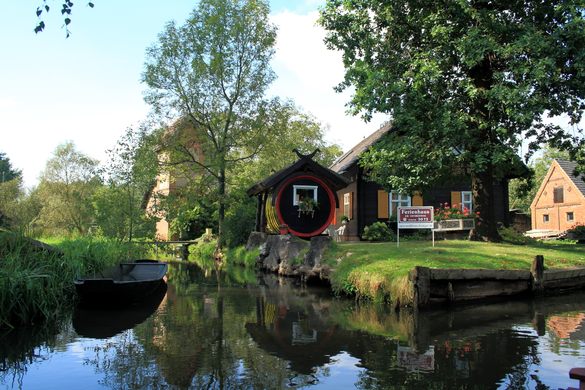
Spreewald, a wetland region in eastern Germany, is known for its plethora of pickles. Cucumbers have been one of its agricultural staples for centuries. The Starick family opened Gurkenmuseum, a private museum in the quaint village of Lehde, to honor the area’s star fruit.


Spreewald’s gherkins have held worldwide fame for the last 150 years among pickle partisans. It’s been said the region once had as many different types of cucumbers as it had farms. But the fruit’s importance goes back for millennia. The Sorbs, the people who have inhabited the region since the 6th century, placed great importance on the crop.


The Gurkenmuseum, which is housed in one of Lehde’s oldest buildings, is full of information about the traditions associated with cucumber cultivation and processing. Visitors can also peruse the many different pickling tools on display, as well as sort their way through photographs and trivia. They can also relish in the abundance of gherkin recipes and even sample some of the region’s renowned produce.

Each August, Spreewald holds a gherkin festival, where the year’s current Gherkin Queen is crowned and celebrated. The museum also features the 500-gallon barrels used to soak the gherkins. There’s also a replica of a Sorbian bedroom, which displays the traditional communal family bed.


1 December 2022 - WORLD'S OLDEST EDIBLE HAM


WORLD'S OLDEST 

EDIBLE HAM


G'day folks,

This nearly 120-year-old piece of pork wears a brass collar and was once a man's "pet ham." 

The 119-year-old ham, which is reportedly the oldest in the world, was originally cured in 1902 by the Gwaltney Foods meat company before it was lost in storage. On its rediscovery two decades later, the elated Pembroke D. Gwaltney Jr. made the piece of pork his “pet ham.” He put a brass collar on it and paraded it around various expositions to prove to customers his meat could be kept without being refrigerated.


The dry curing process used to create the ham involved salting the meat and draining the blood, which allows for a longer shelf life and a richer flavor. Supposedly, microbiologists say the ham is technically still edible. However, it isn’t a delicacy anyone would enjoy pigging out on, as the taste and sensory experience of the cured ham may not appeal to modern palates. The appearance of the ham itself has garnered comparisons to dried leather and an expired human arm.


The ham is housed in the Isle of Wight County Museum, which is also home to the world’s oldest peanut. It occupies a climate-controlled display case with two other hams, one of which is purportedly the largest ham in the world. A nonstop, live-streamed “ham cam” allows anyone to keep up to date with the preserved pork, as does the ham’s Twitter account.

The town of Smithfield, Virginia is well-known across the United States for its cured hams. Smithfield Foods, a large pork producer, is headquartered in the town, and is the company of which Gwaltney Foods is an antecedent.

5 December 2022 - ANCIENT TOLLUND MAN PRESERVED IN BOG


ANCIENT TOLLUND MAN

 PRESERVED IN BOG 


G'day folks,

An Iron Age "bog person" has been preserved for over 2,300 years. 

The story of Tollund Man is like that of many of the other “bog people” discovered in the peat bogs of Northern Europe. His remains were uncovered in 1950 by villagers in the town of Tollund, Denmark, who were gathering peat for fuel.


Initially his remarkable state of preservation led the villagers to believe they were viewing a recent murder victim and after much debate, the local police were called to investigate. Puzzled by the appearance of the remains, the police asked a scientist named P. V. Glob to come and view the discovery. Recognizing that this was an ancient burial, Glob began efforts to remove the body for further study.

Like all the “bog people,” Tollund Man showed signs of a violent death. Nude but for a leather cap and wide belt around his waist, the body was discovered with a rope tightly wound around his neck. Later research was to reveal that this Iron Age man had been hanged in what is commonly thought now to be a ritual sacrifice.

Knowledge on how to best preserve discoveries like Tollund Man was not yet known in 1950 and only the head of the original specimen was kept intact. The rest of the body was subjected to various tests to determine his probable age - 40 - and the conditions surrounding his life and death.

Tollund Man’s body was reconstructed for the exhibit which now resides at the Silkeborg Museum in Denmark. The detail evident in his face is remarkable. Stubble on his chin, eyelashes, and the wrinkles in his skin are all exceptionally well preserved. The rope used to end his life still lies wrapped around his throat and visitors can peer into the almost peaceful visage of this victim of ancient violence.

24 November 2022 - ANCIENT LIMESTONE MINE BENEATH DENMARK


ANCIENT LIMESTONE 

MINE BENEATH DENMARK


G'day folks,

Nearly 40 miles and 1,000 years of limestone mines exist under Denmark. 

If the walls of Mønsted Kalkgruber could talk, they could say a lot about the thousands of people who have come through the mines over the centuries, but probably even more about the thousands of bats that currently live there.

The caves are very, very old. When Denmark was becoming an increasingly Christian nation around the 11th century, limestone mining was a profitable industry because the stone was used in cathedrals. From this time up until the 19th century, the miners used practically the same technique of assembly line-style limestone ferrying. Machinery was introduced in the mid-1800s, individual mines merged together, and the tunnels were mined more extensively. Limestone remained profitable until the mid 20th century. The mines closed in 1953.

The caves changed hands many times in the years following the quarry’s closing. At one point they were the property of Anker Buch, a concert violinist who staged performances in the acoustically accommodating caves, a practice which continues even now. In addition to cultural events in the caves, a museum dedicated to showcasing Denmark’s oldest industry also operates within the mines. 


Sixty kilometers (about 37 miles) of underground paths comprise the caves of Mønsted Kalkgruber, though only two kilometers of that are electrically lit. The tunnels vary wildly in size: Some are cathedral height, some are low enough that an adult can’t walk through upright. These tunnels open up into various cave “rooms,” some of which contain entire underground lakes. Visitors to the Mønsted Kalkgruber museum can wander through the caves on their own or take a train ride tour throughout. 

The train rides are only available between May and August, however, out of respect to the caves’ inhabitants: some 18,000 bats. In spring and summer the bats fly all over Jutland, eating insects to their hearts’ content. In the fall and winter months the bats retreat to the caves, when they need quiet for hibernation (hence no trains). During the beginning of the cold season, they tuck themselves into crevices in the caves, out of view from the museum visitors. In the latter half of the season though, the bats emerge from hibernation to test the climate. They fly about and hang from the ceilings as they wait for spring. The Mønsted Kalkgruber museum is intent on preserving the bat population, so much so that they feature a bat counter, noting each bat’s entry and exit from the caves.

26 November 2022 - STUNNING LAKE TEMPLE in BALI


 STUNNING 

LAKE TEMPLE

 in BALI


G'day folks,

I found this temple and massive lake by pure accident, whilst riding my motorbike, searching for things to photograph.This tiny lake temple is dedicated to a water goddess and seems to float on the surface.

Bali’s Pura Ulun Danu Bratan temple pokes up out of the waters of Lake Bratan as though it is simply the peak of some much larger temple just beneath the water. While it is as starkly humble as it seems, its importance to the community would seem to back up that grander fantasy. 


Constructed in 1633, the temple is devoted to the goddess of the lake, Ida Batara Dewi Ulun Danu, in Balinese. The pair of relatively small pagodas that sit on the lake’s waters act as the mother shrines to a countless series of smaller shrines set up at various points downstream. The lake itself has been the main reservoir for a large portion of central Bali for ages and is thus not only functionally very important but also holy to many. In order to keep the waters clean and flowing, the temples on the lake are devoted to the goddess Dewi Danu whose demesne includes rivers, lakes, and other waters. There are also fertility idols at the site of the temples due to the area’s legendary potency and virility, which is also attributed to the waters of the lake.


Visitors to the Pura Ulun Danu Bratan site will first pass through an ornate temple structure on land before being able to board a canoe directly to the pagodas, which seem to almost float right on the water. The little buildings actually sit on a pair of small lake islands; however, the visual effect is nonetheless impressive. The site is popular among those looking to take in Bali’s most beautiful temples, but the meditative quietude of the lake backdrop is likely enough to make up for the presence of any strangers.        


27 November 2022 - NATIVE AMERICAN PAINTINGS FOUND in CALIFORNIA


NATIVE AMERICAN PAINTINGS

 FOUND in CALIFORNIA


G'day folks,

Colorful Native American paintings are hidden within this small cavern. 

Hidden along a narrow, steep, and windy road is a tiny piece of the Chumash Native American history preserved for visitors to view. The state park is small, and doesn’t look like much at first glance. But peek through the bars blocking the entrance to this cave, and you’ll discover striking traces of the past.

This little cave is filled with preserved art that was created long before Europeans settlers moved into California.


The colorful symbols are a bright contrast with the pale sandstone surface. Though the meaning of the images is unclear, it’s believed the artwork is related to Chumash cosmology. Though the exact age of the rock art is unknown, anthropologists estimate that the paintings were created in the 1600s, if not earlier.

The Chumash and Gabrielino-Tongva peoples were the first human inhabitants of the Channel Islands and Santa Monica Mountains areas in California. Some archaeological sites connected with the tribes and their ancestors date back as far as 15,000 years.

There is evidence that the settlers have known about this spot for years, as early migrants left their mark in the form of graffiti near the Indigenous artwork. Bars were installed over the entrance and the area was declared a state park to prevent further damage.

28 November 2022 - ABANDONED RESORT IN BALI, INDONESIA


ABANDONED RESORT

 IN BALI, INDONESIA


G'day folks,

 An abandoned hotel in the highlands of Bali is shrouded in stories of ghosts, curses, and corruption. 

Near the road from hard-partying Kuta to picturesque Lake Beratan, a massive luxury resort stretches languorously down a mountain ridge—not a particularly notable sight, but for the fact that this hotel sits dark and empty. Built in the 1990s and seemingly abandoned on the eve of its opening, the pristine modernity of this derelict building adds significantly to that giddy, something-bad-happened-here feeling that tantalizes ghost hunters and urban explorers alike. 


The Ghost Palace Hotel—more formally known as the PI Bedugul Taman Rekreasi Hotel and Resort—lies overgrown with creepers, weeds, and legends. One story suggests that the real estate developer behind the project became cursed due to his corrupt business practices and subsequently went bankrupt. Another tells of a fully operational hotel filled with workers and guests, all of whom suddenly disappeared in one night, leaving specters and demons to stalk the hotel’s empty corridors. Other ghostly accounts chalk up the supernatural presence to the spirits of laborers worked to death in the construction of the hotel.

Bizarrely, the actual history of the Ghost Palace Hotel is somewhat difficult to verify, but the most likely scenario is that it was built starting in the early 1990s as an investment project of Tommy Suharto, the youngest son of former Indonesian President Suharto. Tommy went to prison in 2002, after being convicted of ordering the assassination of a judge on Indonesia’s Supreme Court who had previously found him guilty of corruption charges. Subsequently, construction of the hotel ground to a halt and has never restarted.

Now abandoned for over a decade, the building still bears the furnishings and fixtures of a hotel preparing to receive its first guests.


23 November 2022 - THE TOUGHEST JOB in INDONESIA


 THE TOUGHEST JOB

 in 

INDONESIA


G'day folks,

Think you have a tough job? Try carrying 200 kilos through a cloud of sulfur down the side of a volcano. 

It is an American pastime to complain about one’s job. A bad boss, late hours, poor pay; there is always plenty to complain about. However even the worst office 9-5 in the U.S. is a cakewalk compared to being a sulfur miner on Kawah Ijen, an 8,660-foot active volcano in East Java, Indonesia, which bears a certain similarity to Dante’s vision of hell.

Working on the side of the active volcano in temperatures surpassing 100 degrees Fahrenheit, workers use metal poles to hack out chunks of elemental sulfur. Using ceramic pipes, they channel the gases which drain out as liquid red sulfur which then hardens into the yellow chunks the miners carry out. To do all this, the workers must stand near a live sulfur vent pouring out masses of the noxious, choking gas (the air carries H2SO4 and CaSO4, which are both toxic). The workers then load baskets with 150-200 pounds (68-91 kilos) of sulfur chunks and haul them up 200 meters to the crater rim, and then down three kilometers of traile and 1500 meters of elevation to the weighing station where the sulfur is sold to be used in vulcanizing rubber and bleaching sugar. The reward: around US$13 a day.


One of the problems with improving the men’s situation is that they are all essentially freelance, with no direct employer, so the only safety standards are those the men impose on themselves, which are very few. The men generally work without (expensive) gas masks, despite the fact that prolonged exposure to the noxious fumes can cause respiratory problems similar to severe asthma. And that’s not to mention the sheer backbreaking nature of the work. One reason the men work in the mine, despite having a life expectancy of about 30, is that it pays marginally better than being a farmer.


There is a nearby crater lake, which from afar looks like it might be nice for a cool dip after a hard day of mining, but one would be seriously mistaken. The lake is a 90-degree pool of sulfuric acid in which nothing lives, and which would kill any that dared to swim in it. Birds have been reported to drop dead from the lake’s fumes and to fall into it if they fly overhead. There is no respite to be taken in the harsh volcanic world of Kawah Ijen.

Paradoxically, the unusually high sulfur concentrations that feed Kawah Ijen’s mining industry also result in brilliant blue flames that erupt from the volcano and flow lava-like down the mountain. The spectacular display, visible most nights, occurs when the volcano’s sulfuric gases reach the surface and ignite. Burning liquid sulfur creates the appearance of blue lava streaming down the mountainside. From a distance, Kawah Ijen appears not as an unforgiving workplace but as one more of nature’s odd and beautiful phenomena.