2 September 2022 - RUSTED RAILWAY MUSEUM IN ETHIOPIA


 RUSTED RAILWAY

 MUSEUM IN ETHIOPIA


G'day folks,

Rusting railcars and locomotive equipment fill this Ethiopian train graveyard. 

Usually when a rail line is decommissioned, the cars and equipment simply disappear, sold off or thrown away, but this old Ethiopian line has been turned into a sort of rusty folk museum.  

The Railway Station at Dire Dawa was the only formal waystation on the railway line which operated from Djibouti on the coast to Addis Ababa in the Ethiopian highlands. The railway line which was constructed and operated by a French company the Chemin de Fer Ethiopien began operations in the reign of Emperor Menelik II and was completed in 1929.


The Railway Line ceased running in the early 2000s and is currently being upgraded into a more modern service. However, when the service stopped, most of the rolling stock, trains, and carriages ended up in the Dire Dawa Station where a museum of sorts has been established.

The museum is a wonderful collection of train memorabilia slowly decaying in the Ethiopian sun. One will receive a tour from the curator, an elderly man who was employed by the railway and speaks a smattering of English, fluent Amharic, and good French, the operational language of the railway. French signs can still be seen hanging in the workshops and there are railway carriages from the 1st, 2nd, and 3rd classes dating from the 1950s. There are a selection of diesel engines and some minor gems such as the rusted shell of an Italian locomotive from the 1940s and some wagons supposedly gifted to the former Communist regime by Mugabe and used to transport tanks.

Wandering around, with bee-eaters providing little bursts of color as they flit between the old telegraph wires, the curator is perfectly happy for all the exhibits to be handled and clambered on, actively encouraging people to “get in,” unafraid that a little bit more of an engine may crumble into the rust colored soil.


15 September 2022 - LAAS GEEL - SOMALIA


LAAS GEEL

 - SOMALIA -


G'day folks,

This cave located in the badlands of Somaliland contains some of the oldest cave art in Africa.  

The Laas Geel caves and their marvelous contents have been known to locals for many years. However, they remained relatively unknown to the rest of the world until 2002. That year, a team of French archaeologists conducted a survey and documented the various cave paintings across the site.


They discovered that the amazingly well-preserved paintings displayed both humans and animals; mostly dogs, cows, giraffes, antelopes, monkeys and possibly hyenas. Some of the researchers belonging to the team believed the cows represented divinity, as many of the paintings displayed them wearing robes. Several scenes also depict what appears to be humans worshipping cow-like figures and a woman caring for a dog. There have been difficulties in dating the paintings, but they are believed to be between 5,000 to 11,000 years old.

Laas Geel is located within the self-declared Republic of Somaliland, just a few kilometers from the Hargeisa-Berbera road. Sadly, due to a lack of international recognition of the Republic, Laas Geel does not benefit from international funding or protection. The cave and dozens of other archaeological sites across Somaliland are vulnerable to looting and degradation from a lack of preservation. 


10 September 2022 - TEVERGA PREHISTORIC PARK - SPAIN


TEVERGA 

PREHISTORIC PARK 

- SPAIN -


G'day folks,

Here, you can see replicas of Europe's most famous cave paintings and even some of the animals that feature in the art. 

No replica, no matter how realistic, can ever compare with seeing a real cave painting created by the hands of prehistoric humans. But at the Prehistoric Park of Tevergaain, located in the foothills of the awe-inspiring mountains of Asturias, you have the chance to visit some astoundingly replicated rock art in preparation for visiting the real thing.

At Tevergaain’s main gallery, the “Cave of Caves,” reproductions of the famous cave paintings at Niaux, Tito Bustillo, Pena de Candamo, Altamira, and many other sites are exhibited in dark underground tunnels explored with a tour guide using flashlights. Exact copies of Ice Age artifacts from all over Europe are also displayed in the museum building.


As a unique added touch, Tevergaain is also a superb place to see, in the flesh, some of the animals that feature in the cave art and once roamed the prehistoric landscape. Species such as European bison, Przewalski horses (which look just like the equines painted at the Tito Bustillo and Pena de Candamo caves), red deer and fallow deer are housed in large enclosures on the grounds. You can also marvel at the results of modern attempts to “recreate” extinct species like the Aurochs and the Tarpan through selective breeding.

The park hosts workshops throughout the day where you can learn to light fires in the laborious way that primitive humans would have done, or how to accurately use an atlatl (spear-thrower) or bow and arrow to hunt game (no real animals harmed in this). This educational park is a window into another era, and a great way to learn about the environmental and historical context in which this ancient cave art was created by the early human tribes of modern Europe.


1 September 2022 - PREHISTORIC CAVE ART - INDONESIA


PREHISTORIC CAVE ART 

- INDONESIA -


G'day folks,

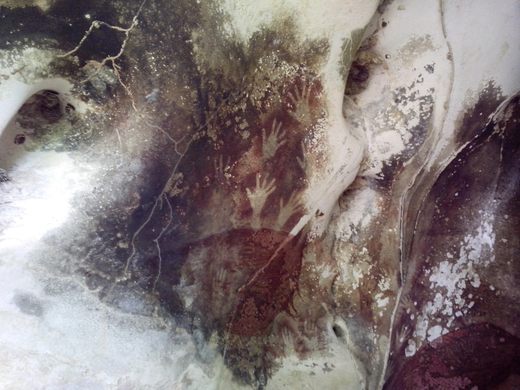
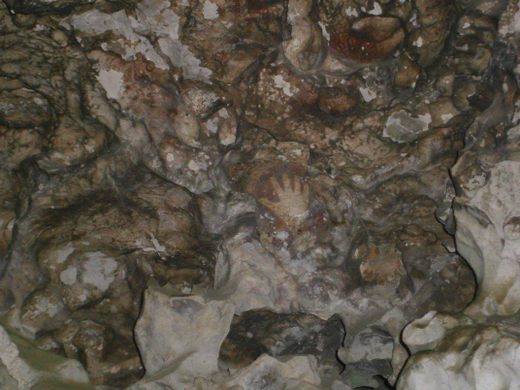
These 40,000-year-old stenciled hands are older than the famous cave art in France and Spain. 

A torch beam finds a stencil of a hand, its ochre outline surprisingly vibrant given its age. Next to it, a sketch of a babirusa—a type of wild “pig-deer” found in Indonesia—shows such attention to detail that the gender of the animal (female) is still clear nearly 36,000 years after its creation. It’s thought to be the oldest known example of figurative art in the world.

The Pleistocene-era rock art is spread throughout the karst caves within the Maros and Pangkep regions in Sulawesi, Indonesia. Researchers from Australia’s Griffith University used uranium series dating and found that one of the handprints was roughly 40,000 years old. The collection of paintings, which includes the handprint and the babirusa, contains artwork that is slightly older than the images found in European caves.


The rock art’s ancient age shattered the preexisting notion among many Western archaeologists and historians that the cave art originated in modern-day Europe. While little-known, these Indonesian cave drawings are even older than the famous stenciled caves in France and Spain. 

But though it wasn’t celebrated until recently, the cave art wasn’t unknown. H.R Van Heekeren, a Dutch archaeologist, documented the figures and published his work in 1950. However, the paintings were deemed to be of no real significance and subsequently no additional exploration was done until nearly 60 years later.

The purpose behind the rock art is unclear. It’s commonly thought that sites with rock art are ceremonial, but there’s no actual evidence to say whether this is truly the case. One theory is that the rock art was an early library cataloging the animals and fish eaten by the people who dwelled here. Another theory is that the stenciled hands may have more symbolic meanings, such as protecting a house, expressing a person’s connection to the place, or attempting to communicate with the spiritual realm.

Getting to the karsts requires boating down the narrow river before an hour long walk through rice paddies. A monkey or two may shriek from the tops of the strange palm trees—described by the guide as “shrimpfingers”—before disappearing. Nearby, cows laze and graze under the monolith overhangs and ducks forage for huge snails in the rice paddies. 


28 August 2022 - SALTY KITUM CAVE - KENYA


SALTY KITUM CAVE

 - KENYA -


G'day folks,

Welcome to a salty cave excavated by elephants, and the location of a deadly disease vector. 

When the Kitum Cave was first discovered, the many marks, scratches, and furrows along its walls were assumed to have been the work of picks wielded by ancient Egyptians searching for gold or diamonds. In fact, the excavated sections of the cave are the result of something much more unusual.

The cave is found on Mount Elgon, an extinct shield volcano, and it developed as the result of cooling volcanic rock. The cave, which extends some 600 feet into the mountain, has walls that are rich in salt, and it is here that the mysterious cave diggers reveal themselves.


Each night for hundreds (possibly thousands) of years, animals have traveled into the cave in the dead of night to use it as a giant salt lick. Buffaloes, antelope, leopards, hyenas, and most of all elephants bumble blindly through the cave (the elephants often bump their heads in the process), making their way to the salty walls of the cave. It is the elephants that have done the digging.

Using their massive tusks, the elephants pull off chunks of the walls to crush and lick up the salt. Over the centuries this has resulted in a noticeable increase in the size of the cave as well as walls that are covered in tusk marks. The trip to the depths of the cave is not without its dangers; there is a deep crevasse into which many younger, more inexperienced elephants have fallen, leaving behind an elephant graveyard.

The Kitum Cave is more recently famous for a very different sort of lifeform: a deadly virus. In 1980 and again in 1987, visitors to the cave contracted Marburg virus, a deadly virus similar to Ebola. The cave and Marburg virus rose to notoriety when they were featured in the 1994 bestseller The Hot Zone. It is believed that bats in the cave are carriers of the virus, and that their powdered guano may act as the disease vector.


22 August 2022 - THE LARGEST CAVE SHAFT IN THE WORLD - MEXICO


THE LARGEST CAVE

 SHAFT IN THE WORLD 

- MEXICO -


G'day folks,

The largest cave shaft in the world is home to thousands of birds and popular with BASE jumpers. 

Simply staring down into the Cave of Swallows is a test of one’s fortitude.

Known as a pit cave, it is a vertical shaft, essentially a 160- to 205-foot gaping hole in the forest floor which drops straight down 1,220 feet – 1,904 from the higher edge – before reaching the cave floor. It is deep enough to fit the Statue of Liberty standing on her own shoulders, the Eiffel tower, or the Chrysler building. 

Called Sótano de las Golondrinas in Spanish and the Cave of Swallows in English, it is the largest known cave shaft in the world and the second deepest pit in Mexico. The cave gets its name from the green parakeets and white-collared swifts that live along its walls. Each day the birds fly in concentric circles up the cave shaft before the flocks come spilling out of the of the hole into the jungle. 


The cave has more recently become the home to a number of newer aerial species, namely vertical cavers and base-jumpers. A popular destination with the extreme sports enthusiasts, it is tall enough for the BASE jumpers (BASE stands for Buildings, Antennas, Spans, and Earth, all things they enjoy flinging themselves off of) to leap off the edge and free-fall for a couple of seconds before deploying their parachutes. While it takes about ten seconds to reach the bottom, the ascent back up is slower taking between 40 minutes and 2 hours. 

While the cave has long been known to the local Huastec people, it was first explored by outsiders in 1966 by T. R. Evans, Charles Borland and Randy Sterns. The cave is so deep that when rappelling, which can easily take an hour, the friction can cause the rope and equipment to heat up to dangerous levels, so spray water bottles are used to cool the equipment as one descends. 

27 August 2022 - THAM LOD CAVE - THAILAND


THAM LOD CAVE

 - THAILAND -


G'day folks,

Welcome to a mile-long navigable cave adorned with stalactites and stalagmites reaching up to 65 feet tall. 

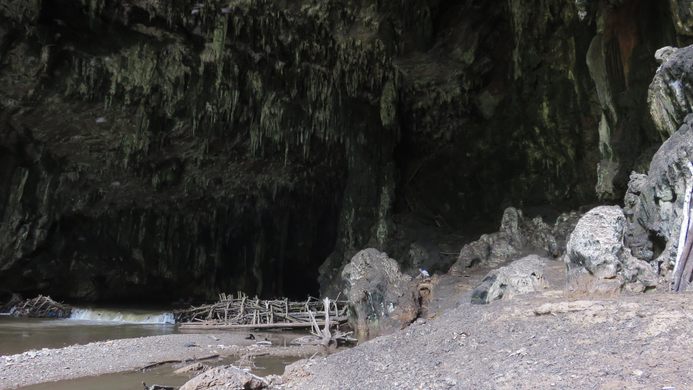
Tham Lod is a cave system in Thailand’s Mae Hong Son province that stretches nearly a mile long. The Lang River (Nam Lang) runs through the entire length of the cave, from one side of the mountain to the other, and the only way to explore the long cavern is to hire a rickety bamboo raft and a local guide with a gas lantern.


Upon arriving at the entrance of the cave, it is obvious that you are not the first visitor to get here, but once you get inside the cave, the utter lack of artificial lights and permanent facilities adds a certain sense of adventure. In no time, stalactites and stalagmites put up a show that took millions of years to form. At different points of the trip, depending on the time of the year, guides stop to let visitors step on the muddy ground and slippery bamboo passageways to get a closer look at the rock formations, which can exceed 65 feet in height. 

As the end of the trip approaches a shaft of light cuts through the darkness, and the emerald green of the vegetation outside can be blinding. The opening at the end of the cave is huge and thousands of birds dart in all directions.  The chirping can be deafening, but it is an impressive sight.

The Lawa people used to bury their dead inside caves, and at one point 1,400-year-old coffins were found inside Tham Lod. You won’t be able to see the coffins upon visiting, but archaeological excavations in the area have proved that Tham Lod was used as a burial place by the Hoabinhian people between 5,500 and 9,000 BC.


21 August 2022 - BATTAMBANG BAT CAVE - CAMBODIA


 BATTAMBANG

 BAT CAVE 

- CAMBODIA -


G'day folks,

Here, you can take a hidden path to the mouth of a cave to watch millions of bats swarm at sunset.  

Just down the road from the Killing Caves of Phnom Sampeau, visitors gather at sundown for an incredible spectacle of nature: the nightly exodus of a gargantuan colony of hungry wrinkle-lipped free-tailed bats.

Most spectators convene at the bars and stalls on the side of the road, where food and drinks (and cover) are available. But for those wanting a more intimate experience, you can have a local guide lead you up the hidden path to the mouth of the cave.

Standing so close to the cloud of flying creatures whooshing out of the cave is an enthralling encounter. The bats won’t hurt you—they’re too busy hunting for bugs to even care about you—but the swarm is so large and furious you can actually feel the temperature rise as they soar overhead.


The bat population is so high it can take upwards of 20 minutes for the cave to clear. Once they’re out, it’s amazing to watch the animals streak across the sky. The hordes of flying bats seem to paint the air with fluid black shapes, forming a series of striking images against a sky tinged with the last bits of sunset colors.


20 August 2022 - TREEPOD RESTAURANT - THAILAND


TREEPOD RESTAURANT

 - THAILAND -


G'day folks,

Here, you can eat dinner in the trees, and eat like a bird in a bamboo nest. 

The Treepod Restaurant on the island of Koh Kood, Thailand, may be the only eatery in the world where the servers wear harnesses.


Diners must make a short trek through the island’s beachside rainforest to reach their “pod.” These egg-shaped, handmade structures are built by a resident craftsman from locally sourced bamboo and rattan, and resemble the nests of native birds. The pods are hoisted by electric cables 36 feet in the air to float among the rainforest canopy. Patrons enjoy unobstructed views of the Gulf of Thailand while their waiter soars through the massang trees on zip-lines with their food. Much of the menu is sourced from the eco-resort’s organic garden, featuring Thai classics, seafood, and fresh fruit platters.


The real-life dreamscape is the brainchild of Graham Grant, manager of Soneva Kiri Resort, which owns the Treepod Restaurant. The eco-resort is true to its nature, sourcing its building materials locally and banning imported bottled water. Koh Kood is a large and sparsely populated island, allowing visitors to spend some alone time with the birds, like birds themselves.