Showing posts with label NOBEL PRIZE. Show all posts

29 February 2016 - ALFRED NOBEL


ALFRED NOBEL

G'day folks,

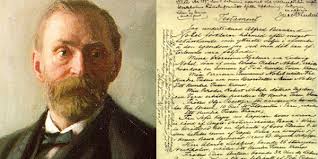
No doubt you have heard of the Nobel Prize, but do you know anything about the man behind the prize?  Alfred Bernhard Nobel was a Swedish chemist, engineer, innovator, and armaments manufacturer. He was the inventor of dynamite. On the anniversary of Alfred Nobel's death, which coincides with the Nobel Peace Prize Award Ceremony, here's a look at some surprising facts about Nobel's life and legacy.

 You may know that after a lifetime of working with explosives, Alfred Nobel wanted the fortune he'd earned to be used to create Nobel Prizes in the fields of chemistry, medicine, physics, literature and peace. However, there's much more to this 19th century scientist's story. Here are a few surprising facts about Nobel's life (and death):


A Benevolent Misanthrope

For a man who would establish prizes that celebrate the best in human accomplishment, at times Alfred Nobel had very little enthusiasm for people.
Nobel, who suffered from chronic bad health, lived a lonely life; he preferred not to entertain and once wrote that "numerous friends are to be found only among dogs." In addition, the people he met in his career often frustrated him, as competitors tried to appropriate his work on multiple occasions.

Yet Nobel didn't completely give up on humanity, as his prizes indicate. He once wrote: "I am a misanthrope, but exceedingly benevolent."


Nitroglycerin Man

 Nobel's reputation and fortune were built on his work with nitroglycerin. He invented an igniter that made it possible to control the unstable compound's explosions, then figured out how to combine nitroglycerin with silicon-containing earth in order to create the more stable dynamite. Later in his career, Nobel also used nitroglycerin to make blasting gelatin and ballistite (smokeless powder).

In Nobel's lifetime, nitroglycerin was also found to have medicinal uses. And when Nobel experienced heart problems himself, doctors directed him to take the compound. Nobel recognized the absurdity of the situation, noting, "[I]t seems an irony of fate that they should be prescribing nitroglycerin internally for me!"

 Nobel the Playwright


Nobel had a lifelong appreciation for literature. He often wrote poetry, and also drafted a few novels. And shortly before his death, he completed a play, Nemesis, that was based on the story of a 16th century noblewoman who'd killed her abusive father. Nobel wrote that he thought his work was "rather good," and 100 copies of the play were made for distribution. 

 After Nobel died in 1896, family members tried to destroy those copies because they felt the play could undermine his reputation. Despite these efforts, three copies survived, and in 2005 Nemesis premiered at a theater in Stockholm.

However, though Nobel was a man of many talents, apparently his skills did not include writing drama — so don't feel bad if you missed the show. A Guardian article about the premiere stated: "According to the show's director, Rikard Turpin, Nemesis is a lurid parade of torture, rape and incest that features a drug-induced vision of the Virgin Mary, a conversation with Satan and ends in a 40-minute torture scene."


 Nobel and Peace


Throughout his life, Nobel didn't see his work with explosives as something he had to atone for. Most of his nitroglycerin products were put to use in fields like mining and communications (though ballistite was used in firearms). Of course there were military applications for all his explosives, but Nobel felt that "there is nothing in our world that cannot be misused."

In addition, Nobel believed that increases in destructive power might lead to peace. In 1890, he wrote, "On the day when two armies will be able to annihilate each other in one second, all civilized nations will recoil from war in horror and disband their forces." And Nobel, who was friends with peace activist Bertha von Suttner, told her, "Perhaps my factories will put an end to war sooner than your [peace] congresses."

However, Nobel's views did evolve to the point that he chose to establish the Nobel Peace Prize in order to honor those who "have done the most or the best work for fraternity between nations, for the abolition or reduction of standing armies, and for the holding and promotion of peace conferences" — a decision that many attribute at least in part to his ongoing discussions with von Suttner. In 1905, she won the Peace Prize herself.


 Feared Being Buried Alive


In the 19th century, it wasn't uncommon for people to worry about being live burial (Edgar Allan Poe's "The Premature Burial" was published in 1844). In fact, Nobel's father was afraid of such a fate — at one point, he wanted to build a coffin that allowed its occupant to call for help, just in case.

It turns out that Nobel shared his father's fears of being entombed alive, and placed instructions in his will to prevent this: "It is my express will and injunction that my veins shall be opened after my death." Only after "competent doctors [had] noted definite signs of death" did Nobel want his body cremated.

 A Confusing Will


Given the importance of Nobel Prizes today, it's hard to imagine a world without them. Yet issues with Nobel's last testament mean that's almost what happened.

Nobel didn't like lawyers — he felt they made a living "by inducing people to believe that a straight line is crooked" — and he therefore wrote his will without any legal counsel. This helps explain why Nobel never checked to make sure that the groups he selected would be willing to do the work needed to award Nobel Prizes.

In addition, Nobel wanted the bulk of his fortune to establish a fund for these prizes, yet he didn't provide specifics about how that fund would be administered. Yet more issues arose because some family members were not happy to lose out on what would've been a large inheritance. 

Obviously these problems were eventually resolved. However, it took time, which is why the first prizes were not awarded until 1901, five years after Nobel's death.


  Clancy's comment: Mm ... Where there is a Will, there is a family.

I'm ....


29 September 2015 - WOMEN WHO HAVE WON NOBEL PRIZES


WOMEN WHO HAVE
 WON NOBEL PRIZES

G'day folks,

I think you will find this very interesting. I sure did. As a male, I've always been a great advocate for women, kids, and those who cannot stand up for themselves, for whatever reason. You may ask why? Well, it's easy. I was brought up in a tough environment, and I still recall what my mother went through at the expense of my father who came back from the war a total mess. Fortunately, I turned a negative situation into a positive life experience. Having said that, let me highlight some women who have been rewarded for great work.


When it comes to record-setting Nobel Prize recipients, there’s Marie Curie and there’s everyone else. The Polish-French scientist was the first woman to share a Nobel Prize (the 1903 physics award, with her husband Pierre and fellow French scientist Henri Becquerel, for their pioneering work on radioactivity) and was also the first woman to receive an unshared Nobel, the 1911 chemistry prize, for her discovery of the elements radium and polonium. That makes her the only person ever to win Nobel Prizes in two different sciences. As if that weren’t enough, four of her family members are also Nobel laureates. In addition to Pierre, her daughter and son-in-law shared the 1935 chemistry prize, while another son-in-law was the director of UNICEF when it won the 1965 peace prize.


The first woman to win the Nobel Peace Prize was Baroness Bertha Sophie Felicita von Suttner, née Countess Kinsky von Chinic und Tettau, who won in 1905. Von Sutter was the author of an influential anti-war novel and had a leading role in convincing dynamite magnate Alfred Nobel to include a peace prize in his bequest. The first female Nobel literature laureate was novelist Selma Lagerlöf, whose most popular book was about a boy who flies around Sweden on the back of a goose. The first woman to win the Nobel Prize for Physiology or Medicine was Gerty Theresa Cori, who shared the 1947 award for discovering how sugar-derived glycogen is used by the body as an energy source.


The last first woman to win the Nobel in her category was Elinor Ostrom, who shared the 2009 economics prize for her groundbreaking analysis of common property. The wait was so long for a woman economics laureate in part because that prize wasn’t established until 1969. In all, as of 2013, Nobel Prizes have been awarded to 44 different women.


Clancy's comment:  You go, girls. Love ya work!

I'm ...


23 July 2015 - ELIE WIESEL


ELIE WIESEL

G'day folks,

Welcome to a very interesting and distinguished man who is a professor, author, humanitarian and Nobel Peace Prize winner.


Eliezer Wiesel is a Jewish American professor, writer and political activist. He was born in Sighet, Transylvania, Maramures, and Kingdom of Romania on 30th September 1928. In 1986, recognizing his struggle for peace, atonement and human dignity Norwegian Nobel Committee awarded him The Nobel Peace Prize. He is also famous for his arguably most powerful and renowned book in Holocaust literature, “Night” which is inspired by his personal experience as a prisoner in Auschwitz, Buna, and Buchenwald.


Since Elie Wiesel’s early age his father implanted in him a sense of humanism. Wiesel recalls that his father always taught him reasoning, his mother on the other hand represented faith. Growing up in a tiny village, his only affection was his family, religious study and community. His father always encouraged him to study the Modern Hebrew language and concentrate on his literature. 


In 1944 Nazis invaded Sighet and destroyed the once secure childhood world of Wiesel. All the Jewish families were placed in camps. Wiesel and his father were separated from his mother and sisters. They were forced to work almost to death and were shuffled between different camps mostly bare footed without food or proper clothing in driving snow. He lost his father on January 29th 1945 only months before the US army rescued him from the camps. 


 After the war Wiesel, reunited with his two surviving sisters, settled in France. There he taught Hebrew and mastered the French language. He also studied philosophy at the Sorbonne. He became professional journalist and wrote for newspapers both in France and Israel. In 1955, after ten years of utter silence about his experience in the camps and war in general, Wiesel met Francois Mauriac, a Nobel Prize awarded French author who later became his close friend for life. Mauriac is credited to have encouraged Wiesel to write about his experiences. “La Nuit” was the result of this persuasion which was later translated in English Language as “Night”. Wiesel had to struggle several years to find a publisher for his book and even when he did only few copies were sold initially. However, as yet, Night has been translated in more than 30 languages and by 1997 the book was selling over 300,000 copies annually in the US alone. 


 In 1956, Wiesel visited New York for his report on United Nations. During his visit, he was struck by a cab driver and was confined to a wheelchair for nearly a year. He applied for the renewal of his French permit which had allowed him to travel, upon denial of his request he successfully applied for US citizenship. 

He started his career in US as feature writer for The Jewish Daily Forward. Wiesel used his international fame earned by his publications, to win justice for oppressed people and societies in different parts of the world. In 1978 he was appointed Chairman of the United States Holocaust Memorial Council by President Jimmy Carter. 


1985 brought him a Congressional Medal of Freedom, followed by the Nobel Prize of Peace in 1986. Wiesel has given many guest appearances and lectures in a number of universities all over the world. Despite his growing popularity as a humanitarian, Wiesel has not discarded his passion for fiction and continues working on his books and semi auto-biographical novels.


Clancy's comment:  What can I say?

I'm ...