SHIP OF
GOLD DISAPPEARS
G'day folks,
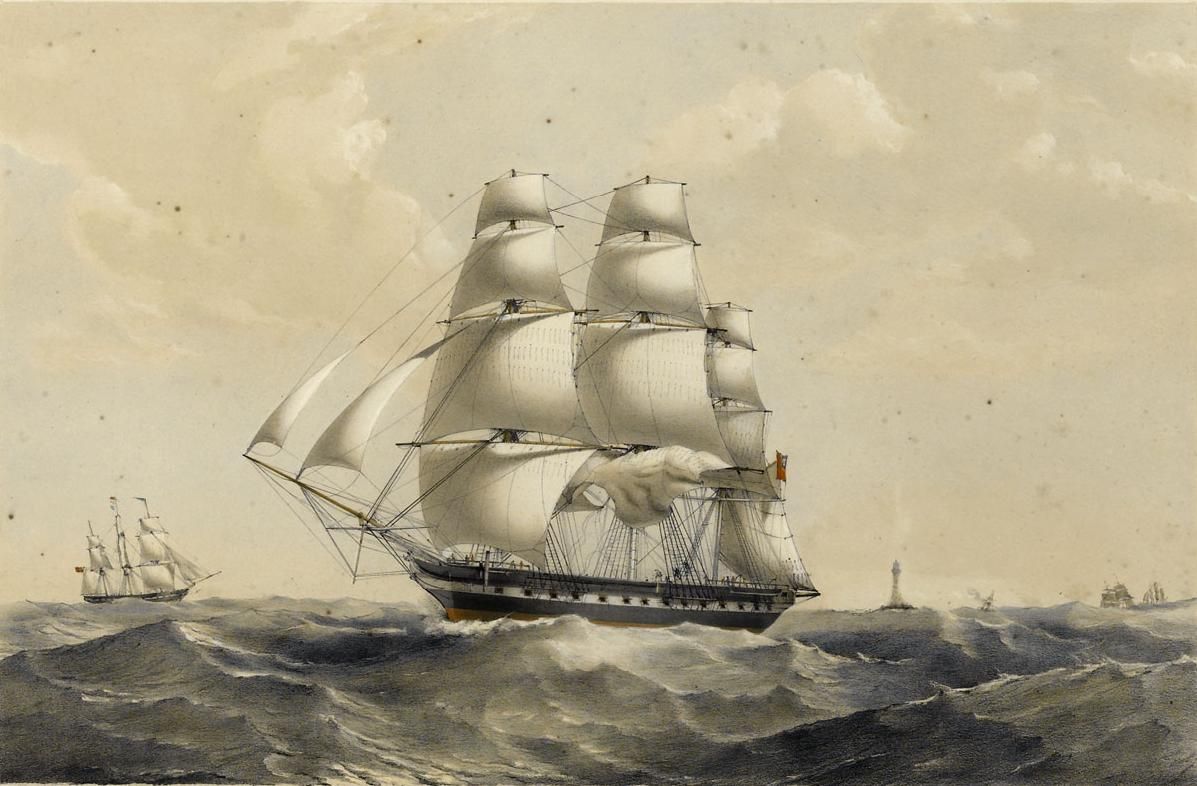
The frigate Madagascar left Melbourne for London in 1853 with more than 150 passengers and crew. She also had nearly three tons of gold on board – and was never seen again.
The Madagascar was a sturdy British merchant vessel built in 1837, used
for carrying soldiers to India as well as passengers looking for an
exotic holiday on the Indian sub-continent.
But by the 1850s, Victoria was in the grip of a gold rush and the
Madagascar found it had a new role. Instead of being packed with troops
for India, the ship was crammed with would-be pan-handlers and
rock-pickers heading for Melbourne, convinced that there were fortunes
to be made.
So much so, that after arrival in Melbourne in 1853, 14 members of the
crew resigned after deciding to stay in Australia. Captain Fortescue
William Harris could find only three replacements for the return
journey. The skeleton crew faced a busy time of it because 110
passengers had signed up to travel back to England.
In the hold, the Madagascar carried a box of specie, eight boxes of
silver, nine boxes of sovereigns (about 60,000 gold coins), 86 boxes of
gold dust and nuggets, making a total weight of 68,390 ounces (nearly
three tons) and all valued at about £250,000.
In addition, a large cargo of flour, rice, wool and timber was taken on board.
Preparations to sail on August 10 were dramatically interrupted when
police came on board and began to search the vessel. A bushranger called
John Francis was arrested on a charge of robbery, and Captain Harris
was told to delay his departure.

The following day two other passengers were arrested on related charges.
The ship was allowed to sail on the afternoon of August 12. It left the
port, never to be seen again.
There has been much speculation about what happened to the Madagascar.
One theory is that the wool on board spontaneously combusted – such a
tragedy had happened before. There was the possibility that the ship had
been wrecked by a freak wave or, Titanic-style, sunk after colliding
with an iceberg.
There was also a growing belief that criminals on board, undetected by
the police in port, had taken over the ship. But a more plausible
explanation is that the vessel was the victim of pirates who would have
sunk the Madagascar after relieving it of its treasure.
In 1997 Australian researcher Gerald Crowley discovered artefacts –
knives, spoons, nails, and so on – on the remote atoll of Anuanuaro in
French Polynesia. He believes they are from the Madagascar.
His theory is that the ship was hijacked in the Pacific, turned north,
and sunk on the atoll, 1,500 kilometres south-east of Tahiti.
"There's a wreck there. We're beyond doubt," he said a few years later . . .“but I can't prove it.”