Showing posts with label HISTORY. Show all posts

21 June 2022 - ANCIENT FOOTPRINTS FOUND in TANZANIA


ANCIENT FOOTPRINTS 

FOUND in TANZANIA


G'day folks,

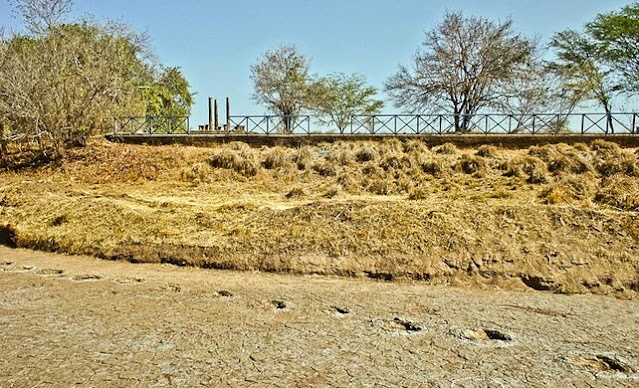
Human ancestor’s 3.6 million year-old footprints found in Tanzania. 

Roughly 3.6 millions years ago the Sadiman Volcano erupted covering the surrounding ground in ash; rain soon followed making a soft and muddy ground over which prehistoric animals trekked. More ash then erupted from the volcano covering and, in effect, preserving the prehistoric tracks.


Forward to 1978, when a group of researchers (led by paleoanthropologist Mary Leakey) discovered the preserved tracks, within which were the oldest known footprints of human ancestors. From the prehistoric footprint’s shape, length, and toes it was evident that these hominids were bipedal and were walking upright on two legs, before even the use of stone tools. The prints were left by two or three hominids (one or two adults and a child) and show that these early humans walked in a very similar manner as modern humans.

Today, the actual footprints have been covered up in hopes of protecting them, but due to fear of erosion they are planned to be uncovered again. Whether the prints remain at their discovered location (with a possible museum built over them) or are to be cut-out and moved entirely is currently under debate.

For now visitors can visit the covered up site of discovery and the nearby Olduvai Gorge Museum, which features casts of the prints and related artifacts.


 

12 April 2022 - CROMWELL'S BRIDGE - ENGLAND


CROMWELL'S BRIDGE 

- ENGLAND -


G'day folks,

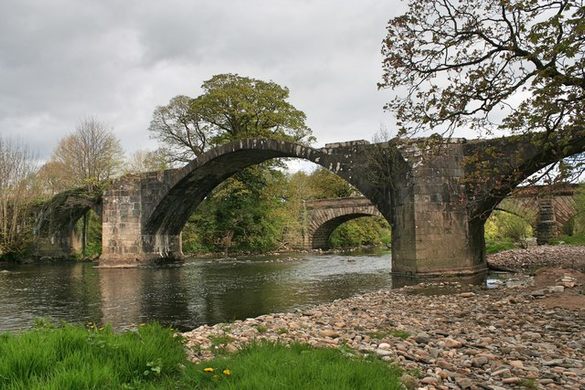
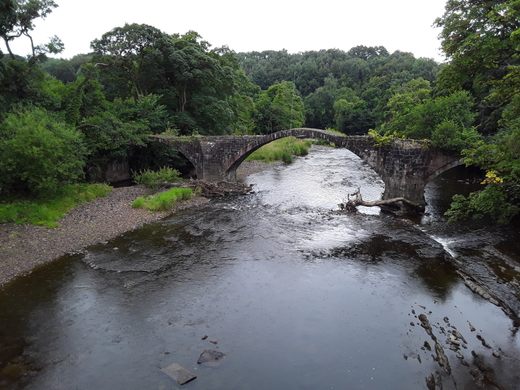
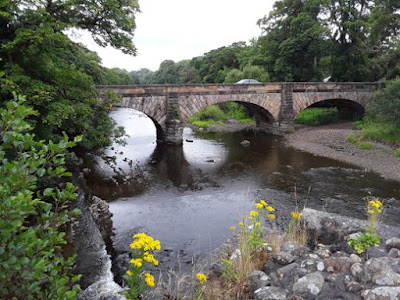
Oliver Cromwell marched his army over this narrow bridge to victory at the Battle of Preston in 1648. 

This bridge was built during the Tudor period but found fame in August 1648 in the English Civil War. During the war, Oliver Cromwell marched his army of more than 8,000 soldiers along with artillery over the bridge on his way to the battle of Preston. Despite being outnumbered, he defeated the combined army of English Royalists and  Scots “Engagers” who marched south in support of King Charles I.


The bridge was a packhorse bridge and has been out of use since the nearby Lower Hodder Bridge was built in the early 19th-century. The parapets of Cromwell’s Bridge were constructed very low from the start, to allow pack horses, loaded with panniers, to cross.

The bridge provides an attractive and romantic setting. The central arch has become quite popular with wedding photographers.

Clancy's comment: I loved seeing these ancient structures when I toured the UK and Europe.

I'm ...


22 January 2022 - VALLEY OF THE DINOSAURS - BRAZIL


VALLEY OF 

THE DINOSAURS

 - BRAZIL -


G'day folks,

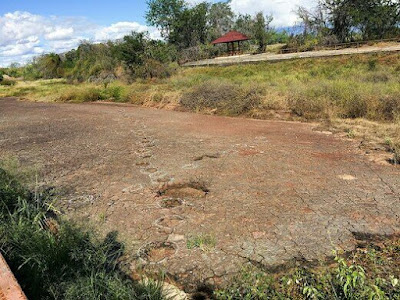
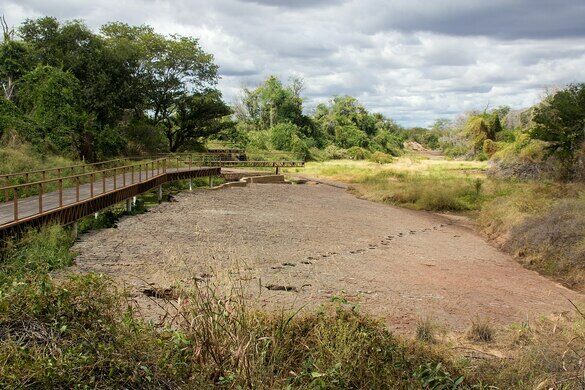
This is one of the few places in the world where visitors can walk alongside fossilized tracks from 80 different dinosaur species. 

As you walk around this natural monument in Northeastern Brazil, alongside dinosaur footprints in different shapes and sizes and life-size replicas of these jurassic creatures, you’ll be taken back in time over 100 million years ago.

The Valley of the Dinosaurs (Vale dos Dinossauros) contains about 20 fossilized dino tracks from 80 different species of dinosaurs. The walkways let visitors near 50 fossilized footprints of the carnivorous Noasauridae and 53 tracks of the herbivore Iguanodon, among many others.


The impressive tracks are set within a 270-square-mile preserved ecological area. The damp earth from rivers and ponds hardened over periods of drought, gained new layers of clay and fossilized these footprints for posteriority, making this area one of the most important places for dinosaur lovers all over the world.  

If you want to find out more about who these Brazilian jurassic creatures were, what they ate, how fast they ran, if they hatched their eggs, or if they could fly, you can also visit the museum of the Valley of the Dinosaurs. There, investigators carry on unraveling mysteries and working so they can answer questions from curious visitors, filmmakers, and children. 

Clancy's comment: It's hard to imagine that these creatures existed.

I'm ...


9 January 2022 - OYA HISTORY MUSEUM AND CAVE - JAPAN


OYA HISTORY MUSEUM 

AND CAVE

- JAPAN - 


G'day folks,

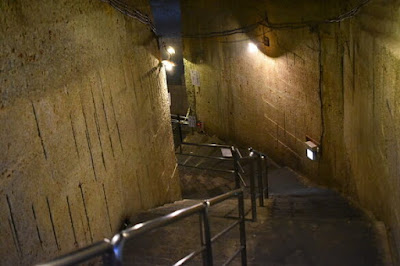
This massive, beautifully-lit underground quarry leaves visitors in awe.  

ÅŒya stone is an igneous green tuff renowned for its warm texture and flexibility, famously used by Frank Lloyd Wright to build the Imperial Hotel in Tokyo. It was the same material used to create the Venus of Gyoza and is a specialty of Utsunomiya City, quarried in its namesake town of ÅŒya.

The earliest usage of ÅŒya stone dates back to the 6th-century when it was used to build burial mounds and sarcophagi for local lords. The mass quarrying of ÅŒya stone was initiated during the mid to late Edo period, around the 17th-18th-centuries. 

From 1919 to 1986, ÅŒya stone was quarried underground, resulting in a massive hollow space known today as the Subterranean Cave. Large enough to contain an entire baseball field, it’s quite an impressive, awe-inspiring sight. Today, this location is often used as a filming location and for concerts, weddings, and traditional Noh plays.


It’s quite cold in the Subterranean Cave, which is generally about 46.4 degrees Fahrenheit (8 degrees Celsius) on average. During World War II, the underground quarry was used as a weapon factory and then as a government storage facility for rice after the war.

In 1979, the Oya History Museum was established and the subterranean quarry finally opened to the public. The old quarry is beautifully lit in many colors, giving the so-called “underground temple” a surreal, quasi-sci-fi look from time to time. Aboveground, the museum also explains the history and geology of the area while exhibiting a variety of mining tools.

Nearby, there is a temple called ÅŒya-ji which is home to several ÅŒya stone sculptures allegedly created by the legendary monk KÅ«kai in 810 CE. There is also a public park about a 10-minute walk away from the temple where the Heiwa Kannon statue stands. It’s an 88-foot-tall stone sculpture of Guan Yin dedicated to those who died in the Pacific War.

Clancy's comment: What an amazing history.

I'm ...


15 December 2021 - CHACO CULTURE NATIONAL HISTORICAL PARK - NEW MEXICO


CHACO CULTURE NATIONAL 

HISTORICAL PARK - NEW MEXICO


G'day folks,

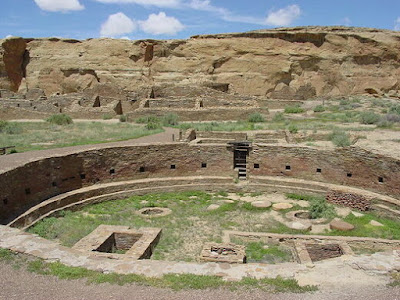
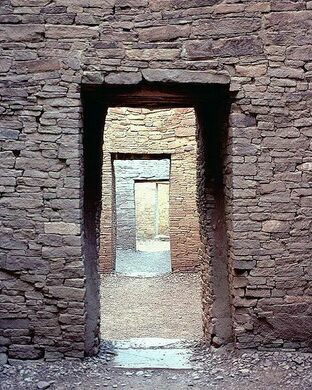
A phenomenal assembly of pueblos in New Mexico is the most complete example of ancient ruins north of the border. 

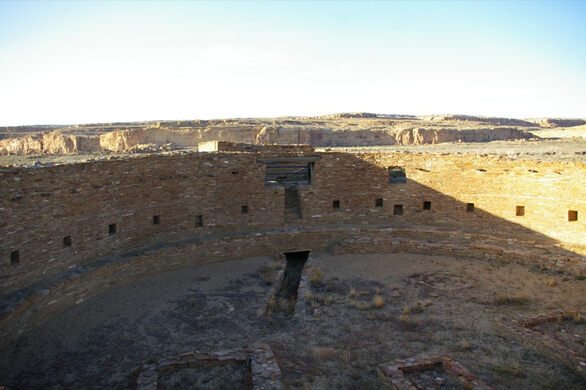
An ancient and mystical place, Chaco Canyon is a fragile and vital piece of pre-Columbian cultural and historical preservation.

The canyon of the Chacoans was once the cultural hub for Ancient Pueblo Peoples. Huge, intricate compounds showing in their construction evidence of archeoastronomy with several of the buildings aligned to capture the cycles of the sun and moon. The canyon’s 15 complexes also contained the largest buildings north of Mexico until the 19th century. The Chacoans and their complicated, astronomically-influenced architecture thrived between the years 900 and 1150, likely moving on due to a climate change that delivered a drought that lasted half a century.

The Chacoan complexes cover a nine-mile span along the canyon floor. The Northside is home to nine of the “Great Houses,” of which there are 14 altogether. The latest Great House is Pueblo Bonito, a four-story-high complex with 650 rooms, taking up almost two whole acres of land with its girth, its massive scale indicative of the spiritual importance the Great Houses held. Most of the houses facing South are well constructed, many-roomed structures which seem to be carefully aligned. Pueblo Bonito sits directly on the East-West line, an axis that captures the passage of the equinox sun.


Smaller and more numerous than the Great Houses are the kivas. Some greater than others, the kivas held worshippers and contained both religious centers and dwellings. Some still standing, some remain only as foundation ruins, the park is said to contain 2,400 identified archeological sites, few of them have currently been excavated. Along with the complexes that served the city as homes and religious buildings, the site has a massive structure that is believed to have been a dam, elaborate pictographs, and tens of thousands of artifacts have been discovered just in the few excavations that have taken place. 

Today, the park has an observatory and hosts regular night sky programs on summer weekends, as well as special observances of the solstices and equinoxes in the great kivas. Although the park is usually closed from dusk until dawn, campsites are available.

Due to the delicate condition of the erosion-prone site, some parts of the park are closed to the public, but much of it can be seen by car, or from the hiking trails provided at the visitors center. 

Clancy's comment: This site looks monstrous, and I'd love to visit it.

I'm ...


10 December 2021 - CROW CANYON PETROGLYPHS - NEW MEXICO


CROW CANYON PETROGLYPHS

 - NEW MEXICO -


G'day folks,

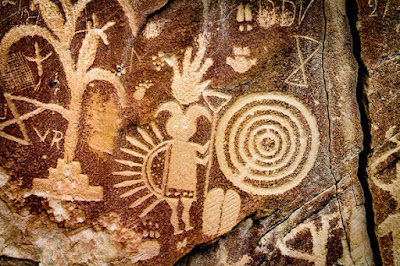
Welcome to one of the American Southwest's most extensive collections of Navajo rock art. 

This rocky swath of land in New Mexico is home to an abundance of archaeological ruins. The Crow Canyon Petroglyphs in particular are said to be the American Southwest’s most extensive collection of Navajo rock art from the 16th through 18th centuries. 

The Crow Canyon Archaeological District is a remote and relatively obscure area in the heart of Dinétah, which is the traditional and ancestral homeland of the Navajo people. The foundations for the Navajo culture were well established in the area, dating back as far as the year 1100. The Navajo lived within Dinétah until about the late 1700s, when they were forced to abandon it and move elsewhere because of pressure from the Ute people and encroaching Spanish settlers.

The artwork in Crow Canyon preserves traces of the people who once called the land home. Most of the petroglyphs are clustered into “panels” carved predominantly within the canyon’s south-and-east-facing walls. Gazing upon them is like viewing a gallery full of hundreds of stylized animals, people, crops, weapons, and supernatural beings.


 Because the petroglyphs appear similar to Navajo ceremonial sand paintings, archaeologists believe these were likely linked to a ceremonial purpose as well. You’ll also see much older Ancestral Puebloan rock art intermingled with the Navajo petroglyphs.

In addition to petroglyphs, Crow Canyon contains several Navajo pueblitos (archaeological ruins), built in the 16th and 17th centuries. They are, for the most part, less accessible than the petroglyphs.

Today, the Navajo Tribe is the largest Native American tribe in the United States, with more than 250,000 members.

Clancy's comment: Stunning pictures. 

I'm ...