Showing posts with label CHURCHES. Show all posts

25 September 2022 - THE CHURCH IN THE SKY - ETHIOPIA


THE CHURCH 

IN THE SKY

 - ETHIOPIA -


G'day folks,

Reaching the "Church in the Sky" requires scaling the cliff face of a sandstone pinnacle with a 650-foot drop. 

If you think going to a normal church can be an enlightening experience, imagine going to worship in a rock-hewn painted cave atop a towering sandstone pinnacle, only reachable via a daredevil climb with 650-foot drops on all sides. 


At Abuna Yemata Guh in northern Ethiopia, this risky and thrilling experience is common practice for a few dedicated priests. The monolithic place of worship is said to be the world’s most inaccessible and dangerous church, reachable only by a 45-minute ascent.

The journey has cliff faces to scale, rickety bridges to cross, and narrow ledges to traverse. After crossing through the valley that underlies the church, you must ascend the half-mile-high sandstone pinnacle, searching for rare footholds to avoid the long drop. Adding to the general sense of dread, the route passes by an open-air tomb filled with the skeletal remains of deceased priests (although it’s said that none of the priests died from falling off the cliff).

If the intense climb and the gorgeous view of the valley below aren’t enough to take your breath away, the interior of the church surely will. The cave’s ceiling is covered by two beautiful frescoes, featuring intricate patterns, religious imagery, and the faces of nine of the twelve apostles of Christ. The church also contains an Orthodox Bible with vibrant, colorful sheets made of goatskin. Abuna Yemata Church is so sacred that some Ethiopian parents even risk bringing their babies all the way to the top of the cliff to have them baptized there.


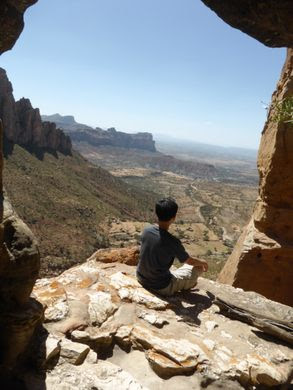


The church is named after Father Yemata, a priest who carved the church out of the cliff face in the 5th century. Some say he chose the high location to escape enemies, while others believe it was an attempt to find true divinity. Either way, his rock-hewn masterpiece has provided a unique opportunity for Ethiopian Christians to demonstrate their commitment to their faith in epic fashion.

3 July 2022 - St PAUL'S CATHEDRAL, LONDON - A GREAT SURVIVOR


St PAUL'S CATHEDRAL LONDON

 - A GREAT SURVIVOR -


G'day folks,

The foundation stone for St. Paul’s, one of the most famous cathedrals in the world, was laid on June 21 1675 as work began to replace its enormous Gothic predecessor, which had been destroyed in the Great Fire of London.

The still celebrated architectural masterpiece designed by Christopher Wren, who was then only 34 years of age, is the fifth church to have stood on the spot since the year 604.

St Paul’s is the burial place of famous Britons such as Horatio Nelson and the Duke of Wellington, who defeated Napoleon at the Battle of Waterloo. It has also been at the centre of royal celebrations such as the diamond jubilee of Queen Victoria in 1897, the silver jubilee of King George V in 1935, and the diamond jubilee in 2012 of the present Queen, Elizabeth II.

The wedding of Prince Charles and Lady Diana Spencer at St. Paul's in 1981 was watched by 750 million people around the world. And it was here that state funerals were held for Sir Winston Churchill in 1965 and Margaret Thatcher in 2013.

The most perilous days for the cathedral came in what became known as The Blitz during the Second World War – the eight-month intense bombing campaign in 1940 and 1941 launched by Nazi Germany against London and other UK cities.

On the night of December 29, 1940, 100,000 bombs were dropped on London causing more than 1,500 fires and turning the City of London’s Square Mile into a furnace. It was later reported that in the 1,000-degree heat, stone walls cracked and crumbled, iron girders twisted, glass melted, and road surfaces burst spontaneously into flames.

The lit-up night sky could be seen 100 hundred miles away on the French coast, and an American war reporter cabled his office: “The second Great Fire of London has ­begun.”

At the heart of it all was St Paul’s, but aware of its historical, psychological and religious significance, Prime Minister Winston Churchill issued orders that the cathedral must be saved at all costs. He knew how it would lift the spirits of a war-weary public if they could see it had ­survived the onslaught. Volunteer firefighter Harold Newell needed no telling. “If St Paul’s goes down, then we all go down,” he said.


This was the 114th night of the Blitz on London, and standing on a Fleet Street roof, photographer Herbert Mason captured the astonishing sight of the nearby cathedral dome, surrounded by devastation but still intact. His now-famous photograph is reproduced above.

“Through the smoke you could see the fires increasing and, as the evening wore on, an artificial wind sprang through the heat,” he wrote. “It parted the clouds, the buildings in the foreground collapsed. And there, ­revealed in all its majesty, was St Paul’s.”

The fires were to burn for days but an army of ­firefighters, men and women, hampered by ruptured water mains, fought to keep 1,700 pumps working ­flat-out.

In his book, Firefighters And The Blitz, Francis Beckett writes: “While the men manned the pumps, the women were driving petrol carriers, canteen vans and staff cars into the thickest parts of the blaze, ensuring the pumps had fuel to keep going.

“Driving vans laden with cans of petrol through the flames that night was about as dangerous a job as you could do.”

The brave firefighters saved many of London’s historic buildings from total destruction, including, of course, St Paul’s Cathedral.

Sir Christopher Wren died in 1723 at the age of 90 and was the first person to be buried in St Paul’s. His epitaph, set in a great circle in the floor directly under the dome, states in Latin: Lector, si monumentum requiris, circumspice  –  “Reader, if you seek his monument, look around.”

6 August 2020 - POLISH CHURCH IS DECORATED WITH 20,000 SKELETONS


POLISH CHURCH IS DECORATED 
WITH 20,000 SKELETONS

G'day folks,

There is a chapel in Poland outside the Kaplica Czaszek that is absolutely terrifying. The modest looking St. Batholomew’s Church (also called the Kaplica Czaszek) is literally made of thousands of real human bones. I really can’t believe that places like this exist, because believe it or not there are more chapels like this throughout the world. 


Stepping inside this place would be one of the most terrifying experiences of my life. So much death in one place really can’t be good for anyone. Imagine trying to worship in a place like this? I don’t think I could ever concentrate on trying to have a spiritual experience with thousands of human bones surrounding me.


The chapel walls are made from bones which are intended to be a reminder of mortality of human salvation in the face of death.


The chapel was created after a priest visited shallow grave sites of fallen soldiers and civilians killed in the Silesian Wars and the Thirty Years’ War, in addition to victims of plague.


 After seeing the poignant reminder of those who had fallen, Czech priest Vaclav Tomasek and J. Langer, the local grave-digger collected and cleaned skeletal remains, embedding them in the chapel walls between 1776 and 1804.


 There are over 3,000 victims in the ceilings and walls and an additional 21,000 remains hidden behind a trap door in a crypt underneath the chapel. Would you ever take a visit to a place like this?

Clancy's comment: There ya go. The world sure is an interesting place, eh?

I'm ...


20 June 2020 - Preserved, but Abandoned, Monastery in Italy


Preserved, but Abandoned,
 Monastery in Italy

G'day guys,

Well, I've found another abandoned building, but this one is a monastery in Italy. 

The road rises from the foot of a small Italian city and ends at the top of a hill, where you will find an imposing monastery rich in art and history, engulfed by an oak forest, a place hard to find for vandals. Perhaps that’s why the interior of the church has been preserved so well. 


In the fifteenth century, the Franciscans raised the monastery consisting of the church and the cloister and more recently, in the 60s, the college with the gymnasium, chapel, typography, and garage was erected.


The whole complex covers an area of ​​over 11 hectares, including barns, various service areas, the market and a large parking lot. To these are added about 6 hectares of forest around the convent. Under the complex, with access from the monastery, there is a network of very narrow passages, and you need at least a whole day for that. 


From the 70’s the complex was gradually abandoned until when in 1994 it was completely closed, ceasing any activity in this area. The degradation slowly crept into this place, making this monastery an attraction for some explorers who know it, but who respect the golden rule: to honour and respect the sacred place.

 Now, let's have a good look at this place ...


Clancy's comment: Beautiful construction, eh? It would certainly make a magnificent bed and breakfast. Another wasted building.

I'm ...