Showing posts with label WASHINGTON DC. Show all posts

9 July 2022 - FORGOTTEN WAR MEMORIAL - WASHINGTON D.C.


FORGOTTEN WAR 

MEMORIAL 

- WASHINGTON D.C. -


G'day folks,

Welcome to an overlooked memorial honoring the local Washington residents who died in World War I.

The first letters started a month after the war ended. People were writing the government with the idea of building a monument honoring the more than 26,000 Washington, D.C. residents who had served in World War I. Thirteen years later in 1931, the D.C. War Memorial was dedicated by President Herbert Hoover. This little-known monument is the only memorial dedicated to District residents on the National Mall.

Frank and Janet Noyes, a prominent newspaper family at the time, agreed to fund the project. Janet also had a hand in the design, proposing that the monument replace an old wooden bandstand in West Potomac Park. The new memorial would even resemble a bandstand: She suggested a domed marble memorial that would honor the dead and be available for military bands to use to play tribute to these soldiers.

Six years after the war ended, the first planning committee for the memorial met, and building began another four years later. Since the memorial was to honor local veterans, the people of D.C. thought it was important to use a local construction company. “Construction of the war memorial by out-of-town agencies would violate the principle and do injustice of the people of our city,” noted the District’s Chamber of Commerce president Harry King. A local builder was chosen from the bids, and the 47-foot-tall monument, comprised of 12 columns supporting a domed roof, was finally erected.
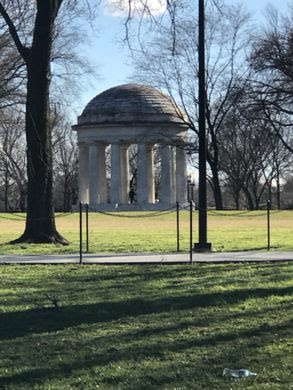


Rather than the initial idea of honoring all of the D.C. residents who served, the monument pays tribute to the 499 Washington residents who died in the war. Besides being dedicated to D.C. residents, the monument has another distinction; in an unusual move for the time, the inscription includes the names of both men and women.

The first concert held in the monument was during its dedication on November 11, 1931.  It was lead by noted composer John Phillip Sousa, and the space became a popular gathering spot for visitors to listen to music. However, as musical tastes changed, the kind of music that filled the bandstand wasn’t bringing the crowds it used to, and concerts happened there much less often. The monument, because of its off the beaten path location, or changing entertainment tastes, or a little of both, went through a period of neglect. In 2003, the memorial was declared one of D.C.’s most endangered places by the DC Preservation League.

In 2010, $3.6 million was dedicated to restore and upgrade the space. This hidden treasure, tucked among the trees, honors the veterans of a war that is quickly fading from public memory.


11 July 2022 - LINCOLN MEMORIAL UNDERCROFT


LINCOLN MEMORIAL 

UNDERCROFT


G'day folks,

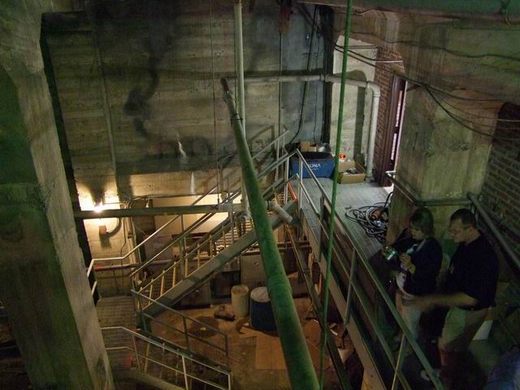
Ascend the 145 white marble steps at the Lincoln memorial, step forward into the shrine room with the seated Great Emancipator, and then direct your gaze down at the floor. Unseen beneath the Tennessee pink marble floor lies a cavernous three-story, 43,800-square-foot basement with architecture that wouldn’t look out of place in a World War II bunker.

Construction began on the Lincoln Memorial in 1914 on the muddy stretch of land known as the Potomac flats. The Army Corps of Engineers had just finished its 40-year-long dredging and landfill project that produced the shoreline we know today. Workers had to dig down 40 feet before work could begin on the marble monument. Here they poured dozens of concrete columns to support the surface structure.

The underground cathedral of concrete pillars was then simply forgotten about until renovations in 1975. According to the Washington Post, in preparation for the Bicentennial, the memorial’s bathrooms were renovated, and the construction crews started peering into the building’s foundation. They brought along their friends, some of whom belonged to the National Speleological Society. The cellar was deemed a cave, complete with stalactites and its own ecosystem (insects, rodents, etc).


One other interesting find was historical graffiti from way back in 1914. Steven Schorr got to explore the Undercroft as a part of a digital preservation project, and described to NBC how “down in the basement of the Lincoln Memorial, they actually have things written on some of the pillars. The builders actually drew cartoons and they have them covered in Plexiglas.”


For a time, the National Park Service offered flashlight tours of the Undercroft, but they were abruptly halted in 1989 when a tourist noticed asbestos and flagged it for authorities. Over the years there have been several proposals to put the space to some productive reuse. For example, in 1992 head of the Capitol Historical Society Fred Schwengel tried to get the Department of the Interior to open a museum in the Undercroft where they could display Lincoln’s papers and memorabilia. Schwengels proposal died on the vine like all the others in the face of strong opposition from the National Park Service.

That would be the end of the story, except for an announcement in June, 2017 that the NPS now wants to rehab and open up the Undercroft in time for the Lincoln Memorial’s centennial in 2022. Their proposal to the National Capital Planning Commission includes a rendering showing a platform floating out into the underground space that will allow visitors to get a look at the columns and graffiti. 


19 September 2020 - NATIONAL MALL IN WASHINGTON DC


NATIONAL MALL
 IN WASHINGTON DC

G'day folks,

This is a place where I used to live and work. The National Mall and Memorial Parks is an official US National Parks unit located in the downtown area of Washington DC

The National Mall is far from your stereotypical mall and constitutes the entire 250 acre stretch across downtown DC. Within the geographic boundaries of the National Mall lies major historical monuments and landmarks like Capitol Hill, Lincoln Memorial, and the Washington Monument. It is also home to the famous Smithsonian Natural Museum of History and the National Air and Space Museum, among many other incredible museums dedicated to different forms of art and significant events and industries. 
 
This stunning landscape is also peppered with beautiful sculpture gardens, grassy lawns, reflecting pools and plenty of places for fun-filled meals and photo opportunities. It’s impossible not to enjoy the energy and history of America’s capital city. No wonder the National Mall gets over 24 million visitors a year! Here are some must-visit locations in this unorthodox “mall” you wouldn’t have expected to be so fascinating! 


Clancy's comment: Yep, have walked for miles around this part of America. 

I'm ...


9 February 2019 - MARBLE STRIPE ON WASHINGTON MONUMENT


MARBLE STRIPE ON
 WASHINGTON MONUMENT

G'day folks,


Ever been to the Washington Monument in Washington DC? I have been there many times, but if you look closely you’ll notice that the color changes a third of the way up the tower. 


Construction on the Washington Monument began in 1848 with funding coming entirely from private donations. But within six years the eponymous Washington Monument Society had burned through its budget, and work on the obelisk ground to a halt. The 152-foot tall marble stub was capped with a wooden roof, and the project sat dormant for years as a source of national embarrassment.


At the time, the federal government had more pressing business to attend to than memorial building—namely fighting the Civil War and then reconstructing the South. The project finally resumed 20 years later in 1878, and the Army Corps of Engineers took over construction of the monument. The only problem was that the original marble quarry, Thomas Symington’s in Baltimore, was no longer in operation.


The engineers did their best to find a match, signing a contract with a nearby quarry owned by Hugh Sission and completing the monument in 1884. The Army Corps of Engineers official history of the project notes that by 1900, high levels of interior condensation “began penetrating the joints of the outer walls, causing the [new] marble ashler to discolor.” The effect has grown more dramatic over the years, and today the two sections are quite apparent. While some see the color disconnect as an architectural flaw, others view the marble stripe as an ugly but interesting wrinkle in the Washington Monument’s


  Clancy's comment: Not many people walk around with big cameras these days, but those that do learn about these things fairly quickly because lenses are brilliant.

I'm ...