Showing posts with label Canada. Show all posts

2 January 2023 - THE SAD TALE of CHATEAU LAURIER - OTTAWA


THE SAD TALE 

of 

CHATEAU LAURIER 

- OTTAWA -


G'day folks,

The mastermind behind this palatial hotel perished on the Titanic weeks before its grand opening. 

With its elegant turrets and enormous size, this riverside hotel looks like it could double as some sort of fairytale castle perched atop a European hillside. The nearby canal even makes it seem as though a moat surrounds part of what could easily be mistaken as a stoic fortress.

The architectural beauty isn’t a palace at all, though it has had a few brushes with royalty. Many famous figures, prime ministers, and royalty from around the world have stayed within this 429-room hotel.


Its insides reveal early 20th-century hand-moulded plaster decorations, original Tiffany stained-glass windows, and walls made with the finest Indiana limestone. When it first opened in 1912, a private room cost a whopping $2 per night.

Yet despite the hotel’s grandeur, its story is tinged with sadness. The palatial Château Laurier was commissioned by Charles Melville Hays, American millionaire, philanthropist, and president of the (now long-bankrupt) Grand Trunk Railway System. But unfortunately for Hays, he died before he could see the hotel’s grand opening.


Hays, anxious to return from London to Ottawa for the Château’s big opening, booked a ticket on the famously ill-fated RMS Titanic. Strangely, he reportedly prophesied an “appalling disaster” on the very night the ship collided with the iceberg and met its demise. Hays sadly perished when the ship sank.

Notably, the Château has a second connection to the Titanic. Hays commissioned French sculptor, Paul Chevré, to create a bust of prime minister Sir Wilfrid Laurier for the hotel’s official opening. The bust, still located in the hotel foyer today, was transported aboard another ship, La Bretagne. Chevré and Hays boarded the Titanic, but unlike Hays, Chevré survived the sinking.

3 September 2022 - THE SMOKING HILLS - CANADIAN ARCTIC


THE SMOKING HILLS 

- CANADIAN ARCTIC -


G'day folks,

These hellish-looking cliffs in the Canadian Arctic have been burning for centuries. 

Located on the Arctic Ocean in Canada’s Northwest Territories, these barren red-striped rocks have been burning continuously for centuries. This smoldering hellscape is aptly known as the Smoking Hills, and it must have been a shocking sight for the first European sailors to approach this strange remote landscape.

The first recorded sighting of the burning hills was by the Irish explorer Captain Robert McClure in the early 1800s. His crew had journeyed to the Canadian Arctic searching for the lost explorer Sir John Franklin, who disappeared five years earlier on an expedition to map the Northwest Passage. (According to the stories, when McClure brought a piece of the smoking rock back to the ship it burned a hole through his wooden desk.)


The explorers believed volcanic activity was causing the hills to burn, but in fact there is another explanation. The underground oil shales in the area are rich in sulfur and brown coal, causing the rock to spontaneously ignite when the hills erode and expose the combustible gases to oxygen.

Over the years, the sulfur dioxide produced from the combustion has changed the acidity of the area to such a degree that it’s now a different ecosystem than the surrounding landscape. And the normally dark mudstone is baked and bleached by the heat, coloring the cliffs with stripes of red and orange.

Thanks to this strange natural phenomenon, it’s likely these Arctic hills were burning with thick plumes of smoke for centuries before the European expeditions. Indeed, local indigenous populations have long come to the area to gather coal. The nearest community (which is over 60 miles away) is called Paulatuk, which means “place of soot” or “place of coal” in the Inuvialuktun language.

14 February 2022 - 'LA LECON' - THE LESSON


'LA LECON'

 - THE LESSON -


G'day folks,

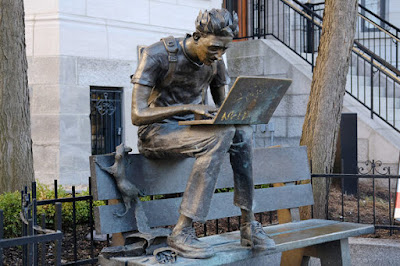
Immortalized in bronze, this frazzled student will be glued to his screen for centuries. 

It’s hard to use a keyboard in a blizzard. But even on the grisliest of winter days, there’s always at least one student lost in a laptop near the grand entrance gates of McGill University in Montreal.

With a fruit-branded notebook, fast food strewn at his feet, and one shoelace undone, the bronze sculpture titled “La Leçon” (“The Lesson”) is a heavy-handed lampoon of student life. It’s the creation of artist Cédric Loth, who has also worked as a creative director and cartoonist. The sculpture is littered with little jokes, from the laptop’s pear-shaped logo (in French, “poire” means “a gullible person”) to the squirrel swiping a hamburger bun. The distressed student’s slick haircut seems to droop in despair. As if his day couldn’t get any worse, his browser window bears the news “Steve Jobs est mort” (Steve Jobs is dead)!


 Placing such a crass caricature across from the entrance of one of Canada’s most prestigious universities might be seen as a prank. Indeed, since its unveiling in 2012, the statue has occasionally been counterattacked by vandals. Someone tried to saw off one of its fingers, and his browser window was once replaced by an error message warning “too much time on social media!”


With its tiny trackpad and generous array of ports, the student’s laptop already seems a little dated. You have to wonder how this disheveled bronze buffoon will be seen a hundred years from now, when he could very well still be failing upwards at the corner of Sherbrooke and McGill College Avenue.

Clancy's comment: These statues always enchant me. As you will see below, here are  some I've photographed in SE Asia.


I'm ...


18 February 2022 - OSLER LIBRARY - THE HISTORY of MEDICINE


OSLER LIBRARY 

- THE HISTORY of MEDICINE -


G'day folks,

One of the world's largest collections of rare medical texts and ephemera. 

This library began as the personal collection of one of McGill University’s most famous graduates: Sir William Osler. After his death in 1919, it was bequeathed to McGill. The library and its fittings were disassembled in Oxford, England and shipped to Montreal. After moving several times over the years, it was reconstructed within the modern biomedical library.


Now one of the largest and most valuable collections of rare medical books and ephemera in the world, to step into the Osler Library is to enter the study of a late-Victorian gentleman scholar. Osler’s desk, bookcases, reading tables and other furnishings are all around you. It is a startling contrast to the modern biomedical library around it, rather like stepping into a literary Tardis.

If you visit, say hello to Sir William, his ashes are held in his library!


Clancy's comment: An amazing wealth of knowledge.

I'm ...


16 January 2022 - RED ROCK COULEE - ALBERTA, CANADA


RED ROCK COULEE 

- ALBERTA, CANADA -


G'day folks,

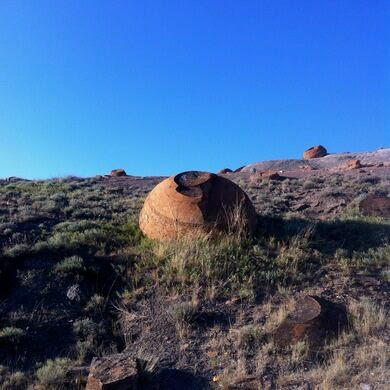
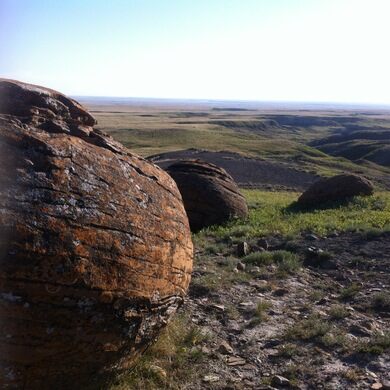
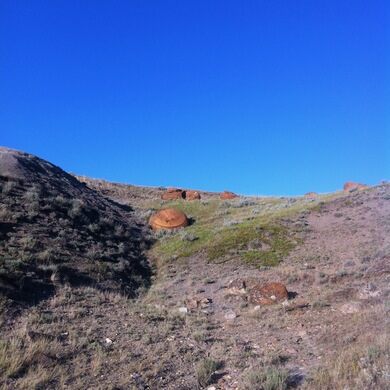
Here, you will find huge spherical rocks in the middle of the prairie.  

Dotting the pristine prairie hills of Southern Alberta, these large and exceptionally spherical red rocks make it feel as though you’re standing on Mars. Some of the fiery-hued boulders are over 8 feet across (2.5 meters), putting them among the largest sandstone concretions in the world.


 This geological oddity can be a little tricky to get to, just enough off the beaten path to keep the area remarkably quiet, only adding to the otherworldly feel. Red Rock Coulee is about 30 miles (50 kilometers) southwest of the city of Medicine Hat, and although it’s not really on your way to anywhere, this detour or day trip is an interesting sight.

You can climb the large rocks and marvel at the mystery of their formation. One of the spheres is split clean in half, showing off its strange shape. The concretions have eroded out of the soft bedrock that blankets the area, and turned red from iron oxide. If you’re in luck you can study the unique quartz crystals you can find in the area, while taking in the beautiful sunrise or sunset over the colorful badlands landscape. 

Clancy's comment: Weird, eh? That's nature.

I'm ...


5 November 2021 - FLOATING McDONALDS BARGE ROTTING IN VANCOUVER


FLOATING McDONALDS BARGE 

ROTTING IN VANCOUVER


G'day folks,

Back in 1986, there was a well-known expo in Vancouver known as the Vancouver Expo otherwise known as the World Expo. A huge, world-wide fair, with the theme of “World Exposition on Transportation and Communication”. The fair started in May and went until October of that year featuring different booths and pavilions representing 54 different nations and thousands of corporations. 


Each innovative pavilion was designed by a specific company and they all had a unique flare to them. One of the most unique places, one that truly stood out among the rest in the fair, was what the McBarge, a floating McDonalds! 30 years ago, this floating restaurant was the talk of the crowd and thousands of people came from all over to visit the unique McDonalds. Crowds lined up outside to be able to experience luxury and fast food on the water. McDonalds was ambitious to say the least and luxury and innovation were the main goals that the fast food chain was trying to portray.


Unfortunately, shortly after the expo the McBarge was quickly forgotten about. The McDonalds was unlike any of its kind. There was nothing like it anywhere and it was designed with a modern nautical feel. It was so unique that people travelled from all over to visit the unique place and experience a McDonalds unlike any other.  The first ever floating McDonalds cost a whopping $8 million to build. It was marketed as a luxury dining experience for wealthy people who were increasingly rejecting fast food.

The interior design definitely did not disappoint featuring hardwood floors, real plants, and panoramic windows allowing the customer to enjoy beautiful views of the open water and the lavish surroundings.


After 30 years of neglect, this floating McDonalds is now a thing of the past. It would require a lot of work, money and dedication to make this a happy place again. For now, it sits in the river as a reminder of bold design, brave concepts and innovation. The floating McDonalds is sadly a thing of the past slowly being forgotten. In fact, most people don’t even know the history is behind this old attraction sitting in the waters of Vancouver.


Clancy's comment: What a waste. Surely, it could be used for something. Maybe a floating gallery?

I'm ..