Showing posts with label LINCOLN. Show all posts

11 July 2022 - LINCOLN MEMORIAL UNDERCROFT


LINCOLN MEMORIAL 

UNDERCROFT


G'day folks,

Ascend the 145 white marble steps at the Lincoln memorial, step forward into the shrine room with the seated Great Emancipator, and then direct your gaze down at the floor. Unseen beneath the Tennessee pink marble floor lies a cavernous three-story, 43,800-square-foot basement with architecture that wouldn’t look out of place in a World War II bunker.

Construction began on the Lincoln Memorial in 1914 on the muddy stretch of land known as the Potomac flats. The Army Corps of Engineers had just finished its 40-year-long dredging and landfill project that produced the shoreline we know today. Workers had to dig down 40 feet before work could begin on the marble monument. Here they poured dozens of concrete columns to support the surface structure.

The underground cathedral of concrete pillars was then simply forgotten about until renovations in 1975. According to the Washington Post, in preparation for the Bicentennial, the memorial’s bathrooms were renovated, and the construction crews started peering into the building’s foundation. They brought along their friends, some of whom belonged to the National Speleological Society. The cellar was deemed a cave, complete with stalactites and its own ecosystem (insects, rodents, etc).


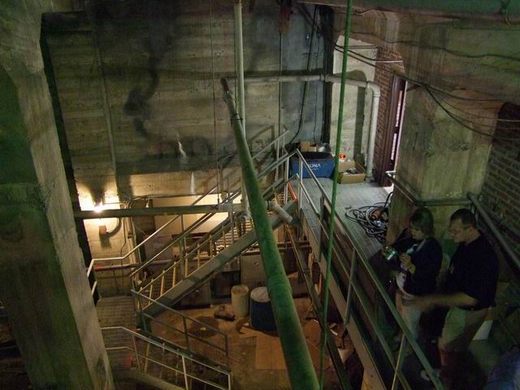


One other interesting find was historical graffiti from way back in 1914. Steven Schorr got to explore the Undercroft as a part of a digital preservation project, and described to NBC how “down in the basement of the Lincoln Memorial, they actually have things written on some of the pillars. The builders actually drew cartoons and they have them covered in Plexiglas.”


For a time, the National Park Service offered flashlight tours of the Undercroft, but they were abruptly halted in 1989 when a tourist noticed asbestos and flagged it for authorities. Over the years there have been several proposals to put the space to some productive reuse. For example, in 1992 head of the Capitol Historical Society Fred Schwengel tried to get the Department of the Interior to open a museum in the Undercroft where they could display Lincoln’s papers and memorabilia. Schwengels proposal died on the vine like all the others in the face of strong opposition from the National Park Service.

That would be the end of the story, except for an announcement in June, 2017 that the NPS now wants to rehab and open up the Undercroft in time for the Lincoln Memorial’s centennial in 2022. Their proposal to the National Capital Planning Commission includes a rendering showing a platform floating out into the underground space that will allow visitors to get a look at the columns and graffiti. 


13 February 2018 - JOHN WILKES BOOTH


JOHN WILKES BOOTH

G'day folks,

Welcome to some details about an assassin. Despite his success as an actor on the national stage, John Wilkes Booth will forever be known as the man who assassinated President Abraham Lincoln. 

Booth, a native of Maryland, was a fierce Confederate sympathizer during the Civil War. Before the fateful night at Ford’s Theatre, he had conspired to kidnap Lincoln and hide him until all Confederate prisoners were released. On April 14, 1865, Booth entered the theater’s balcony, shot Lincoln at close range and immediately fled the scene. After a 12-day manhunt, Booth was tracked down and killed by Union soldiers.

The celebrated actor Junius Brutus Booth immigrated to the United States from England in the early 1820s and settled his family in Harford County, Maryland, where the ninth of his 10 children, John Wilkes, was born on May 10, 1838. In 1846, it was revealed that Junius Booth had neglected to divorce his first wife before eloping with his second, Mary Ann, 25 years before. The scandal made an impression on young John Wilkes, who was fiercely proud of his illustrious family name.


After his father’s death in 1852, Booth left his studies at the prestigious military school St. Timothy’s Hall. In 1855, he followed his older brothers, Junius Jr. and Edwin, into the acting profession, making his debut in Shakespeare’s Richard III at the Charles Street Theatre in Baltimore. Booth worked for a year at a Philadelphia theater before moving to the Marshall Theatre in Richmond, Virginia, where he became known for his dark good looks, his intensely physical, almost acrobatic, performances and his popularity with women.

In October 1859, Booth–who, like many Marylanders, supported slavery–was shocked and galvanized by the abolitionist John Brown’s bloody raid on Harper’s Ferry, Virginia. Booth briefly enlisted in the Richmond militia and witnessed Brown’s hanging in December. That summer, he signed on as the leading man in a touring theater company. Booth was about to take on the part of Hamlet in October 1860 when he accidentally shot himself in the thigh with a co-star’s pistol. Abraham Lincoln was elected president one month later, and Booth watched the South move toward secession while recuperating in Philadelphia.


Shortly after the outbreak of the Civil War, Lincoln declared martial law in Maryland as part of an effort to keep the state from seceding. Angry and frustrated, Booth nonetheless promised his mother he would never enlist in the Confederate Army. He continued his acting career, drawing crowds and impressing critics from St. Louis to Boston. In November 1863, he performed in The Marble Heart at Washington’s Ford’s Theatre. In the audience were President and Mrs. Lincoln. It was the only time Lincoln would see Booth perform.

In late May 1864, Booth invested in an oil company in western Pennsylvania. After seeing no immediate profit, he backed out of the operation, losing most of his savings. By that time, he had already begun working on his conspiracy to kidnap Lincoln. He performed less and less frequently, and by late 1864 had gone into debt. Booth attended Lincoln’s second inaugural in early March with his secret fiancĂ©e Lucy Hale, the daughter of an abolitionist New Hampshire senator. In what would be his last performance, Booth appeared in front of a full house at Ford’s in The Apostate on March 28, 1865.


Less than a week later, Confederate forces evacuated Richmond, and within two weeks, General Robert E. Lee surrendered his troops. As Washington exploded in celebration, Booth attended another Lincoln speech on April 11, reacting strongly to Lincoln’s suggestion that he would pursue voting rights for blacks. Booth angrily told his co-conspirator, Davy Herold: “Now, by God, I’ll put him through.” Three days later, at Ford’s Theatre, John Wilkes Booth made good on his word.


Clancy's comment: Yet another person who has slain someone famous.

I'm ...