Showing posts with label NAPLES. Show all posts

20 July 2022 - THE YOUNG WITNESS TO THE ERUPTION OF VESUVIOUS


THE YOUNG WITNESS TO

 THE ERUPTION OF VESUVIOUS


G'day folks,

In 79 AD Pliny the Younger was seventeen and staying with his famous uncle, Pliny the Elder, a naturalist, author and naval commander for the Roman fleet at Misenum in the Bay of Naples. His account written as a letter to the Roman historian Tacitus 25 years later made the eruption of Vesuvius famous long after Pompeii was buried under debris and forgotten.

Pliny wrote how the volcanic cloud that initially erupted from the mountain:

"It was not clear at that distance from which mountain the cloud was rising (it was afterwards known to be Vesuvius); its general appearance can be best expressed as being like an umbrella pine for it rose to a great height on a sort of trunk and then split off into branches, I imagine because it was thrust upwards by the first blast and then left unsupported as the pressure subsided, or else it was borne down by its own weight so that it spread out and gradually dispersed." - Epistulae VI.16, VI.20 from the Penguin translation by Betty Radice

Pliny goes on to relate how his uncle then sets off across the bay to Pompeii on a rescue mission, while he stays behind with his mother. His uncle later dies on the beach at Pompeii, his body found the next day. In a second letter Pliny describes his uncles' last moments based on eyewitness accounts. Pliny the Younger is also able to describe in vivid detail his experiences escaping the eruption with his mother in the dark, 19 miles from the volcano, all daylight blocked by the explosion with ash raining down upon them.
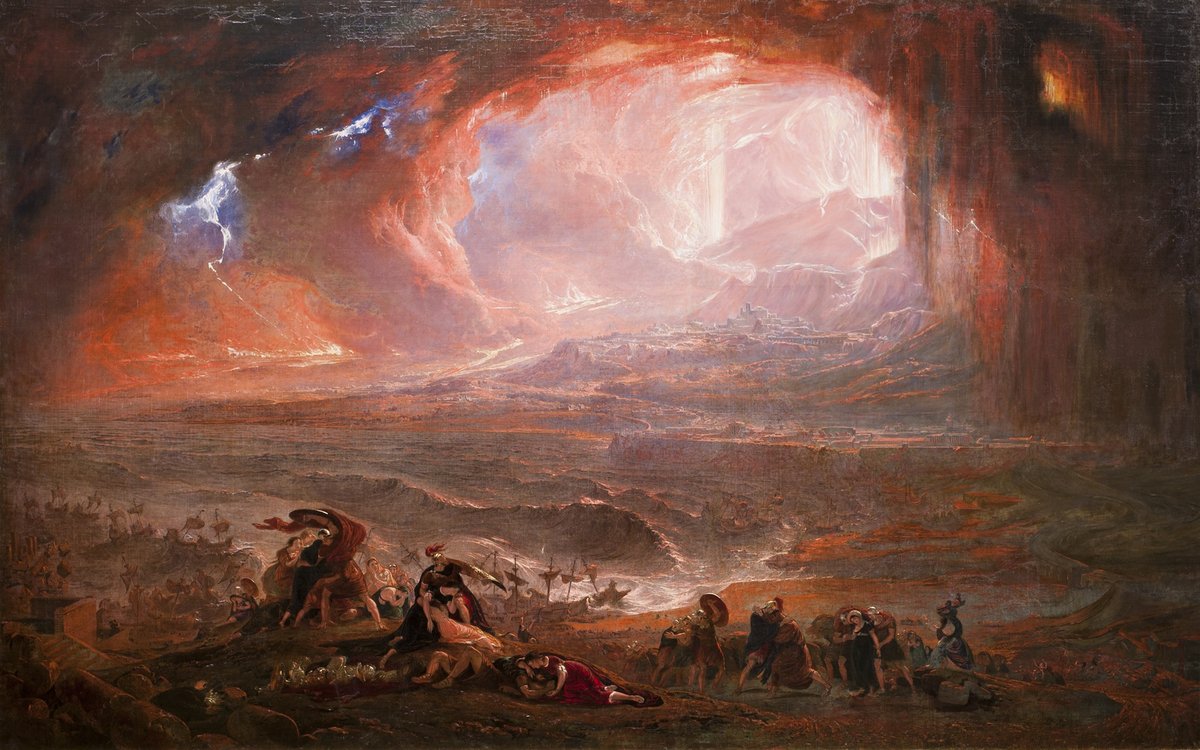


Pliny's description of how Vesuvius's column of pumice and ash later collapsed has helped scientists ascertain that the volcano then sent waves of pyroclastic surges at 180-220 °C (360-430 °F) across the countryside burying Pompeii and nearby Herculaneum and killing instantly the estimated 1,500 people still left behind.

So precise was Pliny's memory and description of the large cloud that blew out of Vesuvius that modern volcanologists have termed these types of eruptions Plinian eruptions. Other volcanic eruptions of this type include the 1883 eruption of Krakatoa in Indonesia, Mount St Helen's in the United States in 1980 and Mount Pinatubo in the Philippines in 1991.

The ruins of Pompeii were not rediscovered until 1599 and not properly excavated until 1748 when the discovery of an almost perfectly preserved Roman society caused a sensation across Europe.

Pliny himself went on to have a distinguished career as a Roman official and as a man of letters. Pliny the Younger was our source for the exact date of the eruption, in his Letters he notes it occurred 24 August 79 AD. Curiously in 2018 archaeologists working in Pompeii uncovered notes by a probably a builder repairing a house with the date 16 days before the "calends" of November, or 17 October in modern dating. It now appears probable that the eruption happened 24 October 79 AD instead and that Pliny's Letters had been mistranslated as some point.


23 May 2022 - EVERY DAY IS CHRISTMAS ON THIS STREET


EVERY DAY IS CHRISTMAS 

ON THIS STREET


G'day folks,

Every day is like Christmas on this street where the traditional Neapolitan nativity scene comes to life. 

The center of Naples is marked with many narrow pedestrian roads, but Via San Gregorio Armeno, also known as Via dei Presepi (Presepi Street), stands out. The street is completely full of shops dedicated to the traditional Neapolitan presepio, the Christian nativity scene. Almost every figure and decoration found here is handmade by local nativity scene artisans.

The tradition of the presepio (also spelled presepe) goes back to the Middle Ages, when Saint Francis of Assisi created the first nativity scene in 1223, depicting the infant Jesus in a manger. But it wasn’t until the 16th century that it started to become common in Naples to put nativity scenes in churches and houses before Christmas. During the 17th and 18th centuries the nativity scene became more widespread and began incorporating fine handcrafted figurines. Many presepi from this era that are true works of art can be seen in churches and palaces in Naples and the surrounding region.


Now, besides the classical figures of the presepio—the baby Jesus, Mary, and Joseph—all kinds of statuettes can be found on Presepi Street, from pizza makers to animals, and especially caricatures of celebrities like politicians, singers, TV personalities, and athletes (mostly soccer players), in a fusion of sacred and profane. The figures are often small enough to place in a nativity scene, but sometimes even life-size statues can be found. Also on offer are various decorations and structures crafted for nativity scenes, from little household objects to full houses, as well as trees, mountains, and evens rivers and waterfalls with real water.

Many characters or places have hidden meanings rooted in the long tradition of the presepio. Different merchants represent different months of the year, and the river represents the mythical river Acheron that marked the border of Hell. Statues of the classical masked character of Pulcinella that has represented Neapolitan people since the 16th century are also very common, along with other symbols of the local culture, such as the little horn amulet worn to protect against bad luck.

Clancy's comment: This is an enchanting part of Naples. 

I'm ...


14 January 2019 - ANCIENT TUNNELS BENEATH NAPLES


ANCIENT TUNNELS 
BENEATH NAPLES

G'day folks,

 A labyrinth of ancient tunnels hidden below the city holds the ruins of 2,500 years of history. Underneath the ancient city of Naples lies a vast geothermal zone composed of tuff, a volcanic rock. Over the last two-and-a-half millennia, extensive caves and tunnels have been carved out of the tuff, forming a shadow city obscured below the ground. 


The 280-mile (450-kilometer) subterranean network was formed by the Greeks in the 4th century BCE in order to build what was then named Neapolis, or “New City.” The Romans later used the chambers and pathways to build aqueducts that provided water for many centuries of Neapolitans. As the centuries passed, buildings where constructed on top of previous ancient infrastructure, and the the remains of these structures are were hidden deep below the city. 


Today, Napoli Sotterranea (Naples Underground) offers a chance to explore this Italian city from a different point of view. Down a long case descending some 120 feet (40 meters) below the earth, aqueducts, sewer tunnels, rainwater cisterns, caverns, catacombs, and pre-Christian hypogea can be found in the tuffaceous cavities, along with roadway and rail tunnels. Some caves that were part of the reservoir are still full of water today. One highlight of the subterranean network is the remains of the Greco-Roman theatre of Neapolis, where the Roman emperor Nero also had his private dressing room. 


Many years later, the underground network was used as an air raid shelter during the Second World War, and you can still see forgotten war relics such as weapons and vehicles in the tunnels. More recently, the first Hypogeum Gardens in the world can be found, an experiment to grow various species of plants far from pollution, but also light, in the dark chambers underneath the city.


Some tunnels are very narrow and it is necessary to use a candle to see, for this reason some passages of the route are optional.


Clancy's comment: Mm ... Sounds interesting.

I'm ....


10 January 2019 - INTERESTING ANATOMY MUSEUM IN NAPLES


INTERESTING ANATOMY
 MUSEUM IN NAPLES 

G'day folks,
MUSA (Museo Universitario delle Scienze e delle Arti, or the University Museum of Arts and Sciences) celebrates the marvels of the human form, inside and out at the historic Anatomy Museum. Science and art intersect to display all manners of human curiosities, medical marvels, and some dark Italian history.


Naples houses one of Italy’s most eccentric anatomy museums, with ancient Roman medical tools, the skulls of victims who died when Mount Vesuvius erupted in Pompeii in the year 79 A.D., anatomical sculptures made from wax, and mutated specimens preserved in formaldehyde within its expansive holdings.


The MUSA Anatomy Museum is a site of convergence for art, history, and education. Learn about the processes of cremation and fossilization; the evolution of medical equipment and the modernization of Neapolitan hospitals; and the cultivation of studies in physiology and pharmacology.


 After years of neglect, the Anatomy Museum (then referred to as the Anatomy Museum of the University of Campania Luigi Vanvitelli) reopened to the public in 1997. In 2012, a rebrand re-presented the museum as part of the Museum of Arts and Sciences. A new museum director and a committee board transformed the space into an educational resource and concept museum that exhibits the university’s vast collection while delving into Italian medical history.


Clancy's comment: This would not appeal to everyone, but I'd find it very interesting.

I'm ...