Showing posts with label China. Show all posts

14 September 2022 - CHINA'S BIGGEST E-WASTE VILLAGE


CHINA'S BIGGEST

 E-WASTE VILLAGE 


G'day folks,

Welcome to the modern day's industrial revolution, where Guiyu is a town covered beneath a mound of e-waste - piles of computers, monitors, and cell phones.

Moore’s law dictates the computing power of each new generation of electronic components but it also renders the previous generation obsolete. Companies feel the need to put a new product out on the market every few months. For a computer the average “life span” is 3 to 5 years, roughly the same as a house mouse. For an iPod it is only 2 years, roughly that of a stick insect. Most of these electronics begin their life somewhere in China, and China is where the journey for most of them ends. Some reports indicate that over 80% of so called e-waste eventually gets shipped off to Asia.


While manufacturing of electronic components is decidedly a high-tech industry, their disassembly is a much more “DIY” affair. Guiyu in the Guandong province is the biggest of China’s e-waste villages. Here piles of discarded electronic gadgets are scattered around numerous junkyards, makeshift workshops and even in the streets themselves. Electronics are dissembled by the most basic methods. Transformer coils are untangled by hand to extract wires, and circuit boards are burned, cooked and dosed in acid to extract scraps of precious metals.

These methods, along with the e-waste itself, have made Guiyu into world’s second-most polluted place on the planet. The air is full of toxic fumes, the soil has been saturated with lead, chromium, tin, and other heavy metals. The water is undrinkable and there is dioxin in the ash and lead in the river sediment.

E-waste started flooding into Guiyu in 1995 and a flood of migrant workers from the countryside came to claim the hazardous jobs. Central government tried to mitigate the situation after the alarm was raised by the media. While China has imposed a permanent ban on import of e-waste, the situation remains much the same in places like Guiyu and the e-trash is still flowing in.



8 September 2022 - FUJIAN TULOU HOUSING CLUSTER - SOUTHERN CHINA


FUJIAN TULOU 

HOUSING CLUSTER 

- SOUTHERN CHINA -


G'day folks,

Welcome to some walled family complexes in Southern China. 

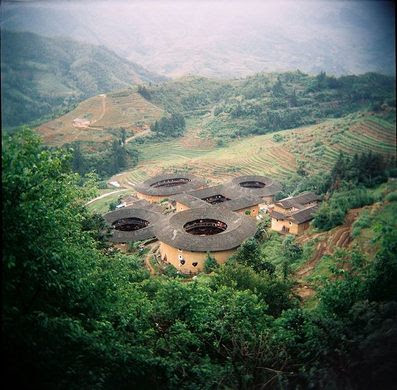
Tucked into the mountains in Fujian are clusters of self-contained micro-villages. Shaped like little donuts and positioned closely together, the houses of the Hakka people are a perfect protection from the outside world.

The Hakka people, although originally from central China, have migrated throughout the last 1000 years to the mountainous regions of Southern China. As a smaller minority group, the tight-knit Hakka people needed protection from marauding bandits and other dangers in the new territory. For protection and to simultaneously create a strong community, they developed a style of house that could accommodate entire communities. With their own unique language and culture, the Hakka needed to create their own secure villages in the South.


With security in mind, the Hakka began with earth packed walls sometimes six feet thick and formed into circles. After building the massive outer circle, and adding only one entrance, they developed the interiors of their new, tiny village. Completely self contained, wooden tiers were built on the inside looking out over a main courtyard area.

Some of the villages contained up to 80 families and were as large as 40,000 square meters. As perfectly defensible structures, many of the earthen buildings have survived throughout centuries, living through bandit attacks and earthquakes. The most famous cluster is the Fujian Tulou cluster, in the village of Tianluokeng.

The cluster in Tianluokeng is centered around a square building, constructed in 1796 and surrounded by the typical circular earthen villages. There are five well-preserved structures in total and they are part of a larger UNESCO World Heritage Site.

More than 35,000 earth-rammed buildings still exist across Fujian and Guangdong, and can be toured and visited. 


31 December 2021 - LABRANG MEDITATION HUTS IN CHINA


LABRANG MEDITATION 

HUTS IN CHINA


G'day folks,

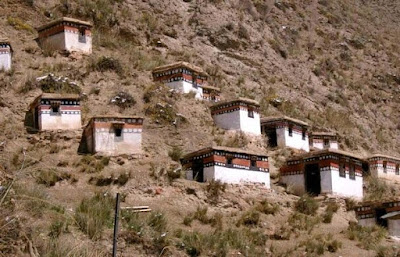
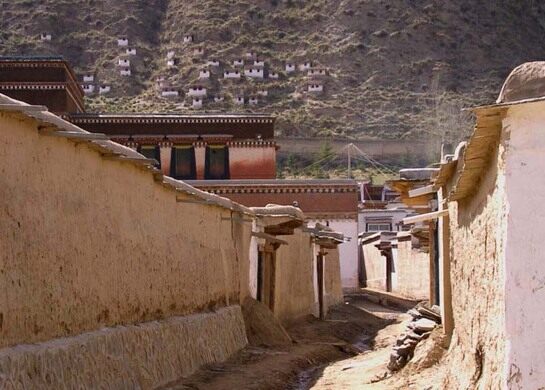
These picturesque structures speckle the hill above the monastery in Gannan Zangzuzizhizhou, China. 

At Labrang, monks wearing bright red garbs stroll around the main thoroughfare and the narrow alleys, mutter guttural chants in unison, and engage in heated philosophical debates. Being one of the largest monasteries outside of Lhasa, it’s not short of pilgrims, which can be seen circumambulating stupas, turning decorated prayer wheels, and reciting holy passages—and also thumbing through their smartphones.


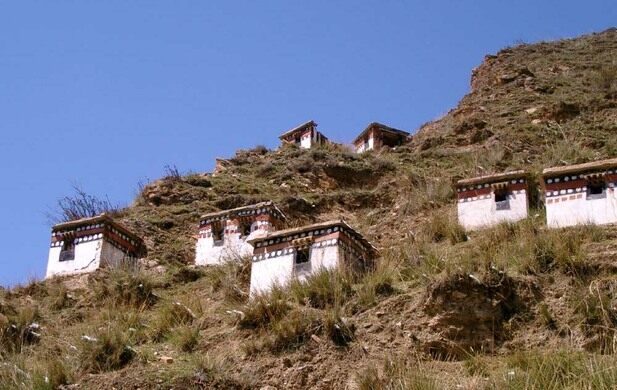
 Yet, Labrang has something special to offer: meditation huts. The hill adjacent to the temple is dotted with tiny huts the monks use to meditate.

The view is reminiscent of Hobbit-like imagery. These huts are no bigger than four-feet-by-6.5-feet, with low ceilings, a door on the side, and one or two windows in front. These flat-roofed huts don traditional Tibetan patterns on the upper section of the external walls, while the lower portion is whitewashed using lime. The interior is Spartan to avoid unnecessary distractions.

While viewing the huts, it’s important to remember that tourists should not enter them. Monks use them for their retreats, so you must stick to observing the structures from the outside.

Clancy's comment: Solitude can be good for the soul. 

I'm ...


23 December 2021 - THE GREAT THANGKA - CHINA


THE GREAT THANGKA 

- CHINA  -


G'day folks,

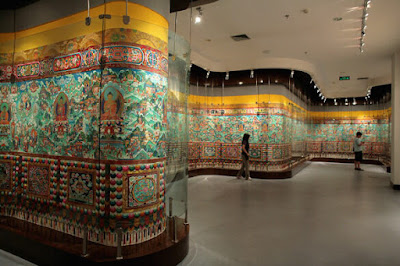
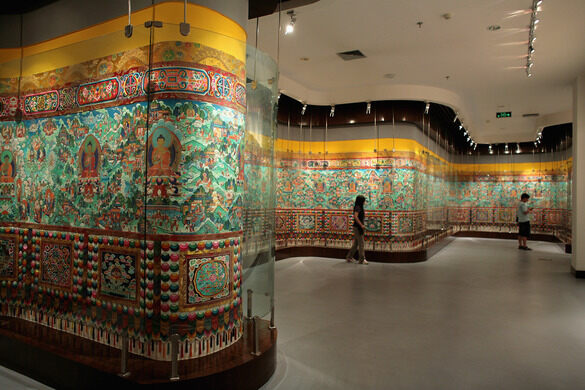
Stretching almost 2,000 feet, this painting is one of the longest pieces of Buddhist artwork in the world. 

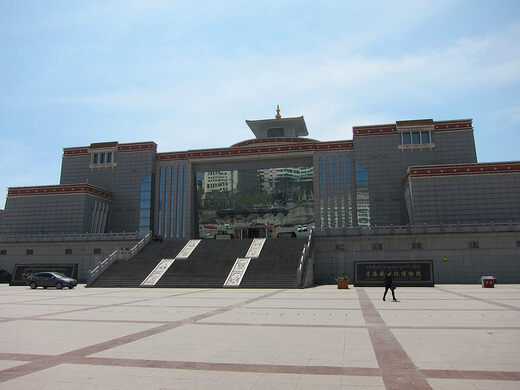
China’s Tibetan Medicine and Culture Museum is one of the country’s few museums dedicated entirely to Tibetan culture, history, and religion. It also contains a magnificent artistic treasure.

A nearly 2,000-foot-long thangka (a religious Buddhist painting) wraps around the interior walls of its second floor. The painting is one of the longest thangkas in the world. More than 400 Tibetan artists spent almost 30 years finishing the masterpiece.


Thangkas (also spelled tangkhas) are usually kept rolled up, but this one is stretched for all to see. The colorful blend of religious figures and events creates a visually stunning tapestry of Buddhist knowledge. It’s divided into a continuous and contiguous set of scenes blending one into the other. The thangka shows the entire Tibetan history, the history of Tibetan Buddhism, and famous Buddhist monks, temples, and events. It also depicts the creation of the world, astronomy, technology, science, medicine, architecture, linguistics, and poetry.

You’ll also find scenes showing the creation of humankind, with organisms crawling out of the oceans and evolving into human beings. Another segment portrays a contemporary lama that travelled to the United States, which includes images of an airplane and the American flag. The absence of the current Dalai Lama is also notable.

Clancy's comment: That is extraordinary.

I'm ...


26 December 2021 - THE FASCINATING MOGAO CAVES - CHINA


THE FASCINATING 

MOGAO CAVES 

- CHINA -


G'day folks,

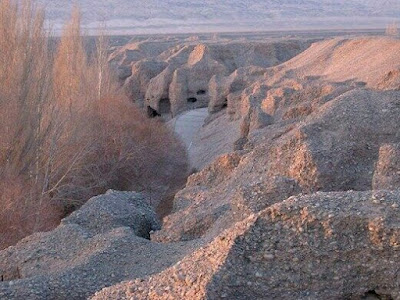
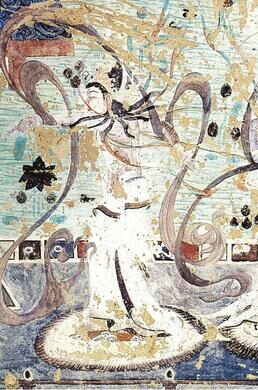
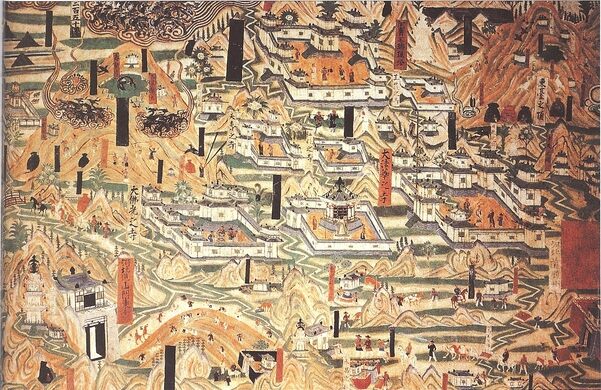
Hundreds of caves filled with thousands of centuries-old statues and murals exist in Mogao. 

Tucked away in a disused section of the Silk Road on the edge of the Gobi Desert, this place managed to stay under the radar for centuries. Along a one-mile long trail of cliffs beside the Dachuan River are the Mogao Caves, a complex of human-made caves and cells that preserve Buddhist statues and paintings spanning a whole millennium, from the fourth to the 14th centuries. A total of 492 of these caves have survived the test of time.

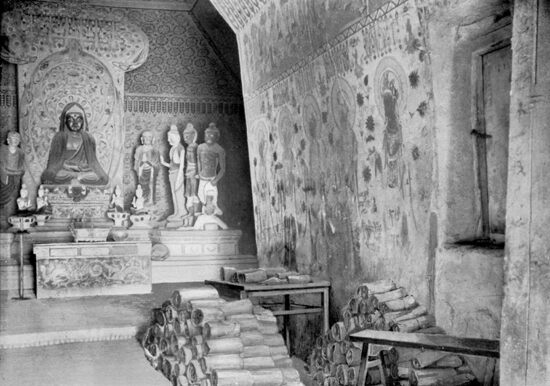
The caves house more than 2,000 statues and more than 480,000 square feet of murals, all created by monks. A keen eye will notice a fusion of different artistic influences, with hints of Roman, Indian, Persian, Turkic, Mongolian, and Tibetan traditions behind the more prominent Han Chinese style.

Each and every cave has its own artistic merits, but taken as a whole, they showcase the evolution of Buddhist art in the region. Many murals go beyond the religious theme and incorporate more mundane scenes, with valuable information about the political, economic, and cultural context of the time. Among the worldlier depictions are a camel pulling a cart and farmers at work.


Although the murals are in the caves, they were not painted on naked rock. The surface was covered with mud, straw, and reeds, which were commonly used for construction, and an additional layer of lime. The statues, on the other hand, are made of wood, straw, reeds and plaster. These are all easily perishable materials, and they likely survived due to the caves’ remoteness.

Part of this complex of caves and cells is also a library (Cave 17) that in addition to Chinese texts, also houses Tibetan, Turkic, and Hebrew documents. Unfortunately, most of the 50,000 documents found in the library were readily sold to foreign (mostly Western) hands. The most valuable of these was the Diamond Sutra, one of the oldest printed books in existence (now at the British Library in London).


 Clancy's comment: This place would be fascinating to visit.

I'm ...


26 September 2021 - THE ANGEL OF THE NANJING RIVER BRIDGE


THE ANGEL OF THE 

NANJING RIVER BRIDGE


G'day folks,

The Nanjing River Bridge is an architectural marvel that lies over a portion of the Yangtze River. The massive bridge holds a 22,000-foot railway track, a number of piers, a viewing tower, and a 4-lane highway. 
 
Despite its structural beauty, this bridge stood as a landmark of tragedy. Between its completion in 1968 and 2006, approximately 2000 people took their own lives on this bridge. In 2008, Chen Li, a vegetable vendor that walked along the bridge every day, caught sight of a man about to take the plunge. He intervened and pulled the man away from the ledge. 
 

At that moment, he decided to devote his life to saving others. He has since spent his weekends patrolling the bridge for people with signs of depression. Chen Li notes the way they walk, their shoulders slumped, and the heaviness in their steps. He spends his time talking to them and trying to give them hope.
 
 He also hands out pamphlets on suicide prevention and awareness, hotline details, and even lists his own number as an emergency contact. His remarkable kindness has resulted in hundreds of lives being saved and has been documented in the award-winning documentary film, Angel of Nanjing. 
 

For more than a decade now, Chen Li has watched over the residents of the city and done what he can to lift the spirits of sad souls he sees walking across the monumental bridge. 


Clancy's comment: Well done, Mr Chen. 

I'm ...


5 September 2021 - MILLIONAIRE FLATTENS VILLAGE AND REBUILDS NEW HOMES


 MILLIONAIRE FLATTENS 

VILLAGE 

AND REBUILDS FREE NEW HOMES 


G'day folks,

Oftentimes when you hear about rags to riches stories, you think that the person that made millions probably forgot where they came from. Well that is not the case at all in the story of Xiong Shuihua. 


He was born in Xiongkeng village in the city of Xinju located in Southern China. He always said that his family was well looked after in their small village and that the residents supported them throughout his childhood. Rather than forgetting where he came from when he made his millions in the steel industry, he decided that it’s important that he spends his wealth giving back to the community, and he did this all for free!

When Xiong Shuihua returned to his village, he decided to give everybody a place of their own to live. The area was very run down and many lived in a basic home.  He decided to transform this village, and ended up building 72 luxury flats for 72 different families in the village.

However, there were 18 different families that were extremely kind to the businessman and his family when he was growing up. For these families, he gave them their very own villas in the village. The project ended up costing over $5 million.


 Once the families moved in, he even promised the older residents and the low-income residents three meals a day so they wouldn’t have to worry about feeding their family.

One resident named Qiong Chu, 75, said, “I remember his parents. They were kind-hearted people who cared very much for others, and it’s great that their son has inherited that kindness.”

 Xiong Shuihua said, “I earned more money than I knew what to do with, and I didn’t want to forget my roots.” “I always pay my debts, and wanted to make sure the people who helped me when I was younger and my family were paid back.”


 What a truly amazing story and an even more amazing businessman. It’s so great to hear when people remember where they came from, especially when they spend their hard-earned money giving back to the community, helping people who are less fortunate than them.


Clancy's comment: Great story, eh? There should be more of it.

I'm ...