Showing posts with label SCOTLAND. Show all posts

20 December 2021 - DINOSAUR TRACKS ON THE ISLE OF SKYE


DINOSAUR TRACKS 

ON THE ISLE OF SKYE


G'day folks,

On this stunning Scottish island, you can walk in the footsteps of dinosaurs.  

The past is vast on the Isle of Skye. Ruined castles that are hundreds of years old stand atop an unusual topography shaped by glaciers during the last Ice Age. But the land holds traces of an even more ancient past as well.

Before the dinosaurs died out, they roamed this breathtaking stretch of land. Fortunately, you can still find marks of their presence in a few places on the island.

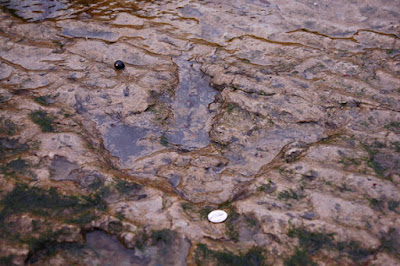
Sometimes the footprints are hard to find because the tide covers them with seaweed or sand, so you may have to scour about a little. Once you find one, you will soon see the others and be able to connect with these amazing, lost creatures.


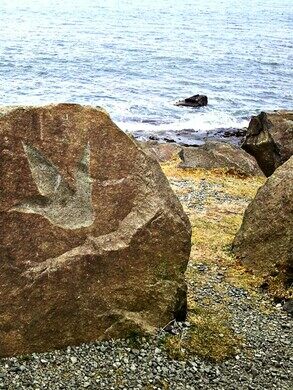
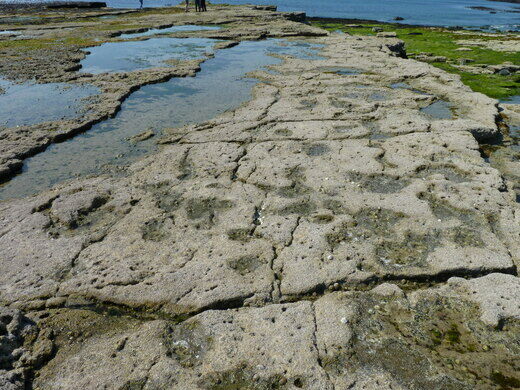


There are a few places to find the dinosaur prints on the Isle of Skye. On An Corran, you can see prints on rocks not far from the ramp. These three-toed prints belonged to a family of ornithopods, which were two-legged herbivores. You can also visit Score Bay to see prints from sauropods, which are from the same family as brontosaurus and diplodocus. These tracks are about 170 million years old. Some of these footprints are quite big, and it’s believed to be the largest dinosaur trackway in Scotland.

Clancy's comment: They must have been enormous in size.

I'm ...


11 December 2019 - THE ANTONINE WALL - A SCAR OF THE ROMANS


THE ANTONINE WALL
 - A SCAR OF THE ROMANS -

G'day folks,

Scotland still bears an enormous scar of its Roman past. 


An unusual line stretches across Scotland’s Central Belt. It may look like no more than a strange scar speckled with clusters of stone structures, but it’s actually a remnant from when the Romans invaded the British Isles.


It’s a commonly held misconception that the Romans never reached Scotland and that their endeavors to conquer the entire British Isles stopped at Hadrian’s Wall in England. But not only did the Romans reach Scotland, they also built a massive turf wall to keep the Scottish tribes out of their southern territory.


Under the orders of Roman Emperor Antoninus Pius, construction of this massive undertaking began in the year 142 and took 12 years to complete. The final work spans 39 miles from Old Kilpatrick on the Firth of Clyde to Carriden on the Firth of Forth. Bar Hill marks the highest point along the length of the wall at 250 meters (820 feet).


But after numerous attacks and greater problems at home in Rome, the wall was abandoned after only eight years. An attempt to re-establish occupation in 208 began with repairs to the wall, but ended only a few years later.

Time has not been kind to the abandoned wall, and much of the barrier and its forts have disappeared due to weathering and decay. However, what is left is protected and is now a UNESCO World Heritage site. Whether it’s a simple scar in the land or the foundations of an ancient bathhouse, all these ruins are worth exploring.


Clancy's comment: Mm ... I'd love to be sitting on a cloud, watching life,  just for a day during these times. 

I'm ...


17 April 2019 - A Secret Doorway Has Been Found Leading to Caves Hidden Under a Castle.


A Secret Doorway Has Been Found  Leading to Caves Hidden Under a Castle.

G'day folks,

A secret doorway in a castle has been found near Glasgow, and wine bottles have been also found in the caves.

SINCE THE LATE 18TH CENTURY, Culzean Castle has stood in its current form on the west coast of Scotland, less than 50 miles southwest of Glasgow. But the caves in the dramatic cliffs below the castle have been there for much, much longer. Recently, a team of volunteer archaeologists investigated the entrance of the Stables Cave and discovered a forgotten doorway, built hundreds of years ago to control access to the cave’s entrance.


Legends surround these caves—it’s said that they’re haunted, that they were used by smugglers, that fugitives hid here. The archaeology team also found wine bottles dating back to the 18th century, and it’s fun to imagine smugglers swigging down some booze while spending the day or night in the shelter of the caves.
 But it’s just as likely the bottles have a more mundane story behind them. Before the current castle was built, there was a castle here called House of Cove or Coif Castle, a nod to the caves below, and as early as the 14th century, there was a stone tower here. For many years, the caves were used as cellars, for provisions including wine.

Human use of the caves goes back even further—dating a charcoal sample from a different cave below the castle, shows evidence of human occupation in the Iron Age, somewhere between the years 135 and 325.


The most exciting discovery of the volunteer group, though, was the door, which was buried about three feet deep. They discovered two sides of the doorway, with stones stacked eight layers high, framing a space about 3.6 feet across. It could have “been secured with a draw bar,” according to the National Trust. If you have access to a good cave—all the more reason to keep other people out.


Clancy's comment: Wow, nice looking castle, eh? Reminds me of the 'Famous Five' series by Enid Blyton. Looks like a great writer's retreat.

I'm ...


23 March 2018 - ALEXANDER GRAHAM BELL


ALEXANDER GRAHAM BELL

G'day folks,

Welcome to some background on a man who changed the world, and often not for the better when I see the addiction to mobile phones. Notwithstanding, he was a smart man.

Alexander Graham Bell (1847-1922), the Scottish-born American scientist best known as the inventor of the telephone, worked at a school for the deaf while attempting to invent a machine that would transmit sound by electricity. Bell was granted the first official patent for his telephone in March 1876, though he would later face years of legal challenges to his claim that he was its sole inventor, resulting in one of history’s longest patent battles. Bell continued his scientific work for the rest of his life, and used his success and wealth to establish various research centers nationwide.


Bell owes his immortality to his having been the first to design and patent a practical device for transmitting the human voice by means of an electric current. But Bell always described himself simply as a “teacher of the deaf,” and his contributions in that field were of the first order.

Bell, who was born in Edinburgh, Scotland, was educated there and at the University of London. He also studied under his grandfather, Alexander Bell, a noted speech teacher. He taught elocution, assisted his father, also a speech teacher and noted phonetician, and taught at a school for the deaf in England, using his father’s methods. In 1870, Bell immigrated with his parents to Canada.


Two years later he established a school for the deaf in Boston, Massachusetts, and the following year became a professor in speech and vocal physiology at Boston University. While teaching he experimented with a means of transmitting several telegraph messages simultaneously over a single wire and also with various devices to help the deaf learn to speak, including a means of graphically recording sound waves.

 In 1874 the essential idea of the telephone formed in his mind. As he later explained it, “If I could make a current of electricity vary in intensity precisely as the air varies in density during the production of sound, I should be able to transmit speech telegraphically.” Two years later he applied for a patent, which was granted on March 7, 1876. On March 10, the first coherent complete sentence—the famous “Mr. Watson, come here; I want you”—was transmitted in his laboratory.


In later years Bell experimented with a means to detect metal in wounds and with a vacuum-jacket respirator that led to the development of the iron lung. He helped bring Thomas A. Edison’s phonograph to commercial practicality and experimented with hydrofoil boats and with airplanes as early as the 1890s.

 With the wealth derived from the telephone, Bell was able to assist the careers of other scientists. He also founded and helped finance the journal Science, today the premier American scientific journal, and the National Geographic Society.

While constantly engaged in scientific experiments, Bell crusaded tirelessly on behalf of the deaf, encouraging their integration into society with the help of lip-reading and other techniques. In 1890 he founded the Alexander Graham Bell Association for the Deaf.


He died in 1922 at his summer home on Cape Breton Island, Nova Scotia. People throughout North America were urged to refrain from making phone calls during his burial so that telephones would remain silent as a tribute.


Clancy's comment: Helloooooooooooooooo!

I'm ...


23 January 2017 - DAVID BYRNE


DAVID BYRNE

G'day folks,

Welcome to some facts about a successful composer.


David Byrne is the thinking man’s rocker. The idiosyncratic singer, songwriter, and ambient composer may well be the single greatest influence coursing through today’s rock radio consciousness. While groups like R.E.M., the Pixies, and the Cure all deserve mention in this category, The Talking Heads best represent the nervy arthouse ethos of new wave, the lyrical obscurity of alternative, and the addictive hookiness of today’s beardly hipster bands. All owe a debt to David Byrne for their right to be weird and successful all at once.


Born in Dumbarton, Scotland, Byrne’s family relocated several times during his youth before ultimately settling in Baltimore when he was nine. By this time, Byrne was already adept at the guitar, accordion, harmonica, and violin. 

Studying music first at the Rhode Island School of Design and thereafter the Maryland Institute College of Art, Byrne ultimately dropped out of school to pursue music in New York. His arrival there could not have come at a better time. His off-kilter vocals, quirky songwriting, and staccato time signatures were perfectly at home in the burgeoning punk scene.


Forming the Talking Heads in 1975, Byrne rose to recognition as part of the wild CBGB scene that give birth to punk legends like the Ramones, Television, and Blondie. Among them, the Talking Heads stood out for their intelligence and conscious artiness. In 1977, their breakthrough hit, “Psycho Killer,” burned up the charts while the Son of Sam terrorized New York.

Over the course of eight albums, David Byrne was responsible for the lion’s share of writing, as well as for his band’s musical eclecticism. Albums like Fear of Music (1979) and Speaking in Tongues (1985) produced substantial charting hits while incorporating elements of Brazilian music, African polyrhythms, and the synthesizers that would define new wave. As to the latter, the Talking Heads were the most essential trailblazer in a genre that shot the Police, Duran Duran, and the Cars to megastardom. Byrne’s contributions to the MTV era may best be captured in the band’s groundbreaking Stop Making Sense (1984), an ingenious concert documentary (not to mention album) directed by Jonathan Demme. Its imagery and performance aesthetics make it a template-setting document in the music video medium.


Though the Talking Heads disbanded at the end of the ‘80s, Byrne’s solo career continues to distinguish him. Starting with 1981’s highly influential ambient record, My Life in the Bush of Ghosts (1981), Byrne has lent his name to a series of solo works that touch on all manner of world, electronic, and even dance music. David Byrne was inducted into the Rock and Roll Hall of Fame with the Talking Heads in 2002 and is the owner of a Grammy, Oscar, and Golden Globe.


Clancy's comment: Mm ... Another very successful life.

I'm ...