Showing posts with label FREEDOM. Show all posts

29 May 2022 - NELSON MANDELA AND 27 YEARS OF PRISON


NELSON MANDELA 

AND 27 YEARS OF PRISON


G'day folks,

Born in 1918, Nelson Mandela belonged to a royal family of the Xhosa-speaking Thembu tribe in the South African village of Mvezo, where his father was chief.  

After he died in 1927, nine-year-old Mandela was adopted by a high-ranking Thembu regent who saw his young ward as a future tribal leader.

Their relationship came to an end some years later when Mandela learned that his guardian had arranged a marriage for him. Rather than go through with it he fled to Johannesburg and took a job as a night watchman.

It was a sad turn of events for a man who had been the first in his family to receive a formal education. Mandela — then known by his birth name, Rolihlahla — had completed his primary studies at a missionary school.

At the time it was common practice for teachers to give African students English names. So when he was seven years old Rolihlahla became Nelson. In later years, as a sign of respect, many people referred to him as Madiba, his Xhosa clan name.

Mandela may have needed the night watchman job to earn money but he moved on to study law at Johannesburg’s University of the Witwatersrand, and qualified as a lawyer in 1942 at the age of 24.

Two years later, disturbed by the racial prejudice that had become rife in South Africa, he joined the African National Congress (ANC), a political group seeking equal rights for black people.

It faced a monumental challenge in its struggles after the 1948 election victory of the Afrikaner-dominated National Party, which introduced its formal system of racial classification and segregation — apartheid (separate development).

While maintaining white minority rule, apartheid meant that by law the basic rights of non-whites were heavily restricted. Not only were they unable to serve in government, they weren’t even allowed to live in the same areas as whites or go to the same schools. They could not share a table in a restaurant with whites, nor sit next to them on a train or bus.

In retaliation, the ANC launched its Campaign for the Defiance of Unjust Laws and called for boycotts, strikes, civil disobedience and other non-violent protests. Mandela travelled across the country to organise protests.

His activities became too much for the authorities so in 1956 he was arrested on a trumped-up charge of treason. Mandela was held at a prison in Johannesburg for five years before the charge was dropped and he was released.


The ANC, which became a banned organisation while Mandela was behind bars, had always advocated peaceful protest. But after he came out of jail Mandela and other ANC leaders decided to set up a secret military group called Umkhonto we Sizwe, or Spear of the Nation.

It was a fateful decision. In 1963, the police found weapons and documents belonging to the secret group, which led to the arrest of Mandela and seven others. They were charged with plotting to overthrow the government and each was sentenced to life imprisonment.

Mandela would spend the next 27 years in jail, initially on Robben Island, seven miles off the coast of Cape Town. After 18 years he was transferred to the first of two inland prisons.


Whilst behind bars he was quoted as saying: “I have cherished the ideal of a democratic and free society in which all persons live together in harmony and with equal opportunities. It is an ideal which I hope to live for and to achieve. But if needs be, it is an ideal for which I am prepared to die.”

Over the years he became one of the world’s most famous prisoners and there were international campaigns to ‘Free Nelson Mandela’. At the same time South Africa came under increasing pressure to abolish the apartheid system and by the mid-1980s it found itself among the world’s pariah states, the subject of economic, sporting and cultural boycotts that affected almost every aspect of life.

It all came to a head in 1989 when President (Pieter Willem) “P.W.” Botha suffered a stroke. The reforming (Frederik Willem) “F.W.” de Klerk, who had held secret talks with Mandela in his cell, took his place – first as party leader, and later as President.

Knowing that the apartheid system was leading to both economic and political bankruptcy, de Klerk was bent on reform. As President, he released all important political prisoners in 1990, including Mandela, and lifted the ban on the ANC. His government then began systematically to dismantle apartheid.

Mandela became President of the ANC in 1991 and worked with de Klerk in bringing an end to apartheid while introducing equal rights for all. They shared the Nobel Peace Prize in 1993 “for their work for the peaceful termination of the apartheid regime, and for laying the foundations for a new democratic South Africa."

The country’s first all-race elections, held in April 1994, saw the ANC win a majority of seats in the new National Assembly. Mandela became South Africa’s first black President with de Klerk as his deputy in a government of national unity.

An iconic figure around the world symbolising peace, equality and determination, Mandela retired from politics in 1999 and set out to live a quiet life with his third wife, Graça. He said: “I have retired, but if there's anything that would kill me it is to wake up in the morning not knowing what to do.”

A lung infection brought his days to an end and he died in December 2013 at the age of 95. The world mourned his loss.

Clancy's comment: What an interesting life. 

I'm ...


3 December 2021 - THE FAMOUS COTTON TREE IN FREETOWN


THE FAMOUS COTTON 

TREE IN FREETOWN


G'day folks,

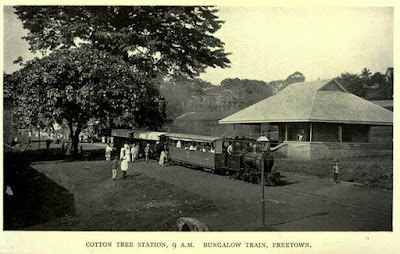
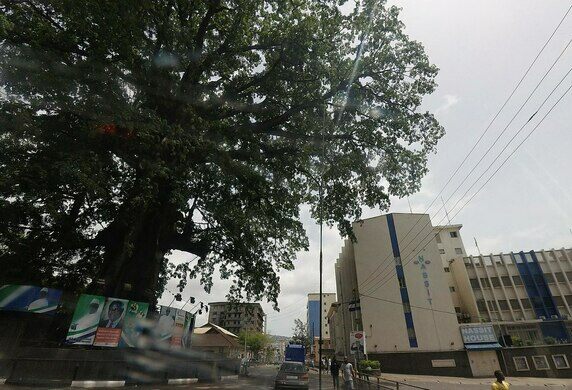
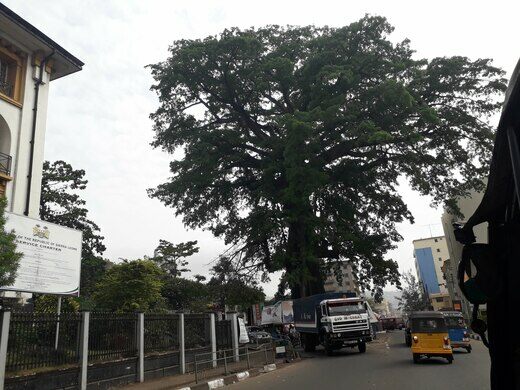
The oldest of its kind in the country, this tree sits where formerly enslaved people are said to have founded the city of Freetown.  

The historic symbol of Freetown, the capital of Sierra Leone, is a large kapok tree known as the “Cotton Tree.” According to legend, the tree gained importance in 1792 when a group of formerly enslaved people settled the site of what is now Freetown.

After the American Revolution, the British granted freedom to the enslaved people who had fought with the Crown during the war. Some so-called “Black Loyalists” were given land and supplies to resettle in British-controlled Nova Scotia, while others went to London and parts of the Caribbean. In 1787, some 4,000 formerly enslaved people were resettled in Sierra Leone—regardless of where they or their ancestors had originally come from. Five years later, another group emigrated from Nova Scotia to Sierra Leone.


According to the story, when the first boat arrived, they walked up to a large tree just above the bay and held a Thanksgiving service there, praying and singing hymns. That tree still stands, now between the courthouse and the National Museum. Though its exact age is unknown, it is known to have existed in 1787 and believed to be the oldest cotton tree in the nation. The Cotton Tree is an iconic monument in the capital and appears on the 10,000 Leones banknotes.

Clancy's comment: Let's hope it lasts forever. 

I'm ...


14 May 2021 - JFK'S FAMOUS CALL FOR FREEDOM


JFK'S FAMOUS 

CALL FOR FREEDOM


G'day folks,

 June 26, 1963 — President John F. Kennedy electrified the world on this day with his “Ich bin ein Berliner” speech, delivered from a platform overlooking the notorious wall dividing east and west Berlin.

The concrete and barbed wire wall, stretching across the heart of Berlin, had been erected in 1961 by the communist East German government, with Russian support, to keep out West Berliners and restrict free movement in the divided city.

Thomas Putnam, former director of the John F. Kennedy Presidential Library and Museum in Washington, said later that when Kennedy arrived for his state visit he was overwhelmed and deeply moved by the crowds that welcomed him. And when he viewed the wall itself, and the barrenness of East Berlin on the other side, his expression turned grim.

He was disappointed by the address prepared by his speechwriters, threw it away and quickly fashioned a new speech of his own. Kennedy knew that in Roman times, no claim was grander than “I am a citizen of Rome.” For his Berlin speech, he decided to use the German equivalent: “I am a Berliner.”

“Two thousand years ago, the proudest boast was ‘Civis Romanus sum,’” he proclaimed. “Today, in the world of freedom, the proudest boast is ‘Ich bin ein Berliner!’”


The words rang true not only for the hundreds of thousands of people who were there, Putnam said, but also for the millions around the world who saw the speech captured on film.

Kennedy’s point-by-point dismissal of support for communism with a repeated mantra, “Let them come to Berlin,” accompanied by his fist beating the rostrum, electrified the crowd.

His conclusion linked him eternally to his listeners and to their cause: “All free men, wherever they may live, are citizens of Berlin. And therefore, as a free man, I take pride in the words, Ich bin ein Berliner.”

Afterwards, according to Putnam, it would be suggested that Kennedy had got the translation wrong—that by using the article ein before the word Berliner, he had mistakenly called himself a doughnut!

In fact, Kennedy was correct. To state Ich bin Berliner would have suggested being born in Berlin, whereas adding the word ein implied being a Berliner in spirit. His audience understood that he meant to show his solidarity and rapturously cheered and applauded.


Clancy's comment: And, many people are still struggling to find freedom.

I'm ...


7 March 2016 - THE CHRISTMAS TRUCE IN 1914


THE CHRISTMAS 
TRUCE IN 1914

G'day folks,


It’s one of history’s most cherished stories of wartime camaraderie: Five months after the start of the First World War, more than 100,000 British and German soldiers on the Western Front called an informal ceasefire on Christmas Eve. Starting that night and continuing the next day, soldiers on both sides joined in singing songs, exchanging gifts and even enjoying a friendly soccer match. Hostilities resumed (and intensified) immediately afterwards, and the ceasefire would not be repeated, but the Christmas Truce of 1914 emerged as one bright moment amid the war’s unrelenting devastation. Now, recently discovered letters from a British officer who experienced the truce reveal new details about the events of Christmas Day 1914--including the fact that not everyone on the front lines agreed with the ceasefire.

Just after midnight on Christmas morning, the majority of German troops engaged in World War I cease firing their guns and artillery and commence to sing Christmas carols. At certain points along the eastern and western fronts, the soldiers of Russia, France, and Britain even heard brass bands joining the Germans in their joyous singing.


At the first light of dawn, many of the German soldiers emerged from their trenches and approached the Allied lines across no-man’s-land, calling out “Merry Christmas” in their enemies’ native tongues. At first, the Allied soldiers feared it was a trick, but seeing the Germans unarmed they climbed out of their trenches and shook hands with the enemy soldiers. The men exchanged presents of cigarettes and plum puddings and sang carols and songs. There was even a documented case of soldiers from opposing sides playing a good-natured game of soccer.

The so-called Christmas Truce of 1914 came only five months after the outbreak of war in Europe and was one of the last examples of the outdated notion of chivalry between enemies in warfare. In 1915, the bloody conflict of World War I erupted in all its technological fury, and the concept of another Christmas Truce became unthinkable.

 As the UK’s Daily Mail reports, Major John Hawksley of the Royal Field Artillery wrote to his sister Muriel at her home in Coatham Mundeville, near Darlington, describing the Christmas Truce as it played out in his position on the Western Front. According to Hawksley, at least one British regiment flatly refused to take part in the ceasefire. As he writes: “The Seaforths…would have none of it and when the Germans in front of them tried to fraternise and leave their trenches, the Seaforths warned them that they would shoot.”


Although Hawksley himself expressed discomfort with the truce in his letter–stating “This is an extraordinary state of things and I don’t altogether approve of it”–he also wrote in more detail of the camaraderie that blossomed between the two sides during the ceasefire. He described British and German soldiers on Christmas Eve “whose trenches were only one or two hundred yards apart” singing “Home Sweet Home” in English together, then “God Save the King.” The next morning, as it grew light, “each side showed itself above the trenches…until a German got out of his trench and then an Englishman did.”

All in all, according to Hawksley, about 100 Germans and 60 Englishmen, including officers, stepped out of the trenches and interacted near his position. He also wrote that a football match between the two sides was also arranged for Boxing Day (December 26), but was canceled once they learned that shelling from the British “big guns” was due to commence.

Hawksley was already a decorated veteran by Christmas 1914, having been awarded the Distinguished Service Order for his service during the retreat from Mons the previous August. In 1916, he was killed by sniper fire and buried at Becourt Military Cemetery in France. His letters to Muriel are scheduled for auction at Bonhams in London on June 19, where they are expected to sell for some £4,000, or around $6,100.

Hawksley’s are only the most recent letters to reveal details of the extraordinary truce that took place at Christmas of 1914 on the Western Front. Last year, Englishman Rodney Barker discovered a letter from his uncle, Staff Sergeant Clement Barker, featuring details about the ceasefire and the legendary football (soccer) match that took place during the Christmas Truce. Writing four days after Christmas 1914, Barker described how a German messenger made his way across No Man’s Land on Christmas Eve to negotiate the ceasefire. British soldiers were then able to recover the fallen bodies of their comrades from between the lines and bury them. The impromptu football match broke out when British soldiers kicked a ball from their trenches into No Man’s Land.


The experience of the truce apparently left Barker optimistic about the possibility for lasting peace. He wrote that “We have conversed with the Germans and they all seem to be very much fed up and heaps of them are deserting….Some have given themselves up as prisoners, so things are looking quite rosy.” In fact, the war would grind on for another four years, costing nearly 10 million lives, until an armistice was reached in November 1918. The unofficial ceasefire enjoyed that Christmas would never be repeated.

Even as such new details emerge about the extraordinary events of Christmas 1914, plans are in the works for a centennial commemoration of the truce. The British government is cooperating with the National Children’s Football Alliance on efforts to hold a commemorative international football match in Flanders as part of an extended series of events marking the 100th anniversary of key moments in World War I.


Clancy's comment: Mm ... I actually wrote a short story about a real truce during the next big war. Might post it here one day. True story too.

I'm ...