Showing posts with label COAL. Show all posts

1 December 2021 - SUNDAY CREEK COAL COMPANY , OHIO


SUNDAY CREEK COAL 

COMPANY , OHIO


G'day folks,

This is the site of the worst mining disaster in Ohio's history. 

On November 5, 1930, a Wednesday morning tour by Sunday Creek Coal Company officials and customer reps was cut short by a massive underground explosion. Eighty-two men lost their lives in what remains the worst mining disaster in Ohio history. Company officials had wanted to display the safety improvements made to the recently acquired mine.  


 Before the disaster, Mine Number 6 was said to be the Sunday Creek Coal Company’s best and safest mine in the Hocking Valley. The explosion took place around 11:45 a.m., about 10,200 feet away from the mine’s main shaft. There were about 250 people at the mine when the explosion occurred, many of whom were able to escape using ventilation shafts to exit the mine.

Investigations later revealed that a fallen wire had produced an electric arc in an unused part of the mine. The electricity ignited methane gas, causing a massive explosion. Investigators faulted poor ventilation and an accumulation of coal dust as contributing factors in the severity of the explosion. After the gas had been cleared and repairs made, production resumed a month later.

The mine was permanently closed in May 1945. The Sunday Creek Coal Company cited increased labor costs and strikes coupled with stagnant coal prices as justification to shutter the mining operation.


The tipple and various buildings fell victim to the ravages of time and now only the chimney and a few building walls remain standing. A memorial plaque stands at the entrance to the former mine property on Millfield Road.

The main entrance into the mine collapsed in 2012, creating a sinkhole. The Ohio Department of Natural Resources undertook a major project to seal the shaft in 2013, and now no trace of the tipple remains. A Historic American Engineering Survey of the remaining ruins was conducted by the U.S. Government in December, 2013, updating the condition of the mine site. 

Clancy's comment: Mm ... I hope our federal government reads this.

I'm ...


12 May 2020 - ABANDONED COAL DISTRIBUTION CENTRE IN PENNSYLVANIA


ABANDONED COAL DISTRIBUTION
 CENTRE IN PENNSYLVANIA

G'day folks,

Once again, I've found another place that has been abandoned, and the graffitied ruins stand hidden within the Pennsylvania woods. 


Hidden away and engulfed by nature is an abandoned coal distribution facility that endured multiple fires and years of weathering. Its surviving buildings hold the clues that suggest what this place was used for.


Back in its heyday, this site was used for storing and transferring coal. The Knox Coal Mine company built as a hub for transporting coal by road, railroad, and boat back when Pittston was essential for mining and coal transportation.

But as with many mines, the Knox Mine disaster saw an end to its operations. The disaster spurred new safety laws, and the mine was unable to keep pace with the changing economic environment.


Today, the buildings remain abandoned, nearly swallowed by the woods. The first structure you’ll see from the path by the road has a huge iron frame roof that has long since collapsed due to fires and weathering. There is an iron beam in this main building that has an embossed business logo. This large open building is connected to three other buildings, along with two small storage structures that have been reclaimed by nature. Before these two is a loading dock covered with graffiti.


The structures behind the main building are a storage closet, a path to a large pile of bricks, and another opened-up room that allows you to climb up the wall (at your own risk), and a large area with garage-type doors. The space has some coal car tracks that may have been used to slide these cars for loading onto trucks.


Clancy's comment: The graffiti experts have had a field day here, but what a shame that so many bricks and metal pieces have not been used elsewhere. You could build a fabulous house out of them.

I'm ...


11 October 2019 - HIDDEN CHICAGO FREIGHT TUNNELS


HIDDEN CHICAGO 
FREIGHT TUNNELS 

G'day folks,

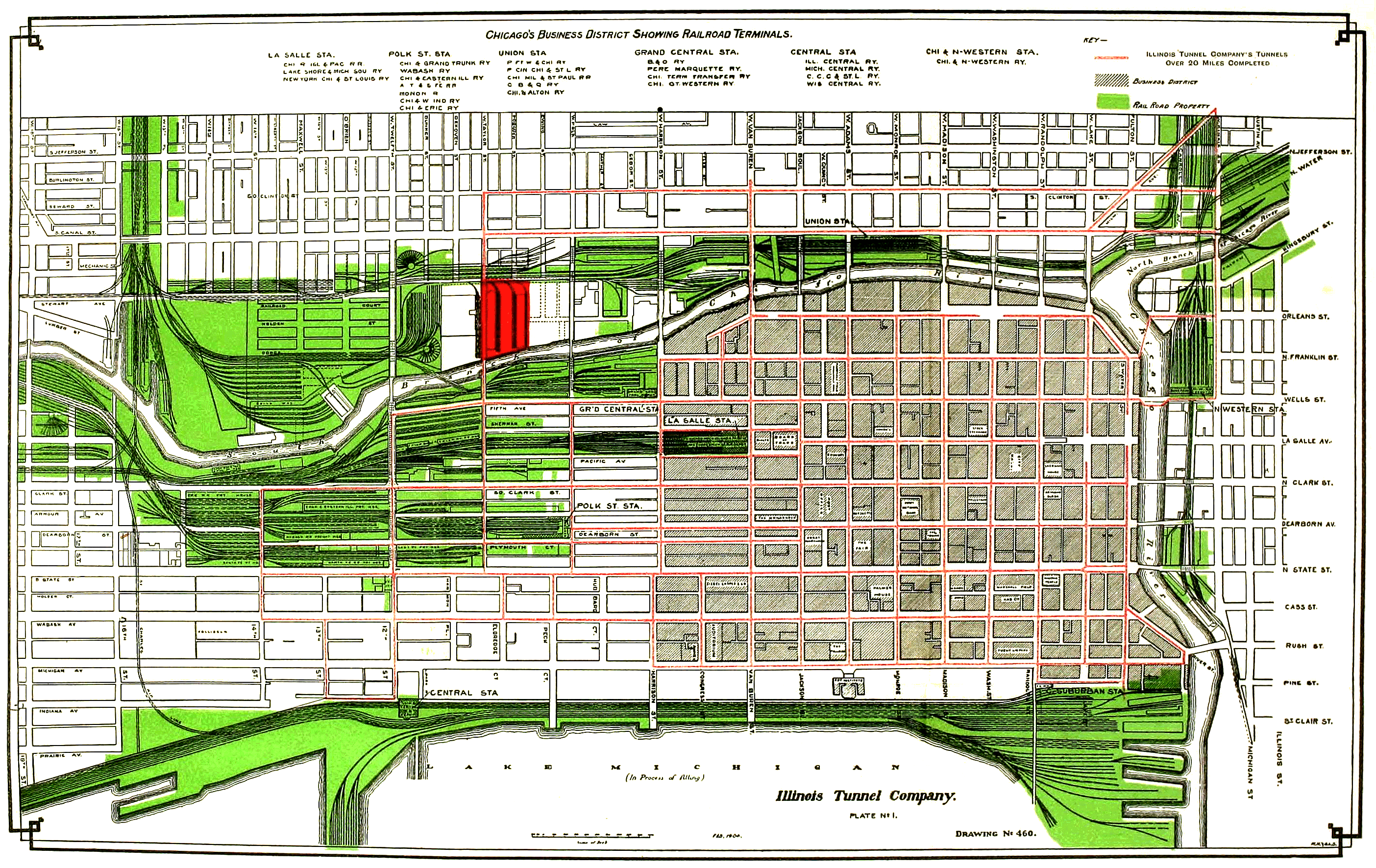
Welcome to a century-old network of freight tunnels underneath the city's historic business district.  

There’s a vast network of tunnels underneath Chicago that once handled coal and ashes for dozens of buildings connected at their sub basement levels. The tunnels were in operation from 1904 to 1959, and then forgotten about until a catastrophic flood reminded everyone they were there.

Work began on the tunnels in 1899 under the auspices the Illinois Telephone and Telegraph Company, reorganized in later years as the Chicago Tunnel Company. An enormous quantity of blue clay soil was excavated by hand and used as landfill to build up low lying areas on the waterfront.


The Chicago Tunnel Company had an aggressive (perhaps brash) business strategy, building 60 miles of tunnels before securing a single client. Once the network was complete they approached downtown buildings and offered an array of services, including telephone and telegraph connections, and coal, mail and merchandise deliveries. And the clients did come; tunnel connections were built to the Board of Trade, City Hall, Merchandise Mart, the Federal Reserve Bank, the Chicago Tribune, the Civic Opera House, the Field Museum, and dozens of others. One of the Chicago Tunnel Company’s  more inventive products was “tunnel air” (55˚F year round), which they piped into theaters and hotels as natural air conditioning.  


For decades, little electric trains used the tunnels to make their deliveries free from the congestion of surface traffic. Operators navigated using street names painted onto the walls, and avoided collisions using nothing more than a “sight and sound system,” in the generous words of Electric Railway Journal. The tunnels saw their peak usage in the 1940s and 1950s but struggled financially because of tremendous capital investments and increased competition from the trucking industry. In 1959 the Chicago Tunnel Company went out of business and sold their fleet of little trains for $64,000 in scrap. 


Of course, the tunnels didn’t just go away after that. As memory of this unique bit of infrastructure faded into obscurity the city allowed a few special businesses to continue to use them. The Chicago Tribune, for example, used the tunnels until 1981 to transport newsprint from their paper warehouse to Tribune Tower. 

On April 13, 1992 the tunnels jumped back into the headlines in what the press dubbed “The Great Chicago Flood.” Employees of the Great Lakes Dredge and Dock Company driving new river pilings near Kinzie and Canal Street inadvertently punctured a tunnel roof, allowing millions of gallons of water to gush into the network. All the old buildings that had connected to the tunnels decades earlier were flooded, electricity shorted, and records at City Hall were soaked. The incident ended up costing roughly $2 billion in damage. Since then the tunnels have been sealed, and entry is near impossible.


Clancy's comment: Mm ... Interesting, eh?

I'm ...


23 April 2018 - INDIAN COAL FIELD HAS BEEN BURNING CONTINUOUSLY FOR OVER 100 YEARS


INDIAN COAL FIELD 
HAS BEEN BURNING  CONTINUOUSLY
FOR OVER 100 YEARS

G'day folks,


One of India’s largest coal reserves, the Jharia coalfield, situated in the Dhanbad district of Jharkhand, is the site of one of the longest-burning fires in the world. The area has been burning continuously for over 100 years.

Mining in the Jharia coalfields, which cover over 100 square miles, began in the late 1800s, under British rule. The first detected fire broke out in 1916, but by the 1980s over 70 blazes had sprouted up, and none of them could be contained, let alone extinguished. As they were often deep underground, they were left to smolder in the hope that they would eventually burn out on their own. Unfortunately, a new mining operation in 1973 smothered that hope.

That year, Bharat Coking Coal Ltd (BCCL), a subsidiary of state-owned Coal India, started a large-scale opencast mining operation as a rapid and more cost-effective method of extraction. Local activist Ashok Agarwal explained to Al Jazeera that this was when the fires took hold, with catastrophic consequences.


“The idea was they’ll get quick coal and they’ll get cheap coal … but there was underground mining already done over here. So there were a lot of galleries – galleries are tunnels which these people make and they extract coal. So the ground of the galleries is always full of small pieces of coal, and that catches fire. When you went in for open-cast mining where already underground mining has been done, you opened up the face of the galleries and then there was free flow of air inside and now you’ve got a massive fire.”

The flow of oxygen into the mining shafts fed the smoldering embers until they became massive flames, some recorded at 60 feet high. Many of the fire started as spontaneous combustion caused by the oxidization of minerals in the exposed coal, but they grew exponentially worse when surface mining operations exposed the embers to oxygen.

  Experts estimate that over 37 million tons of coal, worth billions of dollars, have been lost to the uncontrolled blazes, with a further 1.4 billion metric tons made inaccessible because of the fires. Despite this, and the woeful carbon emissions caused by the flames, India’s government reportedly intends to increase production in the area. Indian Prime Minister Narendra Modi has allegedly made moves toward putting out the fires, but only in the hope of expanding coal production.


Meanwhile, life for the residents of Bhulan Bararee, a nearby village, resembles that of a hellscape. “The ground is so hot at places, that walking even in shoes is near impossible. Almost everyone here is ill. Authorities ask the villagers to leave their homes and go. But most people fear loss of livelihood, and hence continue to stay,” Mohammad Nasim Ansari, a resident, told YourStory.

The burning coal releases toxic gasses and particles into the air, making it a hazard to breathe. The underground fires have also caused massive sinkholes that have claimed many lives over the years.

 “Just imagine the emissions that are being produced by these fires,” Glenn Stracher, a professor emeritus of geology and physics at East Georgia State College, said to CNBC. “I have collected gas samples from different fires, and there are usually 40 to 50 hydrocarbon compounds, and many of them are toxic or carcinogenic. So this stuff is bad, really bad. There are for sure toxins or poisons in these fires, and they certainly exceed U.S. Environmental Protection Agency standards”

Unfortunately, the Jharia coal fire is only one of the thousands burning worldwide on every continent other than Antarctica. It is a costly and dangerous phenomenon affecting a fuel source that brought about the rapid economic development of the western world.

 The emissions caused by these fires are almost impossible to calculate as the flames act erratically, sometimes calming down, sometimes suddenly intensifying. They can also be difficult to contain or extinguish, although some methods, such as pouring sand on the flames or injecting inert gas into the tunnels, can smother parts of the fires. These operations, however, are costly and have had little effect. Experts are skeptical that the fires can ever be fully extinguished as long as they have fuel to burn.


Clancy's comment: Now I know why Australia exports coal to India.

I'm ...