Showing posts with label BIRDS. Show all posts

27 June 2022 - LAKE NATRON - TANZANIA


LAKE NATRON 

- TANZANIA -


G'day folks,

A salty red wasteland in Tanzania is a breeding spot for endangered flamingos. 

Don’t let the ring of salty marshes along the edge of Lake Natron fool you. This body of water is one of the most inhospitable areas on Earth.

Colored a deep red from salt-loving organisms and algae, the lake reaches hellish temperatures and is nearly as basic as ammonia. Although most human settlements throughout history have formed around lakes and rivers, the barren landscape around Lake Natron tells a clear story of a place no one ever wanted to live.


Africa’s Great Rift Valley is known for some of its environmentally extreme regions such as the Erta Ale and Dallol. The saline environment of Lake Natron certainly qualifies. Water is supposed to give life, yet this salty world seems content to make life almost impossible… almost.

Although most species cannot handle the 120-degree lake water, cyanobacteria have made Natron their home and turned the lake its trademark reds and oranges. This algae growth has also fostered the developments of Lesser Flamingo nests. Amazingly, 2.5 million flamingos make Lake Natron their home and it is considered one of their only breeding grounds, making preservation of the lake an environmental concern.

In fact, bringing in fresh water would greatly upset the ecological balance of the lake and many in Tanzania have actively fought against bringing in water from the Ewaso Ng’iro River. If the salinity of the lake decreases, the cyanobacteria will also decrease and cause a loss of habitat for the endangered flamingos. Besides losing a bird habitat, the world would also lose a beautiful and salty natural wonder if too much water is diverted south to Natron.


 

4 March 2022- BATH ROAD HERONRY - OHIO


BATH ROAD HERONRY 

- OHIO -


G'day folks,

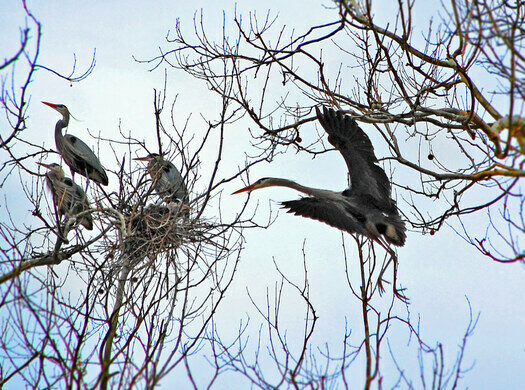
Beside a busy highway, a colony of Great Blue Herons raises hundreds of offspring each year.  

Every year around Valentine’s Day, hundreds of great blue herons (Ardea herodias) descend upon the Cuyahoga Valley National Park in Northeast Ohio to engage in their annual courtship and mating rituals. The birds build their nests in communal rookeries called heronries. Heronries typically appear in secluded areas, and the birds are ordinarily cautious and skittish. They’re usually surrounded by marshland, and observable only by the most intrepid birdwatchers. The Bath Road Heronry is unusual because of its proximity to the busy highway between Riverview and Akron-Penninsula Roads. It affords people a rare opportunity to see an active heron rookery without trudging through miles of wetlands. Because the road is so heavily traveled, there’s a pull-off to prevent vehicles from obstructing traffic while birders view and photograph the nests and their occupants.

Blue herons were first observed nesting in the Cuyahoga Valley National Park in 1985. Since that time, the birds have grown in number and return annually. The Bath Road Herony peaked at 176 nests in 2003. Unfortunately, the loss of two trees during the ensuing years reduced the number of viable nesting places. Since that time, the nest numbers have ranged from 50 to 100. In 2006, another heronry appeared in a more remote area to the north.    

The Bath Road nests occupy three enormous sycamore trees on the south side of West Bath Road. The area is marshy and close to the Cuyahoga River, with its plentiful supply of fish and amphibians. Nothing more than a chainlink fence separates the nesting area from the highway. 

The heron nests are large—up to four feet in diameter and two feet deep—and between 30 and 70 feet off the ground. Each nest is constructed from a platform of sticks and branches, and lined with pine needles, moss, grass, and leaves. Although rickety in appearance, the nests are stable enough to support the weight of two big parents and up to seven jostling nestlings. Great blue herons are North America’s largest herons. At four feet tall with a wingspan of seven feet (at up to 5.5 pounds, since they are birds, after all), they are very hard to miss. 


Their mating behavior is charming.  Couples can be observed “clappering”—quickly and repeatedly clicking their long bills together in a mating display. Courtship continues when the male heron presents the female with a stick. If she accepts, they are bonded and commence building or remodeling their nest. Nest construction or repair is usually completed by early April. A clutch numbers three to seven eggs that are incubated by both parents for 28 days.

Hatching begins in late April or early May. For two months, observers can watch the parents continually flying between the heronry and the Cuyahoga to bring food to their growing offspring. The gangly youngsters are easily viewed from Bath Road as they stand in the nests and compete for food. The herons remain at the rookery until they fledge in early July. The abandoned nests remain through the fall and winter months, awaiting the herons’ return in February. 

Clancy's commment: I've photographed these and similar birds in SE Asia ... lying on my back with a long camera as they flew over me like Jumbo Jets.

I'm ...


22 April 2022 - EUROPE'S LARGEST SEABIRD CLIFF


EUROPE'S LARGEST 

SEABIRD CLIFF


G'day folks,

Puffin enthusiasts flock to Europe's largest seabird cliff, which over one million birds call home. 

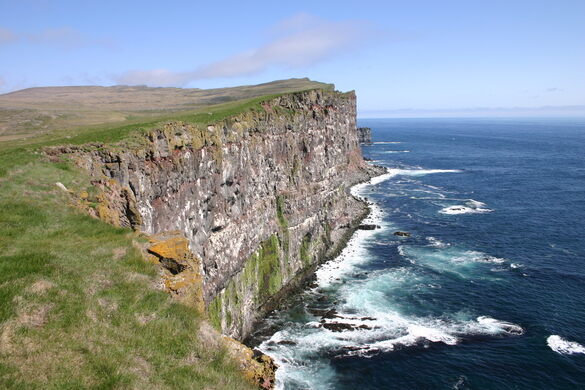
Látrabjarg, Iceland’s westernmost point, is also the largest seabird cliff in Europe. Over one million birds pepper the wind-battered crags, protected from predators while perched within the rocks that jut out from their towering domain.

The puffins, of course, are typically the star attraction. The adorable orange-beaked creatures are fairly comfortable around the humans who brave the fierce winds that tear through the air. You’ll typically find them peeping out from the grass that coats the top parts of the cliffs.

 Látrabjarg is a key site for seabird conservation. In addition to the puffins, you’ll find other seabirds like guillemots, razorbills, and northern gannets clustered throughout the rocks. At times, the area houses approximately 40 percent of the world’s razorbill population.


 The cliffs also boast splendid hiking and photography opportunities for those who can stand the wind. The nearly nine miles of over 1,000-foot-tall cliffs offer a chance to walk Iceland’s most western perimeter. Be sure to stop for a bit to take in the views of the Atlantic Ocean, which merges uninterrupted with the distant horizon.

If you do decide to walk along the cliffs, make sure you stay behind the white line that’s painted near the edge. It’s there to keep you from accidentally falling and plummeting into the churning waters far below.


 Clancy's comment: A top spot for wildlife photographers like me.

I'm ...


12 July 2021 - STUNNING SHOTS OF BIRDS IN THE WILD


STUNNING SHOTS OF

 BIRDS IN THE WILD


G'day folks,

Seeing birds in the zoo is all fine and dandy, but it doesn’t come even close to being able to observe them in their natural habitat. 
 
It’s only in the wild that you’re able to observe how birds interact with each other and with the outside world, be it a baby penguin cuddling with its parents, a duckling curiously observing a fly, or a group of red-crowned cranes dancing on a wintry morning.

It is the goal of the Bird Photographer of the Year contest (BPOTY, for short) to highlight the most precious, intimate, and beautiful bird moment captured on film so that we’re able to appreciate the beauty of our avian friends and partake in their adventures. For the sixth year in a row, the competition published a selection of finalists, and I'm here to share the highlights with you today. Enjoy!


Clancy's comment: Stunning work!

I'm ...


14 February 2021 - STUNNING BIRDS CREATED FROM PAPER


STUNNING BIRDS 

CREATED FROM PAPER

G'day folks,

Zack Mclaughlin is an artist inspired by the beauty of colorful birds. He makes his stunning sculptures from paper, wood and other mixes. He started making these paper birds a few years ago, with the designs becoming more and more lifelike, staying true to what he found so beautiful while also maintaining realism in his sculptures.

Zack cuts every individual feather with his scissors, from the big wing feathers to the tiny tail feathers. 

Now, let's see some of his work ...


Clancy's comment: Stunning art, involving hours of work.

I'm ...


13 May 2020 - THE AFRICAN JACANA HIDES HIS CHICKS FROM DANGER


THE AFRICAN JACANA 
HIDES HIS CHICKS
 FROM DANGER

G'day folks,

The animal kingdom is full of the most peculiar beings that not every person knows about. If you’ve never heard anything of an adorable and sometimes creepy bird called African Jacana, you’re just about to learn something new! 

The Jacanidae family has 8 known species of Jacanas, and one of them is the African Jacana. It is a tropical bird that mostly resides in wetlands and is usually found in sub-Saharan Africa.


 Commonly referred to as “Jesus birds”, these vertebrates have an ability to walk on water or at least give a good impression of this ability.

Their slender, long legs paired with large feet and toes up to 7cm (2.75 inches) allows them to walk on floating vegetation with ease.


 INTERESTING FACTS:

 These vertebrates fare well not only above water but also under it. They are very good divers and use this skill as great protection from predators.

Jacanas engage in quite an unusual mating system called polyandry. It means that females mate with multiple males, leaving the duty of taking care of the chicks to them.

While males are the protectors of the chicks, females protect the territory due to the fact that they are much bigger in size.


Clancy's comment: Amazing bird, eh? Creatures in our world continue to surprise me. 

I'm ...