Showing posts with label MURDER. Show all posts

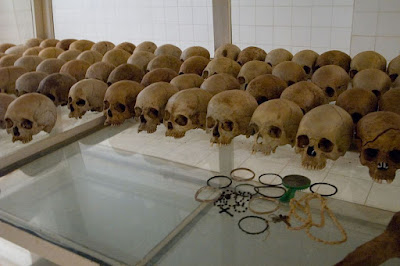
14 January 2022 - RWANDAN GENOCIDE SHOULD NOT BE FORGOTTEN


RWANDAN GENOCIDE 

SHOULD NOT BE FORGOTTEN


G'day folks,

Over a period of 100 days in 1994, in the small but densely populated East African country of Rwanda, one of the worst and most brutal genocides in modern history occurred.

More than 800,000 Tutsi people, Twa and moderate Hutu were murdered by Hutu extremists. The genocide came at the climax of the Rwandan Civil War, which had been raging since 1990, but followed a long history of tension between the groups.

Rwandan President Juvénal Habyarimana had signed peace accords with the rebels in 1993, since neither side was able to gain an advantage in the conflict. His assassination on April 6, 1994, created an immediate power vacuum in the country and ended the accords. The Rwandan crisis committee that took power following his death, led by Théoneste Bagosora, immediately began issuing orders to kill Tutsi. The killings were large-scale and highly organized, perpetrated primarily through the Interahamwe, originally a far-right Hutu paramilitary group. Many believe the genocide had been planned for over a year.


Road blocks were set up throughout Rwanda and any person showing Tutsi identification was killed immediately. Hutu extremists went from house to house slaughtering Tutsi, regardless of age. Churches were burned with people in them, such as at Ntarama were killed by guns, grenades, fire or machete.

The international community has long been criticized for its failure to intervene. The genocide caused worldwide revulsion and shock, but the killings only stopped when the Rwandan Patriotic Front led by Paul Kagame (still the President of Rwanda as of 2020) enacted a swift military victory over the Rwandan government and ended the civil war.

Many responsible for the genocide were never punished given the vast number of participants, though some of the main organizers were imprisoned by the International Criminal Tribunal for Rwanda.


Clancy's comment: Shameful stuff!


I'm ...


3 August 2021 - WHO KILLED WHO IN THE FAMOUS CRIPPEN MURDER CASE?


WHO KILLED WHO IN 

THE FAMOUS CRIPPEN 

MURDER CASE?


G'day folks,

Cora, the flirtatious wife of Dr Crippen, disappeared from her London home on 31 January 1910, sparking one of the most puzzling and notorious murder cases in British legal history – and one that is still unresolved today.

Hawley Harvey Crippen, born in 1862, was an American homeopath. He practised in New York where, in 1894, he married Corrine "Cora" Turner, a struggling music hall singer who went under the stage name of Belle Elmore.

Later that year Crippen started working for a mail order pharmaceutical company and was appointed London manager when the business was extended to England in 1897.

Cora, however, proved to be the fly in the ointment. After affairs in America she continued to take lovers in London while becoming increasingly frustrated over her failure to succeed as a professional singer. Her demands meant that Crippen lost his job in 1899 because his boss thought he was spending too much time on Cora’s career.

On 31 January, 1910, after a dinner party at their home in Holloway, North London, Cora disappeared. Crippen told her friends that she had returned to the US to visit relatives. Later, he claimed that she had died after being taken ill.

That could have been the end of the matter, but Crippen made the fatal mistake of quickly asking his secretary and lover, Ethel Le Neve, to move in with him. Cora’s suspicious friends contacted the police.

Crippen told detectives that Cora had left him for another man, and that he had lied to her friends to save face. When the police returned a few days later to ask more questions, Crippen and Le Neve had vanished.

A search of the house revealed body parts beneath the cellar floor, the police suspecting straight away that the corpse was Cora’s. A nationwide hunt was immediately mounted for Crippen and Le Neve.

The two suspects had boarded a ship bound for Canada but unfortunately for them the captain became suspicious of them after reading newspaper reports of the case and alerted police using the newly invented wireless telegraph. His message read:

"Have strong suspicions that Crippen London cellar murderer and accomplice are among passengers. Mustache taken off. Growing beard. Accomplice dressed as boy. Manner and build undoubtedly a girl.”

They were arrested when the ship reached Canada and sent back to Britain to stand trial.

Though the court was told of a drug found in the body and that newly manufactured clothing at the scene ruled out claims the remains were years old, the most damning evidence against Crippen came from pathologist Bernard Spilsbury. He said that a piece of skin from the human remains carried an abdominal scar “consistent with Cora’s medical history.”

A jury took just 27 minutes to find Crippen guilty of murder, for which he was hanged. Le Neve was tried separately, accused of being an accessory after the fact.

She was acquitted and left Britain for the US on the morning of Crippen's execution. At his request, her photograph was placed in his coffin and buried with him.

However, nearly a century later, scientists in America looking into the case compared the DNA from the cellar tissue to DNA from Cora’s modern-day relatives. Not only was there no match – proving that the corpse was not Cora’s – but it was the wrong sex – the body remains in the cellar belonged to a man!

John Trestrail, the toxicologist who led the new research, said: "Hawley Crippen was tried solely on the evidence that he killed Cora. The body wasn't hers, so he was convicted and hanged in error."

Referring to the glass slide of tissue evidence used by Spilsbury to identify the body as Cora's, Mr Trestrail said: “This was the evidence on which Crippen was convicted. But the substance in the slide is not Cora Crippen. No question. I don't say Hawley Crippen is innocent, but he is no longer proven guilty."


The results were conclusive, said Dr David Foran, head of the forensic science programme at Michigan State University. "That body cannot be Cora Crippen, we're certain of that."

James Patrick Crippen, the doctor’s closest living relative, made a formal request for Hawley Crippen to be pardoned and his bones returned to America. But the Criminal Cases Review Commission refused to refer the case to the Appeal Court.

It said it could not do so because Mr Crippen was too distantly related. In law, the person bringing such an appeal had to be a close relative. It is understood the Commission did not examine the grounds for the appeal.

Before he was executed, Crippen wrote in a letter to Le Neve: “Face to face with God, I believe that facts will be forthcoming to prove my innocence.” John Trestrail said: “When I read that the hairs stood up on my arms. I think he was right."


Clancy's comment: Interesting, but I'm sure many innocent people have been wrongly convicted.

I'm ...


6 July 2019 - CHRIS WATTS - MURDERER FROM COLORADO


CHRIS WATTS
 - MURDERER FROM COLORADO -

G'day folks,

Welcome to some facts about a gruesome muderer from Colorado. Chris Watts is a Colorado man who committed familicide by murdering his pregnant wife and two young daughters in August 2018.

Who Is Chris Watts?


Born on May 16, 1985, Chris Watts is a Colorado man who murdered his pregnant wife, Shan'ann Watts, and their two young daughters, four-year-old Bella and three-year-old Celeste, on August 13, 2018. That November, Watts pleaded guilty to first-degree murder on multiple counts and was subsequently sentenced to life in prison without parole. 

Watts Family Murder


Returning from a business trip in the early morning hours of August 13, 2018, Shan'ann Watts got into an argument with her husband, Chris Watts, in their Frederick, Colorado home when he confessed he was having an affair and wanted a divorce. According to Chris' confession to authorities, Shan'ann — who was 15 weeks pregnant with their son — proceeded to threaten Chris, saying he'd never see their daughters again, which prompted him to strangle her to death. 

Four-year-old Bella reportedly walked onto the scene after Shan'ann was killed and asked her father, "What are you doing with Mommy?"

According to Chris' lawyer, Chris had told Bella that her mother was feeling ill and they had to take her to the hospital. He then loaded Shan'ann's body and his two daughters in the car and drove them to his work site, Anadarko Petroleum.

Once there, he smothered Celeste to death with her favorite blanket and pushed her body into an oil tank. When he returned for Bella, who watched him kill her younger sister, she pleaded with her father: "Please Daddy, don’t do to me what you just did to CeCe.”

Chris proceeded to murder Bella and push her body into another oil tank. He buried Shan'ann in a grave on the property site.


On August 21, Chris was charged with first-degree murder on five counts (one additional count was added to each child under the age of 12), along with one count of illegal termination of a pregnancy and three counts of criminally disposing of deceased bodies.

After pleading guilty to the murders on November 6, 2018, Chris was sentenced to life imprisonment without parole on November 19. Shan'ann's family did not pursue the death penalty.

Chris is currently serving five life sentences (three consecutively, two concurrently) and was transferred in December 2018 to Dodge Correctional Institution in Waupun, Wisconsin.

During an interview in February 2019, Chris told investigators he was remorseful for the murders and had found God.


 Clancy's comment: Mm ... One can only imagine what went through young Bella's mind.

I'm ...


4 June 2018 - D.C STEPHENSON - GRAND DRAGON OF INDIANA’S KKK


D.C STEPHENSON
 - GRAND DRAGON OF INDIANA’S KKK -

G'day folks,

Here are some historical facts about a master mongrel of the lowest order.

On the night of March 15, 1925, Madge Oberholtzer received an urgent telephone call. It was D.C. Stephenson, the Grand Dragon of Indiana’s KKK. He wanted her to come immediately. Oberholtzer was an attractive young woman working in a state education program who had met Stephenson at a banquet for the Governor of Indiana. At first, she’d been wary of Stephenson’s aggressive advances, but ultimately gave in, attending two dinners with him. On this night however, she brushed aside her reservations and went to his house. When she arrived, she could see that Stephenson, an ardent prohibitionist, was drunk. Some of Stephenson’s men were there. They made drinks and insisted she take one. She was afraid, and said no.


But Stephenson insisted more forcefully, and Oberholtzer, feeling powerless, had three drinks — and then vomited. Stephenson told her he was in love with her and demanded that she come with him to Chicago. She said no. What had originally seemed like ardor now had a vicious, uncompromising edge. She was terrified and told him she wanted to go home. But Stephenson was used to getting his way. “No, you cannot go home,” he said. “You are going with me to Chi­cago.”


A powerful Klansman with a history of political work, Stephenson was a skillful political manipulator who believed he had impunity. As Linda Gordon revealed in her 2017 book on the 1920s Klan, The Second Coming, Stephenson had beaten his previous wives (there had been at least three) and attempted to rape other women, and gotten away with it. As Oberholtzer would later say, “He said he was the law in Indiana.”


Stephenson, who was born to sharecroppers in Houston, Texas, in 1891, got his start working as a promoter for the coal mining and media industries, but it quickly became clear that he was best at boosting himself, mostly by embellishing his résumé. He got involved in the Democratic party and joined the KKK in 1920, climbing his way through the ranks in a mere two years. In 1922, the Klan’s Imperial Wizard named Stephenson Grand Dragon of Indiana. Stephenson was late to his own Grand Dragon inauguration because, as he boasted to the roaring crowd of 100,000 people, “The President of the United States kept me unduly long counseling on matters of state.”


The 1920s was the Klan’s heyday, and the hate group held sway in nearly all the venues of power in American society. The same year Stephenson kidnapped Oberholtzer, he nudged a Republican, Ed Jackson, into the Indiana governorship. He had the ear of nearly every politician in the state, exerting influence on legislation the way DC lobbyists do today. He had plans to run for office, perhaps the Senate — or higher. “I’m going to be the biggest man in the United States!” he said.


Stephenson, like his hateful colleagues, made boatloads of money off the Klan, which was infamous for giving kickbacks to its recruiters. He moved into a white columned mansion in a posh Indianapolis suburb and purchased a yacht, valued at $125,000 — nearly $2 million in today’s sums.


The Klan’s relationship with women was complex. The group had petered out in the years after the Civil War, but reemerged in 1915, rallying against the perceived dark skinned threat against white women as thousands of immigrants came to American shores. But much to the chagrin of sexist Klansmen, white women had ideas of their own, and those ideas didn’t involve staying at home and waiting around while hatemonger men in hoods got all the glory.


In the years after suffrage, white women were emboldened to enter civic life. White supremacist women were no exception. They rose through the Klan’s ranks, taking up their cause with powerful effect. In fact, arguably, the most powerful person in the Klan was Elizabeth Tyler, the P.R. mastermind behind the Klan’s more expansive vision of hate that included not just black people, but also immigrants, Jews, Catholics, and communists. By the early 1920s, women created their own autonomous arm of the KKK. To the untrained eye, the Klan looked like a friendly place for white women.


Oberholtzer’s story put an end to all that. In the days after the attack, she catalogued each grisly detail for the police. After rejecting Stephenson several times, he and his men had shown her their loaded guns and taken her to a train bound for Chicago. Once in the car, Stephenson took off her clothes and held her down, raping her. “He chewed me all over my body,” she said, “bit my neck and face, chewing my tongue, chewed my breasts until they bled, my back, my legs, my ankles and mutilated me all over my body.”


In the morning, Stephenson took her to a hotel, where one of his lackeys bathed her wounds. According to Oberholtzer, Stephenson apologized, saying “that he was three degrees less than a brute,” to which she replied, “You are worse than that.” She told Stephenson that she needed to go to the drugstore to get some makeup, and one of his men took her. At the drugstore she purchased a box of mercury tablets. Back in the hotel room alone, she took all of them in order “to save my mother from disgrace.”


A few hours later, she vomited blood and deliriously told the men what she had done. Stephenson insisted that she must marry him and then seek treatment. She said no. “I did not care what happened to me,” she said. On the drive back to Indiana, she screamed in agony and vomited all over the seats, but the men wouldn’t stop. When they finally arrived back at Stephenson’s house hours later, he told her, “You will stay right here until you marry me.” She refused and was taken to a room above his garage. The next morning a servant carried her home. Stephenson instructed her to tell everyone that she had been in a car accident. “You must forget this,” he said. “What is done has been done, I am the law and the power.”


Oberholtzer’s testimony against Stephenson was one of her final acts. She was dead 29 days after the attack — the cause of death likely the combination of infection from the biting wounds and poisoning from the mercury pills. Much to his surprise, Stephenson was arrested not long after. Politicians began renouncing him. In November, he was brought to trial. The gallery was crammed with people trying to get a glimpse of the monster as he fell.


Stephenson was convicted of second degree murder and sentenced to life in prison. Afterwards, he began to name names, revealing that vast swaths of Indiana’s politicians were on the Klan payroll. The governor and several other high ups were charged with conspiracy. The Klan’s image would never recover, and by the end of the decade, the organization was entirely wiped out. It’s a comforting idea. Powerful heads had rolled. Yet, the Klan couldn’t have risen to such staggering power without the nation’s indifference and a groundswell of overt support. One hundred thousand people had cheered at Stephenson’s inauguration — but they were only outraged once he had a white woman’s blood on his hands.


 Clancy's comment: Like all who think they are above the law, they squeal like a piglet when caught. 

I'm ....


7 January 2016 - DEATHS AT THE HANDS OF LOVED ONES


DEATHS AT THE
 HANDS OF LOVED ONES

G'day folks,

You might find this interesting. Thirty-one years ago today, Marvin Gaye was shot to death by his father. Gaye is one of many tragic stories in Hollywood, in which the perpetrator was someone close to the victim.


The saying goes, 'There's no greater loss for a parent than the death of a child,' but can you imagine when that death ends up being at the hands of the actual parent? It's a hard pill to swallow. This, however, is what happened to Motown superstar Marvin Gaye, Jr. when he stared down the barrel of a gun held by his own father on April 1, 1984.

As today marks the 31st anniversary of Gaye's tragic death, we take a look at some famous murders that occurred at the hands of a loved one.

R&B/Soul Singer Marvin Gaye: April 1, 1984

 The fatal shooting of Motown's "Prince of Soul," Marvin Gaye, Jr., goes down in the record books as one of the most famous and tragic deaths in music history.

Born Marvin Pentz Gay, Jr. (he later added the "e" in his surname) in 1939 in Washington, D.C., the R&B/soul singer had 18 Top 10 hit singles and is best known for such classics as "I Heard It Through the Grapevine," "What's Going On," "Let's Get It On," and his 1982 comeback song, the chart-topping "Sexual Healing," which earned him two Grammy Awards.

Plagued by drug abuse, the artist moved in with his parents, preacher Marvin Gay, Sr., and Alberta Gay in the West Adams area of Los Angeles. A day before his 45th birthday on April 1, 1984 at approximately 11:38 a.m. PST, a fight broke out between father and son over the senior Marvin's treatment of his mother during an argument over insurance papers. The fight allegedly turned physical when, as Alberta said in a 1985 Ebony article, that her son pushed and kicked his father. As the story goes, Gay Sr. allegedly retaliated with a gunshot from a .38 pistol to his son's chest followed by a second gunshot reportedly fired at point-blank range.

 Playboy Playmate Dorothy Stratten: August 14, 1980


 At the height of her short-lived career, Playboy model/actress Dorothy Stratten suffered a tragic ending at the hands of her estranged husband, Paul Snider, founder of male stripping act, The Chippendales.

Born Dorothy Ruth Hoogstraten on February 28, 1960 in Vancouver, the blonde beauty came to fame after being named Playmate in the 1979 issue of Playboy, and appearing in such movies as Skatetown, USA and Americathon the same year. She was named Playmate of the Year in 1980. The rising star married Snider in 1979, but the pair was estranged at the time of her murder. On August 14, 1980, the two met on at the couple's former home to discuss a divorce. Instead of splitting amicably, Snider shot her to death with a shotgun and then committed suicide with the same gun. 

Reportedly, police believe that Snider raped and abused her corpse before pulling the trigger on himself. Both bodies were naked when police arrived.


 Since her death, Stratten became the subject of two movies, a song, and several books, including Jamie Lee Curtis's portrayal of her in Death of a Centerfold: The Dorothy Stratten Story, and singer Bryan Adams's song "The Best Was Yet to Come." She was only 20 years old when she was killed.

Actress Dominique Dunne: November 4, 1982

Just four months after appearing in the 1982 blockbuster supernatural thriller, Poltergeist, 22-year-old actress Dominique Dunne was strangled by her ex-boyfriend, sous-chef John Thomas Sweeney, at her West Hollywood home. The attack put her in a coma for five days until she was declared brain dead and taken off life support.

Dunne was the daughter of heiress Ellen Griffin and Dominick Dunne, a film producer, writer, investigative journalist, and television host, and the niece of novelists Joan Didion and John Gregory Dunne. Her first break as an actress came when she was cast in the 1979 movie, Diary of a Teenage Hitchhiker. She soon appeared in the hit '80s television shows, Lou Grant, Hart to Hart, and Fame, before landing her first feature film role in the Steven Spielberg-produced supernatural thriller Poltergeist.


The trouble with her boyfriend Sweeney began shortly after the two moved in together, just weeks after meeting. A few months prior to her murder, two altercations occurred, one being his first attempt on her life by strangling. In 1983, Sweeney was acquitted of the second-degree murder charge, but was still found guilty of the lesser charge of voluntary manslaughter and also convicted of a misdemeanor assault for a previous attack. He was sentenced to 6 ½ years in prison, but only served three years and seven months.

 Actor Phil Hartman: May 28, 1998 


 Cocaine use and alcohol reportedly contributed to Brynn Hartman's decision to shoot her husband, actor Phil Hartman, at point-blank range with his own Smith & Wesson .38 as he slept in the bed they shared in their Encino, Calif. home. She shot him twice in the head and once on his side.

Hartman, best known for his work on Saturday Night Live, NewsRadio, and for voicing several characters on The Simpsons, had reportedly threatened to divorce his wife of 11 years, during an argument over her drug use. Along with her drug problems, which resulted in two stints in rehab, Brynn also suffered from depression. She was taking the antidepressant drug, Zoloft, at the time of the shooting.


Shortly after admitting to a friend that she killed her husband in the early morning hours of May 28, 1998, Brynn climbed into the couple's bed where Phil's dead body still lay and sitting up against the headboard she put the gun in her mouth and fired her own fatal shot. When police arrived, they found Brynn's dead body slumped over that of her husband, orphaning the couple's two children. In 1999, Hartman's estate filed a wrongful-death lawsuit against Pfizer, the manufacturer of the antidepressant drug that Brynn was taking, as well as her psychiatrist. Pfizer settled.

Bonnie Lee Bakley: May 4, 2001

 Though out of the public eye for some time, Robert Blake — star of Truman Capote's 1967 film In Cold Blood, and the 1970's show Baretta — became a household name again after he was charged with murdering his wife of one year, Bonnie Lee Bakley. 

The high profile trial intrigue centered on Bakley's background and the couple's strange history. She was widely known as a con artist and for allegedly swindling men for money and had been arrested for writing $200,000 in bad checks, along with having more than 30 fake identifications. She served jail time before meeting Blake in 1999 and becoming his wife after a paternity test proved he was the father of her daughter, Rose, which she initially named Christian Shannon Brando after claiming Marlon Brando's son, Christian, was the father.


On May 4, 2001, the couple had dinner at a restaurant, and upon leaving the restaurant, Blake claimed to have realized that he left his revolver in the restaurant and returned to retrieve it. When he came back to the car, he found his wife dead with a gunshot wound to her head. Blake was charged with one count of murder with special circumstances, two counts of solicitation of murder, and one count of murder conspiracy. He was acquitted in 2005, but found liable for the wrongful death of his wife in the civil case filed by Bakley's children and ordered to pay $30 million in restitution.
   

Clancy's comment: Mm ... Hollywood.

I'm ...