Showing posts with label ICE. Show all posts

5 November 2022 - FROZEN CLEVELAND LIGHTHOUSE


FROZEN CLEVELAND

 LIGHTHOUSE 


G'day folks,

Welcome to an unoccupied lighthouse encased in layers of ice from the waters of Lake Erie. 

There’s a lighthouse in Cleveland, Ohio, that is placed so close to Lake Erie, one of the Great Lakes of the Midwest, that a wonderful weather phenomenon takes place.

It started during the winter of 2010, when the lighthouse was sprayed so many times with water from the lake that it froze into a giant sculpture designed and built by Mother Nature. The ice has built up layer by layer, completely encasing the lighthouse in ice and drawing visitors from all over the state.

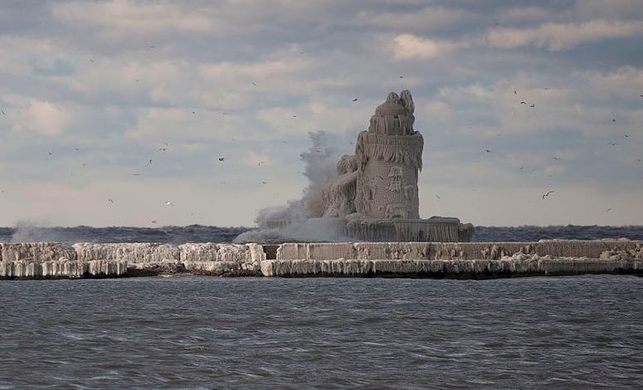


“Days of unrelenting gale force winds which began on December 13 churned up white caps on Lake Erie,” a local broadcasting station explained in 2010. “Those monster waves crashed across the Cleveland Harbor breakwall and West Pier lighthouse.”

The ice has brought more attention to the lighthouse than it has seen in decades. Built in 1911, it has been unoccupied since 1965 when it was automated. The original Fresnel lens was donated to the Great Lakes Science Center in Cleveland, which is within sight of the lighthouse, right across the harbor.

Curiously, over the 105 years, the lighthouse has developed a slight tilt to the right, and the tilt is visible from the shore if you look carefully.


8 June 2022 - ELLENVILLE FAULT ICE CAVES - NEW YORK


ELLENVILLE 

FAULT ICE CAVES 

- NEW YORK -


G'day folks,

The largest known open fault in the United States is basically a giant natural refrigerator. 

Located high on the Shawangunk Ridge, the Ellenville Fault Ice Caves are the region’s natural air conditioner. Even in the dog days of summer, the ice caves at Sam’s Point are home to a thick layer of ice. 


The ice caves are located within the Ellenville Fault, which is the largest known exposed fault system in the United States. The faults create deep crevices and small caverns, which are sheltered from the sun and outside environment, allowing temperatures to remain near or below freezing much of the year. This allows for ice to remain late in the summer and often until the next winter.

Interestingly, the caves act as a sort of natural refrigeration system for the surrounding area. While the top of the Shawangunk Ridge is only about 2,200 feet above sea level, the microclimate created by the ice caves has allowed plants that normally reside farther north and at much higher elevations to exist nearby. As such, there are large stands of northern and alpine plants such as black spruce and mountain ash.

In 1967, the ice caves were designated a national natural landmark by the National Parks Service, due to their unique geology and importance to the regional ecosystem. In the 1990s, the caves and nearby ridgetop were purchased by a non-profit, eventually becoming part of Minnewaska State Park in 2015. Since the 1990s, the caves have been restored to their natural appearance, with only ladders, railings, and solar-powered lights existing to ensure visitor safety.


16 August 2019 - THESE PICTURES PROVE THAT WINTER CAN BE HARSH


THESE PICTURES PROVE
 THAT WINTER CAN BE HARSH

G'day folks,

I hate the cold, and winter for the majority of us, is the worst time of the year. The cold wind stings, we’ve got to always be on the lookout for ice, our skin is eternally dry, we have to stick on about four layers of clothes before venturing outside, the sun is on vacation, and everything, as some of the pictures below show, freezes immediately. There’s no doubt about it…winter is tough!


Clancy's comment: Mm ... Snap, crackle, pop!
I'm ...