FACTS ABOUT
THE CHIMPANZEE
G'day folks,
Chimpanzees are the species of the great apes in the genus Pan,
consisting of the common chimpanzee and the bonobo. Together with
gorillas, they are the only great apes that are currently restricted in
their range to Africa.
Researchers have proven that chimpanzees are self-aware and
can anticipate the impact of their actions on the environment around them, an
ability once thought to be uniquely human.
Quick Facts
- Type: Mammal
- Diet: Omnivore
- Lifespan: Average around 45
years
- Size: 1.2 - 1.7m
- Weight: 32 - 60 kg
- Habitat: Savannas, deciduous
woodland, Montane forest, and rainforest
- Range: Equatorial Africa
- Scientific name: Pan
troglodytes
We, Homo sapiens, share 98.4% of our
DNA with chimpanzees.
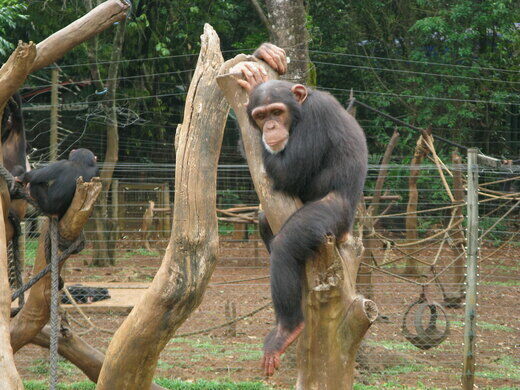
Chimpanzees have the same bones and muscles
as humans with differences only in form (e.g. their arms are longer than their
legs). Adapted for quadrupedal movement and movement through the trees,
chimpanzees have robust bodies and powerful arms. Because of their dense bones
and muscle tissue, the upper body strength of a mature chimpanzee is 8-10 times
that than that of humans.
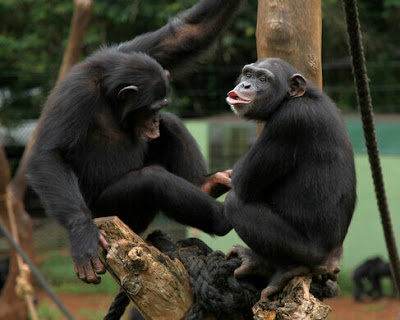
Chimpanzees are black, but older individuals
may have a grey back. Both genders often have short white beards.
The ears are prominent. Infants have a white tail tuft and pink to brown
facial skin, which darkens by adulthood.
Chimpanzees have been shown to have their own
individual
personalities.
Chimpanzees behave in a way indicating
that they feel
empathy.
Chimpanzees live in fluid social groups
consisting of a core of multiple females and dominant related males, whom are
highly territorial and will routinely patrol their home boundaries.
Females tend to live a more solitary life than the males, often choosing to
spend much of their time alone with their offspring.
Chimpanzee infants are
completely dependent on their mothers until about five years of age. When
males are between the ages of 8-12 years, or adolescence, they will increase their
independence and spend more time in the company of adult males. Females tend to
remain close to their mothers during adolescence, becoming mature at age 11 but
only beginning to breed at age 13-14. On average females will have about
three offspring during their lifetime.
- Chimpanzees travel mostly on
the ground but will mostly feed in trees during the day and make a new
nest every night in the forest canopy to sleep.
- Their diet varies seasonally
consisting mainly of fruit (~50-75%), but also leaves (~12-45%), flowers
(~1-18%), seeds (~1-11%) and animal prey (~1-5%) such as grubs, termites,
ants, wasps, birds and mammals including bush-pigs, duikers, rodents and
even other primates. In the Ivory Coast chimpanzees will hunt
together cooperatively to catch red colobus monkeys, the meat is much
prized and its subsequent sharing strengthens male alliances and familial
bonds.
- Chimpanzees have opposable
thumbs and toes that allow for grasping, climbing, and object
manipulation. Chimpanzees are very dexterous and are able to manipulate
objects in their environment in order to fashion and use tools. These tools are usually used to obtain food
sources. Sticks are used for termite fishing and ant dipping, leaf sponges
to soak up water and, in West Africa, chimpanzees use specially chosen
rocks to crack hard palm nuts, a behaviour that can take many years to
perfect. Baby female chimps were recently discovered playing with sticks
like human children play with dolls.
·
Chimpanzees have many different vocalizations
from soft grunts and lip smacks to alarm barks and screams. One of the
most notable vocalizations is the pant hoot used in situations of increasing
social excitement. Chimpanzees are also capable of learning basic human sign
language.
·
In response to our greater understanding of
our close similarity to great apes in terms of their capacity for self
recognition and their innate intelligence, a movement called The Great Ape
Project, calls for certain civil rights to be granted to all great apes,
including the right to life, liberty and freedom from torture.
·
Chimpanzees are classified as endangered in
the wild. Aside from habitat loss they are hunted for bushmeat and infants
taken for sale into the pet trade.
·
Despite
our increasing understanding of the significant similarity between humans and
chimpanzees, humans continue to use chimpanzees in experiments, including
experiments which cause them significant pain and suffering.
Clancy's comment: I love to watch these creatures. So enchanting and entertaining.
I'm ...