Showing posts with label BRITAIN. Show all posts

9 September 2022 - THE SMALLEST HOUSE IN GREAT BRITAIN


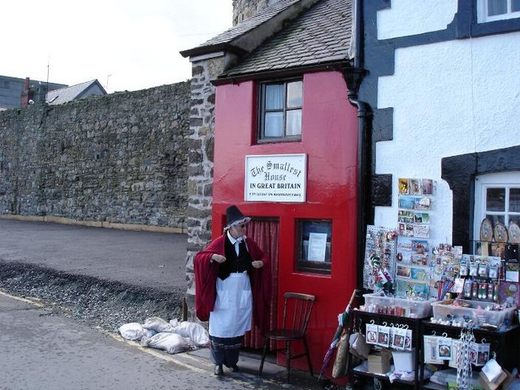
THE SMALLEST HOUSE 

IN GREAT BRITAIN


G'day folks,

A former fisherman's hut deemed too small for habitation is now a delightful tourist draw. 

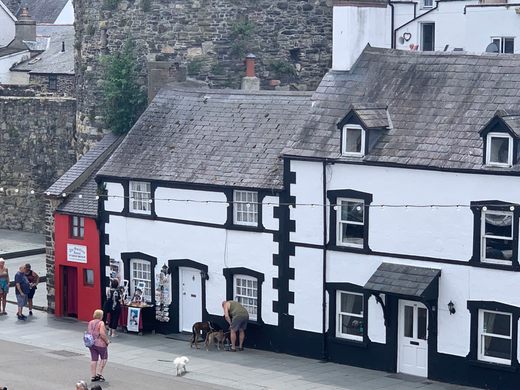
Also known as the Quay House of Conwy, the self-proclaimed “Smallest House in Great Britain” is definitely a tiny abode, but it actually looks quite cozy.

The minuscule home was created in the 16th century and remained in use until 1900, when the final tenant was forced to leave by order of the city council. In terms of space, the little home only measures 10 feet deep and not even 6 feet wide. The ceiling is only a little over 10 feet high from the floor to the top of the eave. Remarkably, it is split into two floors. The first floor is devoted to the living area with room for coal and an open fire, and a water tap tucked behind the stairs. The upstairs holds the cramped bedroom, which also comes with a small niche for storage. How luxurious.


The Quay House has not been lived in since its last owner was made to leave over a century ago, but the interior has been preserved to provide a glimpse of the spartan life of a historic Welsh fisherman. Visitors are welcome to briefly explore the little home, and are usually welcomed by a woman in traditional Welsh garb. They can explore the first floor, but the second floor has become too unstable, although guests can still peek their heads into the still-furnished bedroom.


Construction in recent years has seen the number of tourists to the house decline, but the proud smallest house in Great Britain endures.

12 February 2022 - BRITAIN'S FIRST TV ADVERTISEMENT


BRITAIN'S FIRST

 TV ADVERTISEMENT


G'day folks,

 The first ever advertisement on British television appeared in 1955. It went out at 8.12pm during a broadcast from London’s Guildhall of a dinner to celebrate the launch that day of the Independent Television network (ITV). Until then the BBC held an uncontested monopoly on broadcasting.

Under the umbrella of the Independent Television Authority, four major companies – Granada, ABC, ATV and Associated-Rediffusion – set about challenging the BBC’s supremacy. One of their first targets was the “Toddlers’ Truce” – an established arrangement whereby all television broadcasts were banned between 6pm and 7pm so that parents could more easily put their children to bed!

The truce meant that the BBC – funded then, as today, by a television licence fee – could save money by reducing its hours of transmission. The fledgeling independent companies, on the other hand, were hit by the loss of an hour’s advertising revenue each day and they fought for abolition of the policy.

The BBC would have none of it, nor would it agree to reduce the truce to 30 minutes. In the end a senior politician settled the dispute. The now defunct ministerial post of Postmaster General was held at the time by Charles Hill whose responsibilities included broadcasting.

He said of the “Toddlers’ Truce”: “This restriction seemed to me absurd and I said so. It was the responsibility of parents, not the state, to put their children to bed at the right time. I invited the BBC and the ITA to agree to its abolition.”

When no agreement was reached, Hill took the issue to Parliament and MPs voted for abolition in October 1956. The two broadcasting sides then squabbled over a date, leaving Hill to pick Saturday February 16, 1957.

That first TV ad was for Gibbs SR toothpaste – a product described as “tingling fresh”. To reinforce the message, the ad showed a tube of the toothpaste enclosed in a block of ice in a shimmering stream. TV presenter Alex Macintosh announced: "The tingling fresh toothpaste that does your gums good too. It's tingling fresh. It's fresh as ice. It's Gibbs SR toothpaste."


It was not only the first TV ad, it was also the first ad to use trickery. Brian Palmer, then a 26-year-old advertising executive who wrote and produced it, admitted years later that although a block of ice was used in the long shots, the “ice” was in fact plastic for closer work.

“The lights they used in those days were very hot indeed, and ice would have melted very quickly, so we used a plastic block for the close-ups,” he said.

The ‘SR’ in the name of the toothpaste referred to sodium ricinoleate, its active ingredient, which is the sodium salt of ricinoleic acid, the principal fatty acid derived from castor oil. Though the name was changed in the 1990s to Mentadent SR, the product continued to be marketed worldwide by its owners, Unilever, until 2018 when it was discontinued.

The arrival of TV advertising in 1955 led to protests by church leaders, teachers, academics and politicians, some of them condemning it as “crass and vulgar.”

Labour MP John Wilmot went further. He declared in Parliament that "the nightly poison of advertising which boosts the sale of goods to the working class is against the national interest".

Clancy's comment: Mm ... and haven't we come a long way since then?

I'm ...


16 December 2021 - THE FAMOUS BOWTHORPE OAK TREE


THE FAMOUS 

BOWTHORPE OAK TREE


G'day folks,

England’s ancient oak tree has such an impressive girth, people have been hosting parties within the hollow trunk for centuries.  

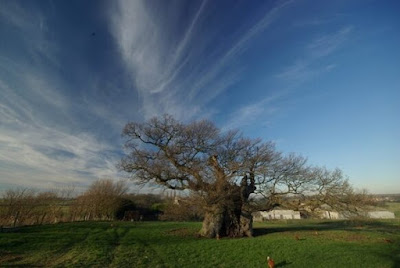
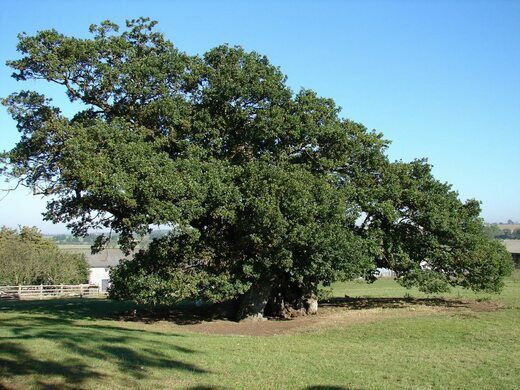
In a field in south Lincolnshire stands one of Britain’s greatest trees: the Bowthorpe Oak, an ancient survivor that may well have witnessed more than 1,000 years of English history.

The Bowthorpe Oak stands in a paddock at Bowthorpe Farm near Manthorpe village. The first references to the tree date back to the 1760s and describe the tree’s hollow trunk being smoothed out by the then Squire of Bowthorpe, who created a room inside the oak in which he could entertain as many as 20 guests at a sit-down dinner.

The oak, however, was around long before the gregarious Squire of Bowthorpe decided to use it as a dining room. Experts aren’t entirely sure of the tree’s true age, but the current consensus is that it’s at least 800 years old and perhaps dates back more than a millennium.

The estimated age of possibly 1,000 years or more makes the Bowthorpe Oak likely the oldest oak tree in England and one of the oldest in Europe. Also, as many humans in their later years can attest, with advancing age comes expanding girth. The Bowthorpe Oak has slowly expanded to achieve a most impressive girth of 43.6 feet (13.3 meters), larger than any other pedunculate oak (Quercus robur) in the United Kingdom.


 Today, the hollow tree serves a variety of purposes. Livestock sometimes take shelter in its ancient interior, and humans are known to throw the occasional party within the walls of the gnarled old trunk. Of course, nature lovers, tree aficionados, and other dendrophiles also come to Bowthorpe Farm just to visit the oak, to marvel at its mighty girth and imagine all that it has seen.

Clancy's comment: Imagine what that tree has seen in the past 1,000 years.

I'm ...


14 October 2015 - WHY ARE BRITISH POLICE CALLED BOBBIES?


WHY ARE BRITISH POLICE
CALLED BOBBIES?

G'day folks,

Ever been to the UK and spoken to a policeman? I have. They are called Bobbies, but do you know why? Read on ....


The concept of modern policing has its roots in pre-Victorian England, when the British home minister, Sir Robert Peel (1778-1850), oversaw the creation of London’s first organized police force. Before Peel’s 1829 reforms, public order had been maintained by a mix of night watchmen, local constables and red-coat-wearing army soldiers, who were deployed as much to quell political troubles as to deal with local crime.


In creating London’s Metropolitan Police (headquartered on a short street called Scotland Yard), Peel sought to create a professionalized law enforcement corps that was as accountable to everyday citizens as to the ruling classes. When Peel’s opponents complained that the creation of the new police force would restrict personal liberties, Peel responded, “I want to teach people that liberty does not consist in having your house robbed by organized gangs of thieves, and in leaving the principal streets of London in the nightly possession of drunken women and vagabonds.” 


Instead of the resented red coats, Peel’s patrolmen wore black jackets and tall wool hats with shiny badges. They went out armed only with a short club and a whistle for summoning backup, walking regular beats and working to gain the trust of the local citizens. Robert Peel’s system was a success, and by the mid-19th century large American cities had created similar police forces. In London, the policemen were so identified with the politician who created them that they were referred to as “Peelers” or—more memorably—“Bobbies,” after the popular nickname for Robert.


Clancy's comment: There ya go. Now you know.

I'm ...


19 September 2015 - BRITISH SLANG


BRITISH SLANG

G'day folks,

Welcome to some more British slang. Many of these expressions are also used in Australia.

Daft - My Dad used to call me a daft 'apeth which is short for a daft half penny (in old money). It basically means stupid.


Dekko - To have a look at something.


Dear - If something is dear it means it is expensive. I thought Texan insurance was dear.


Dicky - Dicky rhymes with sicky and means you feel sick.


Diddle - To rip someone off or to con someone is to diddle them. When you visit England, check your change to make sure you haven't been diddled!


Dim - A dim person is stupid or thick or a dimwit. Dimwit - Someone a bit on the dim side.


Dishy - If someone is a bit of a dish or a bit dishy it means they are attractive or good looking.


DIY - This is short for do it yourself and applies not just to the DIY stores but also to anything that you need to do yourself. For example, if we get really bad service in a restaurant (oh, you noticed!) then we might ask the waiter if it is a DIY restaurant - just to wind them up.


Do - A party. You would go to a do if you were going to a party in the UK.


Do - If you go into a shop and say "do you do batteries?" it means "do you sell batteries".


Do - If you drive along a motorway in the wrong lane the police will do you. You could then tell your friends that you have been done by the police. Prosecute is another word for it!


Doddle - Something that is a doddle is a cinch, it's easy. Unlike ordering water in Texas with an English accent, which is definitely not a doddle!


Dodgy - If someone or something is a bit dodgy, it is not to be trusted. Dodgy food should be thrown away at home, or sent back in a restaurant. Dodgy people are best avoided. You never know what they are up to. Dodgy goods may have been nicked. When visiting Miami I was advised by some English chums that certain areas were a bit dodgy and should be avoided!


Dog's bollocks - You would say that something really fantastic was the dog's bollocks. Comes from the fact that a dog's bollocks are so fantastic that he can't stop licking them! Nice huh? Often shortened to just "The dog's".


Dog's dinner - If you make a real mess of something it might be described as a real dog's dinner. A bit like some joint Anglo-American approaches to Eastern Europe for example!


Donkey's years - Someone said to me the other day that they hadn't seen me for donkey's years. It means they hadn't seen me for ages.


Drop a clanger - When I asked a large lady on the tube if she would like my seat since she was so obviously pregnant, she took the seat then told me she was fat, not pregnant! Boy did I drop a clanger. You might make a gaffe. Either way it was horrendously embarrassing, especially as half the people on the tube had heard me!


Duck - In and around Leeds you will find older people might call you "duck" in the same way that they might call you "love" or "dear" in other places. Usually pronounced more like "dook", which rhymes with "book".


Duff - Anything that is duff is useless, junk, trash. It usually means that the object doesn't do the job it was intended for. Our last Prime Minister was pretty duff!


Duffer - Any person that is duff could be referred to as a duffer. The Prime Minister was a duffer.


Dull - You would say something that was no longer sharp was dull. We would say blunt. To us something is dull if it is boring. It can apply to things - like a film could be dull. It also applies to people - I can think of several people who are dull! 


Clancy's comment: Well, there ya go, Cobber. Ope ya loved these little blighters.

I'm ...