Showing posts with label FINLAND. Show all posts

7 October 2022 - ABANDONED BUNKERS IN FINLAND


 ABANDONED BUNKERS

 IN FINLAND


G'day folks,

Fortifications built for a Soviet invasion that never came now sit abandoned in a losing battle against nature. 

In the early 1940s, between the Winter War and the Continuation War, tensions were high in Finland. The Soviets could invade, seemingly, at any moment. As a result, in 1940, Finland began the construction of Salpalinja (the “Salpa Line”), a system of more than 700 field fortifications made from concrete or excavated from rock along Finland’s eastern border. 


Stretching 1,200 kilometers (746 miles) from the Gulf of Finland in the south to modern-day Pechengsky, Russia, in the north, Salpalinja consisted of bunkers, trenches, fueling stations, weapons depots, and more. The line incorporated many lakes and marshes into its terrain, as these areas could be tough to navigate and easy to defend.

Finished in 1944, Salpalinja was a mammoth project set to defend Finland against a possible Soviet invasion—only that invasion never came.

Fast-forward to today, and Salpalinja sees more action from tour groups and urban explorers than it ever did in combat. Many of the features of the line still stand today, as they never endured any of the devastations of war. Along the line are multiple museums dedicated to its past and its bunkers, as well as tours that provide a great overview of its history.

However, many bunkers, dugouts, and obstacles are buried deep in the forests, away from guided tours and foot traffic. These areas offer great experiences for those interested in a different or additional perspective from the various museums. The Ventovuori area in Virolahti offers numerous bunkers and systems to explore but it is still just a very small part of Salpalinja. 


Salpalinja was painstakingly built in the name of preparedness and defense, but today it remains only as a reminder of a history that never was, but could have been.
26 February 2022 - ANCIENT ETCHINGS AT PIKE'S GUT - FINLAND


ANCIENT ETCHINGS 

AT PIKE'S GUT

 - FINLAND - 


G'day folks,

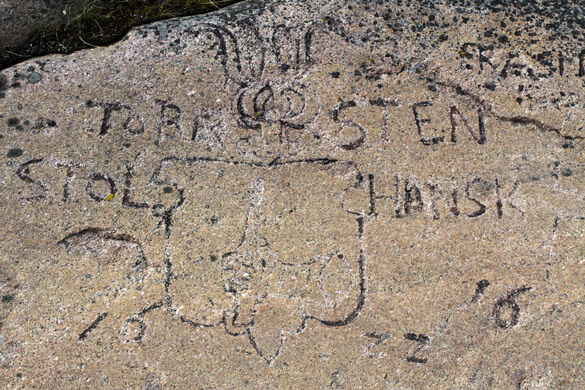
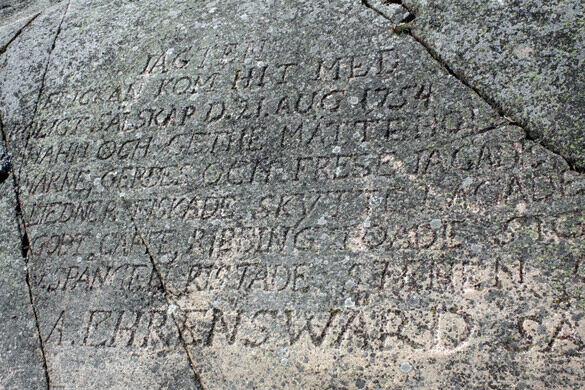
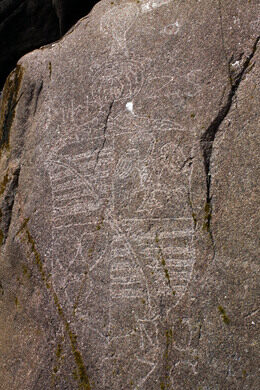
The etchings on this narrow channel between two islands bear witness to maritime travelers who have passed through since the Middle Ages. 

Just off the southernmost tip of the Finnish mainland sit Tullholmen and Kobben Islands. Huddling close to one another where the Gulf of Finland meets the Baltic Sea, the islands are separated by a narrow strait that is home to a unique collection of graffiti stretching back over half a millennium.

Pike’s Gut (“Hauensuoli” in Finnish) has served for centuries as a safe haven for seamen awaiting good weather conditions or favorable winds. Sometimes, however, the wait could last for weeks, so to pass the time the sailors came ashore and carved farewell notes, their names and coats of arms on the rocky faces of these islands. The oldest dates back to the 15th century, though most of the extent carvings are from the 16th and 17th centuries. 


 Over time the word spread about this “guest book of the archipelago”, attracting even more people to visit and add their own marks. Over 600 such carvings have been identified.

Due to exposure to the elements and the considerable age of the graffiti, the markings have worn off and are not easy to see. In 1967 the local community was called to donate their used toothbrushes so the rocks could be cleaned of lichen and dirt. Later the lines were filled with dark color so the markings would be more visible. Nearby shipwrecks also speak to the location’s significance as a cultural and historical site. It is a protected area under Finland’s Antiquities Act and is under the care of the National Board of Antiquities.

Clancy's comment: I always find these fascinating. Many of these would have taken considerable work to produce.

I'm ...


24 February 2022 - BENGTSKAR LIGHTHOUSE - FINLAND


BENGTSKAR LIGHTHOUSE

 - FINLAND  -


G'day folks,

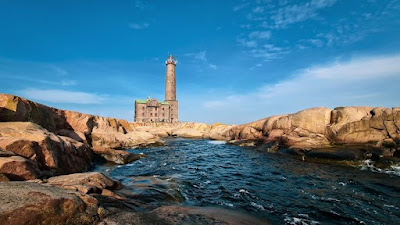
The tallest lighthouse in the Nordic countries was also the site of a bloody World War II battle.  

Countless shipwrecks littered the sea in Finland’s western archipelago during the late 1800s and early 1900s. On New Year’s Day in 1905, a newly constructed steamship became the latest vessel to succumb to the shallow waters.

In 1906, construction on a lighthouse to aid travel along the trade route began in haste. In a mere nine months, the lighthouse was erected and composed of granite and bricks. It was lit for the first time on December 19, 1906. 


 Workers and their families who remained in the area maintained the lighthouse and worked in shifts handling the light and foghorns. The wives tended to the living quarters and taught the children in a small school.

When World War II erupted, Finland was forced to defend Bengtskär. The island’s location not only served well for guiding ships through the labyrinth of islands, but it also was a safeguard from attacks by way of the Gulf of Finland. It’s importance led to Russia launching an invasion of the island.

Approximately 35 Finnish soldiers were stationed on the island. When the invasion began, the radio operator on the island called for support. Within minutes, the coastal artillery team began firing. Within hours, navy ships and planes converged on Bengtskär. When the battle was over, the Finns had secured the island.

The next day, Soviet forces bombed the lighthouse.

When it was all said and done, the Soviet Union pulled out from the Hanko region and Finland regained control of its lands and water. About 32 Finnish soldiers and 60 Russian soldiers were killed in the short Battle of Bengtskär.

After the war, the lighthouse was mostly left to deteriorate. Restoration efforts did not begin until 1992. It took three years to renovate the structure. In 1995, the island opened as a museum to the lighthouse and its wartime history.

The old apartments in which the lighthouse keepers and their families lived have been converted into hotel rooms.

Deep window seals running up along the spiraling, steel staircase contain small exhibits and artifacts paying homage to the island’s dramatic past. A military bunker and other war relics can still be explored on the island.

Clancy's comment: I'd love to visit it and take photographs.

I'm ...