Showing posts with label ICELAND. Show all posts

22 April 2022 - EUROPE'S LARGEST SEABIRD CLIFF


EUROPE'S LARGEST 

SEABIRD CLIFF


G'day folks,

Puffin enthusiasts flock to Europe's largest seabird cliff, which over one million birds call home. 

Látrabjarg, Iceland’s westernmost point, is also the largest seabird cliff in Europe. Over one million birds pepper the wind-battered crags, protected from predators while perched within the rocks that jut out from their towering domain.

The puffins, of course, are typically the star attraction. The adorable orange-beaked creatures are fairly comfortable around the humans who brave the fierce winds that tear through the air. You’ll typically find them peeping out from the grass that coats the top parts of the cliffs.

 Látrabjarg is a key site for seabird conservation. In addition to the puffins, you’ll find other seabirds like guillemots, razorbills, and northern gannets clustered throughout the rocks. At times, the area houses approximately 40 percent of the world’s razorbill population.

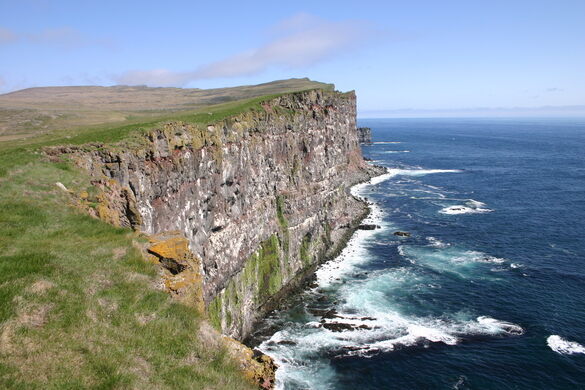

 The cliffs also boast splendid hiking and photography opportunities for those who can stand the wind. The nearly nine miles of over 1,000-foot-tall cliffs offer a chance to walk Iceland’s most western perimeter. Be sure to stop for a bit to take in the views of the Atlantic Ocean, which merges uninterrupted with the distant horizon.

If you do decide to walk along the cliffs, make sure you stay behind the white line that’s painted near the edge. It’s there to keep you from accidentally falling and plummeting into the churning waters far below.


 Clancy's comment: A top spot for wildlife photographers like me.

I'm ...


19 April 2022 - BA 64 - THE OLDEST STEEL SHIP IN ICELAND


BA 64

 - THE OLDEST STEEL 

SHIP IN ICELAND -


G'day folks,

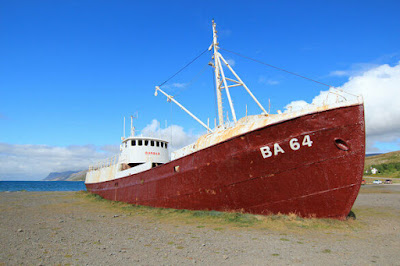
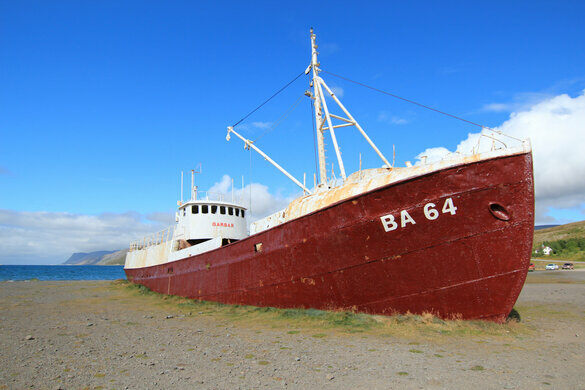
The oldest steel ship in Iceland has been beached for years and is now a rusting ruin. 

Launched the same year that the Titanic met its final fate, the whaling ship that came to be known as Garðar BA 64 was a hulking hybrid of a ship, having both a powerful steam engine in addition to traditional sails.

Originally known as the Globe IV, the large ship was completed in Norway in 1912 as a state-of-the-art-at-the-time whaling vessel. The hull was specially reinforced to break through the icy Southern seas in which it operated and the powerful engine kept the boat sailing even in calm waters. During its active lifetime it was sold around to a number of different countries before finding an Icelandic owner after World War II. Once whaling restrictions became more widespread, Garðar BA 64 (a name it finally received in 1963) was used for fishing herring in the waters off of Iceland. 


 After decades in faithful service to its bevy of owners, Garðar BA 64 was finally deemed unsafe for service in 1981 and as opposed to being scuttled, the old ship was run aground in Skápadalur Valley where it remains to this day, falling apart bit by bit. It is now a popular site for photographers and anyone looking for a lovely mix of Icelandic scenery and industrial ruin.
 
 
Clancy's comment: An old warrior laid to rest.

I'm...


11 April 2022 - MAGNIFICENT WATERFALL IN HIDDEN CAVE


MAGNIFICENT WATERFALL

 IN HIDDEN CAVE

- ICELAND -


G'day folks,

This fantastical waterfall is hidden in a cave located in a cracked cliff. 

Waterfalls can make for some of the most magical vistas in the world as they carve solid rock into often incredible formations.

Such is the case with Iceland’s Gljúfrafoss waterfall, which is almost completely hidden behind a cliff face. The waterfall has carved a mossy cylindrical chamber into the rock which can only be reached through a thin crack in the outside cliff wall.


Once through the crack, explorers are hit with the incredible majesty of the hidden waterfall as it crashes into a pool at the base of the cave. The interior of the cave is nearly completely covered in a thin carpet of greenery thanks to the continually moist surroundings. These clandestine waterworks distill the natural wonder of Iceland’s scenic beauty.

Clancy's comment: Wow, absolutely spectacular.

I'm ...


6 April 2022 - ELEPHANT ROCK - ICELAND


ELEPHANT ROCK

 - ICELAND -


G'day folks,

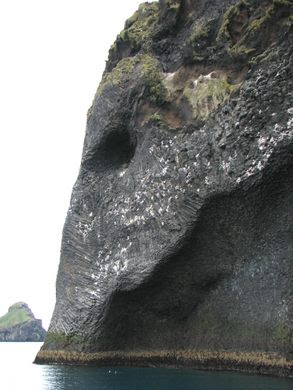
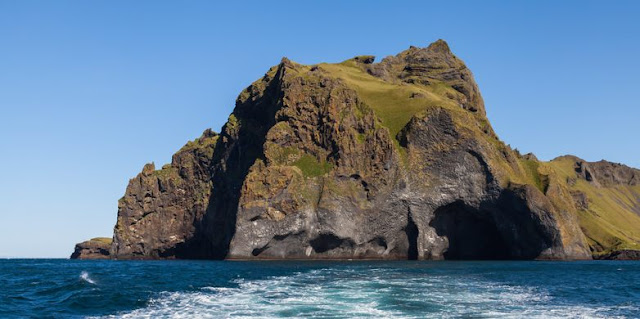
On an island south of Iceland, a large volcanic rock formation resembles an elephant. 

Vestmannaeyjar (Westman Islands) is a small archipelago just off the southern coast of Iceland. The largest of these volcanic islands is called Heimaey, which features various quirky rock formations.

The most outstanding rock formation on this island can be found along the western coast and is shaped like an elephant head, with its curious appearance resembling a pachyderm with the trunk being positioned under the Atlantic Ocean.


Known as Elephant Rock, it was formed by one of the many volcanic eruptions of Mount Eldfell, the main volcano on the island. The last eruption occured in 1973, when half of the town of Heimaey was destroyed, but the rock is believed to be much older. The volcanic basalt is wrinkled in a way that resembles elephant skin. The appearance of the rock has also been compared to Cthulhu, the mythical sea creature featured in H.P. Lovecraft’s works.

Elephant Rock is located on the lower part of a rocky area of the island with steep cliffs and can only be reached by a one-hour boat tour. While on the island, visitors can find many other incredible volcanic formations and a diverse bird population, including the largest puffin colony in the world.

Clancy's comment: Nature has a wonderful way of entertaining us.

I'm ...


27 February 2022 - AN ISLAND WITH FIVE RESIDENTS - ICELAND


AN ISLAND WITH 

FIVE RESIDENTS

- ICELAND -


G'day folks,

Once the site of a 12-century monastery, this tiny island is now home to only five permanent residents. 

Located in the bay of Breiðafjörður, the small, windswept island of Flatey is often overlooked by travelers. But despite being only two kilometers (1.2 miles) long and one kilometer (0.6 miles) wide, this tiny speck of land boasts a surprising wealth of culture, history, and natural beauty. 

A former monastery was founded on the island in 1172, and it long served as the resting place for an important medieval manuscript known as Flateyjarbók. Flatey later received a trading license from the Danish Crown in 1777, sparking an increase in island residents. Toward the end of the 19th century, however, most left to seek opportunities off the small island. 


According to a June 2020 article on Traveo, only five people live on Flatey throughout the year. Given that fact, Flatey is not well-catered to mass-tourism—though it is popular with those who stay on the island over the summer—and has only modest offerings when it comes to entertainment. Those looking for a “thrilling” night might try bingo at Frystihúsið (“The Freezer”) cafe.

Built in 1926, a small white church is Flatey’s most prominent landmark, and its steeple marks the highest point on the island. This, however, is not particularly impressive, considering Flatey takes its name (“flat island”) from its low-lying meadows and bays. The interior of the church was decorated by the painter Baltasar Samper and shows scenes of the island’s past fishermen and farmers. 

The rest of Flatey’s architecture has remained almost entirely unchanged since the late 19th century. With their peeling paint jobs and corrugated iron rooftops, the island’s historic homes give off either a quaint or eerie feel, depending on the weather. 

During the summers, the lush green beauty of Flatey is readily apparent outside of its village: Atlantic puffins swoop in the sky, unshorn rams strut in the fields, and skeletal shipwrecks are left to wither away on the shoreline. It is a place where nature still reigns supreme, with particular allure for those guests in Iceland looking to truly get away from it all.

Clancy's comment: Looks like a great place to fish ... and write books. 

I'm ...


21 March 2020 - New Life for Abandoned Djúpavík Herring Factory in Iceland


New Life for Abandoned Djúpavík 
Herring Factory in Iceland

G'day folks,

Yep, you guessed it, I've found another abandoned structure. This one is in Iceland, but this rusting remnant of the local herring industry is being given a second life. 


Getting to the remote Icelandic village of Djúpavík entails traveling miles away from the nearest town on a bumpy, narrow, winding dirt road through a desolate landscape of fjords, sheep, and little else. This isolated village built up around its herring factory, and has risen and fallen with the local fishing industry throughout the 20th century.

The now-abandoned herring processing factory in Djúpavík was the biggest one in Iceland—in fact, the biggest concrete structure in Iceland, period—when it opened in 1935. But that new-and-improved building was actually the second herring factory in the village, which was first settled in 1917 around the fishing industry, but abandoned when business slowed.


The new factory opened in 1935, fitted with all the latest modern equipment for processing herring. But when the staff of around 300 moved to the sleepy village to work in the impressive factory, they were surprised by the surrounding town’s complete lack of churches, police, or even a mayor. 

Over the next several years, a town was built up around the factory. But by the late 1940s, the herring were all but gone from Húnaflói bay, and the factory folded in 1954. The town of Djúpavík was abandoned by 1968.


Then in 1985, Eva Sigurbjörnsdóttir and her husband Ásbjörn Þorgilsson became the village’s only year-round residents. They turned the former women’s quarters into a hotel, and began refurbishing the old factory and other buildings.

Hotel Djúpavík now offers tours through the giant, rusting old factory. Today the space features artworks and installations, and hosts “the Factory” every summer, an event with concerts, events, and exhibitions with works from artists around the world. In 2006, Sigur Rós played an intimate show there for a crowd of 300 people who made the trek out to Djúpavík.


Clancy's comment: Sounds good. Anything to utilise old buldings and promote the arts is worthwhile.

I'm ...


12 June 2015 - ICELAND


ICELAND


G'day folks,
Welcome to a place I have never visited, but would love go just to take photographs.  Iceland is a Nordic island country between the North Atlantic and the Arctic Ocean. It has a population of 329,100 and an area of 103,000 km², making it the most sparsely populated country in Europe.


Clancy's comment: Wow, sensational place. Worth a visit. Brilliant photographs taken by top photographers.


I'm ...